"Hua-series" Cars Score Big: HarmonyOS Jumps 139%, Arcfox Up 112%, Xiaomi Drops 11%
 11/18 2026
 488
 Image source: Weibo
A long-running joke in China's EV community—"one meter pierces five realms"—was upended this week by a single set of order rankings.
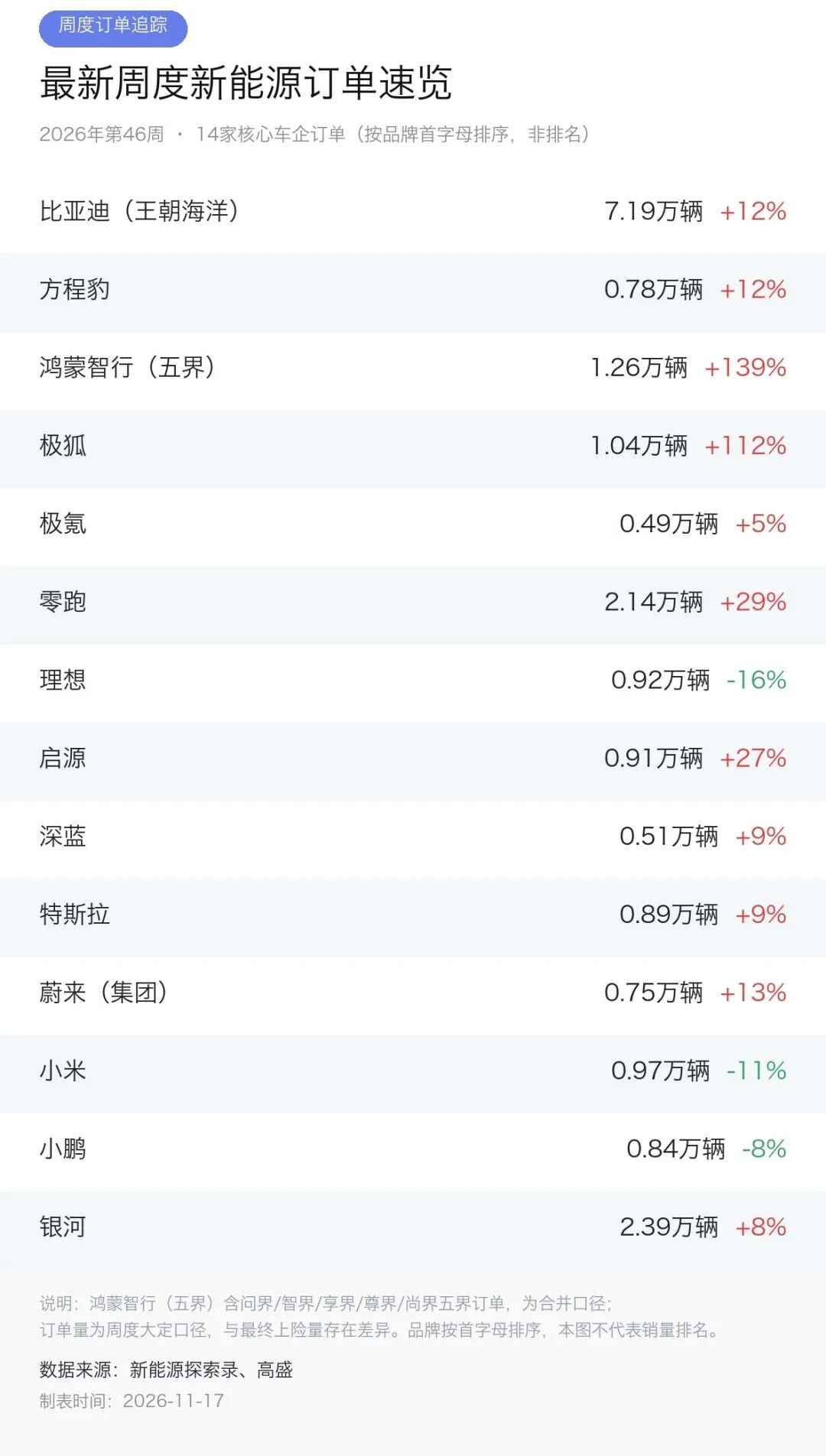
Blogger "New Energy Exploration Record" released brand order statistics for Week 46 (November 9–15). Of the 15 mainstream brands tracked, 12 posted gains, while only Xiaomi, Li Auto, and XPeng hit the brakes.
The most striking comparison:
HarmonyOS Intelligent Mobility vaulted from 5,250 units to 12,550 units—a week-on-week surge of 139%.
Arcfox, also a "Hua-series" brand (and the first to adopt Huawei's HI, or "Huawei Inside," mode), jumped from 4,900 to 10,400 units, up 112% week-on-week.
Xiaomi, by contrast, slid from 10,850 to 9,700 units, down 11% week-on-week.
HarmonyOS Intelligent Mobility seized the moment to complete its comeback, and the viral "one meter pierces five realms" meme has, for now, run its course.
The Full Ranking: BYD Steady as a Rock, HarmonyOS Intelligent Mobility Charges Out of Nowhere
Let's first review the overall market this week. With more than half of November gone, the year-end volume rush in the peak car-buying season has finally kicked in.
BYD Dynasty + Ocean moved 71,900 units, locking down first place with a 12% week-on-week gain—the only brand on the list to break 70,000, a scale in a league of its own. Galaxy posted 23,900 units (+8%) and Leapmotor 21,400 (+29%), firmly holding second and third.
HarmonyOS Intelligent Mobility charged to 4th with 12,550 units; Arcfox followed close behind at 10,400 units, up 112% week-on-week. As a Hua-series car, the "half-price" YU7 won sales for it.
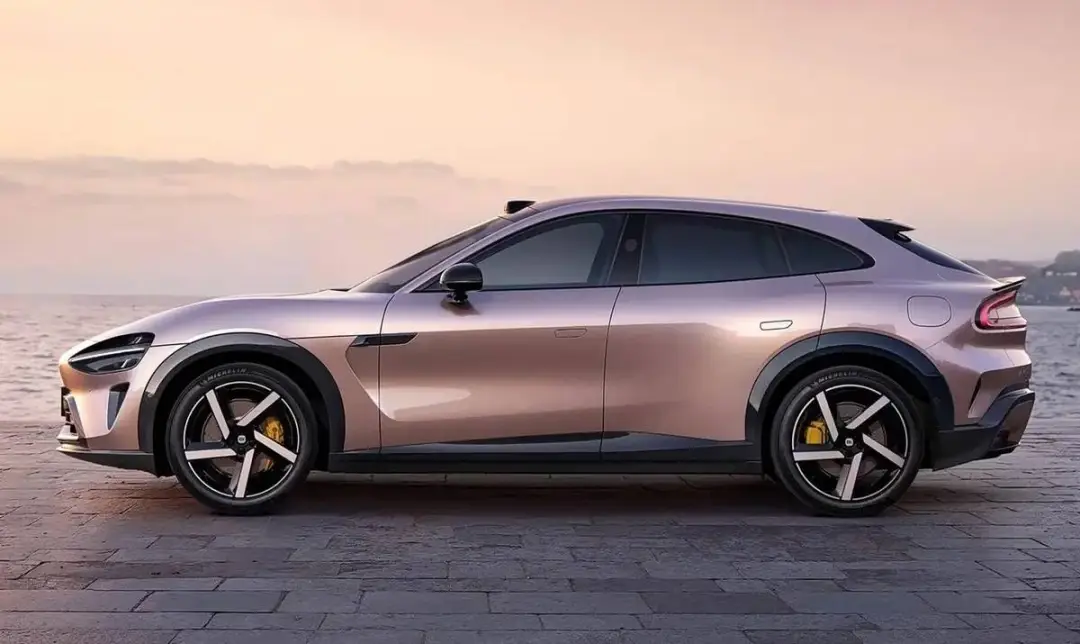
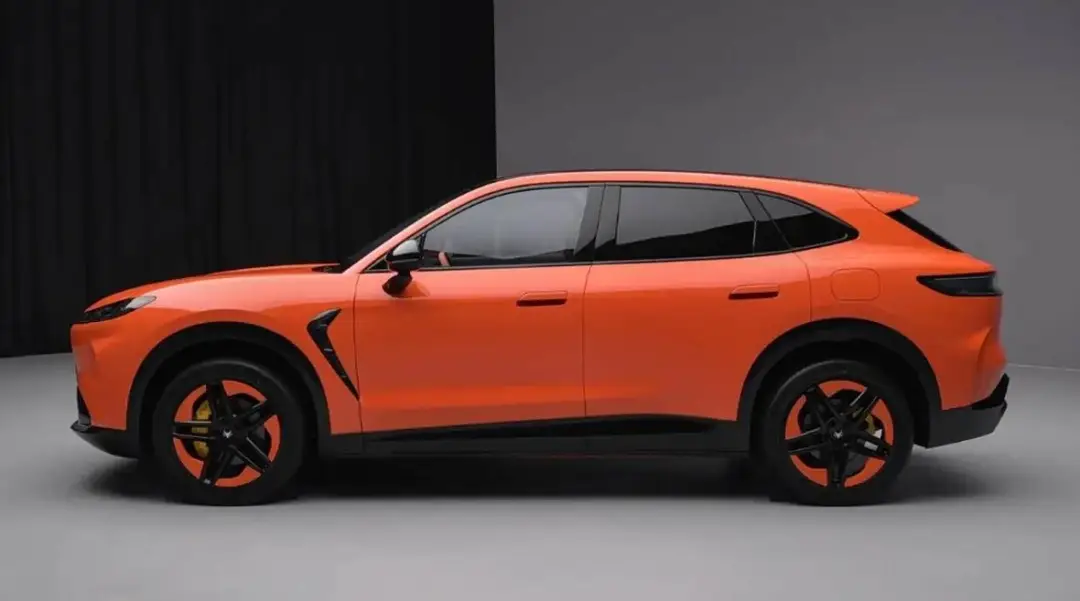
Above: Xiaomi YU7 Below: Arcfox Alpha T7
Both had been sliding for weeks, and both saw a doubling rebound this week. Xiaomi fell to 6th with 9,700 units, overtaken by HarmonyOS Intelligent Mobility.
Among the rest, Changan Qiyuan, MG, NIO, Fang Cheng Bao, and Tesla all rose. Li Auto (9,150 units, -16%) and XPeng (8,350 units, -8%), together with Xiaomi, were the few players posting order declines this week.
The market logic is straightforward: in the year-end volume rush, affordable brands are offering aggressive discounts, and order elasticity is maxed out; high-end brands are more conservative in pace, with milder growth. The signal of order recovery is also passing down the supply chain, and upstream factories' production scheduling remains sustainable.
HarmonyOS Intelligent Mobility: Orders Still Exploding Despite a 20,000-Yuan Price Hike—the New M8 Rewrites the Matchup
This week's outbreak at HarmonyOS Intelligent Mobility, frankly, rested entirely on the newly launched AITO New M8.
On November 13, this family smart flagship SUV officially debuted with a starting price of 379,800 yuan—20,000 yuan above the previous model. Car-savvy observers know that when high-end cars raise prices, orders normally come under pressure. The new M8 delivered a sharply contrasting result: official data shows firm orders exceeded 11,000 units within 72 hours of launch, with delivery available right from day one.
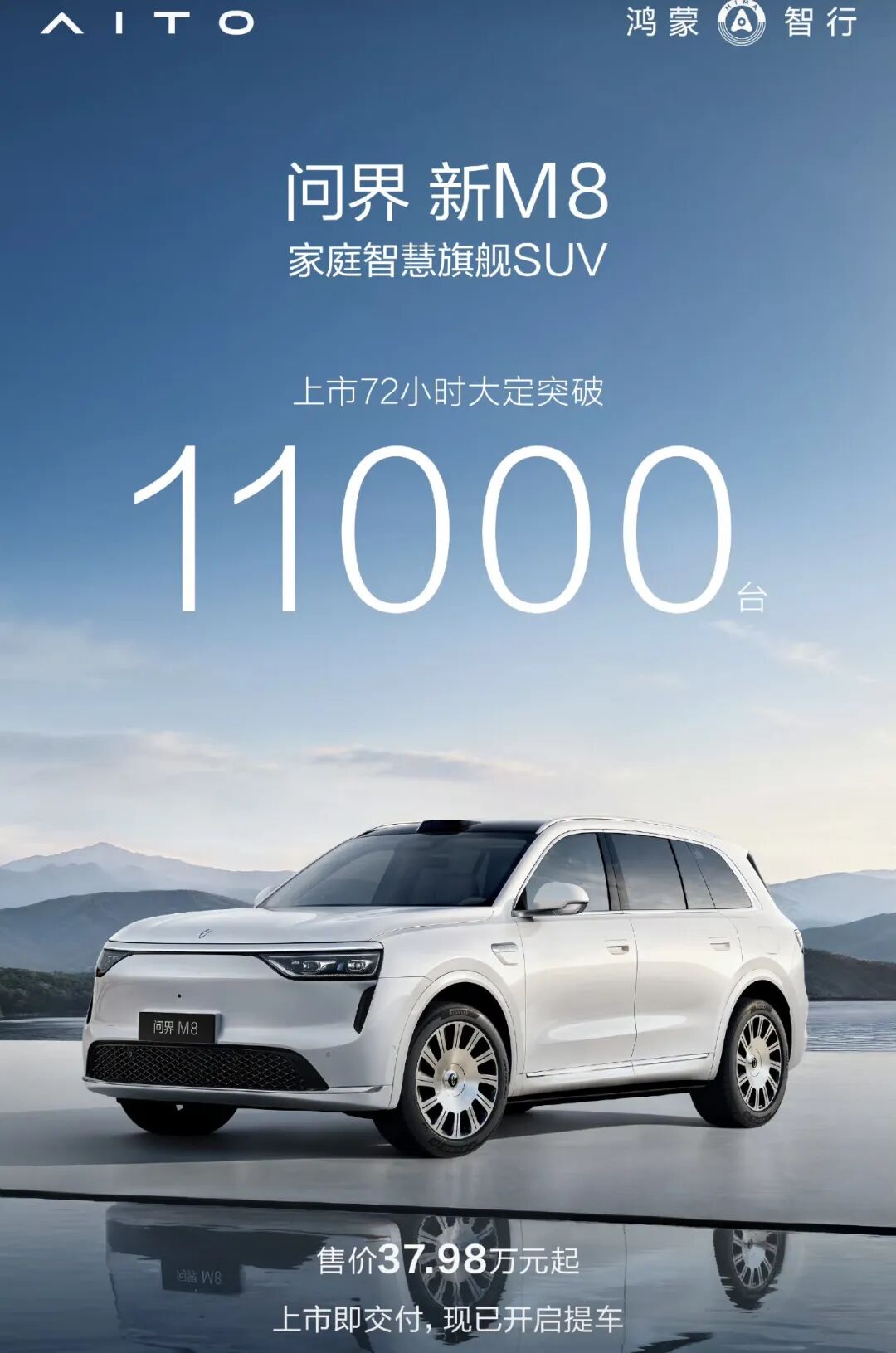
Buyers are willing to pay the premium, mainly for its L3-oriented intelligent driving architecture. The Qiankun ADS5 system and four LiDAR sensors come fully equipped, and the hardware foundation directly reserves L3 implementation capability—targeting the needs of family long-distance self-driving trips.
As it happened, the ranking's statistical period coincided with the new car's launch, and HarmonyOS Intelligent Mobility orders jumped straight from 5,250 units last week to 12,550. The 139% increase was essentially driven by this one model.
And that's not even all of HarmonyOS Intelligent Mobility's cards for November. On November 20, the Luxeed V8 takes the stage—a flagship MPV focused on family use, also fully equipped with Qiankun ADS5. One large SUV and one MPV, two family flagships releasing volume in succession. Many observers are optimistic that HarmonyOS Intelligent Mobility has a shot at 50,000 sales for the full month of November, quickly recovering from its recent slump through the new car matrix.
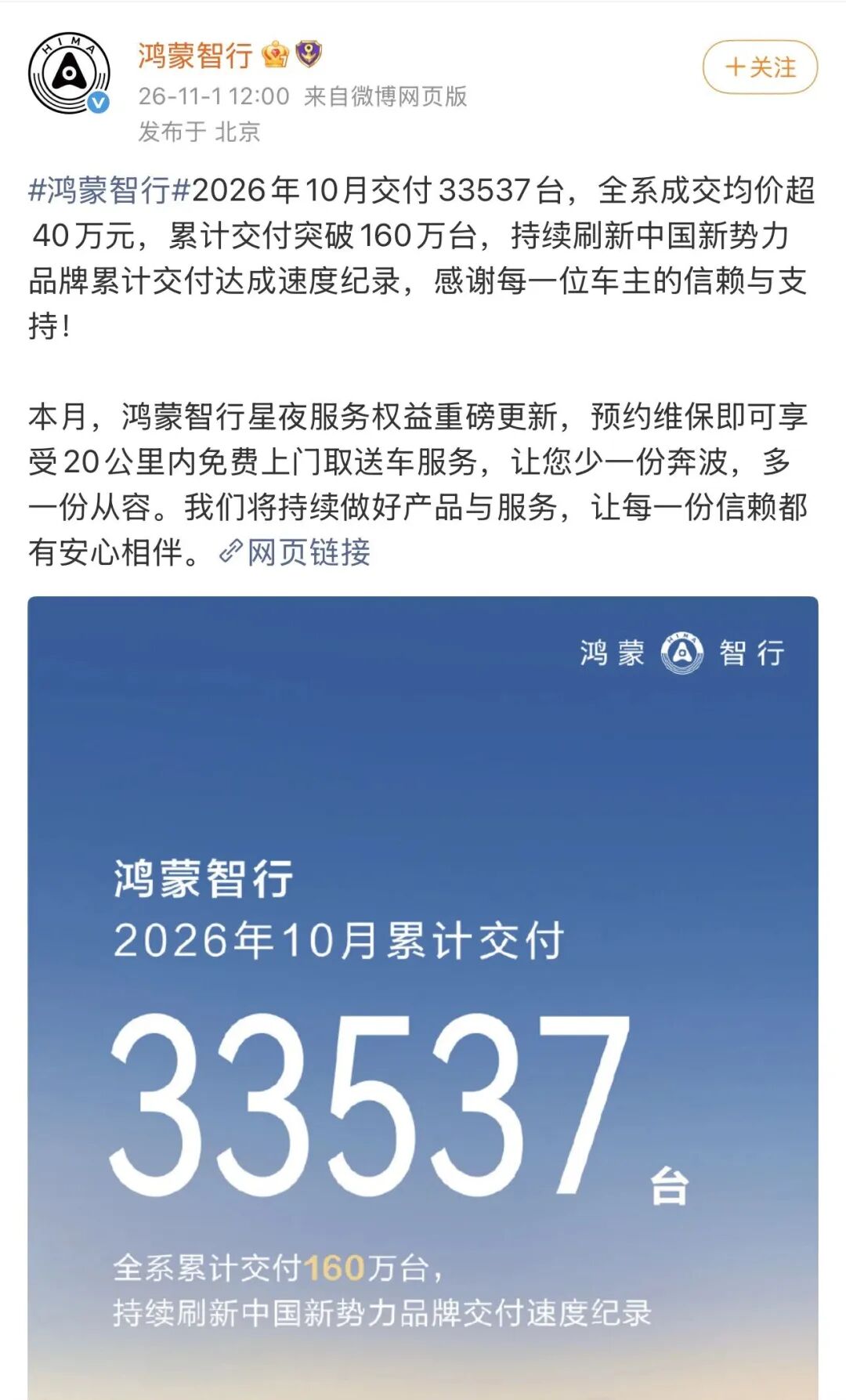
Still, we shouldn't be blindly optimistic. Word is that current locked orders for the new M8 are slightly below initial market expectations. Whether this pulse-like order explosion holds steady will be answered by the data in the coming weeks.
Xiaomi Auto: Incentives Lose Steam, Order Focus Shifts to Pengcheng N70
On one side, HarmonyOS heat is maxed out; on the other, Xiaomi's orders turned downward this week, falling 11% week-on-week from 10,850 to 9,700 units and dropping two places in the ranking.
To be fair, Xiaomi didn't hold back. It previously offered purchase benefits: down payment from 79,900 yuan with three years interest-free; buyers could choose one of two options—either a five-year installment with three years at 0 interest, or a 6,000-yuan insurance subsidy. But judging from this week's data, the appeal of this round of incentives has clearly waned.
One signal in third-party statistics is worth noting: in recent weeks, Xiaomi's order structure has quietly shifted, with the Pengcheng series share continuing to rise—now roughly 60% of orders—and the N70 leading the volume within that line.
Simply put, Xiaomi's order base is gradually shifting from the SU7 to the cost-effective Pengcheng line. The traffic dividend of the first-generation hit is slowly fading, and the brand is now relying on affordable models to stabilize its base.
9,700 units—just shy of the 10,000 mark—is not enough to call a demand collapse. But compared with HarmonyOS Intelligent Mobility's strong rebound, the market direction has visibly changed. People in the circle are already speculating: if HarmonyOS can maintain this momentum, by month's end the final deliveries of Xiaomi and HarmonyOS Intelligent Mobility could end up split fifty-fifty.
Li Auto and XPeng Also Decline: Not Because They Can't Sell, but Because They're Busy Delivering
Li Auto and XPeng orders also moved downward this week, and many people's first reaction is that the high-end track has cooled. That reading isn't necessary.
At this stage, neither company is focused on frenziedly launching new models to chase orders; both are digesting previously accumulated orders and prioritizing deliveries. Li Auto's i6 remains hot, still pulling several thousand orders a week, and its base is very stable; XPeng is also going all out to ramp up deliveries. The short-term order pullback is a normal part of the delivery push, not a sign that nobody is buying.
A Phased Reversal Does Not Equal a Final Victory
The "one meter pierces five realms" meme previously spread all over car enthusiast circles. It refers to Xiaomi's single-brand orders once exceeding the combined total of HarmonyOS Intelligent Mobility's five brands: AITO, Luxeed, Stelato, Maextro, and Shangjie. For a long time, the phrase was the label of Xiaomi's carmaking speed.
But the Week 46 order data has temporarily overturned that situation.
This round of competition is really a head-on clash between two completely different routes. Xiaomi takes the single-brand route—fewer models, a fast pace, relying on hit products to ignite traffic. HarmonyOS Intelligent Mobility plays a multi-brand matrix—five brands separately covering sedans, SUVs, MPVs, and the high-end luxury market, relying on wave after wave of new cars to drive heat.
Xiaomi's strength is unified brand recognition and simple, direct communication; HarmonyOS's biggest card is the reusable Qiankun intelligent driving foundation. Once one car runs through the process, it can be quickly replicated across different brands and models.
It's important to be clear: HarmonyOS's big rise this time is a pulse of market conditions brought by new car launches; Xiaomi's order pullback reflects hit-product heat fading and a product-structure switch. A single week of order data simply cannot determine long-term victory or defeat.
The next melon is easy to wait for: after the Luxeed V8 launches, can HarmonyOS keep orders at the 10,000-plus level? Can Xiaomi's Pengcheng N70 continue to withstand volume pressure and fill the gap left by insufficient heat in high-end models? Will affordable players like Leapmotor and Galaxy continue to grab share?
The new energy track has never been about a one-week ranking determining victory or defeat. In the end, what's tested is the long-run capability of continuous new releases, intelligent driving implementation, and stable delivery.
Interactive topic: How long do you think HarmonyOS Intelligent Mobility's rebound can last? Can Xiaomi's Pengcheng series support subsequent sales? Welcome to share your views in the comments section.
Disclaimer: This article is a major-company financial commentary and does not constitute any investment advice. The enterprise data and regulatory events involved all come from public information and are for reference only; the specific situation is subject to official releases. Images are from the internet; if there is any copyright issue, please contact us for deletion.
-
![]()
SpaceX's Starship Was "Caught" — So Why Didn't the Stock Follow?
-
![]()
"Hua-series" Cars Score Big: HarmonyOS Jumps 139%, Arcfox Up 112%, Xiaomi Drops 11%
-
![]()
Billions in Losses: Xiaomi Auto's Sales Are "Winning Big," So Why Is the Business Bleeding?
-
A Robotaxi at 1.13 Yuan per Kilometer Is Reshaping the Livelihoods of Seven Million Ride-Hailing Drivers
-
Mercedes-Benz Freezes Investment in Germany While Expanding Production in China: Can Halving Costs Double Sales?
-
![]()
Tencent's Muse? Hands-On with the New LightVela: More Like a Personal Agent Than Ever, but Still Not Perfect
-
After the Jensen Huang Incident, Has AI Computing Power Construction Entered Garbage Time?
-
The AI Onslaught on Short Dramas: A Winter Without Obituaries