Billions in Losses: Xiaomi Auto's Sales Are "Winning Big," So Why Is the Business Bleeding?
 11/18 2026
 443

Image source: Weibo
When the October SUV rankings came out, Lei Jun immediately posted the scorecard on Weibo—and it was indeed worth celebrating.
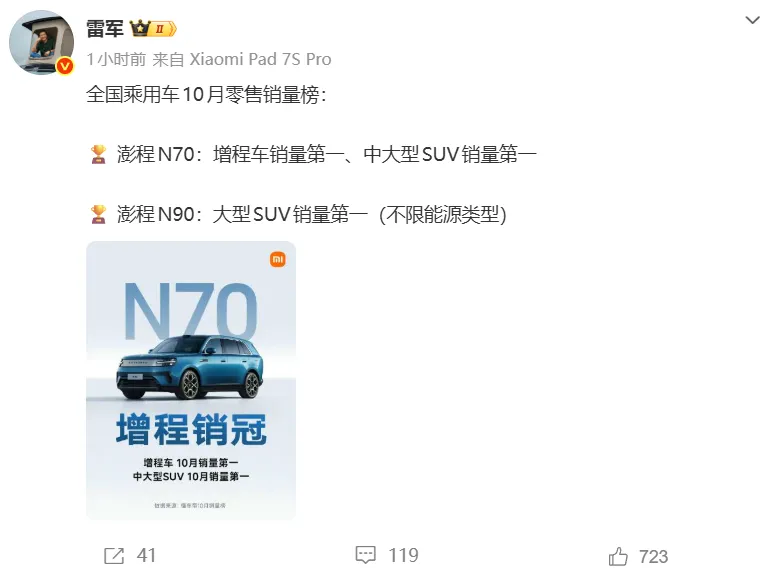 Image source: Weibo
The Pengcheng N70 and N90 took two segment championships, topping both the mid-to-large SUV and large SUV lists. The two vehicles also swept the top two spots in extended-range sales for the month.
Xiaomi fans breathed a sigh of relief.
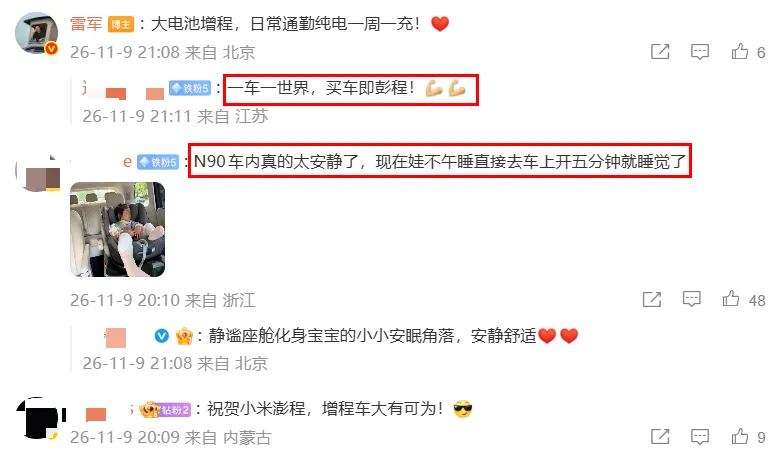 Fans also heaped praise on Xiaomi Pengcheng. Image source: Weibo
For a long time, people online said Lei Jun was just making empty promises. Now the delivery data is right in front of everyone, and goals once dismissed as slogans have become reality. Pengcheng has secured a foothold in the crowded family SUV segment.
At the launch event that day, Lei Jun laid out the two routes plainly. The SU7 and YU7 are driver's cars for people who love driving; Pengcheng is a family SUV with flexible space. After five years of building cars, Xiaomi has delivered two different answers.
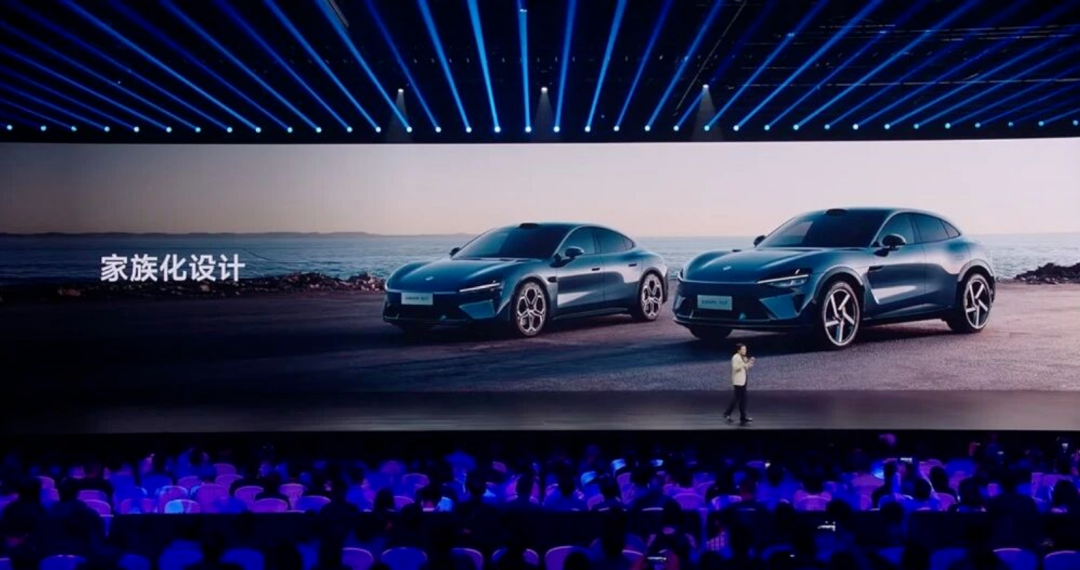 Image source: Weibo
He said at the time that extended-range and pure electric are not a dispute over routes. They are simply for different people and different paths. Many people regarded those words as marketing talk at the time. Only when this ranking list spread did the calculation behind it slowly become clear.
One Ranking List, the SU7 Standing Alone
According to China Auto Market Research statistics, October's all-category pure electric sedans were screened without regard to brand and without thresholds. Among mid-to-high-end pure electric sedans above 200,000 yuan, only the SU7 made the list.
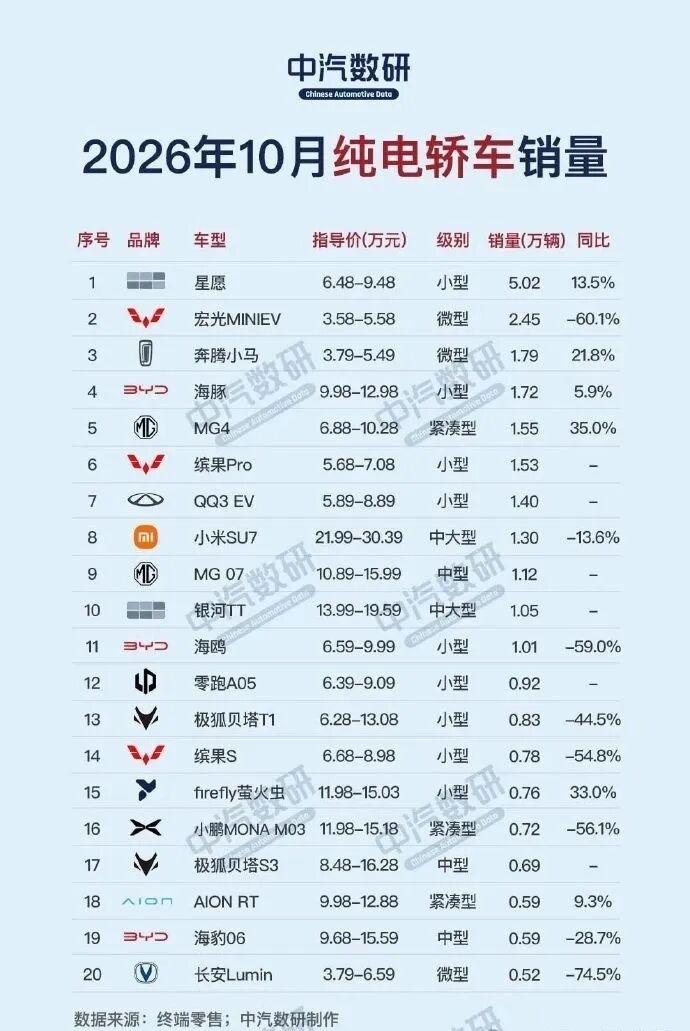 Image source: Weibo
Starting at more than 200,000 yuan, with top trims reaching 300,000 yuan. In the red-ocean pure electric sedan market, it has carved out a curve of its own.
Interestingly, the competitor long used as a benchmark against the SU7 is nowhere on the list. Another leading brand that is usually the subject of heated discussion also had no model on the list. To say it broke through in this price segment is no exaggeration.
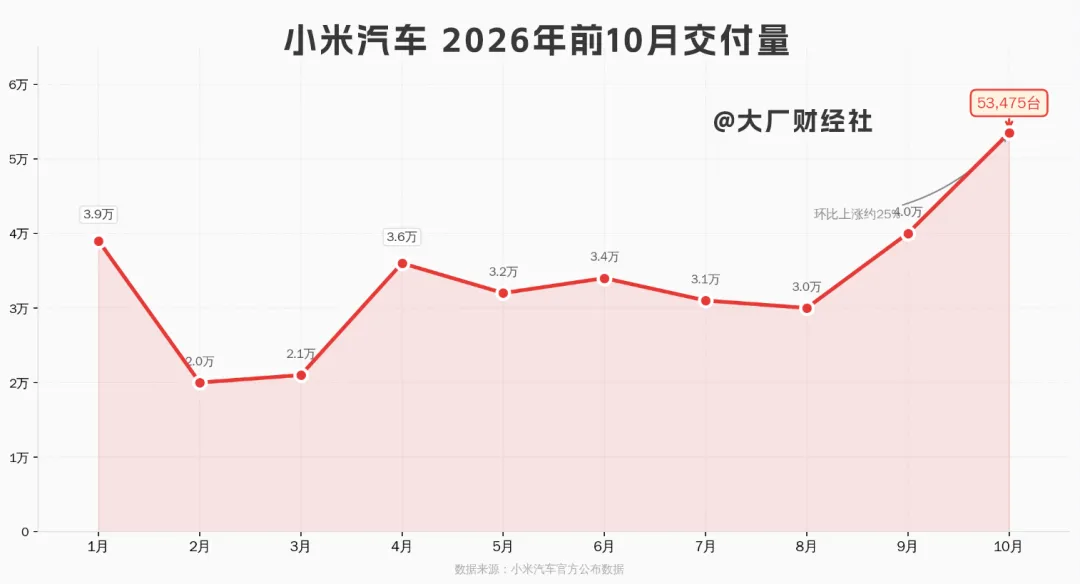 Image source: Dachang Finance Agency
Behind the excitement, there is a crack.
One of the strangest things in this year's new energy circle has landed on Xiaomi. The more cars it sells, the more it loses.
After the Highlight, the Script Flips
2025 was Xiaomi Auto's highlight. It delivered 410,000 vehicles for the full year, and the auto business was profitable by 900 million yuan, setting the fastest profitability record among new forces. At the time, many people thought Lei Jun had grasped the code to carmaking.
In one year, the wind changed.
In 2026, Xiaomi is selling more. October deliveries broke through 50,000 units in a single month, its best result this year; cumulative deliveries reached 336,500 units, and institutions estimate the full year may reach 450,000 units, still positive year-on-year growth.
Sales are rising, while profit plunges into the abyss.
In the first half of the year, Xiaomi's electric vehicle plus AI innovation businesses combined lost 5.7 billion yuan. Institutions have done the math. Under a conservative scenario, even if Pengcheng capacity gradually ramps up and the price war does not stop, gross margin will be difficult to repair. Losses in each quarter of the second half are expected to be 2 to 2.5 billion yuan, totaling 4 to 5 billion yuan for the second half, and full-year losses close to or even exceeding 10 billion yuan are a significant probability.
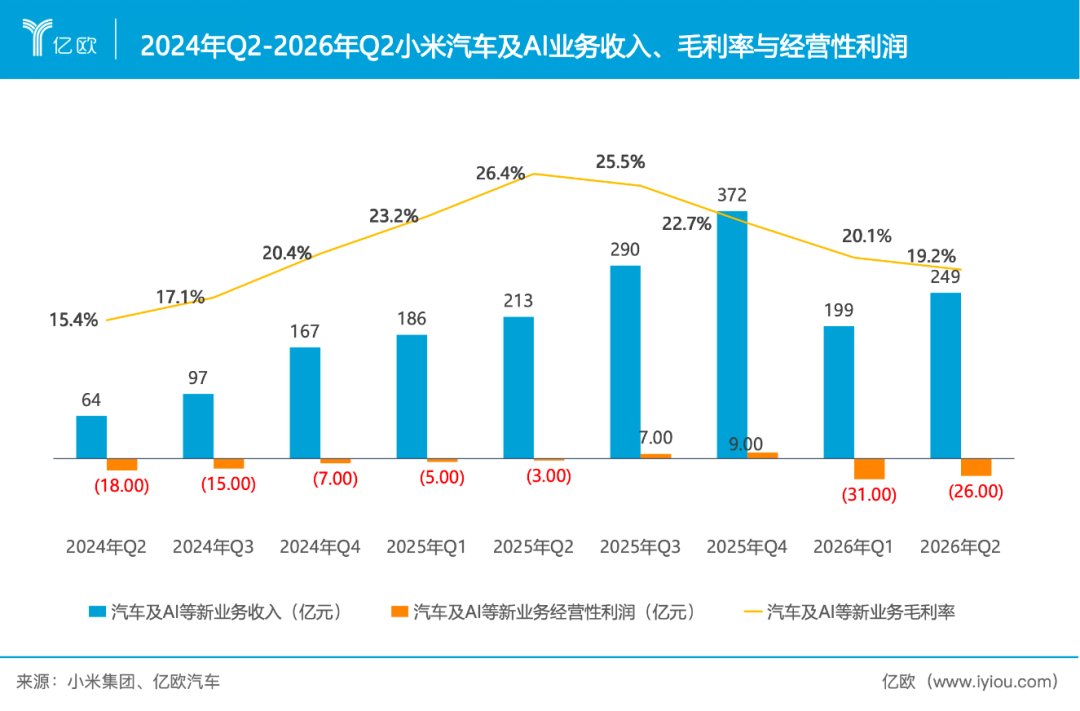
The optimistic version depends on whether Pengcheng orders can explode and whether high trims can achieve volume. Quarterly losses would be suppressed to within 1.5 billion yuan, with the full year ending around 9 billion yuan.
Last year it worked hard to earn 900 million yuan; this year, in half a year, it lost more than six times last year's profit.
Many people do not understand. The cars are selling better and better, so where did the money go?
The first hurdle is rising prices for upstream chips and storage. The biggest black swan in the auto circle this year is the continuous rise of core components—hardware costs alone for one car have increased by more than 10,000 yuan out of thin air. But the price war in the vehicle market has not stopped. Tesla, BYD, and HIMA have cut prices in turn, and Xiaomi does not dare to adjust prices easily. Once it raises prices, the foundation of cost-effectiveness loosens, and sales could slide at any time.
The increased costs can only be borne by Xiaomi itself. With nearly 200,000 deliveries in the first half, price increases alone swallowed more than 2 billion yuan. After all the hustle and bustle, most of the gains flowed to the upstream supply chain.
The second pressure comes from product structure. Xiaomi does not dare to stop launching new products. The SU7 standard version, GT version, new flagship, plus the two extended-range SUVs Pengcheng N70 and N90 launched intensively, have made the product line very broad. The price of covering more customers is a higher share of low-priced volume models, a decline in the delivery share of the high-profit SU7 Ultra, and continued dilution of overall gross margin.
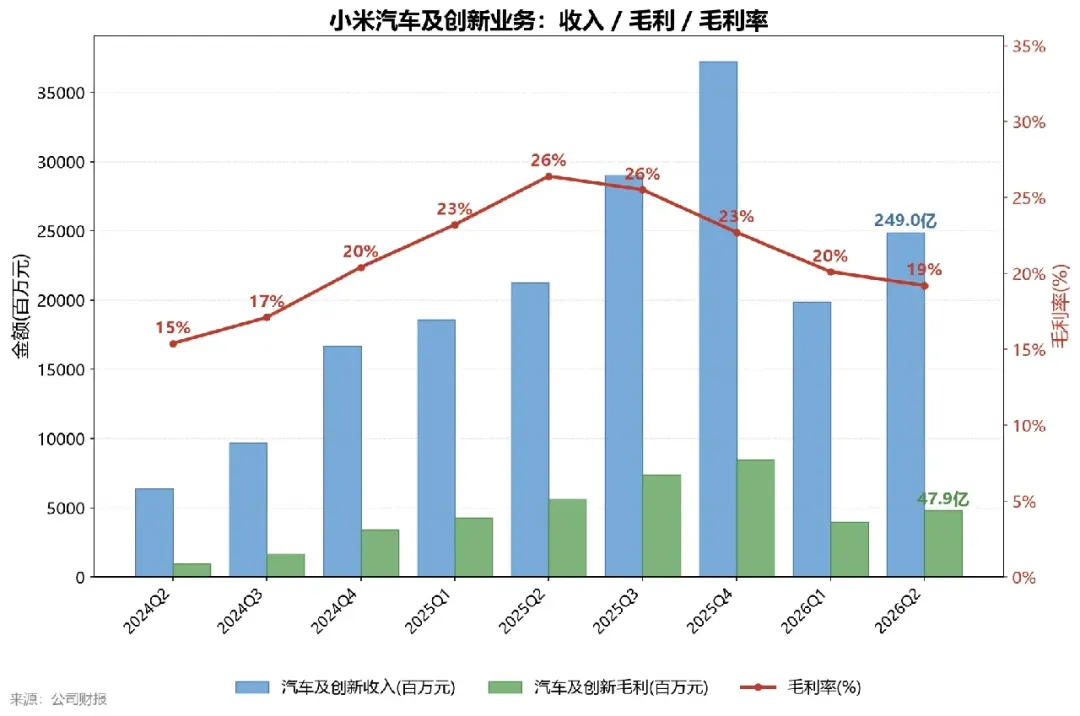
The data does not lie: gross margin fell from 26.4% last year to 19.2% in the second quarter, a nine-quarter low, with per-vehicle profit as thin as paper.
The third is long-term rigid investment. This loss is not entirely from losing money on selling cars. A large amount of money has been poured into invisible places: developing the Kunlun extended-range platform from scratch, molds, offline stores, production line renovations, and intelligent driving iterations. These investments cannot generate revenue in the short term, but they are tuition Xiaomi must pay to escape reliance on a single hit model and build a complete carmaking system.
Xiaomi originally planned to sprint toward 550,000 annual sales in 2026. With the year-end approaching and a huge gap remaining, this goal is basically out of reach. Sales below expectations, rising costs, and a diving gross margin—three mountains are pressing on Xiaomi Auto.
A set of comparisons: in the first half, Xiaomi's auto business lost 5.7 billion yuan, while Seres' net loss attributable to shareholders was 1.717 billion yuan. The two figures cannot be compared directly. Xiaomi's 5.7 billion yuan is a segment loss; Seres' 1.717 billion yuan is group net profit, and its deliveries in the same period were also lower than Xiaomi's. Both are under price-increase pressure, but the burden they carry is worlds apart.
Pengcheng, Opening Another Path
Most of Xiaomi's current expectations rest on Pengcheng.
On November 1, Xiaomi officially announced that October deliveries exceeded 50,000 units. Before that, Xiaomi's monthly deliveries had long been stuck at more than 30,000 or 40,000 units, with the previous high point being 39,000 units in January this year. What pushed Xiaomi back onto the 50,000 step was none other than the recently launched Pengcheng. Lei Jun said Pengcheng deliveries exceeded 10,000 in its first month.
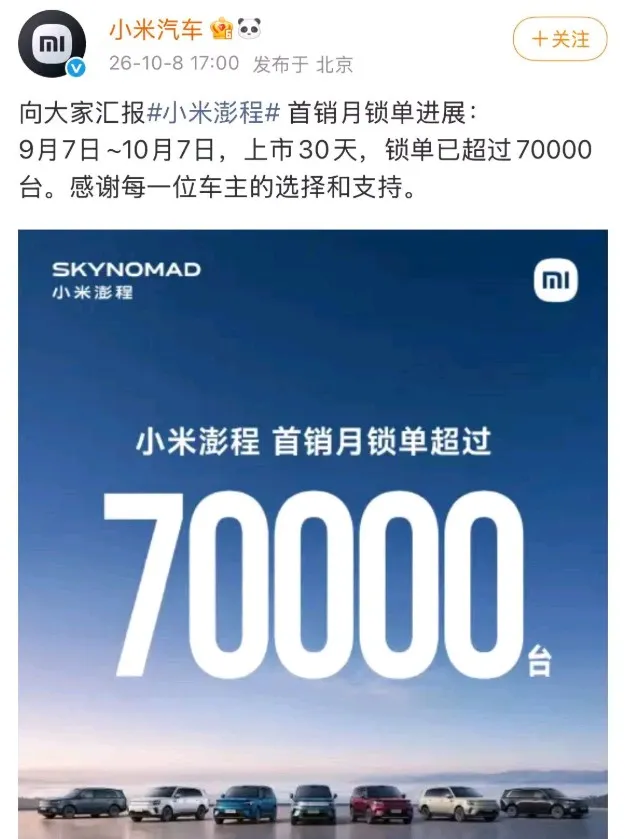
Image source: Weibo
The N70 and N90 were released on September 7 and began deliveries on September 12. With 10,000 units in the first month and only a 19-day delivery cycle, most of these vehicles were pre-built quasi-in-stock cars, and capacity had not yet been fully released.
Compared with the big reservations that flooded the screen for the SU7 and YU7, Pengcheng breaking 10,000 in 4 minutes is not explosive. But frontline feedback is worth pondering. A Chefans survey shows that in the first week after Pengcheng's launch, store traffic tripled, with 80% of customers coming for Pengcheng; a single store locked in 80 to 100 orders, and weekend test drives even exceeded the peak of the YU7 back then.
From the day the project was established, Pengcheng never intended to replicate the SU7's hit-model path. It is a move by Xiaomi into the family-user market.
The extended-range track has long moved beyond the endless route debates of earlier years. Li Auto used the L series to prove the formula for large family SUVs, and AITO relied on intelligence to turn extended-range into a tech-luxury label. For two consecutive years in 2023 and 2024, it was the fastest-growing track in new energy.
Xiaomi did not enter early. Lei Jun said that as early as 2022, friends advised him to do extended-range, but Xiaomi chose to first master the pure electric chassis. The project was only established in 2023, and it took three and a half years to polish the Kunlun architecture. Pengcheng only appeared this year.
Xiaomi's approach is different: it did not add an extended-range version to the SU7 or YU7, but instead pulled out the Pengcheng series separately, supporting it with some dedicated stores and creating moderate brand separation.
Many peers prefer one car with two powertrains, selling the same car in both pure electric and extended-range versions to spread R&D and marketing costs, at the cost of easily blurred positioning. Xiaomi chose to tell the two lines separately: the SU7 and YU7 are tied to performance, handling, and young people; Pengcheng focuses on large space, worry-free long trips, and family travel. The two sets of products share R&D and quality control, while their narratives do not interfere with each other. This approach is similar to Li Auto's split between the L series and i series.
The order structure confirms the success of the positioning. Pengcheng buyers are mostly family users, many of them replacing gasoline cars or adding a family vehicle, a customer group that barely overlaps with the SU7 and YU7. In first-week orders, the N90 seven-seat version accounted for 60%, the N70 five-seat version 25%, and the rest were high-trim Max versions. When placing orders, people focused mainly on the flexible space brought by the sliding rails and the 505 km pure electric range, and rarely made acceleration the primary reason.
Buzzing orders are only the opening act. Large-scale volume must wait for scattered orders to be scheduled and stable off-line production. The market predicts Pengcheng may reach 20,000 units in October, which, combined with the 30,000-unit base of the SU7 and YU7, would support 50,000 monthly deliveries.
The annual target of 550,000 units no longer has practical significance. Cumulative sales in the first nine months were 286,000 units; to meet the target, 90,000 units would have to be delivered each month in the fourth quarter, which is impossible.
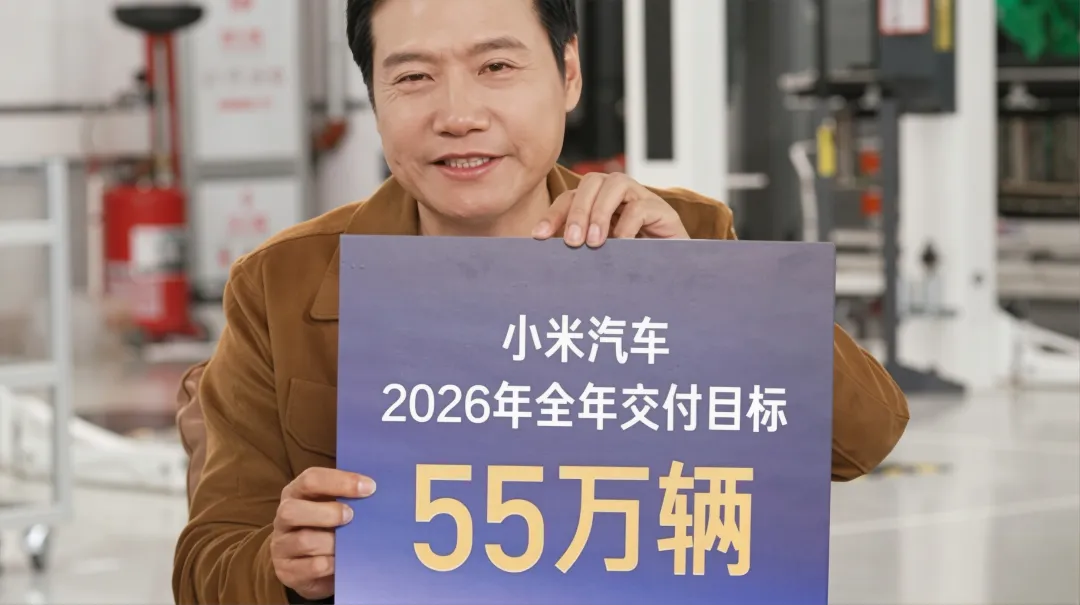 Image source: Lei Jun's Weibo
Pengcheng's value is not to help Xiaomi chase that unreachable goal. It is used to restructure deliveries: from relying solely on pure electric models to carry scale in the past, to a dual line of pure electric plus extended-range steadily contributing 40,000 to 50,000 monthly deliveries. If Pengcheng subsequently stabilizes at 15,000 to 20,000 units per month, Xiaomi's full-year deliveries would land at 350,000 to 400,000 units, which is already a good result in an environment of industry-wide price cutting and collective profit contraction.
Compared with eye-catching sales figures, whether gross margin can be lifted back is the core question.
A Tianfeng Securities research report noted that in the second quarter, Xiaomi's per-vehicle loss narrowed from 38,000 yuan in the first quarter to 25,000 yuan. Pengcheng sits in the golden price range of 200,000 to 300,000 yuan, with better profit conditions: a higher selling price can dilute fixed costs, and the cost of the extended-range system is also more easily accepted at this price point.
Whether Pengcheng can sustain volume and whether the share of high trims rises directly determines whether Xiaomi Auto's overall gross margin can stop falling and recover. To put it bluntly, Pengcheng is not just a volume model, but the fulcrum for Xiaomi Auto's profit repair.
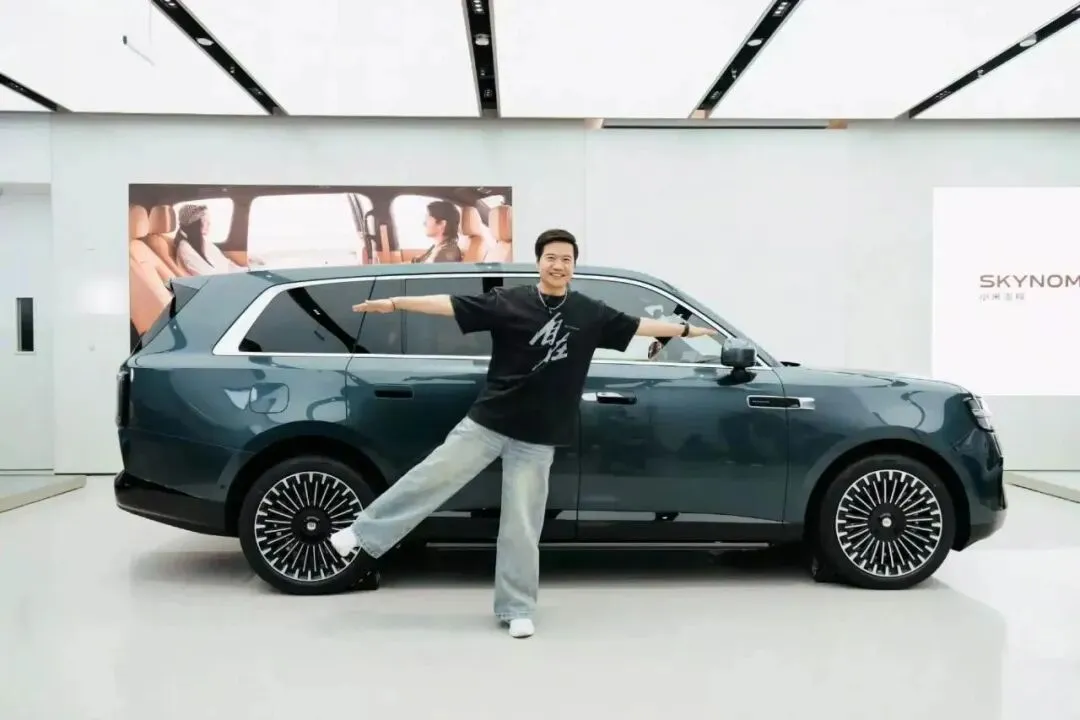 Image source: Weibo
Pengcheng's story is also tied to going overseas. Xiaomi has officially announced that it will enter Europe in 2027, with Germany as the first stop, and has signed cooperation with eight leading local dealers. In this game, Pengcheng's weight is even higher than that of the SU7.
Europe's charging facilities are unevenly distributed, and extended-range vehicles can run on either gasoline or electricity, meeting regulations while solving long-distance anxiety. The SU7 targets performance enthusiasts, always a niche; Pengcheng targets family users, the largest base of global passenger vehicles. Its domestic performance determines Xiaomi's bargaining chips when negotiating channels and pricing in Europe.
Between a Ranking List and a Financial Report
At the Pengcheng launch event, Lei Jun said that over the past five years, we proved Xiaomi can build good cars. Over the next five years, we must prove Xiaomi can build different good cars for different people.
The SU7 and YU7 have solidified Xiaomi's foothold in the pure electric performance segment, while the Pengcheng has unlocked incremental growth in the family extended-range vehicle market. It will be difficult for the Pengcheng to replicate the screen-flooding hype of the SU7 launch, but it provides Xiaomi's carmaking business with an extra safety cushion.
In the rankings, championships come easily; in the financial report, the shadow of tens of billions in losses looms overhead. This is the most tangible contradiction facing Xiaomi Auto today: a short-term sales victory does not equal a viable commercial closed loop. The Pengcheng's ramp-up has only just begun.
Carmaking has never been about looking only at delivery numbers. Some cars are built to seize reputation. Some cars are built to carry scale. And some cars are built to wait for profits to slowly return.
Xiaomi is now trying all three.
It is a game of trading scale for market share and upfront investment for long-term industrial leverage. The outcome is still far off.
Interactive topic: Do you think the Pengcheng can stabilize its position in the family SUV market and help Xiaomi stem its losses? Share your thoughts in the comments.
Disclaimer: This article is a commentary on major companies' financials only and does not constitute any investment advice. The corporate data and regulatory events mentioned in the article are all drawn from public information and are for reference only; official releases shall prevail. Images are sourced from the internet. If there is any copyright issue, please contact us for removal.
-
![]()
SpaceX's Starship Was "Caught" — So Why Didn't the Stock Follow?
-
![]()
"Hua-series" Cars Score Big: HarmonyOS Jumps 139%, Arcfox Up 112%, Xiaomi Drops 11%
-
![]()
Billions in Losses: Xiaomi Auto's Sales Are "Winning Big," So Why Is the Business Bleeding?
-
A Robotaxi at 1.13 Yuan per Kilometer Is Reshaping the Livelihoods of Seven Million Ride-Hailing Drivers
-
Mercedes-Benz Freezes Investment in Germany While Expanding Production in China: Can Halving Costs Double Sales?
-
![]()
Tencent's Muse? Hands-On with the New LightVela: More Like a Personal Agent Than Ever, but Still Not Perfect
-
After the Jensen Huang Incident, Has AI Computing Power Construction Entered Garbage Time?
-
The AI Onslaught on Short Dramas: A Winter Without Obituaries