Alibaba Forced to "Hold Back"
 11/20 2026
 337

Alibaba Cloud cuts its guidance, Qwen stops burning cash to chase monthly active users, and the food delivery price war hits a truce—all while the company waits for T-Head to ramp up chip volume
Author | Xinjian
Editor | Xiaobai
Produced by | Emphasis Next
On the evening of November 19, Alibaba Cloud reported its fastest single-quarter growth in nearly five years: 53%. Yet moments later, management lowered its cloud revenue growth target for the next fiscal year (April 2027 to March 2028) to 30%–45%.
Infrastructure expectations were revised down as well. Alibaba's earlier long-term target of 20GW of data center energy may be scaled back; cloud growth is not expected to return above 50% until 2028; and the point at which free cash flow turns positive has been pushed to the second half of 2028. Only the long-term goals—$100 billion in external cloud revenue and a profit margin above 20% by 2030—remain unchanged.
Why lower next year's expectations just as growth hits a new high? The bottleneck is supply. Wu Yongming put it bluntly on the call: computing power is in short supply, especially in China, and it will be particularly scarce over the next two years.
Just three days before the call, new global computing power regulations cut off the channel for Chinese companies to rent large-scale computing power overseas. In the same week, Nvidia confirmed it would stop shipping previously licensed Hopper chips to China. With external sources of computing power fully locked down, how fast Alibaba Cloud can grow no longer depends on how many orders it has won—it depends solely on how many chips it can build itself. This hard constraint is rewriting the rankings in the domestic cloud market and forcing Alibaba to recalculate the computing power quotas for Qwen and Taobao.
Alibaba Cloud's ceiling rests on T-Head's production lines
Looking at demand alone, Alibaba Cloud is currently at its best moment. External customer revenue grew 64% year over year this quarter, accelerating for 10 consecutive quarters. AI-related product revenue reached 17.9 billion yuan, accounting for nearly half (49%) of external recurring revenue, with annualized revenue crossing the $10 billion threshold.
External orders are still pouring in, yet next year's growth guidance falls back to 30%–45%—the gap can only be filled by domestic chips. Wu Yongming made clear at the earnings call that the new export control regulations will affect product supply next year, and that Alibaba's 2030 AI infrastructure plan is built entirely on the supply chain of T-Head's domestic chips.
For the first time, he publicly laid out T-Head's three-generation mass production timeline: this year the "Zhenwu M890" will fully launch, in 2027 the "V900," and in 2028 the "J900" will successively enter large-scale mass production. Qwen is already training its next-generation models on T-Head chips, and the inference services on the Bailian platform have also switched to domestic cards.
Overlaying the chip schedule with the revenue guidance, Alibaba Cloud's operating rhythm for the next two years lines up: 2027 falls in the lean period before V900 capacity ramps up, with revenue growth constrained by chip delivery progress. Once V900 and J900 gradually ramp up in 2028, growth will be pulled back above 50%.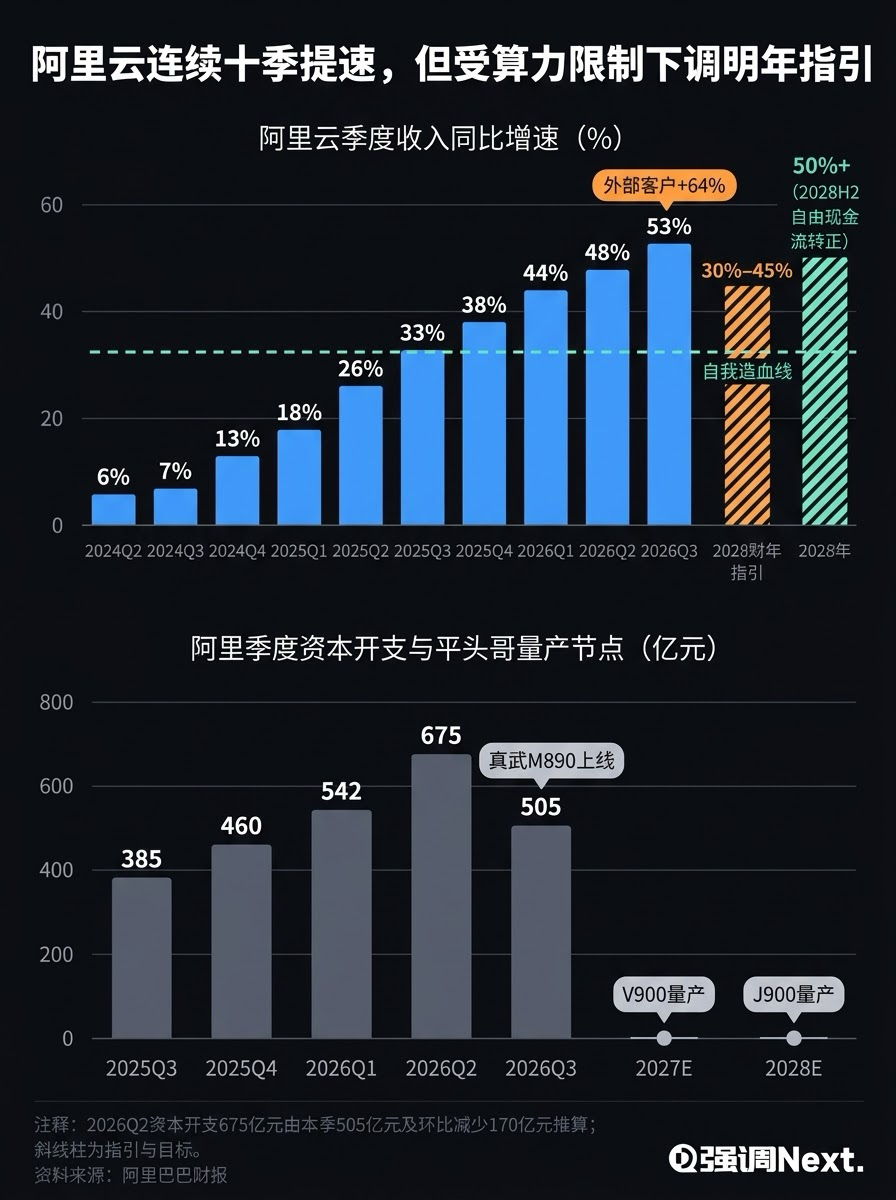 The 30%–45% guidance range also conceals Alibaba's calculations about cash flow. At the August earnings call, Wu Yongming estimated the ROI of the cloud business: if the payback period per card is 3 years, cloud growth kept within 33% can maintain positive cash flow. If the payback period shortens to within 2.5 years, growth above 40% can also be self-funding.
The growth range given for next year happens to straddle the 33%–40% payback line. T-Head bears a dual task in Alibaba's books: it must fill the computing power gap after imported chips are cut off, and also rely on in-house development to lower per-card costs and compress the payback period to within 2.5 years. This also explains why Alibaba set both "growth returning above 50%" and "free cash flow turning positive" for 2028—only when the shipment scale and cost of in-house chips cross the critical point will high growth and positive cash flow stop conflicting with each other.
This quarter's capital expenditure already reflects the difficulty of obtaining chips. Alibaba's capex this quarter was 50.5 billion yuan, down 17 billion yuan quarter over quarter. CFO Xu Hong explained this as normal procurement cycle fluctuation, not strategic contraction. But management also admitted that the main reason the 20GW target may be lowered is chip constraints. As of the end of the quarter, Alibaba still had $32.9 billion in net cash on its books. Alibaba does not lack the money to buy chips; what it lacks are chips available on the market.
This is also another purpose behind Wu Yongming's rare move of revealing all three generations of T-Head chips at the group earnings call. In the past, big companies' in-house chips were mostly kept behind the scenes, rarely directly reporting specific chip codenames and schedules for the next two to three years to the secondary market. Now management has publicly tied Alibaba Cloud's long-term plans—growth returning above 50% in 2028 and $100 billion in revenue by 2030—entirely to T-Head, effectively issuing T-Head an internal guaranteed order with extremely high certainty.
On T-Head's path toward independent financing and eventually an IPO, this mass production schedule, deeply tied to Alibaba Cloud and Qwen, is the hardest commercialization roadshow. Once an independent capital channel is opened, the hefty tape-out investments and capacity prepayments for each generation can be shared by external equity funds, thereby easing pressure on Alibaba Group's income statement and free cash flow. At the same time, the strategic placement and equity space of an independent listed entity are also hard bargaining chips for T-Head to deeply bind interests with domestic wafer fabs and advanced packaging plants, securing priority scheduling in the locally scarce advanced process production lines.
Computing power shifts to a seller's market, and cloud providers are re-ranked by "whether they have chips"
Over the past two years, the theme of the domestic AI cloud market has been price wars and competing for invocation volume. Under this playbook, ByteDance's Volcano Engine charged ahead most aggressively: IDC data shows that in the first half of 2026, the domestic MaaS market was 10.63 billion yuan, with Volcano Engine taking a 45.1% revenue share, nearly 20 percentage points higher than second-place Alibaba Cloud. In the overall AI cloud market including underlying IaaS computing power, Alibaba Cloud remains first, with Omdia statistics showing a 38.1% revenue share in 2025. Volcano captured the most Token distribution, while Alibaba held the more foundational computing power base.
The new regulations that took effect on November 16 directly pulled out the foundation of the price wars of the past two years.
Under the new requirements of the U.S. BIS, any overseas data center providing more than 12 million TPP of computing power to companies headquartered in China must apply for a chip export license—a threshold equivalent to only about 750 H100s. At the same time, scrutiny of overseas wafer foundry and advanced packaging has further tightened, and chip design companies in restricted regions must enter BIS's "approved IC design enterprise" whitelist to be exempt from case-by-case tape-out approval.
Combined with Nvidia CFO Colette Kress confirming in the same week the halt of shipments of approved Hopper chips to China, the three paths for Chinese big companies—renting chips overseas, buying chips directly, and overseas tape-out—have all narrowed simultaneously, leaving domestic chips as virtually the only route for new computing power.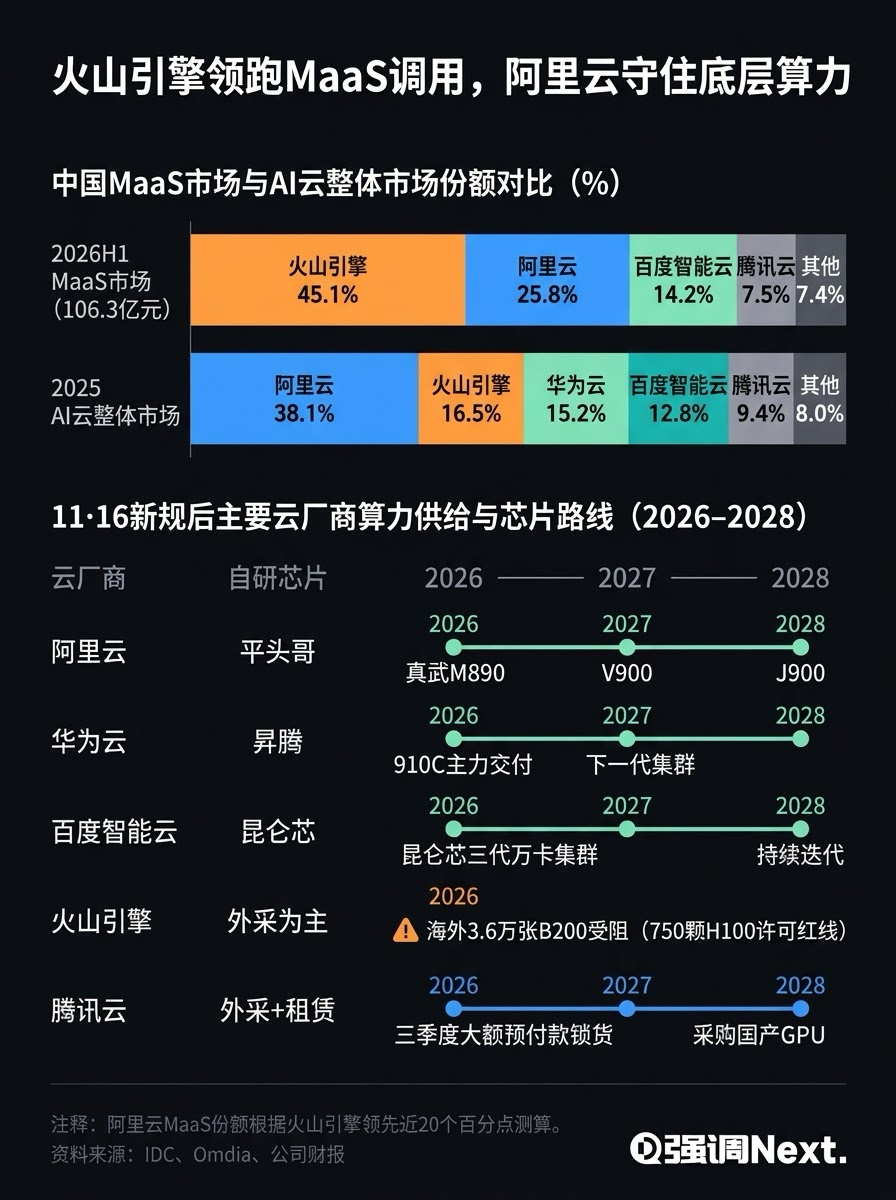
Domestic cloud providers have thus split into two camps.
Only a few have in-house chips and clear mass production schedules: Alibaba has T-Head, Huawei has Ascend, Baidu has Kunlunxin. Big companies without in-house large chips have no choice but to scramble for supply in the market: Tencent mentioned at its Q2 earnings call that computing power comes from leasing, purchasing imported high-end GPUs and more domestic GPUs, and by Q3 it was using large prepayments to grab capacity. ByteDance had previously planned to deploy about 36,000 B200s through local cloud providers in Malaysia, and this overseas workaround bore the brunt after the new regulations took effect.
The chip shortage anxiety of external big companies in turn heightens the urgency for T-Head to go public independently. When ByteDance, Tencent and second-tier cloud providers are all scrambling to lock in domestic GPU capacity in the market, if T-Head remains merely an internal business unit under Alibaba Cloud, external cloud providers and internet giants will find it hard to confidently entrust their underlying computing power to it due to competitive concerns. Only through independent financing and listing, bringing in external strategic shareholders and industrial capital to achieve a neutral governance structure, can T-Head truly step outside the Alibaba system and, as an independent commercial chip company, capture the external market left by Nvidia's supply cutoff.
The MaaS price war could only happen on the premise that new chips could still be continuously bought in the market—whoever did inference optimization well dared to cut prices and grab share. Once new computing power becomes a seller's market, the players with the largest invocation volume and lowest Token prices will instead face the largest computing power gap.
Alibaba's proactive lowering of next year's growth guidance is merely the first to write the hard constraint of chip capacity into an open book. Other big companies face the same hurdle. Over the next two years, the focus of competition in domestic AI cloud will shift from grabbing invocation volume to securing supply. But even manufacturers with in-house chips face another internal dilemma: for the chips finally off the production line, who gets them first?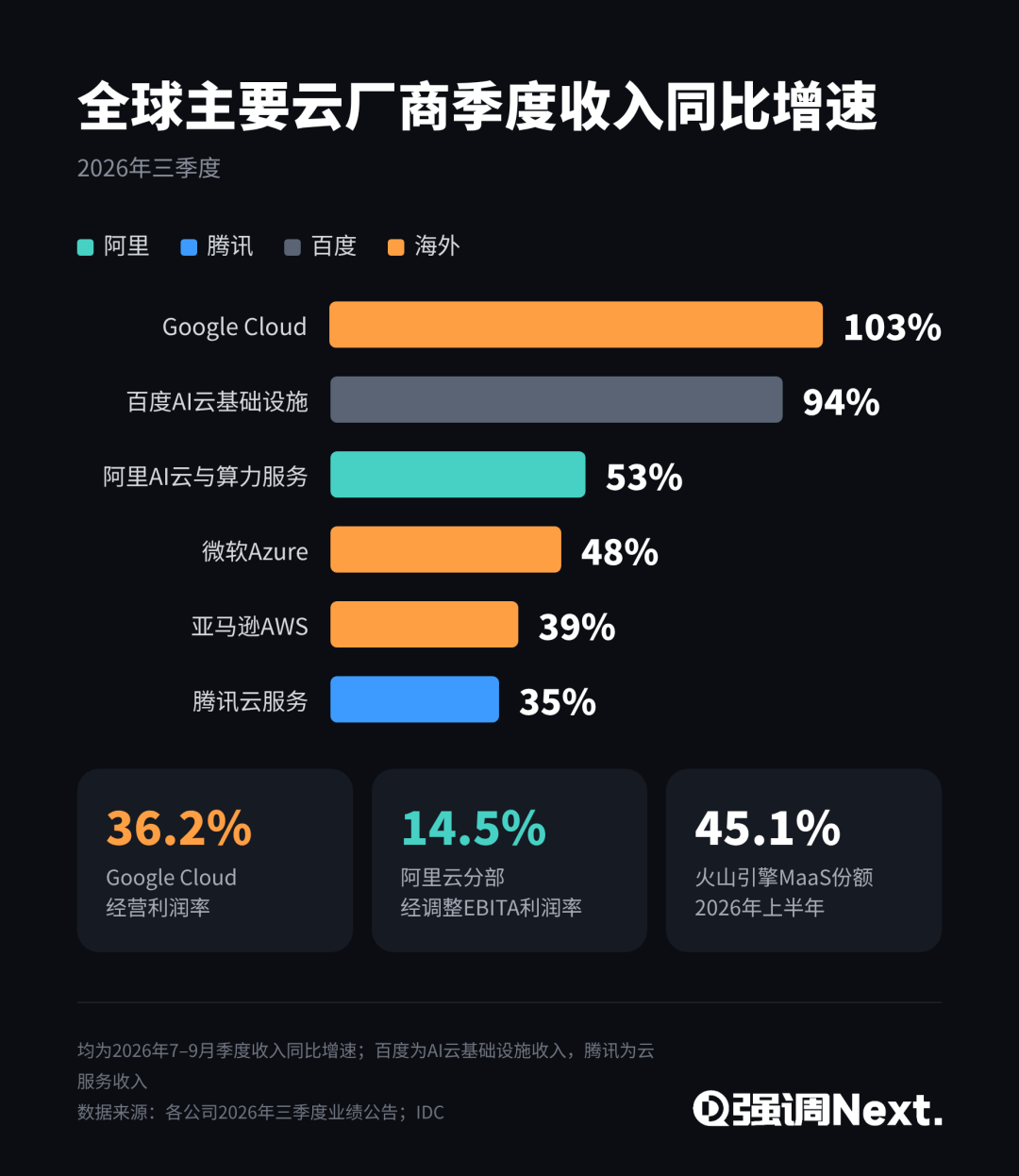
One chip: Qwen first or customers first?
Inside Alibaba, the same T-Head chip on the table has two completely different accounting destinations: installed in Alibaba Cloud and rented to external customers, it can deliver the segment's 14.5% profit margin. Allocated to its own Qwen large model, it is currently pure investment.
When computing power is abundant, the two lines keep separate accounts. But once chip supply caps Alibaba Cloud's revenue ceiling, every additional chip Qwen occupies means one less chip Alibaba Cloud can sell. The computing power consumed by Qwen has become the resource with the highest opportunity cost across the entire Alibaba Group.
Financial data already shows Alibaba's move to contract consumer-facing broad traffic. This quarter, the Alibaba AI Lab and Applications segment lost 10.5 billion yuan—three times the same period last year, but narrowed by a quarter compared with about 13.9 billion yuan in the previous quarter, while segment revenue rose from about 3.3 billion yuan to 4.4 billion yuan.
The other side of the narrowing loss is that Qwen's user growth has nearly stalled. QuestMobile data shows that from March to June this year, Qwen's MAU only edged up from 166 million to 167 million, while ByteDance's Doubao reached 382 million MAU in the same period. In this quarter's financial report, Alibaba simply did not disclose Qwen's user data.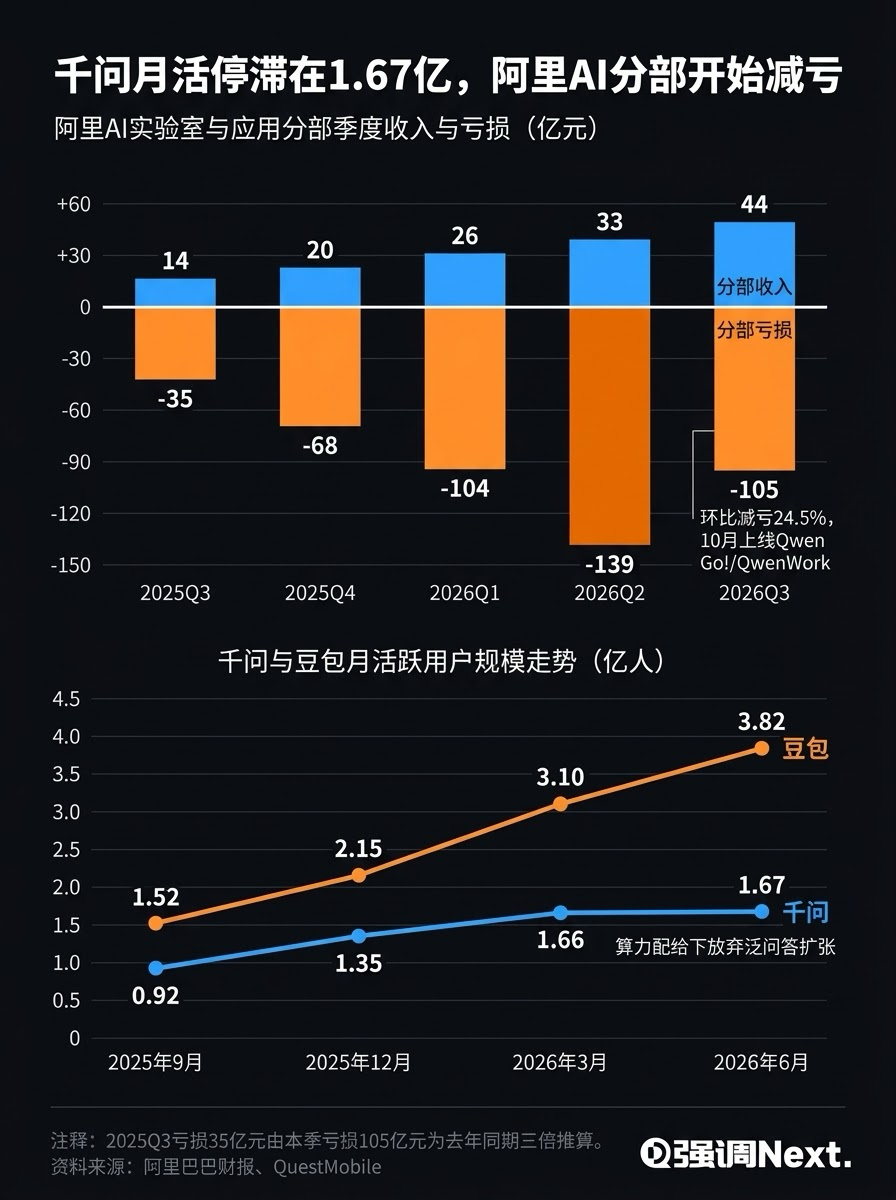
Under the computing power rationing system, Qwen has scaled back the tactic of using free computing power to exchange for broad Q&A MAU, and instead tilted computing power toward scenarios that can directly generate transactions and revenue. The cloud-based personal agent Qwen Go! launched in October this year, and QwenWork, which includes Taobao merchant tools, both take paths closer to transactions. When every chip has a clear opportunity cost, every large model inference must have its input-output ratio calculated clearly.
The exemption clauses in the new U.S. regulations add another variable to Alibaba's internal computing power allocation. The new rules exempt traditional pure commercial recommendation systems; conventional recommendation algorithms on e-commerce and social platforms do not need to apply for licenses. But as long as a system can generate new text or images based on user input, it no longer enjoys the recommendation exemption.
This means Taobao's traditional "Guess You Like" can still run in the compliant exempt computing power pool. But Qwen-style conversational shopping guides and Agent automatic ordering are generative AI, falling within the regulatory red line, and must all flow back to T-Head's domestic computing power pool. The deeper Taobao goes into AI e-commerce, the more prominent its conflict with Alibaba Cloud's external customers over domestic chips becomes.
Taobao needs a new way to make money, but must wait for chips to ramp up
Alibaba Cloud's slowing growth and free cash flow not turning positive until the second half of 2028 mean that for the next two years, Taotian e-commerce must continue to serve as the group's only cash cow. This quarter, the e-commerce group contributed 38.85 billion yuan in adjusted EBITA, almost propping up all of Alibaba's operating profit.
But this cash cow's traditional monetization methods are nearly exhausted. This quarter, Taobao Tmall's customer management revenue (CMR) fell 5% year over year on a reported basis, mainly because subsidies previously booked under sales expenses are now being applied directly against revenue; even on a like-for-like basis, CMR grew just 1% year over year. Thanks to the low base left by the cooling food delivery subsidy war, e-commerce profit rose sharply year over year, though it still edged down from last quarter's 39.75 billion yuan. The gains from tools that lift monetization rates—such as sitewide promotion and software service fees—have largely been tapped out, and the share traditional shelf e-commerce can take from each transaction has peaked.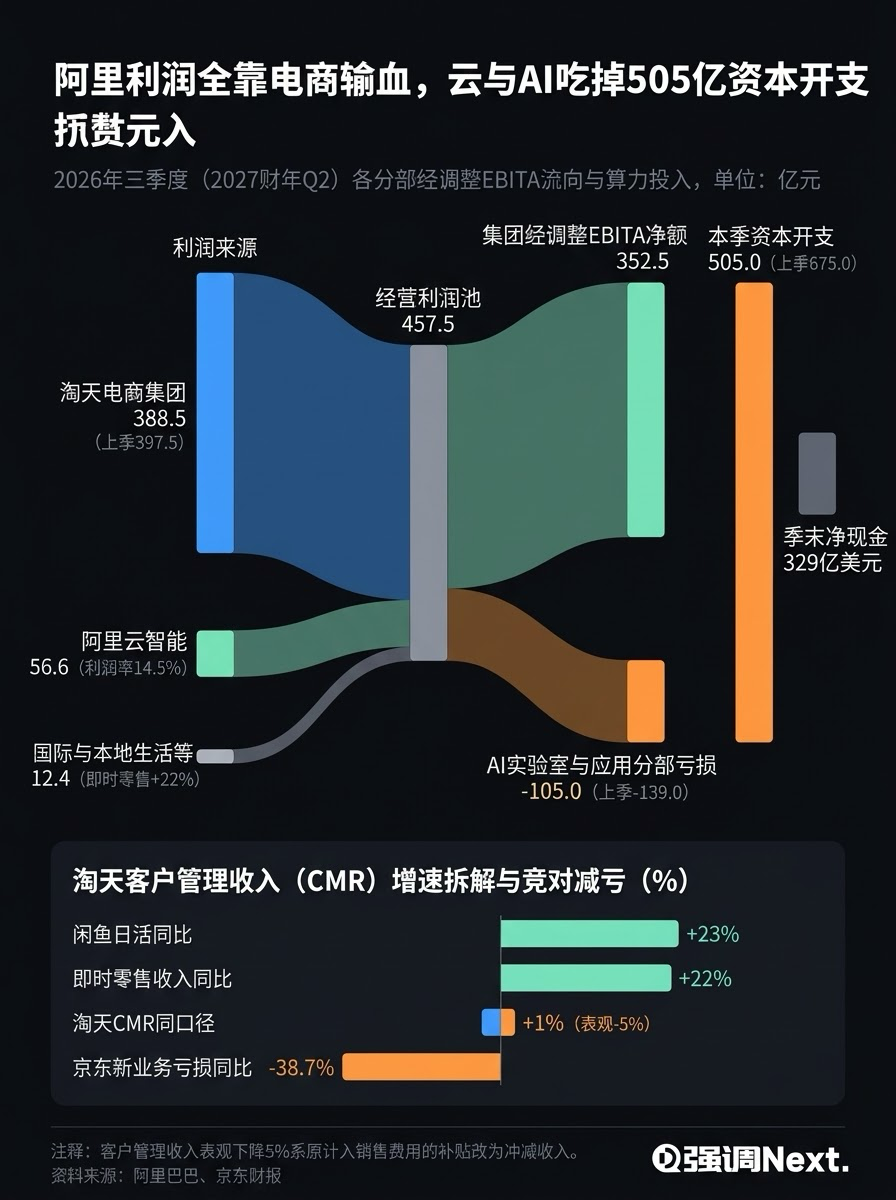
The approach to instant retail is converging accordingly. Instant retail revenue grew 22% this quarter, driven mainly by Hema, and management described its assessment of the food delivery business's unit economics (UE) as "in line with expectations." Just two days earlier, JD.com disclosed that its new business losses had narrowed sharply by 38.7% year over year. The two most aggressive attackers of the past year have pulled back at the same time, with the food delivery business shifting from burning money to grab share toward repairing their respective income statements. For Alibaba, the more core strategic value of flash sales right now lies in serving as the high-frequency, same-city fulfillment foundation for Qwen's "getting things done" capability.
To break through the monetization ceiling of shelf e-commerce, Taobao has staked its next generation of commercialization on agent-driven transactions. After Qwen and Taobao were fully integrated in May this year, users can already complete product selection, price comparison and ordering with a single sentence. ByteDance is also internally testing a direct connection between Doubao and Douyin e-commerce ordering. Whoever first makes the AI shopping entrance work will gain pricing power over the next generation of e-commerce traffic.
What still holds back Taobao's shift is the computing power timetable. Every order in agent e-commerce requires multiple rounds of large model inference calls across product databases, discount calculations and fulfillment systems—consuming precisely the constrained computing power that will be most scarce next year. Before T-Head's V900 ramps up at scale in 2027, Taobao's AI transformation can only advance in small steps under rationing, and its main battlefield must still rely on traditional strengths to defend its base: 66 million high-spending 88VIP members, Xianyu with daily active users up 23%, and the already deployed flash sales same-city fulfillment network.
In the end, several core metrics for Alibaba over the next two years—Alibaba Cloud's revenue growth rate, the commercialization scale of Qwen, the speed at which Taobao shifts traffic to agents, and the point at which the group's free cash flow turns positive—are all tied to the same production line at T-Head. Before domestic chips truly close the computing power gap, Taobao's profit foundation must hold up long enough. Header image: Margin Call. Data source: The data in this article comes from public information and does not constitute investment advice.
- END -
-
![]()
Claude Goes Wild: The Overseas Mac mini Rental Craze Explained
-
![]()
Alibaba Forced to "Hold Back"
-
iCAR V25 Launches with Red Packet Pricing from 119,800 Yuan — Is This Extended-Range Box Car Really a Good Deal?
-
![]()
Boxy SUVs: Only 3 Models Top 10,000 Units in October, 52% Sell Fewer Than 1,000; Deepal G318 and Hongqi G919 Under 200 Units | Mingjing Pro
-
![]()
Google Opens Genie 4 to Eligible Users, Upgrading Real-Time World Generation
-
![]()
Volkswagen Group October China Retail: 145,000 Units — How Do Volkswagen, Audi, and Jetta Break Down?
-
![]()
Musk Wants to Build a Model Y Without a Steering Wheel: Robotaxi Expands from a Solo Car to a Family-Size Vehicle
-
![]()
Weipai Reports 7,886 Retail Units in October; Gaoshan PHEV Alone Accounts for 77.4%