Musk Wants to Build a Model Y Without a Steering Wheel: Robotaxi Expands from a Solo Car to a Family-Size Vehicle
 11/20 2026
 359
Produced by Zhineng Technology
In a remote conversation at the New York DealBook summit on November 18, host Andrew Ross Sorkin mentioned that he has three children and had just ordered a Model Y L.
Musk seized on the remark, saying the Model Y L is very popular and that Tesla may need to shift more Model Y production capacity to the Y L.
The host then asked whether Tesla would build only Cybercabs in the future, or would continue selling ordinary cars.
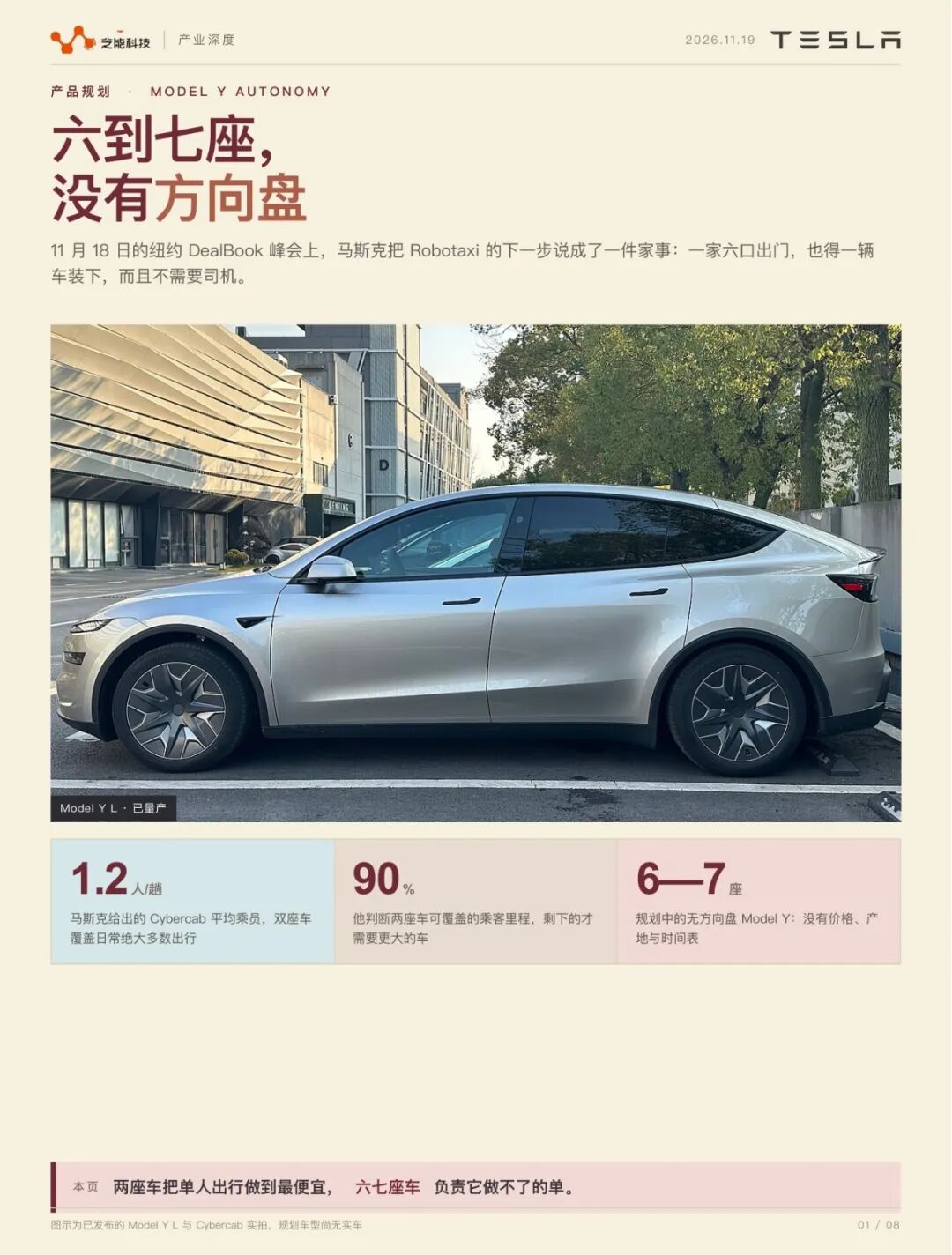
Musk's answer hinged on passenger count: for short trips with one or two people, the two-seat Cybercab is enough; for a family outing, a larger autonomous vehicle is needed. He floated the idea of a new vehicle: no steering wheel, no pedals, able to carry six to seven people—still called a Model Y.
For now, this vehicle remains a verbal plan. In the interview, Musk cited two figures: the Cybercab covers about 90% of passenger miles, with an average occupancy of 1.2 people.
The ready product on the table is the six-seat Model Y L, with a vehicle length close to 5 meters. With the third row fully occupied, the trunk is tight, and Tesla needs to add a large vehicle to its autonomous driving fleet.
01 A Two-Seat Small Car and a Family-Size Large Car
Tesla's Robotaxi is a small golden two-seater with no cockpit, its body made as light as possible to minimize unit transportation cost.
Its sweet spot is high-frequency solo commuting, dining for two, and short urban trips.
◎ Two-seat cars have a cost advantage. A six-seat SUV carries only one passenger most of the time, and every kilometer pays for a larger body, battery, tires, seats, and energy consumption.
◎ When a family heads home from the airport, the scenario flips instantly. Two adults, two or three children, plus a stroller and luggage: the two-seat Cybercab would have to be split into two or even three vehicles, orders would be fragmented, and pickup and boarding would become more complicated.
For groups with children, elderly people, and luggage, sitting separately is sometimes simply unworkable, and they would rather pay more for the whole group to travel together.
This is exactly where 6- to 7-seat models fit into the fleet, even though such vehicles have limited order volume.
Ordinary users want a steering wheel and pedals for the flexibility to drive freely across cities and regions, while operators eliminate human drivers to target the cost structure.
The two types of customers do their own math, and Tesla's orientation is to keep both the human-driven ordinary Model Y and the autonomous version.
The ready example is the six-seat Model Y L. The five-seat Model Y has a length of 4,797 mm and a wheelbase of 2,890 mm, while the six-seat Model Y L has a length of 4,976 mm and a wheelbase of 3,040 mm—179 mm longer, with a 150 mm longer wheelbase, and height rising from 1,624 mm to 1,668 mm.
Inside is a 2+2+2 layout, with two independent seats in the second row, and the third row can also seat two people.
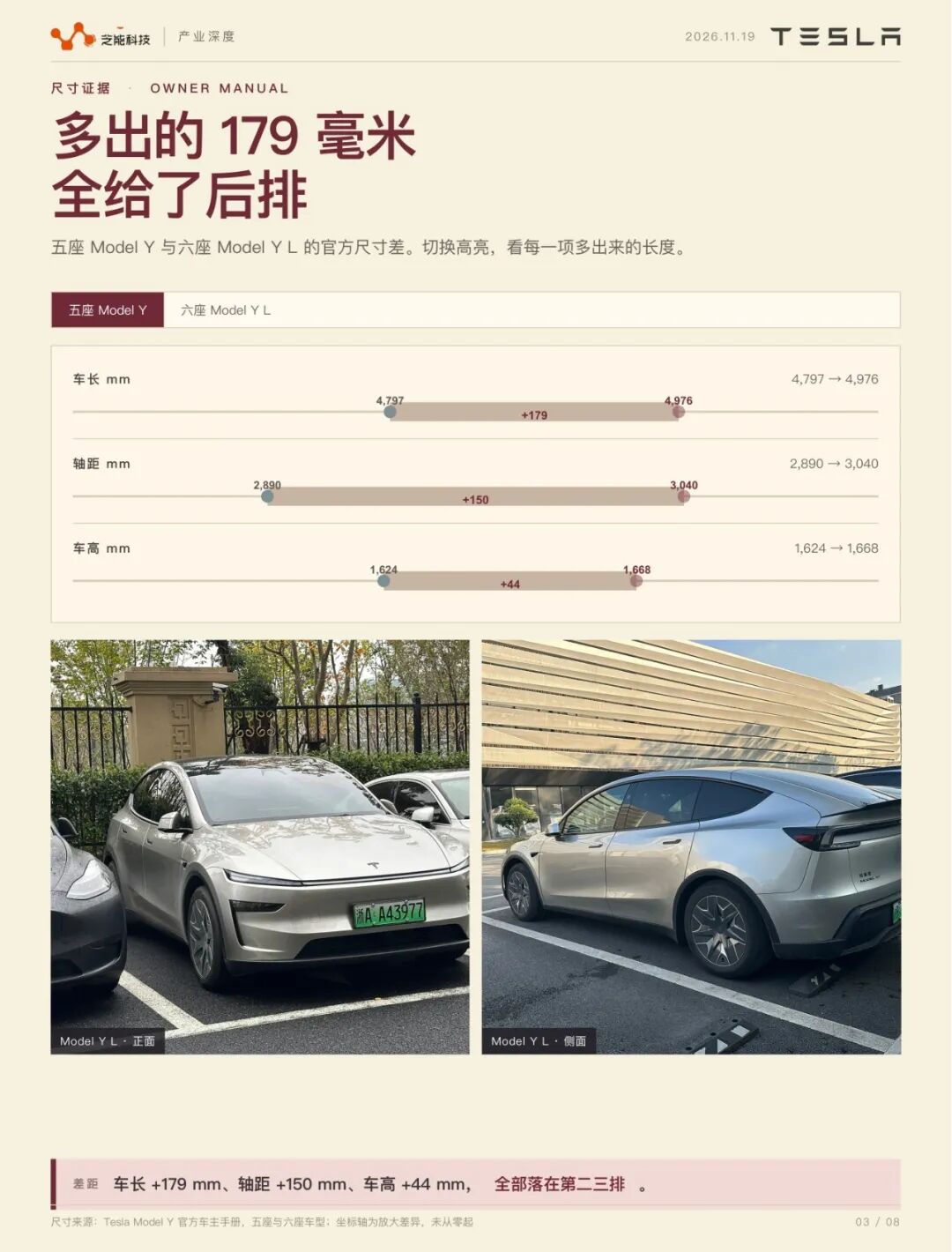
The change in the trunk directly determines loading capacity.
With the third row fully in use, the luggage space behind the third row is 420 liters. Under the official "total storage volume with six occupants" measure, including the front trunk, it is 536 liters. The two figures correspond to different loading definitions.
For six adults with carry-on suitcases sitting in the car, whether 420 liters is enough for six people's cases depends on suitcase size and loading method.
The six-seat Model Y L and the 6- to 7-seat autonomous Model Y are two different products.
The current second row has two independent seats, and the third row has two, for a total of six seats. Musk said it would be "suitable for transporting groups of 6 to 7 people," but he did not elaborate on how the seats would be arranged, whether it would be modified from the current Y L, or whether the interior layout would be redesigned.
If a seven-seat version uses the nearly 5-meter body, third-row access, the center aisle, occupant protection, and luggage space would all need to be rebalanced.
After removing the steering wheel, the new trouble falls on operations.
The vehicle is full of passengers: children not wearing seat belts, child safety seats not installed properly, doors blocked by luggage, elderly people with limited mobility, temporary changes to drop-off points—all of these need someone to handle.
Fixed routes and geofencing can reduce complexity, but every time a human customer service agent is connected, part of the labor cost that autonomous driving aims to save is eaten away.
If the car is handed to private users, an ordinary Model Y can drive from Shanghai to Hangzhou or from Los Angeles to San Francisco. Once a new car without a steering wheel is limited to approved areas, its range of activity follows software services, operating permits, and regulation.
02 Cost, Dispatch, and Deployment Thresholds
Calculated by cost per trip, the comprehensive vehicle cost for a two-seat car is 8 dollars per order, and for a large six-seat car it is 12 dollars. Neither includes platform subsidies or profit.
With only one passenger in the car, the large vehicle loses out due to idle capacity. For three people traveling, two Cybercabs cost 16 dollars, while one six-seat car costs 12 dollars. For five or six people traveling together, splitting into three Cybercabs costs 24 dollars.
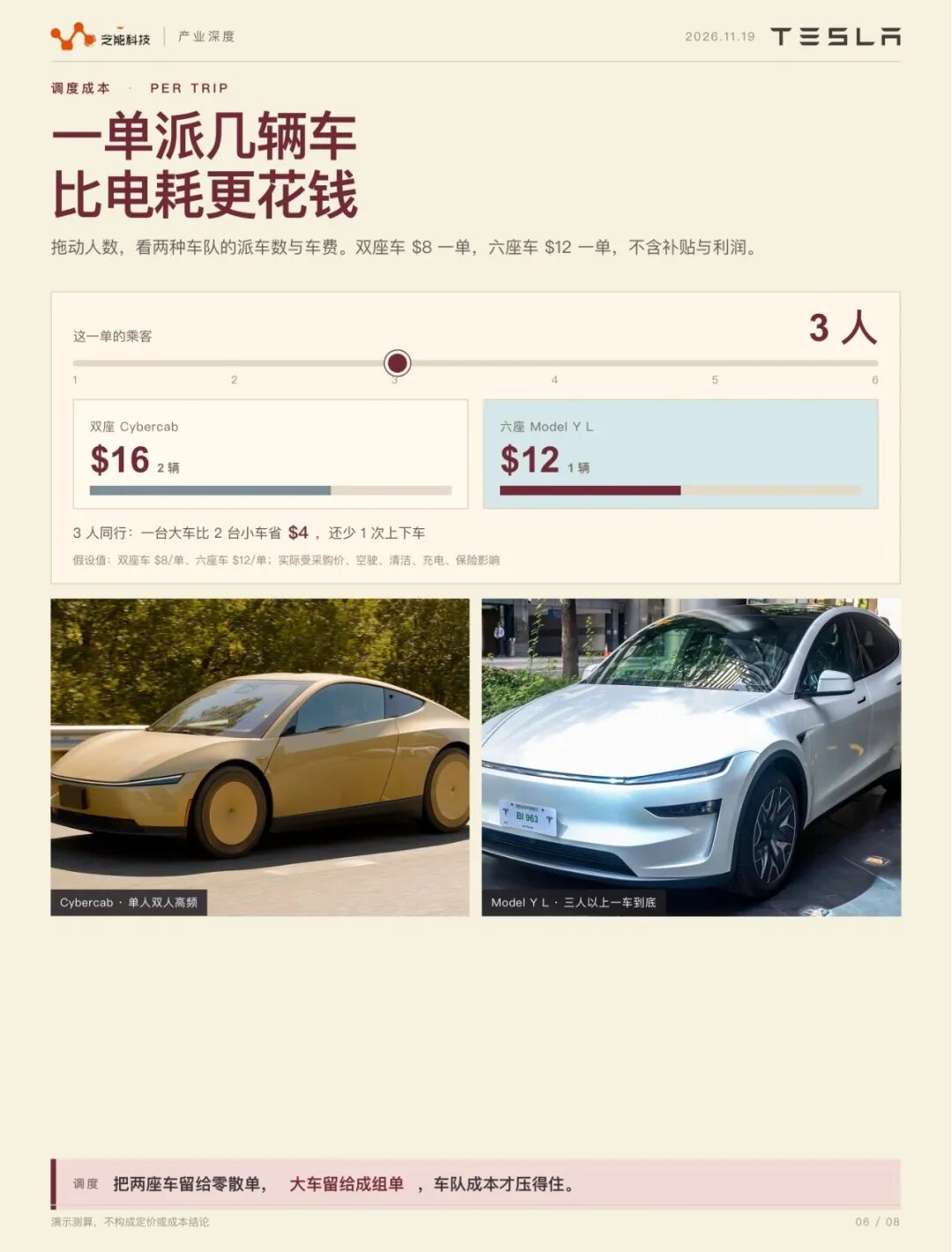
Electricity consumption is only one variable.
Dispatch small cars for two passengers or fewer, and prioritize large cars for orders with three or more people, especially those with luggage and children—this is a dispatch approach derived from cost.
This set of figures is very sensitive to purchase price, residual value, charging speed, cleaning time, deadhead mileage, maintenance frequency, operating area, and actual supply and demand. Change the conditions and the tipping point moves.
Once large vehicles are purchased into the fleet, there is a risk of idleness.
If group demand is concentrated in the evening, on weekends, and during airport peaks, large vehicles sit idle in the fleet during the day, and unlike an ordinary Model Y, they cannot be switched to be driven by a driver.
Supervised assisted driving and an autonomous vehicle without a steering wheel have completely different responsibility attribution. In the former, the driver watches and can take over at any time; in the latter, the vehicle must complete the driving task and post-failure safety handling by itself within its declared operational design domain, or ODD.
Even if it reuses the current Model Y's body, electric drive, and manufacturing system, full autonomous driving still must prove capabilities in perception, planning, control, fault detection, and minimal-risk stopping, and must also handle communication failure and remote assistance.
In June 2026, the U.S. National Highway Traffic Safety Administration, NHTSA, launched a process to revise brake pedal requirements for dedicated autonomous vehicles, responding to how vehicles should adapt after they no longer have traditional driving control components.
After the rule revision, vehicles still have to face several thresholds: vehicle safety standards, state and local road operating qualifications, commercial passenger insurance, and specific road operating conditions.
Seat belt reminders and child seat anchor points for the second and third rows, full-load crash performance, how all passengers evacuate when the vehicle stops unexpectedly, and whether wheelchairs and people with limited mobility can use it—all must be implemented in specific vehicle plans.
In the Chinese market, the Model Y L has already pushed the Model Y toward family use.
Large six-seat SUVs have long been popular in China's family car market, and Li Auto, AITO, and NIO Onvo are fiercely competing on third-row space, second-row comfort, and long-distance energy replenishment.
People in China buying large six-seaters want a car that can take the whole family out, handling urban commuting, highways, Spring Festival trips home, and travel with elderly people and children.
A car without a steering wheel that can only run autonomously in a few cities or areas cannot yet take the place of a family's primary car. Its value is instead more direct in urban Robotaxi service, tourism shuttles, campus transportation, and airport routes.
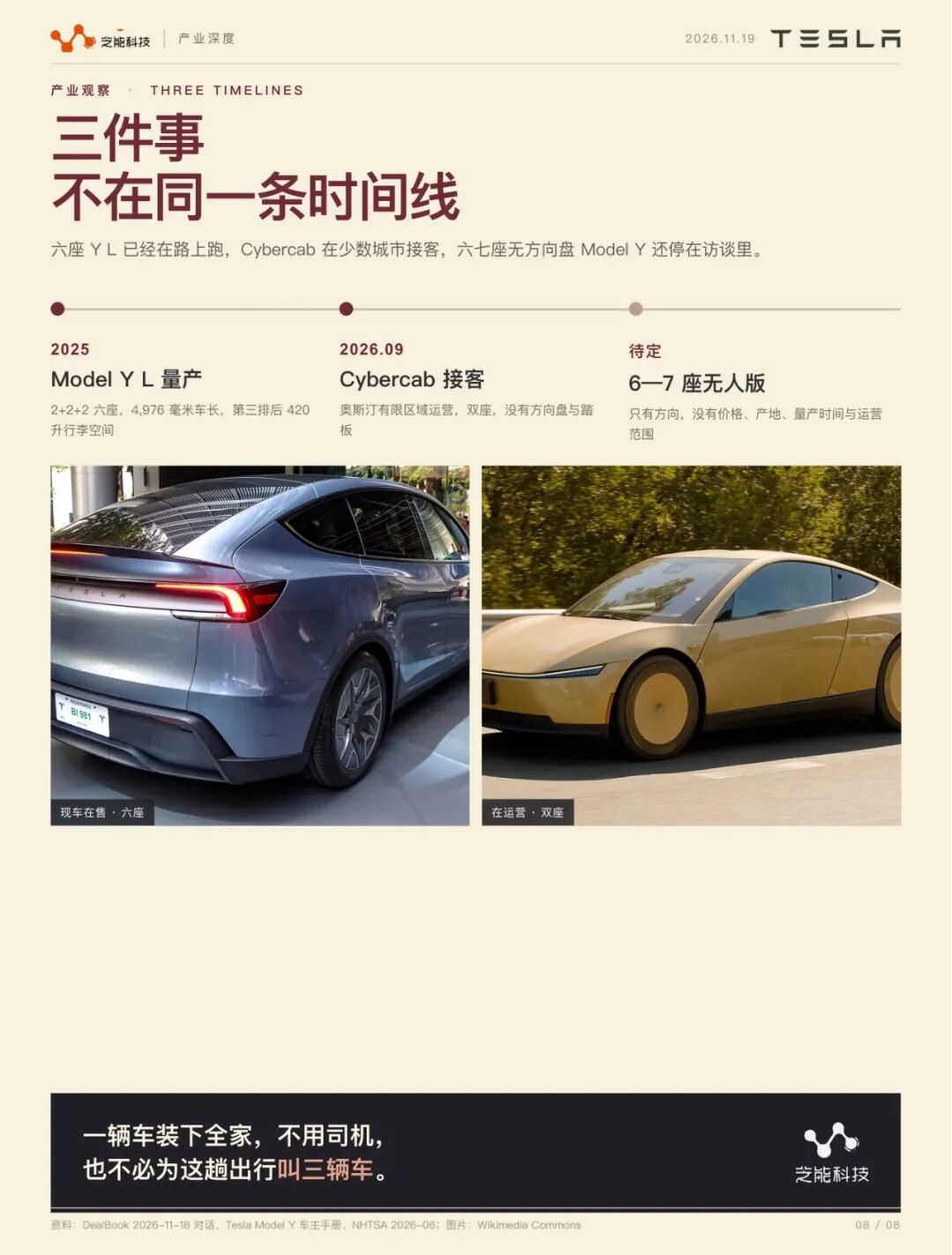
Summary
A Model Y without a steering wheel that can seat six or seven people is a radical product form. The two-seat car lowers the cost of solo travel, while the large car lets a family avoid being split into several vehicles.
-
![]()
Claude Goes Wild: The Overseas Mac mini Rental Craze Explained
-
![]()
Alibaba Forced to "Hold Back"
-
iCAR V25 Launches with Red Packet Pricing from 119,800 Yuan — Is This Extended-Range Box Car Really a Good Deal?
-
![]()
Boxy SUVs: Only 3 Models Top 10,000 Units in October, 52% Sell Fewer Than 1,000; Deepal G318 and Hongqi G919 Under 200 Units | Mingjing Pro
-
![]()
Google Opens Genie 4 to Eligible Users, Upgrading Real-Time World Generation
-
![]()
Volkswagen Group October China Retail: 145,000 Units — How Do Volkswagen, Audi, and Jetta Break Down?
-
![]()
Musk Wants to Build a Model Y Without a Steering Wheel: Robotaxi Expands from a Solo Car to a Family-Size Vehicle
-
![]()
Weipai Reports 7,886 Retail Units in October; Gaoshan PHEV Alone Accounts for 77.4%