NetEase Q3 Earnings: Pipeline Gap Syndrome Bites, With a New "Prescription" on the Way
 11/20 2026
 418
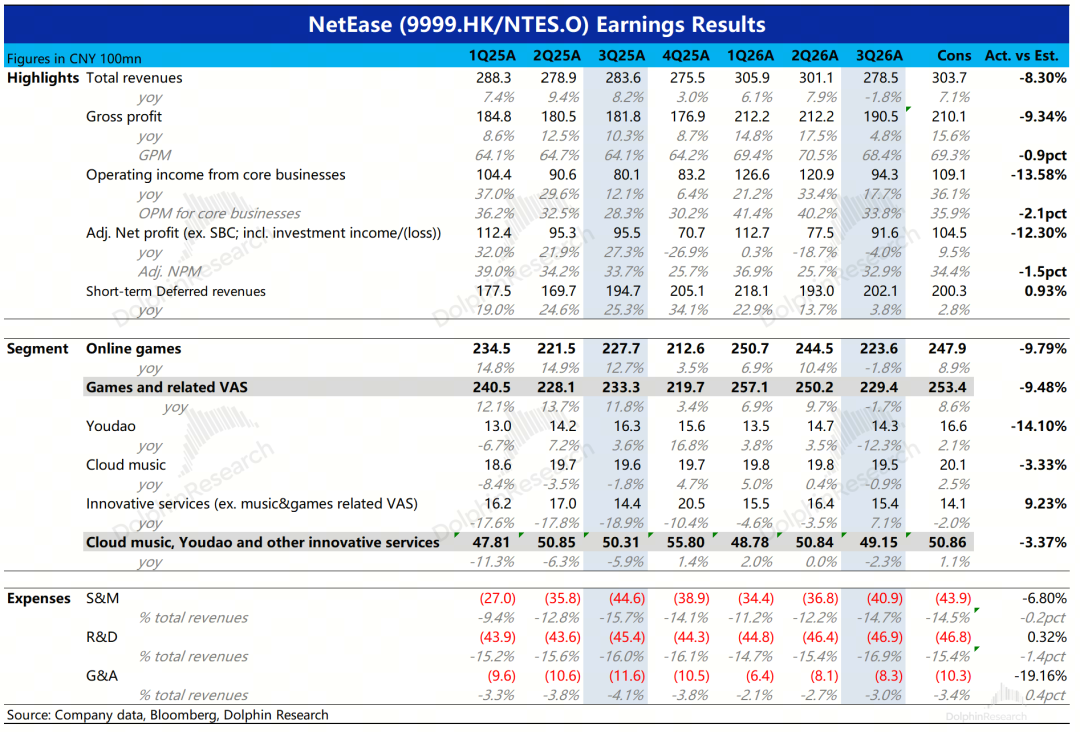
NetEase reported Q3 earnings after the Hong Kong market close on November 19 (Beijing time). The results were soft and clearly below expectations. The pipeline gap problem Dolphin Research flagged last quarter has only worsened in the second half, compounded by a deteriorating consumption environment and the risk that short-drama viewing time is eating into gaming time. Evergreen titles alone are struggling to hold the line.
Here's the breakdown:
1. Gaming revenue posts a rare decline; deferred revenue also underwhelming
Q3 total revenue came in at RMB 27.9 billion, down 1.8% YoY. Gaming revenue was RMB 22.4 billion, also down 1.8%—significantly below expectations.
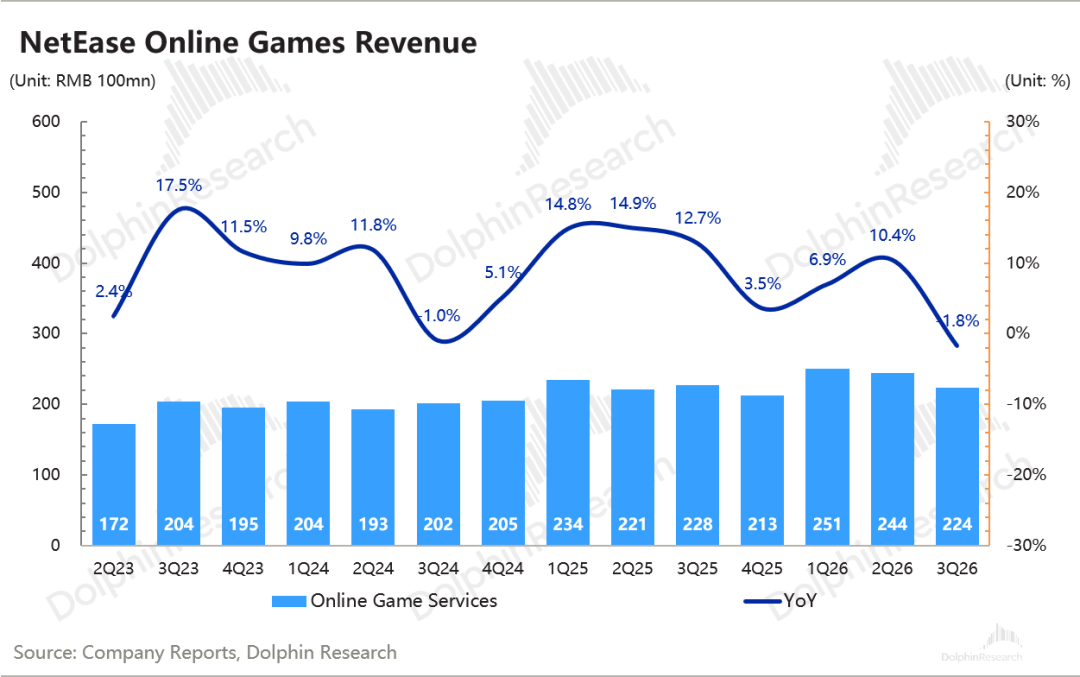
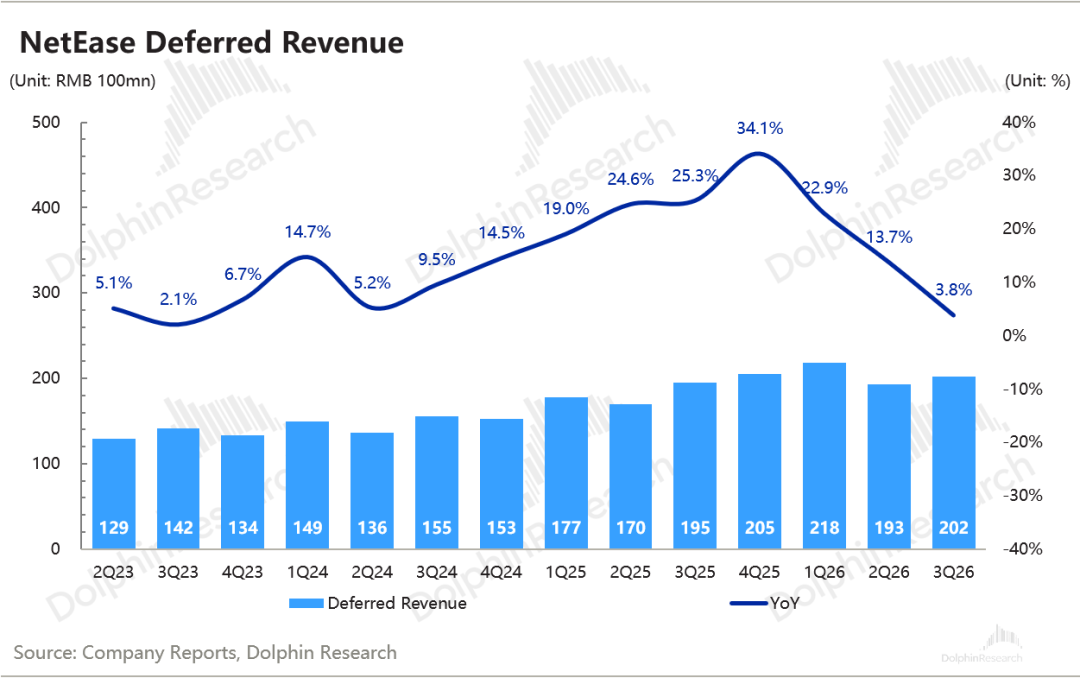
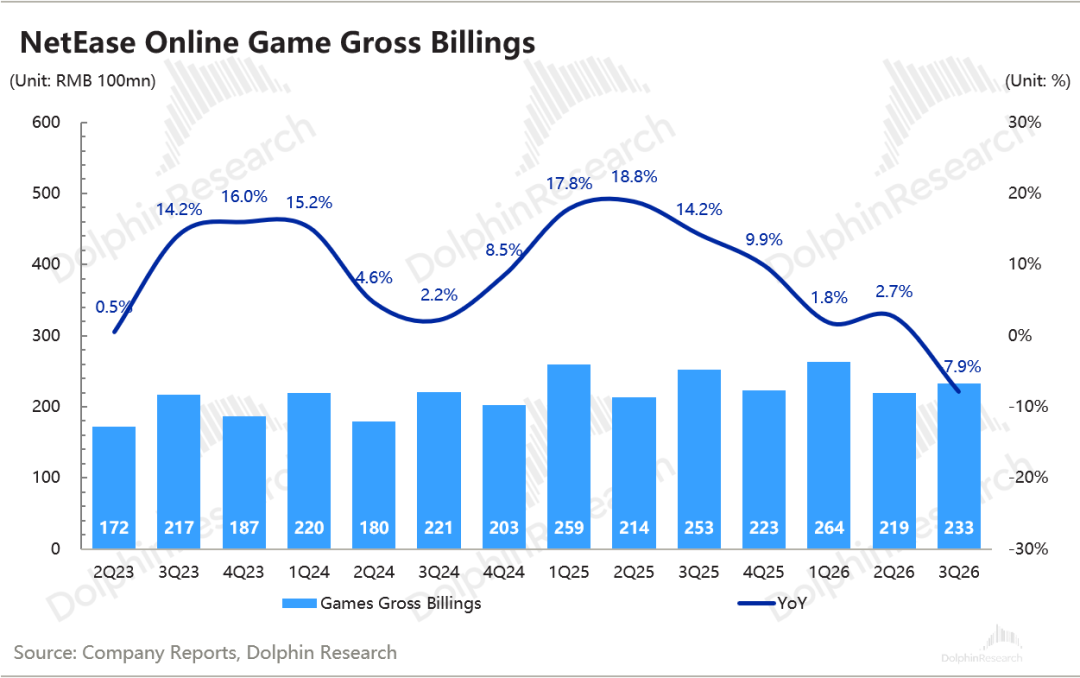
The weak Q3 top line wasn't a timing issue with deferred revenue recognition. Q3 deferred revenue grew just 4% QoQ; back-calculating, gross billings fell 8% YoY and rose 6% QoQ. Adjusted for seasonal swings, this is already NetEase's weakest "summer peak season effect" in nearly five years.
That said, Dolphin Research believes market expectations were themselves somewhat inflated. During the Q2 earnings period, "Sea of Oblivion" had already clearly missed, and Q3 had only one semi-new mobile title in the Fantasy Joy Edition. The gap-period pressure was only greater, not smaller. Yet the market still priced in high-single-digit revenue growth—a somewhat optimistic assumption.
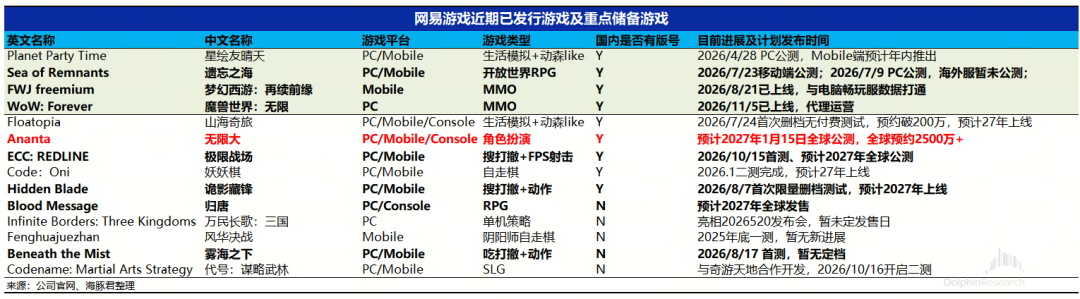
The one silver lining: the 2027 new product cycle is approaching fast, led by the company's great hope, "Infinity Big." Dolphin Research has assembled a preliminary pipeline list; we'll be watching the earnings call for any pipeline updates.
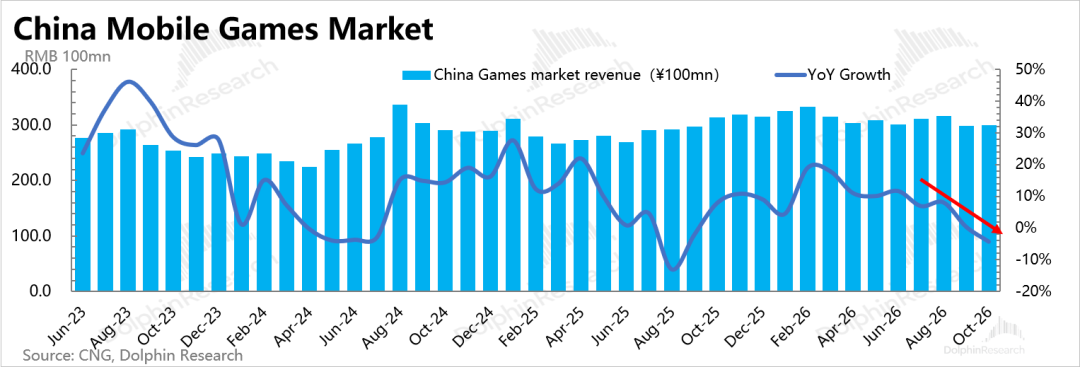
It's worth noting, however, that by comparing with peer Tencent and the broader gaming market, Dolphin Research found that gaming has been on a declining trend since the second half. While there is a high base effect at play, combined with short dramas exploding during the same period under the AI productivity revolution—both belonging to the broader pan-entertainment content space—it's hard to rule out a cross-erosion effect between the two.
Beyond that, there's the further deterioration of the macro consumption environment. Of course, gaming generally isn't that highly correlated with macro conditions—it's more tied to product supply cycles. But from a long-term perspective, if AI's impact on productivity further extends into the gaming industry, then under intense competition, the ultimate winners may still be evergreen games plus channel platforms.
2. Gaming stalls, and profits come under immediate pressure
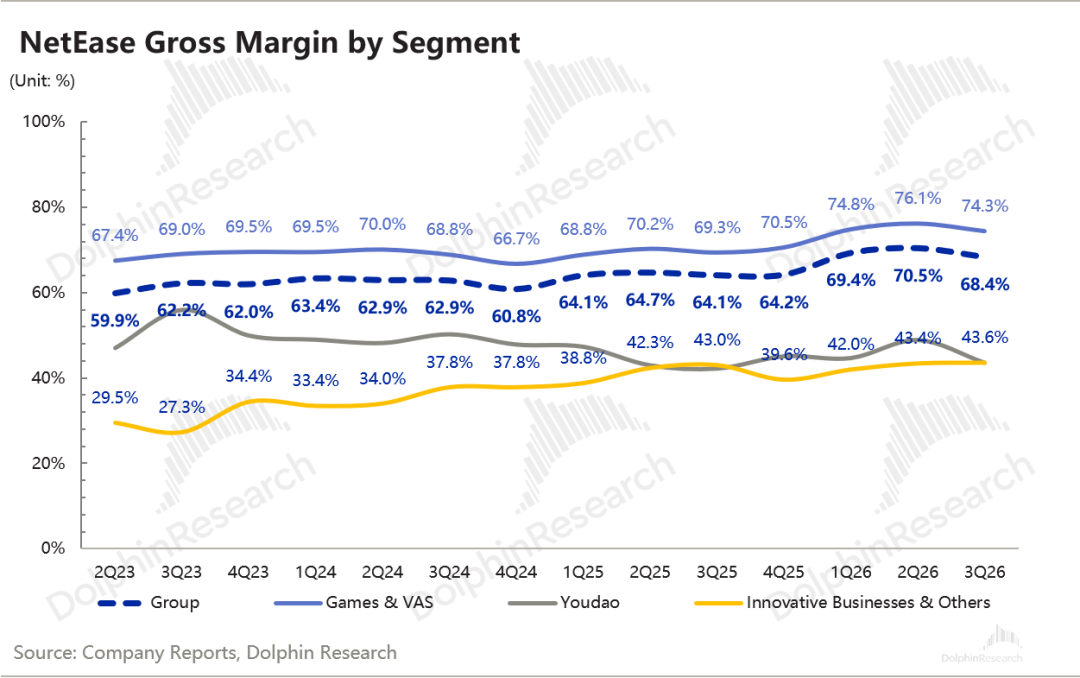
When the highly profitable gaming business falters, gross margin drops right away. Other businesses like Youdao and Cloud Music only drag down rather than lift up. Q3 gross margin fell 2 percentage points QoQ to 69%.
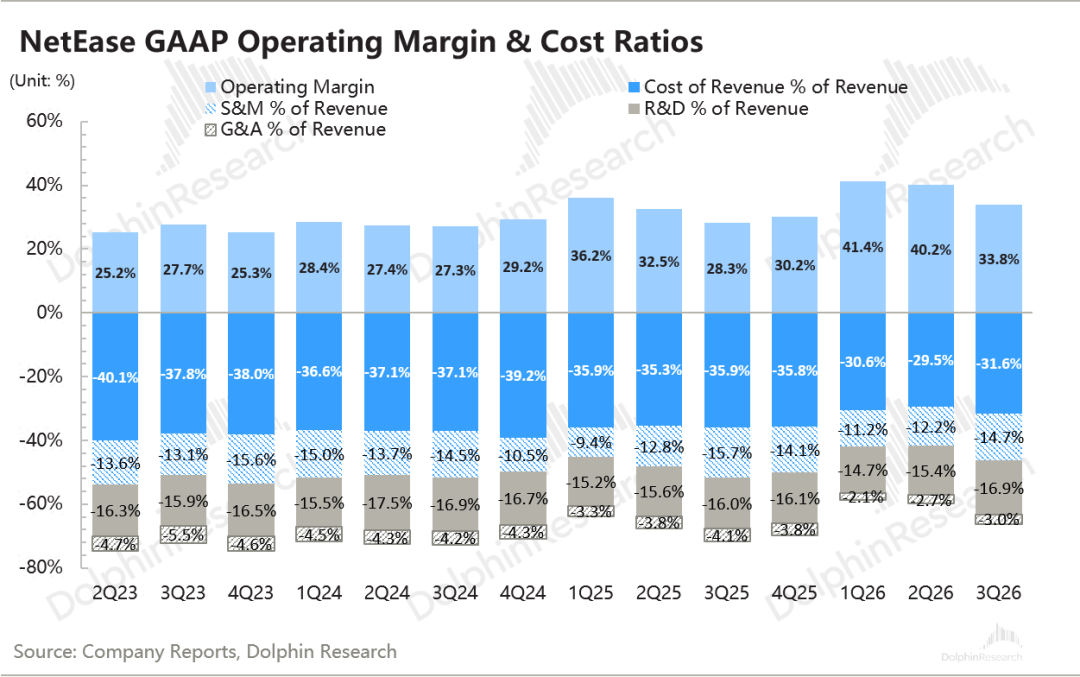
Operating expenses overall declined 5%, mainly due to declines in sales and management expenses (fewer new games meaning less marketing, and management/admin staff in a salary reduction cycle). Overall expense ratio was stable YoY and slightly higher QoQ.
3. Shareholder return value only shows up during adjustments
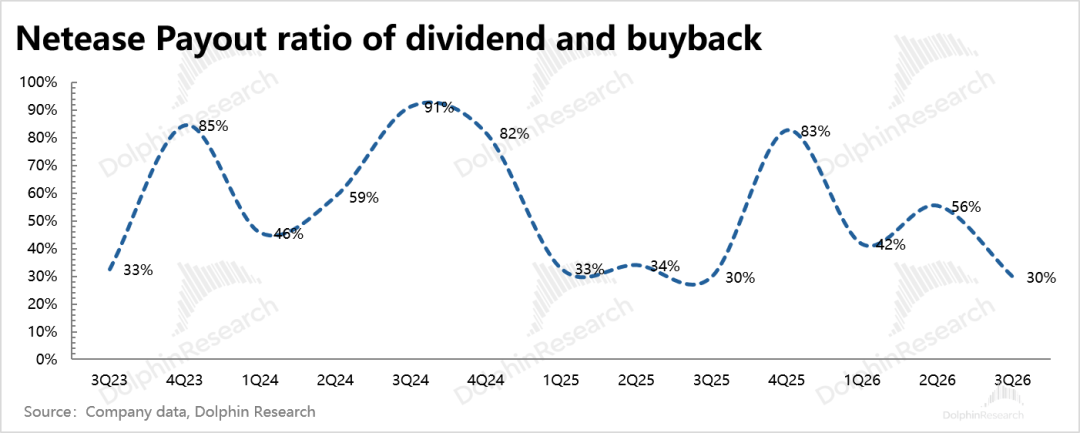
Q3 dividends increased, with a per-ADS dividend of $0.585, up 22% QoQ, maintaining a 30% payout ratio. However, there's usually a special dividend at year-end, which would bring the full-year payout ratio to 40%, translating to about RMB 14 billion ($2 billion) in dividends this year.
There were virtually no buybacks in Q3. NetEase generally does flexible buybacks based on market cap fluctuations. There's $2.7 billion in buyback capacity remaining before the January 2029 expiry. Spread linearly over the remaining time, that's less than $700 million annualized.
Dividends plus buybacks total $2.7 billion. At the current $75 billion market cap, shareholder return is under 4%—present but not much.
At the end of Q3, cash on the books was still RMB 175.2 billion (~$26.1 billion). Theoretically, sustained long-term buybacks are fully supportable. Single-quarter operating net inflow was still RMB 10.5 billion—the cash cow nature remains unchanged.
Dolphin Research's overall view
Last quarter, Dolphin Research mentioned concerns about gap-period pressure. Although we had confidence in evergreen games providing a floor, given the neutral valuation at the time, we still recommended waiting for adjustments for better odds of participation.
Looking at actual Q3 results beyond expectations, the pressure on gaming in Q3 was indeed significant. While evergreen games like "Egg Party" still performed somewhat, going too long without new games is still difficult. Evergreen can provide a floor but cannot guarantee growth.
This earnings miss will likely bring some adjustment. However, given the new product cycle and the "low AI investment" label, Dolphin Research believes the adjustment won't lack buyers:
(1) First, the 2027 new product cycle is arriving soon, led by the company's great hope, "Infinity Big." Therefore, we believe this short-term adjustment due to earnings, if significant, may attract funds willing to step in. However, approaching the mid-January launch of "Infinity Big," one should avoid the risk of "potential performance miss."
(2) Second, on the trading side, the stock has been relatively more resilient than Chinese peer stocks in the short term, mainly because some funds are eyeing NetEase's AI safe-haven label (NetEase invests less in AI, so short-term cash flow won't collapse), rather than purely betting on earnings fundamentals.
- END -
// Reprint permission
This article is original content by Dolphin Research. Authorization is required for reprinting.
// Disclaimer and general disclosure notice
This report is for general comprehensive data purposes only, intended for general reading and data reference by users of Dolphin Research and its affiliates. It does not consider the specific investment objectives, investment product preferences, risk tolerance, financial situation, and special needs of any person receiving this report. Investors must consult independent professional advisors before making investment decisions based on this report. Anyone making investment decisions based on the use or reference of content or information mentioned in this report bears their own risk. Dolphin Research shall not be liable for any direct or indirect liability or loss that may arise from the use of data contained in this report. The information and data contained in this report are based on publicly available materials and are for reference only. Dolphin Research strives for but does not guarantee the reliability, accuracy, and completeness of the relevant information and data.
The information mentioned or views expressed in this report shall not be construed or deemed as an offer to sell securities or a solicitation to buy or sell securities under any jurisdiction, nor does it constitute advice, inquiry, or recommendation regarding relevant securities or related financial instruments. The information, tools, and materials contained in this report are not intended or designed for distribution to citizens or residents of any jurisdiction where distribution, publication, provision, or use of such information, tools, and materials would violate applicable laws or regulations, or would cause Dolphin Research and/or its subsidiaries or affiliates to be subject to any registration or licensing requirements in that jurisdiction.
This report reflects only the personal views, opinions, and analytical methods of the relevant authors and does not represent the position of Dolphin Research and/or its affiliates.
This report is produced by Dolphin Research, and the copyright is solely owned by Dolphin Research. No institution or individual may, without prior written consent from Dolphin Research, (i) produce, copy, reproduce, duplicate, or forward in any form any copies or reproductions by any means, and/or (ii) directly or indirectly redistribute or transfer to other unauthorized persons. Dolphin Research reserves all related rights.
-
![]()
Tencent Can't Win on WorkBuddy Alone
-
![]()
NetEase Q3 Earnings: Pipeline Gap Syndrome Bites, With a New "Prescription" on the Way
-
![]()
DeepSeek's Quota Limits: Are Free Users Becoming the "Roadblock" to AGI?
-
![]()
Starting at 279,900 Yuan: A True Large Six-Seat Boxy SUV—Whose Nose Does the Titan 9's Price Rub in the Most?
-
Vertilite (Zonghui Xinguang) Files for IPO: The Revenue Gap Behind 900 Million Units Shipped—and What a 5 Billion Yuan New Business Could Add
-
![]()
Chinese Smart Driving Goes Global: Clearing Four Hurdles
-
![]()
Claude Goes Wild: The Overseas Mac mini Rental Craze Explained
-
![]()
Alibaba Forced to "Hold Back"