Tencent Can't Win on WorkBuddy Alone
 11/20 2026
 569

On November 18, the contest among internet giants turned into a genuine race against the clock.
At 7:57 p.m., three minutes before Tencent's Q3 earnings call was set to begin, Doubao Work made a high-profile announcement: its own DAU had topped 8 million, and its enterprise customer ARR (annualized recurring revenue) had surpassed 2 billion yuan.
For the past six months, Tencent WorkBuddy has held the lead among office AI products. The only wild card has been its commercialization progress, which Tencent has never disclosed.
Doubao Work's timing was unmistakable—a sniper's shot, timed to the minute.
Tencent wasted no time presenting its own scorecard. On the earnings call that followed, Tencent President Liu Chiping shared a set of figures: WorkBuddy's daily active users had exceeded 10 million, daily consumption had surpassed 100 trillion tokens, and revenue for the most recent seven days, annualized (ARR), had topped $500 million.
By that math, WorkBuddy's annualized average daily revenue comes to roughly $1.37 million—the equivalent of more than 9 million yuan.
The two companies may not be using the same statistical yardstick, but by ARR alone, Tencent has finally won a round in its AI contest with ByteDance.
The capital markets, however, were in no mood to celebrate. Tencent's stock fell 6 points by the next day's close.
Tencent's investment appeal has long rested on stable cash flow, hefty profits, and core businesses that keep growing. Now Tencent has a bigger dream—to drive a strategic shift toward AI and move beyond its familiar operating model. The capital markets, in turn, must re-examine the costs and returns of that transformation.
At this turning point in its strategic narrative, one WorkBuddy is not enough to ease outside unease.
Because Tencent's AI puzzle has yet to take shape.
01 Tencent Also Has to Pay Its AI Tuition
On the top line, Tencent delivered a Q3 report in which revenue growth slowed and net profit declined.
Revenue for the quarter came in at 207.3 billion yuan, up 8% year on year—the slowest single-quarter growth in nearly two years. Under Non-IFRS, net profit attributable to shareholders was 66.5 billion yuan, down 6% year on year; operating profit was 68.1 billion yuan, down 6% year on year.
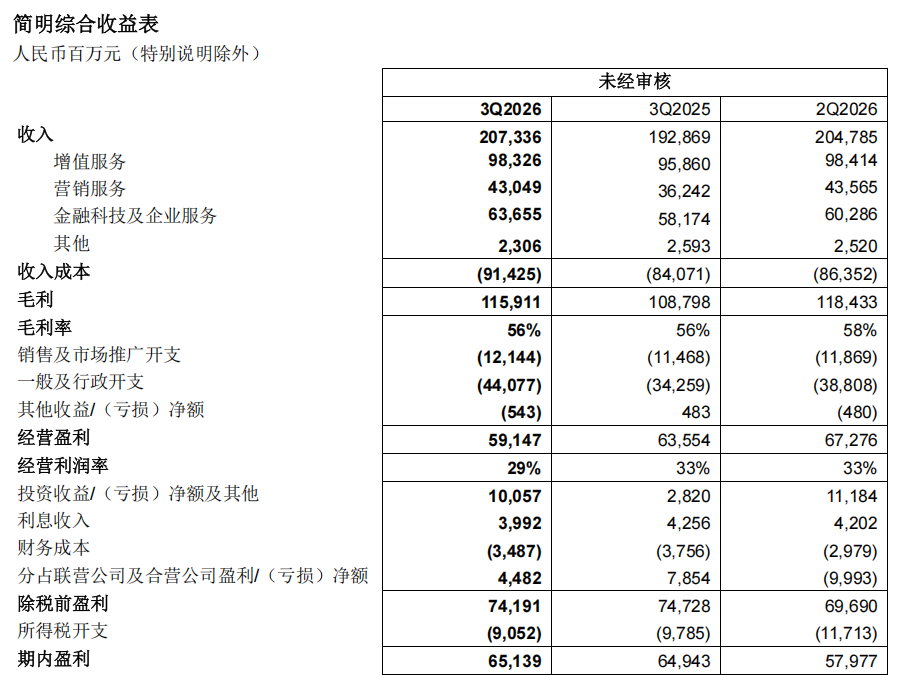
▲Source: Tencent 2026 Q3 financial report
AI investment is a major reason for the profit pressure. Tencent disclosed that excluding the impact of "new AI products," profit on that basis was 83.3 billion yuan, up 8% year on year.
At the same time, capital expenditure for the quarter reached 81.4 billion yuan, far exceeding the market expectation of 55.4 billion yuan.
Investors may be feeling conflicted: they used to worry Tencent wouldn't spend on AI; now they worry it will spend too much.
But on a longer timeline, the real turning point came in the first quarter of 2026: capex rose 63% quarter on quarter that quarter, then grew 65% and 54% in the two quarters that followed, climbing all the way from 31.9 billion yuan to 81.4 billion yuan.
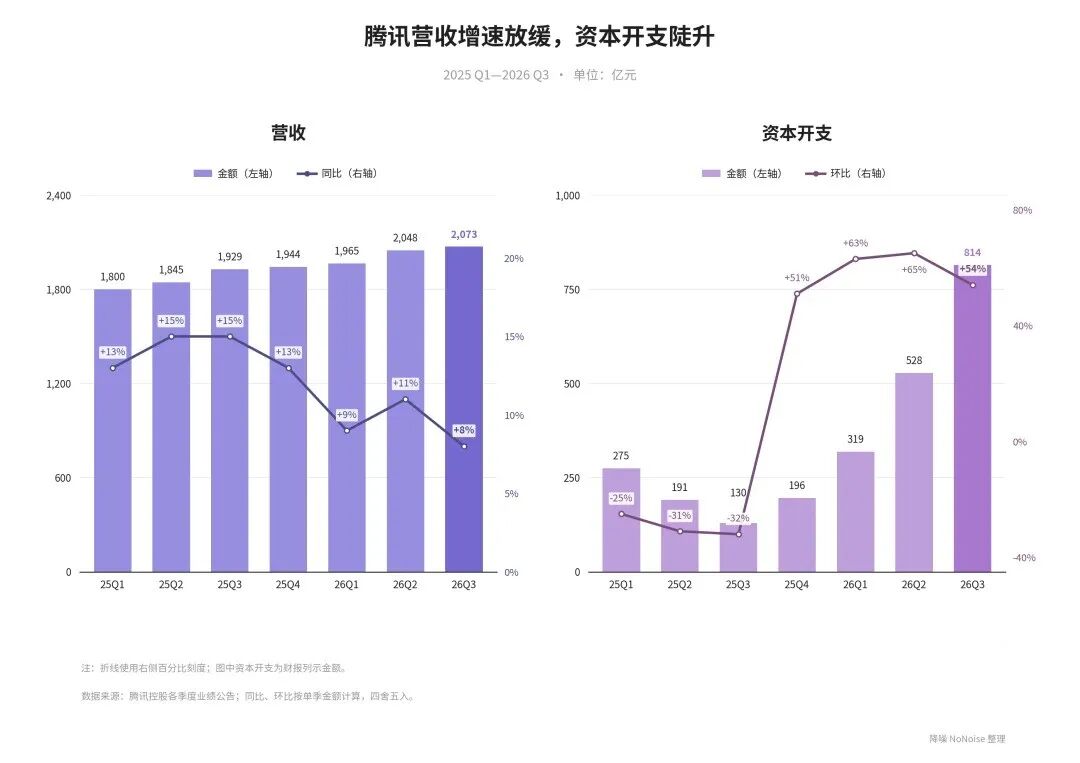
▲Tencent's revenue and expenditure trends
Behind this shift is a change in how Tencent does business.
For much of its history, Tencent was an internet company built around traffic and products. WeChat accumulated a massive user base, and gaming, advertising and marketing, and payments turned that scale and engagement into revenue.
With a mature product system and commercialization capabilities, Tencent could earn handsome profits under an asset-light model.
When AI first emerged, Tencent followed that familiar path for a while: embedding AI capabilities into existing businesses and boosting the money-making efficiency of the entire Tencent ecosystem through better ad recommendation, content distribution, and game development.
In the third quarter of 2025, Pony Ma said AI was already paying off in areas such as precise ad targeting, game user engagement, and programming and content production.
Compared with Alibaba's and ByteDance's aggressive AI investment, Tencent's posture was joked about by outsiders as "hold the fewest cards, make the most money." The strategy was not unreasonable: let AI serve mature businesses first, cash in on technology investment as quickly as possible, then look for new growth opportunities.
But the choice was controversial from the start. Supporters called it "pragmatic"; critics said Tencent lacked "dreams" in its top-level design.
In hindsight, the real problem is that, whatever the original intent, the pace of competition in AI left Tencent little time to stand by and watch.
AI disruption came too fast, and the competitive landscape shifted just as quickly. As Pony Ma put it recently at Tencent's 28th anniversary employee meeting, "the wave has already come crashing in."
AI is no longer a contest of a single technology or product.
Frost & Sullivan's latest "China Full-Stack AI Cloud Service Market Report 2026 H1" predicts that over the next three years the industry will move from a "resource race" to an "efficiency and ecosystem race." The key question is who can more efficiently convert chips, computing power, models, and ecosystems into intelligent productivity that enterprises can use directly.
Tencent's main competitors have already assembled new capability combinations around AI—
Alibaba has built a full-stack layout spanning self-developed chips, cloud services, model platforms, and applications, with Qwen on the consumer side and Qwen Office on the enterprise side. Frost & Sullivan data shows that in the first half of 2026, Alibaba Cloud held 42% of China's full-stack AI cloud service market. Alibaba Group CEO Eddie Wu has set a target for the cloud and AI businesses: annual revenue exceeding $100 billion within five years.
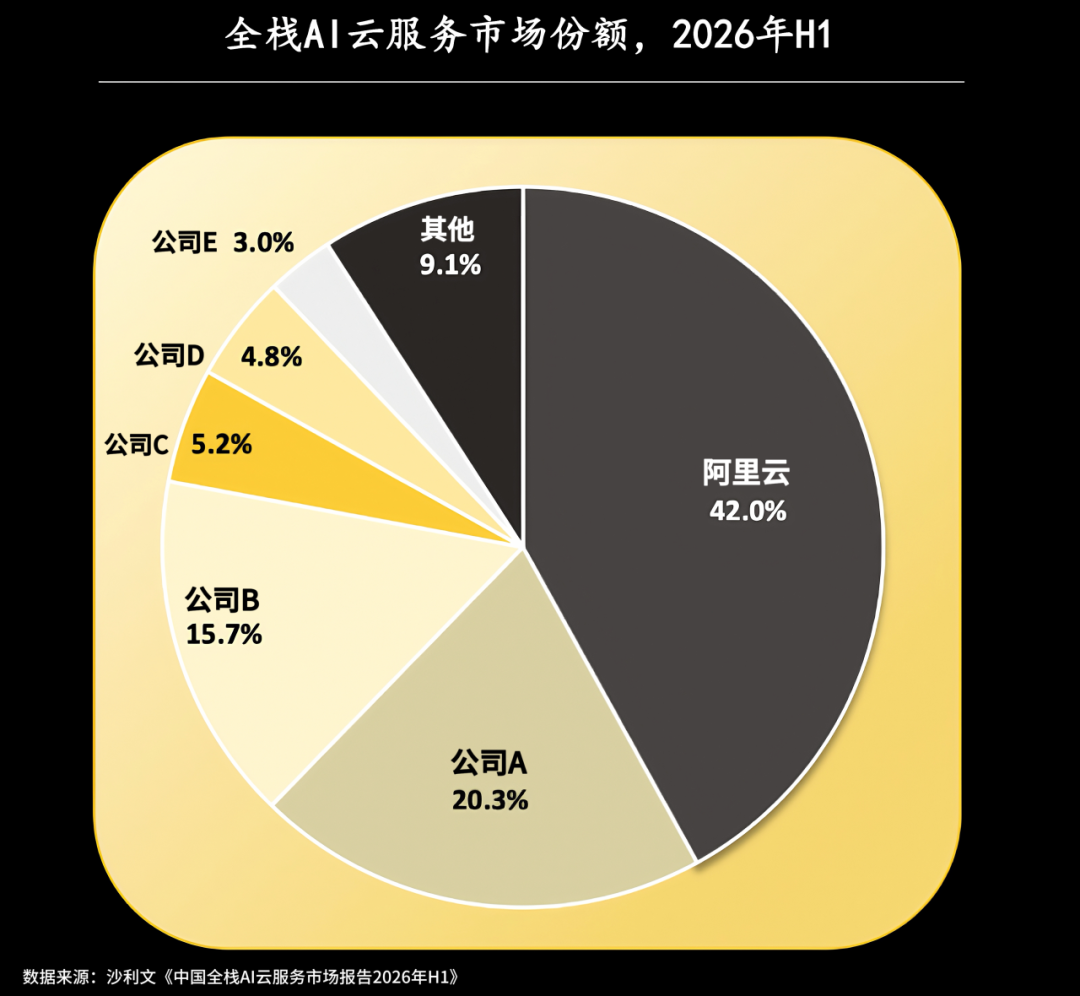
▲Source: Frost & Sullivan
ByteDance has likewise built a new AI-centered business ecosystem beyond Douyin. At the base sit the large language model Doubao, the multimodal video generation model Seedance, and the cloud and AI service platform Volcano Engine; on top are phenomenal consumer products such as Doubao and Hongguo AI short dramas, along with the enterprise application Doubao Work...
QuestMobile data shows that in August 2026, among China's top 50 apps by mobile internet usage time, ByteDance accounted for 41.8% and Tencent for 28.6%.
Bolting AI onto existing businesses is no longer enough to meet the competitive demands of the next stage.
It is therefore not hard to understand why the usually mild-mannered Pony Ma looked so grave at the anniversary event. He stressed to 110,000 Tencent employees that even core businesses that appear firmly established may still be overturned by the rapidly advancing AI wave—"this is a matter of life and death."
In other words, Tencent's dream at this stage must shift from "old trees sprouting new buds"-style AI empowerment to using AI to build a new Tencent.
That means moving from the asset-light operations Tencent knew so well to an asset-heavy playbook. The surge in capex that began in the first quarter, together with parallel organizational restructuring and product integration, are all implementations of the new strategic will.
Tencent has already begun paying its AI tuition.
02 One WorkBuddy Is Not Enough
In its second-quarter report this year, Tencent proposed for the first time that it would build a "brand-new, AI-empowered Tencent" across three levels: intelligence, applications, and infrastructure.
Of the three, the infrastructure layer can be bought, and the intelligence layer can advance on two legs—Hunyuan iteration and opening to the outside world. The application layer, however, can only be driven from within Tencent.
Across Tencent's AI application landscape, WorkBuddy is the first product to break out.
From its launch in March this year to the end of October, WorkBuddy went through 100 major version iterations in seven months and handled 9 billion task requests cumulatively.
On product strategy, WorkBuddy did not put all its chips on self-built models. In addition to Hunyuan, it supports third-party models such as Kimi and DeepSeek. After launching an open platform in September, WorkBuddy brought in outside developers and partners. More than 200,000 Skills are now listed on the platform, and the enterprise edition has been deployed in more than 50 industries.
On October 29, Tencent launched Buddy One, using WorkBuddy as a workbench to connect office products such as Tencent Docs, Tencent Meeting, and ima, and to support connections to enterprise internal systems and third-party agents.
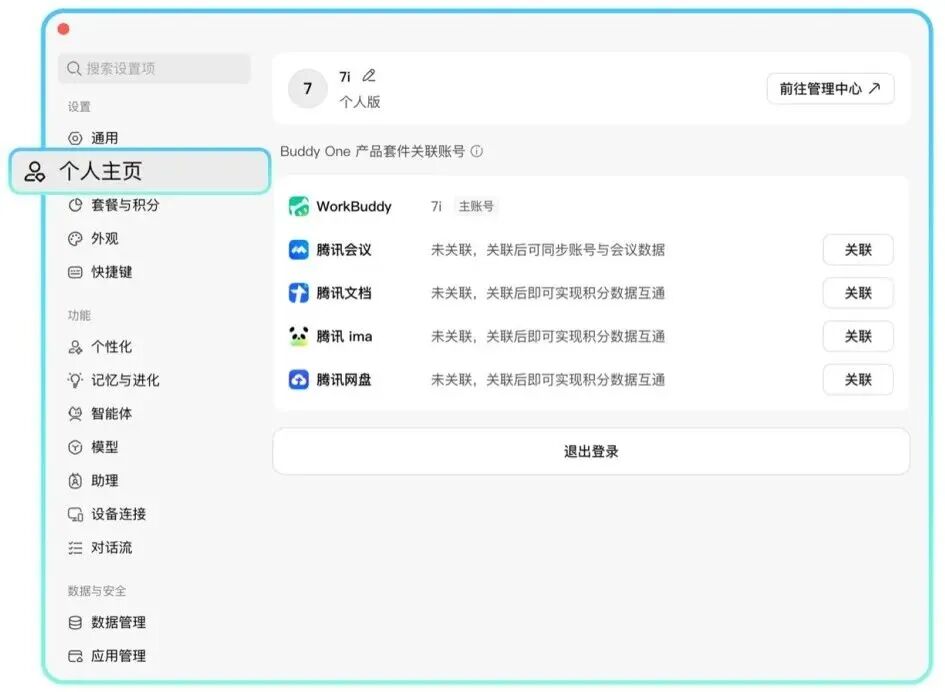
▲Buddy One connects multiple Tencent products
Clearly, Tencent is trying to make WorkBuddy a unified entry point for office tools and intelligent agents.
That entry point is still being integrated, though. A Tencent employee told "/NoNoise/" that Pony Ma requires every system to be able to connect and integrate with WorkBuddy. But unlike Feishu and DingTalk, which embed AI assistants directly in chat boxes, WeCom has its own AI assistant, "Dayuan." Once WorkBuddy is connected to WeCom, the two systems run in parallel. When sensitive information such as chat records is involved, the WeCom agent manages access permissions, and only after authorization is granted does it exchange information with WorkBuddy.
Of course, internal collaboration constraints can be set aside for now given WorkBuddy's impressive scorecard. Liu Chiping noted on the Q3 call that WorkBuddy's revenue in the quarter was more than five times that of the second quarter, and that 60% of China's top 100 enterprises are already customers.
At Tencent's 28th anniversary employee meeting, management called WorkBuddy the first AI-native product to break out. The thinking, as management framed it: Tencent should keep half its forces on the original battlefield—an army holding core businesses and using AI to improve efficiency—while the other half transforms into a navy, actively seeking new battlefields and exploring more AI-native businesses.
Tencent clearly needs more than one WorkBuddy. Judging by the current product lineup, WorkBuddy has cracked the enterprise office market, but in broader individual-user scenarios Tencent has yet to find a breakthrough.
On the consumer side, Yuanbao was once highly anticipated, but Liu Chiping acknowledged frankly that it fell short of Tencent's earlier expectations. Tencent no longer treats user-scale expansion as Yuanbao's main goal; it has shifted to improving product capabilities and substantially cut related investment.
By comparison, the WeChat intelligent agent "Xiaowei" has a shot at becoming the AI entry point connecting individual needs with WeChat's service ecosystem.
Xiaowei, which began gray-scale testing in June, is now connected to touchpoints in more than 30 scenarios, including WeChat Moments, Official Accounts, and Channels, with daily active users reaching 30 million. In the future it will further connect services such as Mini Programs and WeChat Stores, letting users complete tasks and transactions directly through AI.
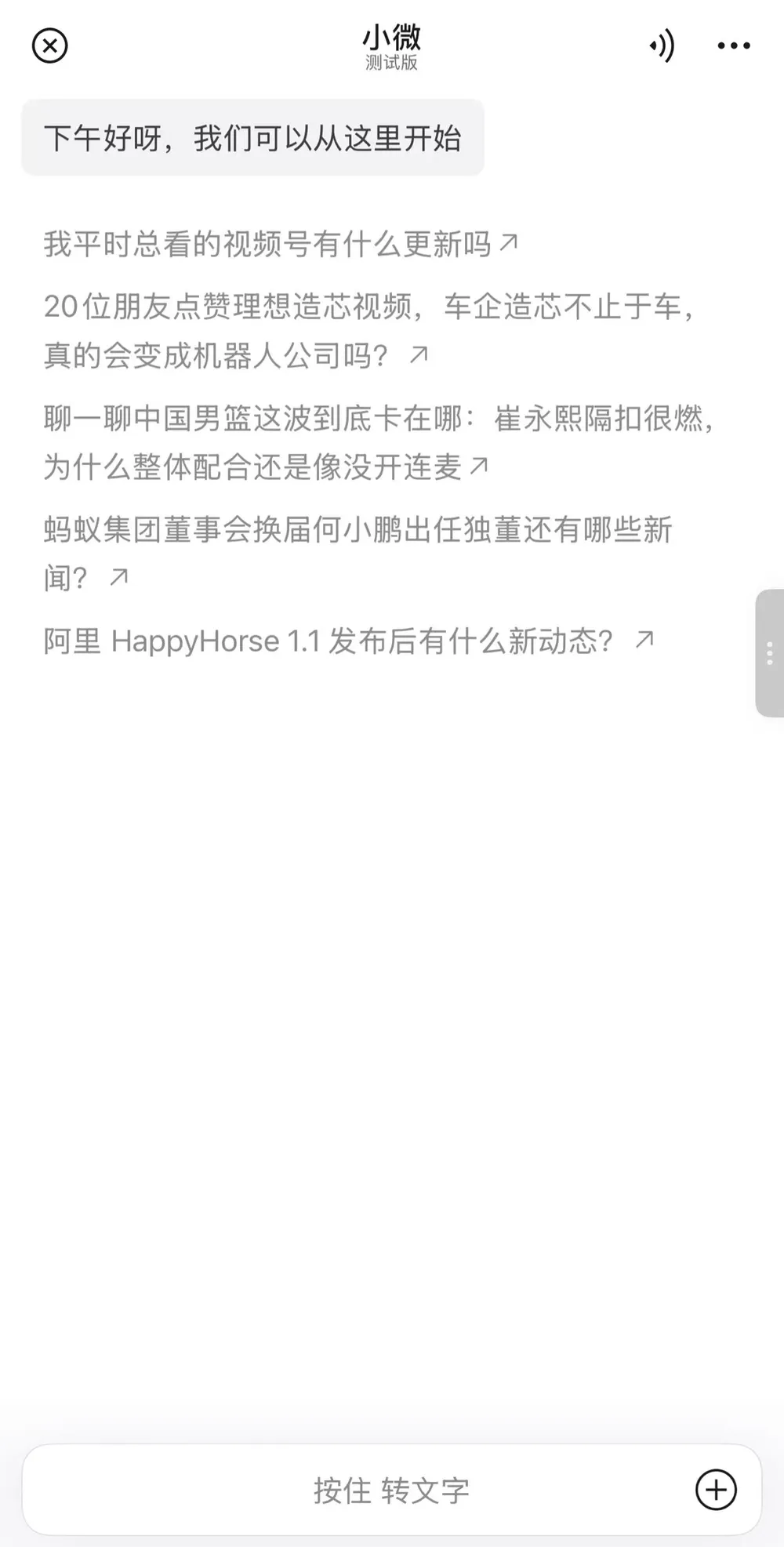
▲Screenshot of the Xiaowei beta
On the Q3 call, Tencent acknowledged that Xiaowei's capabilities currently lag behind the hugely popular AI assistant Muse. Management said this was intentional: facing more than a billion WeChat users, Xiaowei must prioritize controlling inference costs rather than single-mindedly chasing the strongest model capabilities.
Moreover, although the WeChat ecosystem holds resources such as social relationships, payments, and Mini Programs, Xiaowei cannot call on them at will. Connecting the interfaces and permissions of different businesses while safeguarding user privacy and security—so that AI can actually get things done for individual users—remains a hard problem.
That also explains why Pony Ma increasingly stresses AI-native. Tencent needs more products like WorkBuddy—ones that grow out of the new demands of the AI era and can generate revenue on their own.
The good news is that Tencent still has relatively ample funds and the rich mine that is the WeChat ecosystem. The bad news is that Tencent must also pay for its own late realization: having missed the time window, the supply of advanced AI computing resources is constrained. Management admitted that training the next-generation model will take longer.
That means Tencent must solve problems in technology, products, organization, and resource allocation all at once.
From a broader perspective, WorkBuddy at least proves that Tencent can create a product with market demand and commercialization potential in the AI era. The next step is to keep consolidating the three layers—intelligence, applications, and infrastructure—so that infrastructure, the Hunyuan model, the WeChat ecosystem, and various AI applications form synergies and gradually establish a new AI-driven growth model.
For Tencent, what is truly worth anticipating is not merely when the next WorkBuddy will emerge, but whether the company can discover a new entry point on the scale of WeChat in the AI era.
After all, a single product can run ahead, but it is a complete new ecosystem that determines the era ranking of a major corporation.
-
![]()
Tencent Can't Win on WorkBuddy Alone
-
![]()
NetEase Q3 Earnings: Pipeline Gap Syndrome Bites, With a New "Prescription" on the Way
-
![]()
DeepSeek's Quota Limits: Are Free Users Becoming the "Roadblock" to AGI?
-
![]()
Starting at 279,900 Yuan: A True Large Six-Seat Boxy SUV—Whose Nose Does the Titan 9's Price Rub in the Most?
-
Vertilite (Zonghui Xinguang) Files for IPO: The Revenue Gap Behind 900 Million Units Shipped—and What a 5 Billion Yuan New Business Could Add
-
![]()
Chinese Smart Driving Goes Global: Clearing Four Hurdles
-
![]()
Claude Goes Wild: The Overseas Mac mini Rental Craze Explained
-
![]()
Alibaba Forced to "Hold Back"