50,000 GPUs Face Lease Non-Renewal, $7.5 Billion for a Software Stack: The AI Computing Market Is Being Repriced
 11/27 2026
 468
Demand for AI computing power continues to grow, yet rental prices for some GPUs are falling.
According to SemiAnalysis, Anthropic plans not to renew its lease on roughly 50,000 NVIDIA H200 GPUs rented from SpaceX—equivalent to an estimated annual rent of about $2.2 billion at full utilization. Meanwhile, SpaceX has cut its spot rental quote for small-scale Blackwell (B200/B300) clusters from $15–15.5 per GPU-hour to $10–12, a drop of roughly 20%–35%. Following the news, the U.S. Neocloud sector sold off.
In a related development, Amazon plans to acquire the core technology stack and 100-person R&D team of AI startup Decart for about $7.5 billion. The deal's focus is not the large model itself, but software that can boost the operating efficiency of different chips.
On one side, expensive GPUs face falling rents; on the other, cloud giants are willing to spend heavily on software stacks. Both point to the same economic question: how much effective output and commercial return can already-invested computing assets actually generate?
1. Is the Earning Power of GPUs Declining?
Over the past three years, GPU supply has been tight, and large-model companies and cloud vendors first had to secure enough computing power in time. Neoclouds generated revenue by financing GPU purchases and signing long-term lease contracts. Supply falling short of demand propped up rental prices and strengthened market expectations for long-term returns on computing assets. Now, faster chip iteration and shifts in the supply structure are altering that expectation.
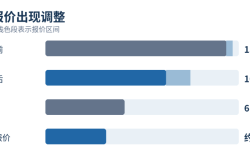
The roughly 50,000 H200 GPUs Anthropic plans to release in early 2027 still pack strong computing capability, but SpaceX's quote for re-renting this capacity is about $5 per GPU-hour—roughly 23% below the Ornn cloud rental index of $6.53.
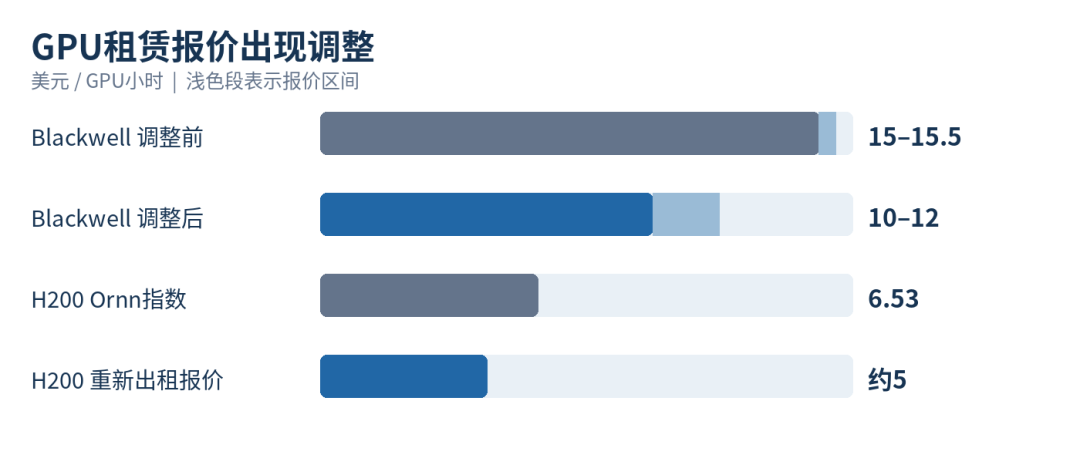
Figure 1: Comparison of GPU rental quotes (Source: SemiAnalysis, Ornn data)
A GPU's economic life may be shorter than its technical service life.
Equipment that isn't damaged isn't necessarily still earning what it once did. As new-generation computing platforms such as Blackwell, Vera Rubin, and cloud vendors' custom chips keep raising output per unit cost, large-model companies have incentives to reallocate computing budgets to cut model operating costs and improve gross margins. Previous-generation GPUs can still handle workloads suited to their performance and cost profile, but may no longer command the original rental premium. The AI market can expand overall even as some computing assets depreciate.
Long-term lease contracts also cannot fully eliminate operating risk. Some contracts may include non-cancellable periods and early-notice exit mechanisms. To assess Neoclouds' future revenue, one cannot look only at contract amounts and terms; one must also weigh specific constraints, customers' willingness to renew, and the generational competitiveness of the equipment.
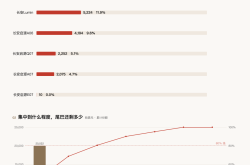
More noteworthy is revenue after the first contract expires. Estimates show that for CoreWeave alone, contracts covering more than 130,000 GPUs will expire in 2027, and about 170,000 in 2028. Expiration does not mean equipment will necessarily be returned, but if a large number of previous-generation GPUs hit the secondary leasing market at the same time while new-generation chips keep improving production efficiency, secondary rental prices may come under pressure.
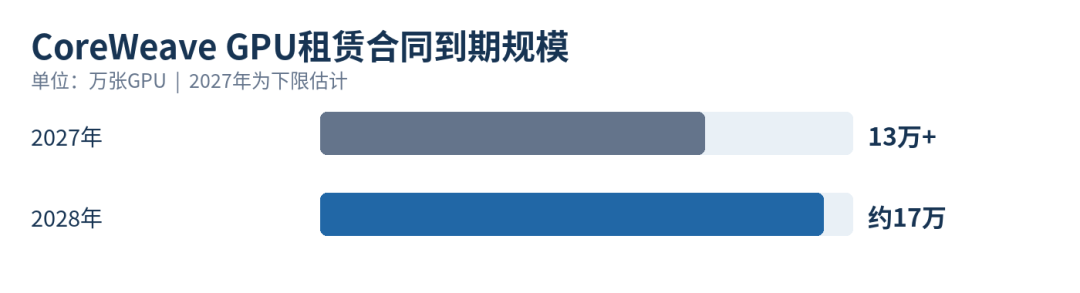
Figure 2: Scale of CoreWeave GPU lease contract expirations
Return on investment for computing assets requires full-lifecycle accounting: first-contract revenue, subsequent rental prices, actual utilization, power, cooling, and O&M costs, and final equipment residual value. For service providers that rely on debt financing to expand, these factors also affect debt-servicing capacity and subsequent procurement plans. The Bank of England's Financial Stability Report on November 26 also flagged potential risks arising from the deepening link between AI infrastructure investment and debt financing.
In the past, GPU scarcity supported high valuations of computing assets; in the future, the ability to generate revenue continuously will more closely determine the value of computing assets.
2. Cloud Giants Don't Lack Chips—So Why Spend $7.5 Billion on Software?
If pressure on GPU rents reflects changes in the profitability of hardware assets, Amazon's plan to acquire Decart's software stack and engineering team offers another perspective: how to increase the output of already-invested hardware assets.
Gartner data shows that in 2026, inference will account for 55% of AI cloud infrastructure spending, surpassing training for the first time. Compared with some training tasks that require high generality and flexibility, large-scale inference workloads with relatively stable computing patterns focus more on cost per token and power consumption, providing application space for custom AI chips. Bernstein's research report on November 25 estimates that the share of custom AI accelerators in the data center computing market will rise from about 10% in 2026 to 20% in 2027.
But the more diverse the chip supply, the higher the complexity of model adaptation and performance optimization. Data shows that Amazon's Trainium2 deployment has exceeded 1.4 million units, and the new-generation Trainium3 is also advancing; Google, OpenAI, and domestic companies such as Alibaba, Baidu, and Huawei are also developing custom or in-house computing platforms. When customers migrate models to different chips, they need to solve issues such as framework compatibility, operator adaptation, compilation optimization, and system coordination. If actual operating efficiency is insufficient, the theoretical performance and price advantages of chips will be difficult to translate into customer cost advantages.
Decart's core product, the Decart Optimization Stack (DOS), addresses exactly this problem by reducing migration difficulty and improving operating efficiency through compilers, operators, and hardware-software co-optimization. According to tests, Decart has achieved more than 80% model floating-point operations utilization (MFU) on Trainium3 and achieved about 2x cost efficiency compared with high-end GPUs in specific scenarios such as real-time video.
Why might this optimization capability have enormous commercial value? For cloud vendors that have already deployed hundreds of thousands or even millions of chips, even a certain percentage improvement in efficiency, scaled across the entire computing platform, may significantly improve investment returns.
It is estimated that, assuming hardware scale, comprehensive operating costs, statistical period, and service quality requirements remain unchanged, if software optimization increases effective token output by 20%, then the comprehensive production cost per token will fall to 1/1.2 of the original—a decline of about 16.7%. Clearly, the value of the software stack lies not only in enabling more chips to run AI models, but also in enabling the huge hardware assets already invested to generate more revenue.
3. The AI Computing Market Is Redefining Competitiveness
In the past few years, in a market environment where GPU supply fell short of demand, GPU procurement scale, computing power reserve scale, and long-term lease contract amounts became important indicators for measuring the competitiveness of cloud vendors, Neoclouds, and large-model companies. Now, with diversified chip supply, faster technology iteration, and growing inference demand, companies need to calculate a more complete economic account: with the same scale of investment, how many tokens meeting business requirements can be produced? What is the comprehensive cost per million tokens? How much revenue can a computing system generate over its entire lifecycle?
The actual production efficiency of AI infrastructure does not depend entirely on the peak performance of chips. From chips, memory, network interconnection to storage, from model adaptation, operator optimization to inference frameworks, resource scheduling, and cluster O&M—bottlenecks in any link may prevent expensive computing resources from fully delivering their efficacy. Especially in large-scale clusters, issues such as communication efficiency, equipment failures, and load imbalance will all affect actual effective output.
This also provides a new perspective for understanding the technology strategies of NVIDIA and cloud vendors. NVIDIA continues to strengthen NVLink high-speed interconnection, Spectrum-X networking, rack-scale architecture, and the CUDA software ecosystem, and expands model deployment capabilities through NIM inference microservices and industry acceleration libraries. In the face of evolving workloads such as agent long-context inference and multimodal world models, generality and system coordination remain important. Cloud vendors, meanwhile, reduce the operating costs of specific workloads through custom chips and software stack optimization.
Each company has a different technology path, but the common goal is to improve the actual output efficiency of computing systems.
SemiAnalysis's forecast that global AI accelerator capital expenditure in 2028 will be revised down by about 28% also suggests that the market needs to pay more attention to investment returns. However, forecast adjustments are not equivalent to an actual decline in demand, nor can they be used to judge that the entire computing market is oversupplied.
But this change will further affect the competitive logic of all links in the AI infrastructure industry chain.
For chip vendors, competition lies not only in peak computing power, but also in performance, cost, energy efficiency, and software ecosystem maturity when running actual models.
For server vendors, competition lies not only in hardware integration and large-scale delivery, but also in multi-chip adaptation, system architecture design, and hardware-software co-optimization—translating chip performance into actual token production capacity.
For computing service providers, competition lies not only in how many GPUs they own, but also in matching different generations of computing power with business workloads, improving equipment utilization, reducing operating costs, and improving the full-lifecycle returns of computing assets.
For large-model companies and AI application companies, computing procurement will focus more on the cost of obtaining tokens that meet business needs, as well as service speed, stability, and continuous supply capability.
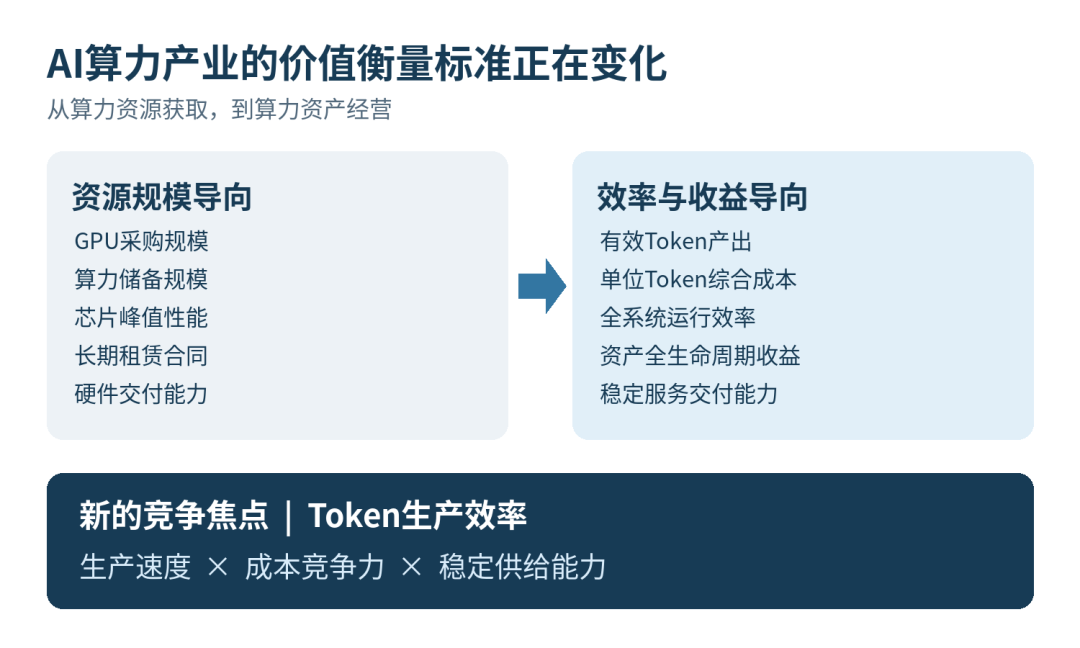
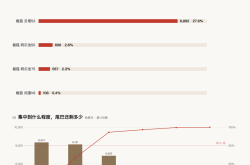
Figure 3: Changes in value measurement standards of the AI computing industry
Conclusion: From Owning Computing Power to Operating It
In the past few years, competition in the AI computing market has largely revolved around who can obtain more computing power. As AI applications scale up, chips iterate rapidly, and pressure on infrastructure investment returns rises, how to operate these expensive computing assets well is becoming a new challenge for the industry.
The revaluation of GPU asset value and the rise in software stack value are backed by the same economic logic: the commercial value of computing power ultimately depends on how much effective output it can create.
How much computing power one owns is still important, but how to convert computing power into tokens that meet business needs faster, more stably, and at lower cost is becoming the key to determining the return on AI infrastructure investment and commercial competitiveness.
-
![]()
50,000 GPUs Face Lease Non-Renewal, $7.5 Billion for a Software Stack: The AI Computing Market Is Being Repriced
-
![]()
Changan Qiyuan Sells 43,882 Vehicles Domestically in October, with Q-Series Models Accounting for 69%
-
![]()
JIYU Reports 24,741 Domestic Sales in October, With Two Beta Models and Alpha T7 Accounting for 95%
-
![]()
Geely and Zeekr Patented a Fishing System for Cars—Using Air Suspension to Control Casting, and Five Automakers Are Exploring It
-
![]()
Titan Hu Robot Launches Lite-1 Series Lightweight Joint Module, Opening Up New Design Space for Mass Production of Humanoid Robots
-
![]()
$55 Billion! Liang Wenfeng Becomes the World's Richest Large-Model Developer
-
![]()
Anthropic IPO Watch: A $1.5 Trillion Valuation and a Pricing Experiment in the AI Capital Era
-
![]()
What Are the Benefits of Becoming a DeepSeek Shareholder? | Juchao