Geely and Zeekr Patented a Fishing System for Cars—Using Air Suspension to Control Casting, and Five Automakers Are Exploring It
 11/27 2026
 423
Produced by Zhineng Technology
The car pulls up by the river. The infotainment system picks a fishing spot. The suspension tilts the vehicle body to an angle. The fishing gear extends from the vehicle body, and after a fish bites, the car reels in the line on its own.
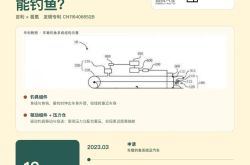
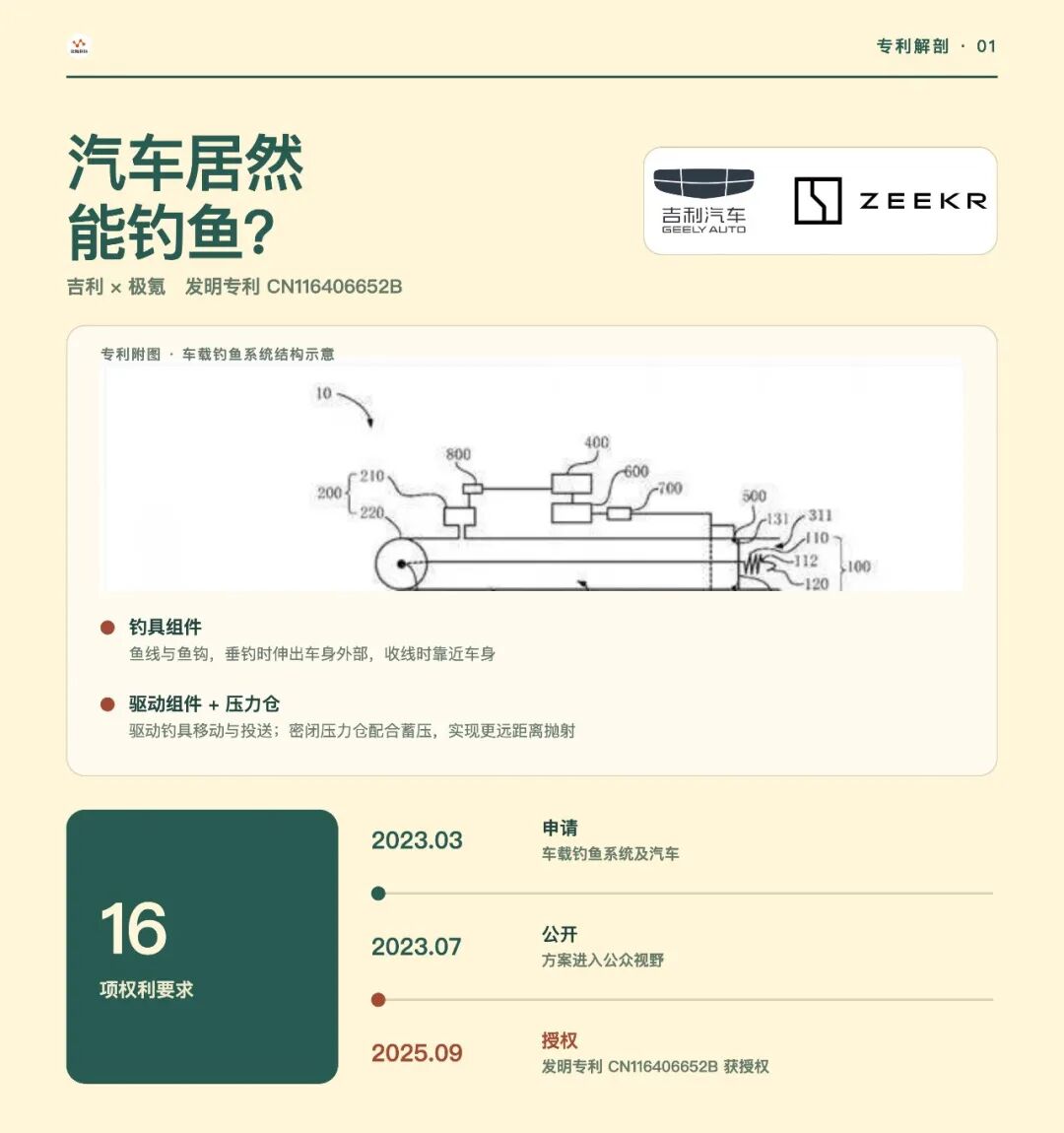
Geely and Zeekr actually wrote this entire process into a patent. "In-Car Fishing System and Automobile" was filed on March 10, 2023, published on July 11 of the same year, and granted on September 5, 2025, under patent number CN116406652B.
What is interesting is who wrote the patent. They are automotive engineers, and the tools at their disposal are cameras, millimeter-wave radar, air suspension, and electronic controllers—components that normally each handle their own tasks: sensing road conditions, adjusting comfort, and controlling the vehicle body.
This patent connects them into a single line, letting a car that can perceive, make decisions, and execute conveniently do the work previously done by dedicated fishing gear.
How the patent moves fishing gear onto the car
Traditional fishing rods take up space in the trunk and still need to be assembled before use. This patent places the fishing gear between the vehicle body structure and the interior—either in the door or trunk area—with a dedicated pressure chamber on the vehicle, equipped with fishing line, fishhook, float, and a line-retrieval mechanism.
Casting follows a pneumatic approach, and the control system determines the action based on target distance and the surrounding environment.
The pressure chamber provides power, the magnetic positioning mechanism handles fixing and releasing the float, and obstacle detection stops casting when conditions are unsuitable. The human motion of swinging a rod is broken down into a series of machine steps. The machine follows the steps.
The chassis is the most unexpected part of this patent. Claim 16 states that changing the heights of several suspensions can adjust the casting direction of the fishing gear. The suspension actuators originally used to adjust ground clearance, handle rough roads, and improve ride comfort become the components that control the casting angle here.
What a car can do depends on the actuators, control software, mechanical travel, and the vehicle's overall safety boundaries—all of which are listed in these patents.

The car also has to find fish by itself. The environmental information listed in the patent includes water body type, depth, color, flow speed, wind speed, and temperature, and it also considers using historical fish activity to recommend fishing spots.
Cameras observe shoreline terrain, the water surface, and obstacles. When the water surface texture moves, flow speed can also be estimated.
Millimeter-wave radar supplements distance and the positions of surrounding objects. This information forms a chain of data input, target selection, and action execution.
After a fish bites, the next step is playing the fish. A sensing element is installed on the hook, and information is transmitted back along the communication path in the fishing line. A tension sensor monitors the force on the line, and the electric line-retrieval device adjusts its action based on feedback.
The vehicle body also sways gently to simulate manual line control by a person. Sensing the line status, estimating force, determining retraction and release strategy, and having the actuator act follow the same pattern as the vehicle's control system, continuously correcting through feedback.
More than one company is thinking about fishing
Zeekr is not the only automaker thinking about fishing. A rather lively timeline can be seen in the patents.
◎ Jidu applied for an in-car fishing system in 2021, CN114097738A.
◎ Dongfeng connected a fishing device to the door window lift motor in 2022, CN115211411B.
◎ JAC made an in-car automatic fishing control system the same year, CN115624015A.
◎ Geely and Zeekr took another step in 2023 in pneumatic delivery and whole-vehicle coordination, and in the same year also published a solution for in-car drone-assisted fishing, CN117136916A.
◎ BYD applied in 2024 for a solution using a mechanical mechanism to drive the fishing rod, CN118266443A, and obtained authorization on April 3, 2026.
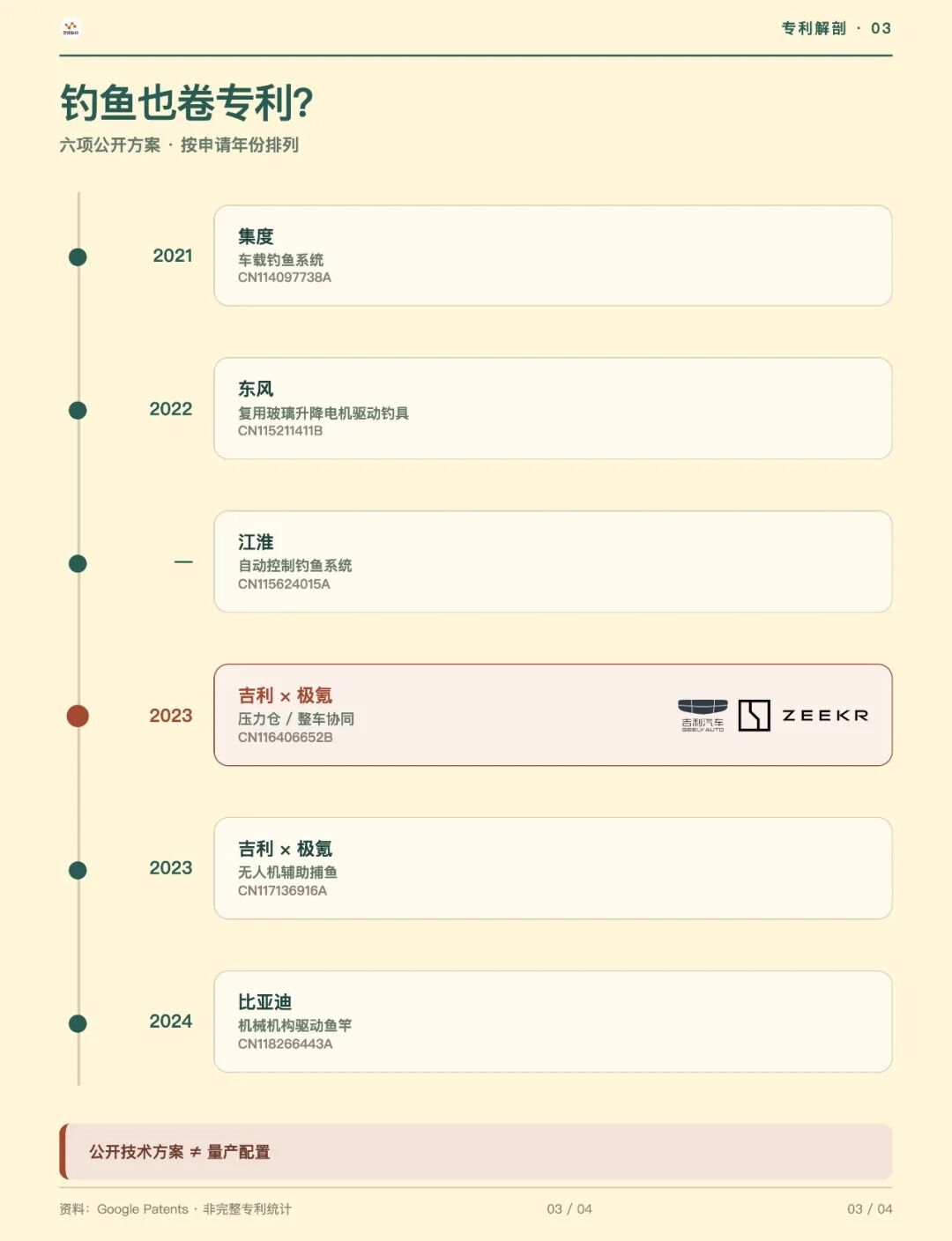
The routes taken by these companies differ. Some reuse existing motors on the car to add fewer components; some create a dedicated mechanical device to let the fishing rod move by itself; Zeekr's route brings whole-vehicle perception and the chassis into coordination. Drone fishing is another scenario. It goes its own way alongside leisurely riverside angling.
Why automakers have set their sights on fishing becomes clear by looking at what EVs are doing while parked.
External discharge, parking air conditioning, camping lighting, in-car refrigerators, and large-screen entertainment. The battery, thermal management system, computing platform, and actuators can also contribute while parked. Fishing is the most imaginative of these scenarios. It is simply the most fun.
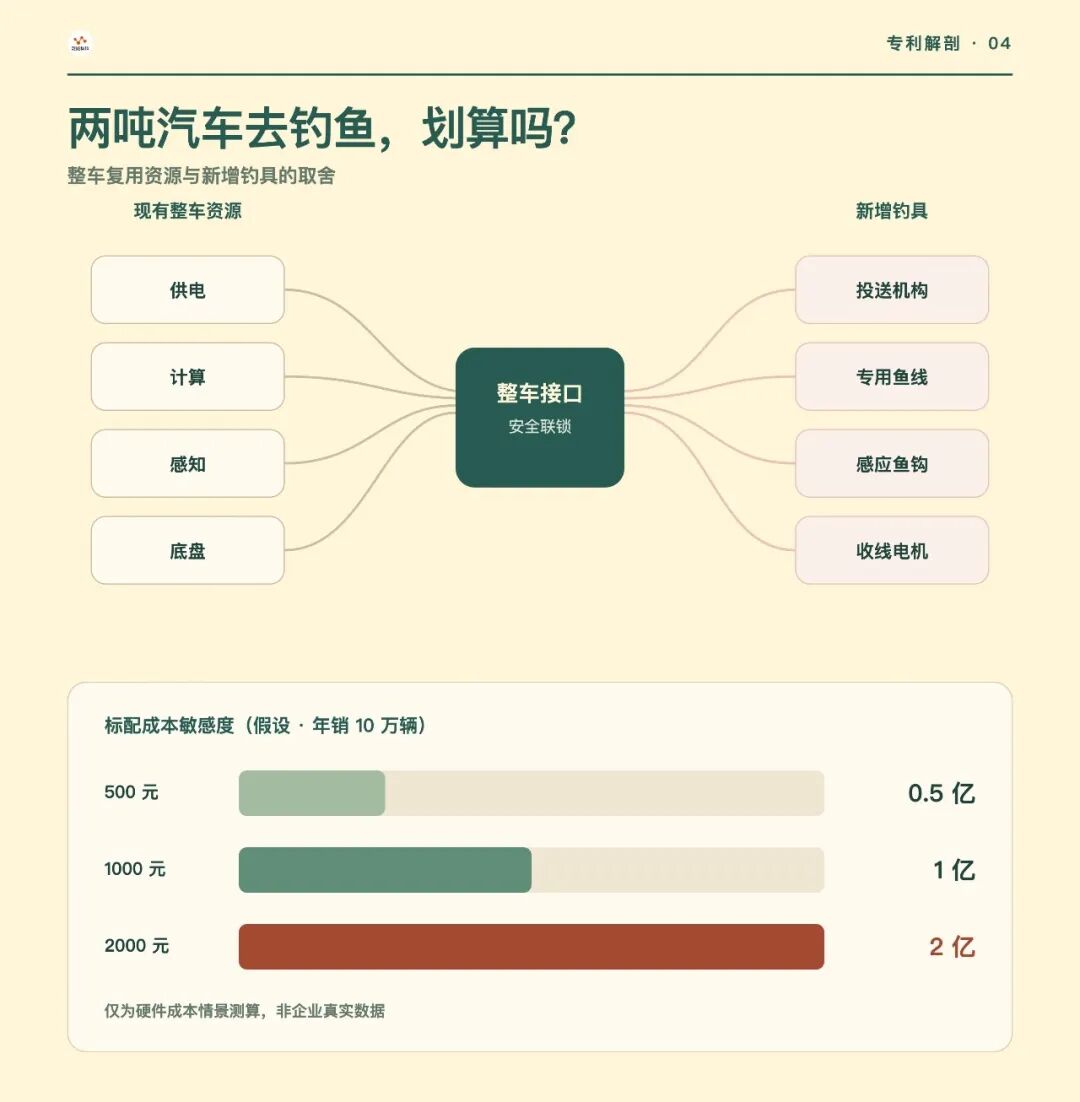
The money issue also has to be calculated. If this equipment is made standard across the entire lineup of high-end cars, owners who do not fish will pay for it all the same.
Calculated at an added cost of 1,000 yuan and annual sales of 100,000 vehicles, hardware alone would be 100 million yuan, without yet adding R&D, logistics, and after-sales.
A more marketable approach is to make it a detachable accessory. Automakers provide power supply, status display, communication, and safety interlocking, and do a good job integrating the interface and the whole vehicle. The mechanical part is left to professional fishing gear manufacturers, and users buy it if they want it.
Conclusion
Engineers have already broken down every fishing action and assigned it to the car: spot selection to algorithms, casting to the pressure chamber, direction to the suspension, and line retrieval to the tension sensor. Looking at this blueprint alone, the car has already changed from a means of transportation into an intelligent device with a thinking fishing rod integrated into it. Anglers are in luck.
Sources: Geely/Zeekr CN116406652B, CN116406652A; Jidu CN114097738A; Dongfeng CN115211411B; JAC CN115624015A; Geely/Zeekr CN117136916A; BYD CN118266443A.
-
![]()
50,000 GPUs Face Lease Non-Renewal, $7.5 Billion for a Software Stack: The AI Computing Market Is Being Repriced
-
![]()
Changan Qiyuan Sells 43,882 Vehicles Domestically in October, with Q-Series Models Accounting for 69%
-
![]()
JIYU Reports 24,741 Domestic Sales in October, With Two Beta Models and Alpha T7 Accounting for 95%
-
![]()
Geely and Zeekr Patented a Fishing System for Cars—Using Air Suspension to Control Casting, and Five Automakers Are Exploring It
-
![]()
Titan Hu Robot Launches Lite-1 Series Lightweight Joint Module, Opening Up New Design Space for Mass Production of Humanoid Robots
-
![]()
$55 Billion! Liang Wenfeng Becomes the World's Richest Large-Model Developer
-
![]()
Anthropic IPO Watch: A $1.5 Trillion Valuation and a Pricing Experiment in the AI Capital Era
-
![]()
What Are the Benefits of Becoming a DeepSeek Shareholder? | Juchao