What Are the Benefits of Becoming a DeepSeek Shareholder? | Juchao
 11/27 2026
 445
Editor | Yang Xuran
CATL and Geely crossed paths on DeepSeek's investor list.
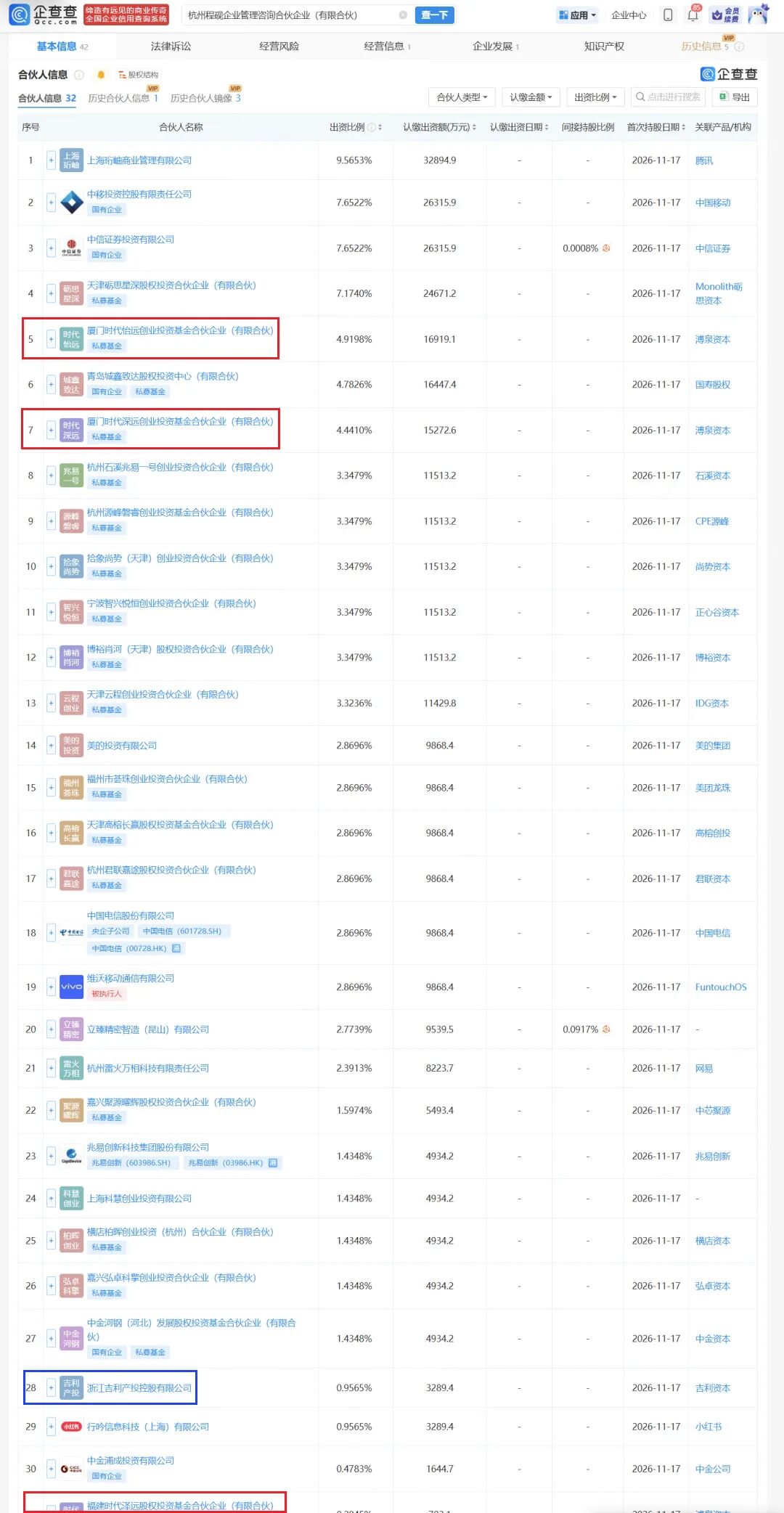
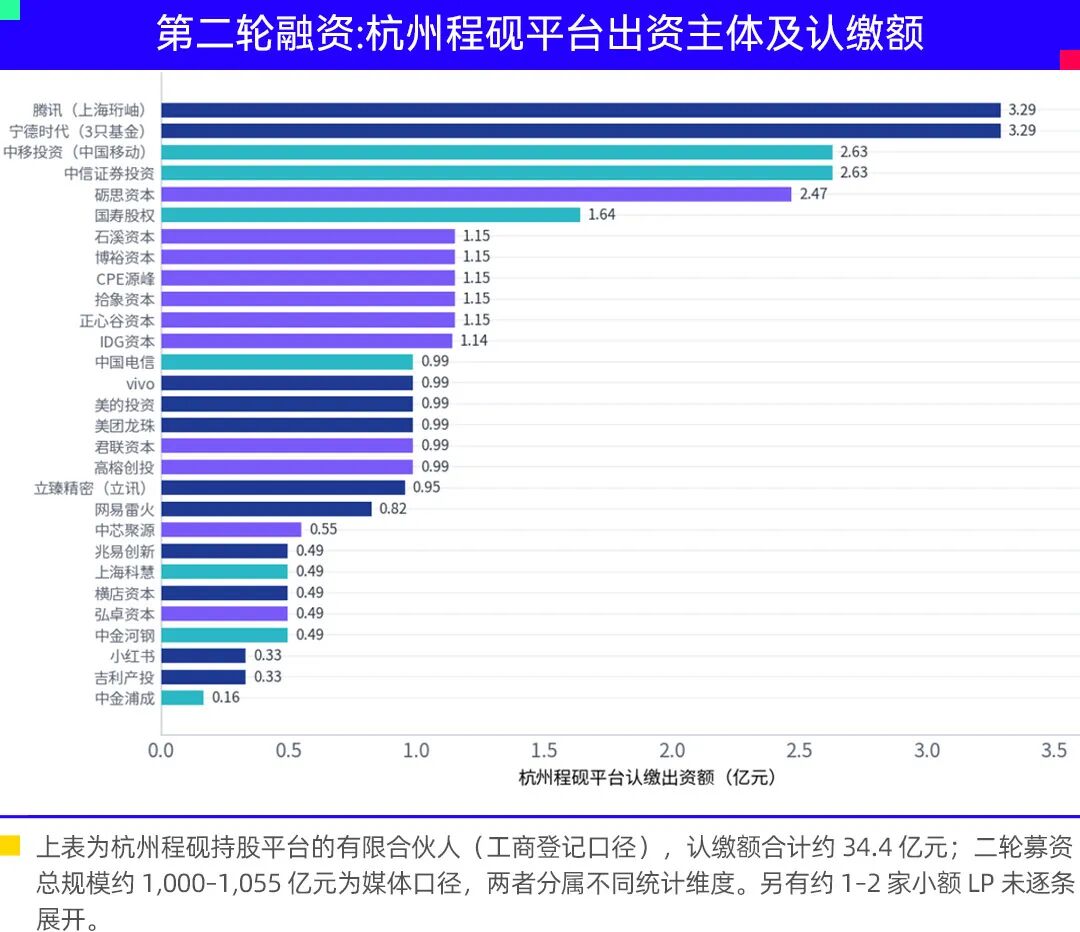
According to information disclosed by the Star Market Daily on November 19, new partners added to DeepSeek's shareholding platform Hangzhou Chengyan include funds affiliated with CATL and Zhejiang Geely Industrial Investment Holding Co., Ltd.
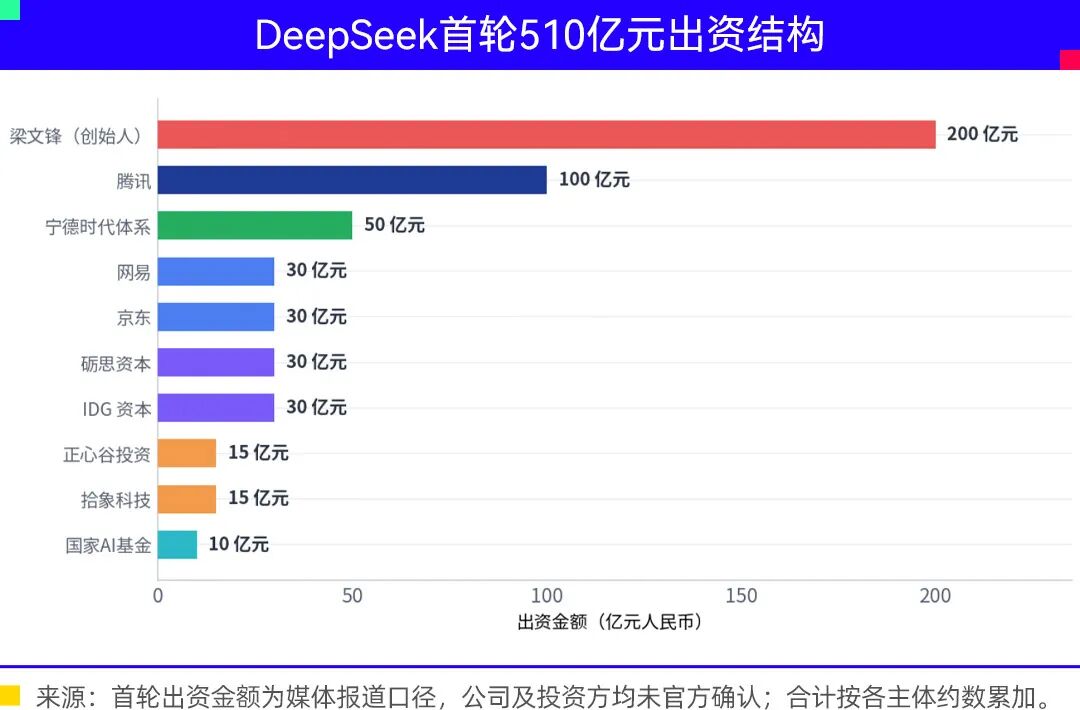
Including the first round of financing, previous media reports showed that a large number of industrial capital participants—among them CATL, Tencent, NetEase, JD.com, Geely, Midea, Meituan, Xiaohongshu, SMIC, and GigaDevice—had all taken part.
It is no exaggeration to say that every company on that list would draw envious glances from across the Chinese business and investment community.
Automobiles, batteries, communications, the internet, chips. Major enterprises from every one of these industries gathering in one place lifts this case beyond the story of a single large-model company's business and fundraising; it looks more like a long-term bet on the future.
CATL, Geely, and the others have products, customers, and engineering systems in their own professional fields. They cannot bring comparable industrial clout—including capital clout—into DeepSeek, but they clearly do not mind.
As is well known, DeepSeek is an open-source model, and using it does not require first becoming a shareholder of its parent company. Since buying services is enough to access the model, why still invest capital that bears risk and waits for an exit? Capital appreciation is not the whole answer. The benefits of becoming a DeepSeek shareholder are all hidden in the future long-term development logic and trajectory of the large-model company.
This article is an in-depth value piece from the "Juchao WAVE" content team. You are welcome to follow us on multiple platforms.

Entry
By breaking down DeepSeek's "major corporate shareholders," more information with analytical value comes into view.
According to disclosures by the Star Market Daily, CATL-related funds participated in Hangzhou Chengyan through three funds—Xiamen Shidai Yiyuan, Xiamen Shidai Shenyuan, and Fujian Shidai Zeyuan—while Geely participated through Zhejiang Geely Industrial Investment. This involves multiple layers, including funds, investment entities, and the model company itself, and cannot be directly equated with how much equity in DeepSeek is held by the listed company CATL or the listed company Geely Automobile respectively.
CATL's fund announcements explain the matter more clearly: Ningbo Wending's subscribed proportion in the Yiyuan Fund is 19.4175%, and Mindong Shidai's in the Shenyuan Fund is 10.2041%; the Zeyuan Fund also has multiple contributors. These are fund-level proportions at the time of their respective announcements and cannot all be attributed to the listed company CATL itself.
At the level of governance rights, DeepSeek has drawn quite clear boundaries. Liang Wenfeng adopted a method that is not rare in itself, but is very rare for these investor shareholders with unusual identities: he firmly welded shut the possibility of investors participating in the company's business and management decisions. It is basically impossible for any investor, whether Tencent or Geely, to interfere in the company's operations.
If they are neither short of money nor making control of the model company a precondition, then what is the key driving force for industrial capital to invest in DeepSeek?
Building one's own model and holding equity in a model company are two completely different inputs. Automobile companies need to understand cockpits and vehicles; battery companies need to master materials and manufacturing. Fully incorporating general model research and development into one's own organization means building another system of talent, computing power, and research decision-making, with costs that have almost no upper limit.
Cooperation at the equity level, while retaining focus on the main business, allows sharing in the opportunity for corporate growth.
From DeepSeek's perspective, the significance of industrial capital involvement may also exceed the funds themselves. Companies that truly operate automobile, battery, or communications businesses know what results customers are willing to pay for, and also know which seemingly reasonable solutions do not work on the ground. This knowledge can shorten the process of technology finding practical uses on the industrial side, but only after actual industrial implementation projects are formed in the future will it become an operational resource.
Therefore, DeepSeek and industrial-level investors may reach a kind of compromise: the model company retains autonomy in research direction, large enterprises provide industrial demand and engineering experience, and each invests in the part it is good at.
This independence may even protect investment value. If one automaker could influence the product roadmap of the model company, obviously other automakers would reassess the risk of accessing it. For minority shareholders, less control may not only come at a cost; it may also bring more independent development of the invested company and greater market space.
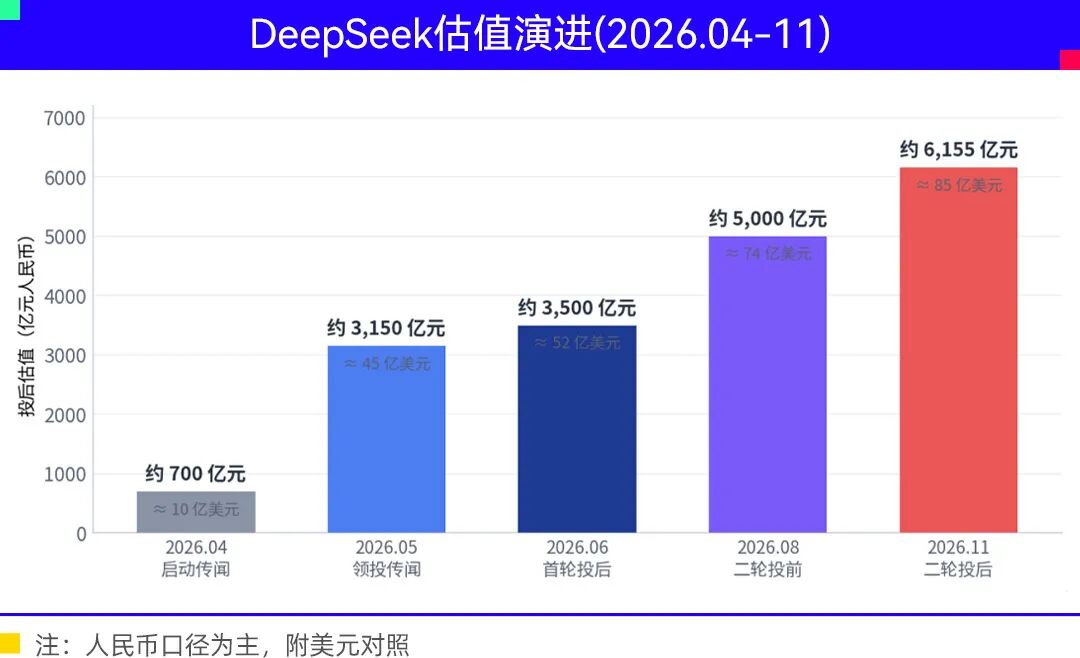
Of course, beyond cooperation, pure optimism about valuation growth is enough to serve as an investment reason. The essence of investment is to obtain capital appreciation, except that if the invested company is as strong as DeepSeek, investment is bound to change somewhat—taking a quick profit and leaving will most likely not be accepted by Liang Wenfeng.

Implementation
At the level of cooperation with DeepSeek, Geely provides an important chronological order.
Geely Automobile's 2024 annual results announcement released in March 2025 already stated that the Xingrui model had accessed DeepSeek's open-source general model. This shows that technology adoption can precede cooperation at the capital level.
The public paths provided by DeepSeek have long been quite clear: enterprises can apply for API keys and call the model through interfaces; the official DeepSeek-R1 repository also allows commercial use and derivative development of the corresponding model. These paths do not use shareholder status as a condition for use.
For shareholders, mature models can be deployed cost-effectively; spending their own money to build models is completely unrealistic.
Take in-car services as an example. When a user says "it's a bit cold," the model understanding the literal meaning is only the beginning. Next, it must determine occupant position, vehicle status, callable functions, and user permissions, and then decide whether to adjust the temperature and whether confirmation is needed.
The model company can provide understanding capability, while the automaker controls vehicle interfaces, product rules, and complete vehicle validation. A stable cooperative relationship between the two parts is important for user experience. Equity relationships will not substitute for this business integration.
The situation of CATL further illustrates the importance of professional capability. The company disclosed in January this year that its intelligent cell design platform is led by a professional team and conducts design by combining battery cases and test data.
If large models enter the process in the future, they must face electrochemical constraints, experimental validation, and engineering responsibility. Simple work such as helping researchers find materials is a different task from generating specific cell solutions that can actually be put into production. No matter how strong the model capability is, it also needs to be combined with the experimental systems and professional judgment accumulated by industrial enterprises over many years.
This means that leading industrial enterprises have the opportunity to benefit from the spread of models: as general capabilities become easier to obtain, industry data, validation facilities, and delivery experience may become more valuable differentiated capabilities.
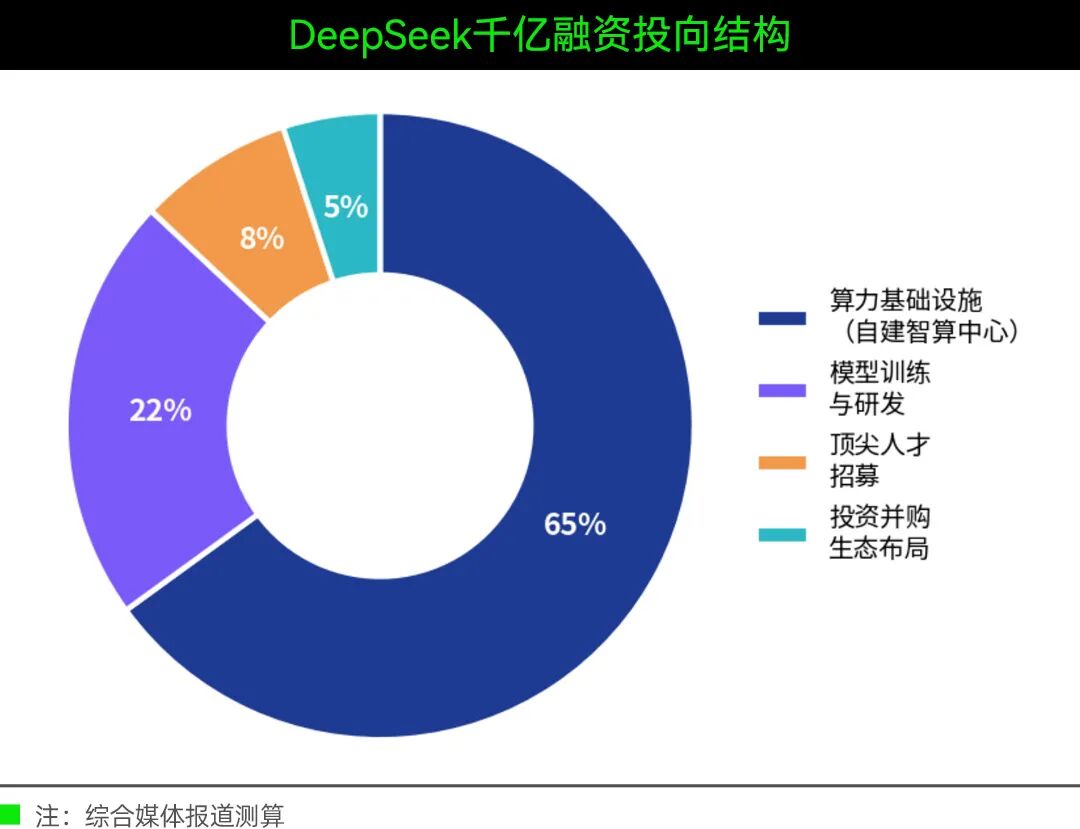
If shareholder relationships have additional value, it should be reflected in the actual ability to solve industrial problems. Whether both sides are willing to carry out deep cooperation, whether they are willing to jointly bear the cost of trial and error, and whether they can arrange long-term development around actual needs all require a more stable relationship. This is the value of cooperation at the equity level.
Model companies need operating revenue and will inevitably go deep into various industries, transforming from TOC companies into institutions with more TOB premiums. When technology is implemented into engineering, partners at the equity level are obviously more reliable.

Accounting
If industrial cooperation gradually unfolds, the returns that DeepSeek shareholders may obtain will have multiple components.
The first is investment return. It depends on comprehensive conditions such as entry price, subsequent dilution, business operations, and capital market conditions at exit. Even if DeepSeek is unquestionably China's top AI name, it is still difficult to judge directly.
Large-model enterprises were once very popular in the capital market, but the situation has now changed significantly: global AI valuations have plunged, and the declines of Hong Kong benchmark companies Zhipu and MINIMAX have even reached about 90%.
These major financial backers' enthusiastic investments will inevitably earn profits, but how much excess profit there will be is really hard to say.
The second is returns at the main business level. For example, automakers can improve services through models, and battery companies can shorten engineering collaboration time through tools. The resulting benefits may be reflected in customer experience, R&D efficiency, and operating costs.
But these two types of returns cannot be calculated simply; capital investment is only the starting point. The money saved by using models needs to deduct deployment, invocation, maintenance, and manual review, while equity returns need to deduct investment costs, expenses, and related risk pricing.
Capabilities formed within industrial enterprises may be productized and sold to other enterprises. Automakers, manufacturing companies, or service providers change from customers into solution providers; model companies thereby increase invocation and service revenue, while investors can collect comprehensive income such as software, integration, or operating fees.
The role of talent in large enterprises will also change after the large-model collaboration model becomes more mature. Talent responsible for model research, engineers who understand the industry, and leaders who can turn user needs into products all need to cooperate deeply within the same project.
If a project is led only by the investment department and the business department has no budget or acceptance responsibility, cooperation can easily stop at the demonstration stage. Whether shareholder status can bring organizational commitment also needs to be continuously confirmed through long-term communication and coordination.
Another situation may also emerge: general models become cheaper and cheaper, and profits remain more in the hands of enterprises with customers and delivery capabilities. Industrial shareholders' main businesses benefit as a result, while the model companies they hold face price competition.
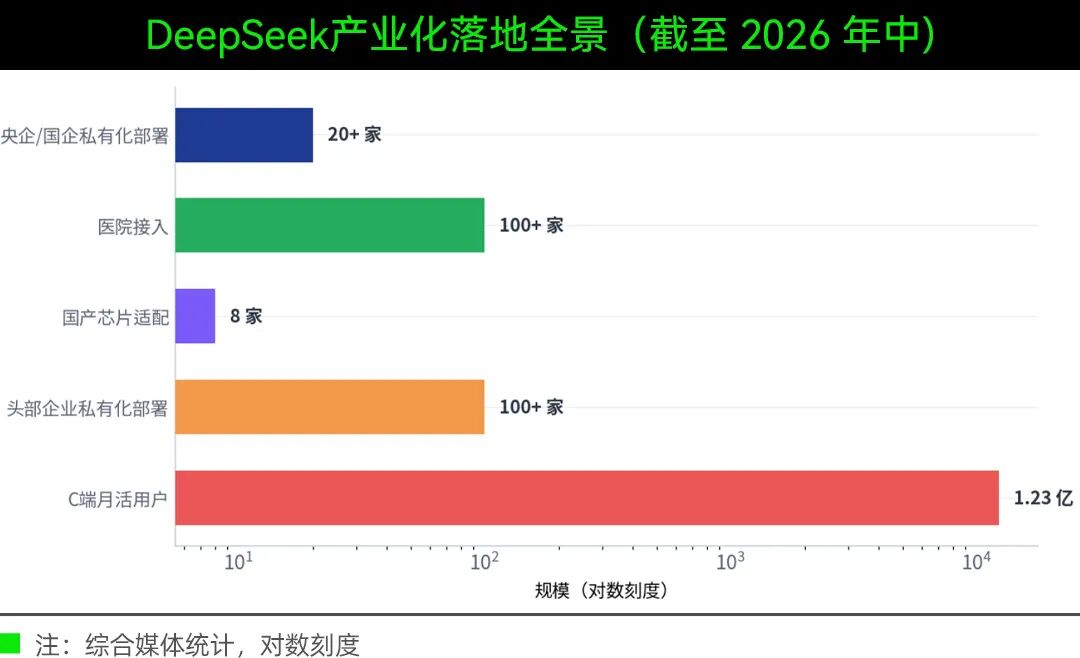
To prevent this from happening, DeepSeek will also continue to break through the industrial boundaries of large models, go deeper into various industries, and implement its technological capabilities at the industrial level.
In this process, DeepSeek also has to take care of non-shareholder customers and partners, but no matter what, partners with deep equity relationships will become the first choice in the industrialization of AI technology.

In Closing
People tend to believe that becoming an investor in DeepSeek means that enterprises can achieve deeper cooperation with DeepSeek beyond investment.
But looking at it from another angle, it is these enterprises that are willing, under the same conditions of cooperation, to bear more investment risk—recognizing DeepSeek's long-term technological value and having deeper trust in Liang Wenfeng himself.
For industrial capital, this judgment also contains greater information content: confidence that artificial intelligence will enter the processes of product design, R&D, and sales work, and confidence in the major value of artificial intelligence for serving customers, improving engineering capabilities, and operating returns.
But equity, technology use, and business cooperation are three relatively independent things.
In the next stage, for DeepSeek, more important than determining its shareholder list will be weighing what each shareholder can provide in this cooperative relationship, what it can gain, and what they can pursue together.
-
![]()
$55 Billion! Liang Wenfeng Becomes the World's Richest Large-Model Developer
-
![]()
Anthropic IPO Watch: A $1.5 Trillion Valuation and a Pricing Experiment in the AI Capital Era
-
![]()
What Are the Benefits of Becoming a DeepSeek Shareholder? | Juchao
-
![]()
The Wealth-Creation Myth Behind the Largest IPO in History
-
![]()
Chinese Brands Are Starting to Make Their Way into European Shopping Malls
-
![]()
China's Robotaxi Battle Heats Up in Dubai | Juchao
-
![]()
$952 Billion: Nvidia's Repurchase of a Guarantee Letter
-
![]()
A 50,000 Yuan C-Segment Car—Is Battery Swapping the Key to Stimulating Consumption?