Anthropic IPO Watch: A $1.5 Trillion Valuation and a Pricing Experiment in the AI Capital Era
 11/27 2026
 493
The Weight of a $900.9 Billion Compute Commitment
Produced by | Meigang Tan'an
On November 19, 2026, Anthropic officially listed on Nasdaq under the ticker "ANT." At an issue price of $83 per share, the fully diluted valuation of this frontier AI company reached roughly $1.5 trillion, making it one of the largest IPOs in history.
The final price of $83 represented a premium of about 6.4% over the top of the $70–$78 offering range. Combined with a $26 billion concurrent private placement involving seven tech giants, total fundraising came to about $107.3 billion, surpassing SpaceX's record of roughly $86.2 billion including the over-allotment option. It also marks the first IPO completed by a pure-play frontier AI model developer.

Pricing Above Expectations: The Subscription Heat Behind $83
This price did not stem from any single fundamental projection; it was driven far more by the order book.
According to CNBC, citing informed sources, institutional demand for Anthropic ran to about $400 billion, while retail demand approached $100 billion—close to $500 billion in total, several times the enlarged offering size. Several institutions placed single subscriptions in the billions of dollars, and the underwriters held an over-allotment option of 147 million shares. When demand so clearly outstrips supply, the price is naturally pushed toward the top of the range.
Another notable factor is the free float. Based on shares outstanding after the transaction, Anthropic had about 13.2 billion shares outstanding, corresponding to an actual market value of roughly $1.1 trillion. The original plan was to offer about 825 million shares—only a limited proportion of total share capital. Even after expanding to 980 million shares, once the locked-up portion of the $26 billion private placement is deducted, the freely tradable float on the first day was squeezed even further. This means early post-IPO price performance will be driven largely by supply-demand structure rather than operating fundamentals.

Fundamental Breakdown: How Much Substance Is Behind the $33.2 Billion in Revenue
What underpins the massive subscription is the commercialization scale Anthropic has already achieved.
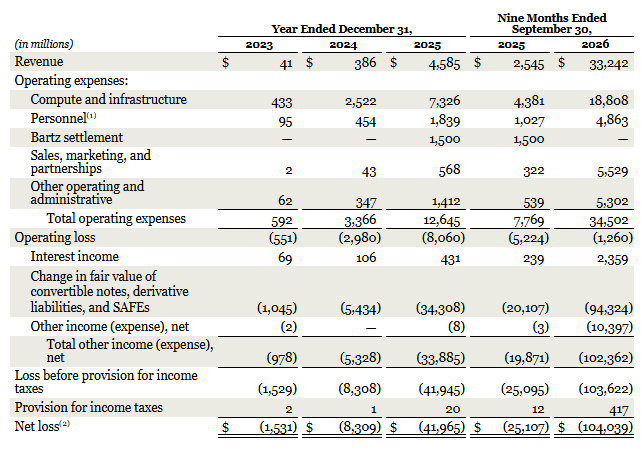
In the first three quarters of 2026, the company's revenue was $33.242 billion, up 1,206% year over year; third-quarter revenue alone was $16.956 billion, up 1,127% year over year. Enterprise APIs and workflows such as Claude Code—"continuously running, consuming large amounts of tokens"—form the micro-level foundation for revenue expansion and also distinguish it from AI assets that have only narratives and lack revenue.
Based on the $1.5 trillion fully diluted valuation and an annualized revenue run rate of about $81 billion as of the end of October, the corresponding price-to-sales ratio is about 18.5 times. For a company in a high-speed growth phase, with revenue up more than 12 times year over year, whether an 18.5 times ARR price-to-sales ratio is reasonable depends on whether its subsequent growth can maintain a sufficient slope—this may be further absorbed by high growth, but also needs continuous verification in subsequent quarterly financial reports.
It is worth noting other figures disclosed in the prospectus: third-quarter revenue growth slowed sequentially from 144% in the second quarter to 47%; at the operating level, the company swung from profit in the second quarter to a quarterly loss; compute and infrastructure spending in the quarter was about $9.863 billion, accounting for 58% of quarterly revenue, corresponding to a decline in the marginal output efficiency per $1 of compute spending. Together, these data show that Anthropic is still in a stage of "trading heavy investment for high growth," and operating-level cost volatility is one of the variables that most need to be tracked at present.

Equity and Shareholders: A Full Picture of Strategic Investor Holdings
The most distinctive feature of Anthropic's IPO is the weight of strategic shareholders in the equity structure.
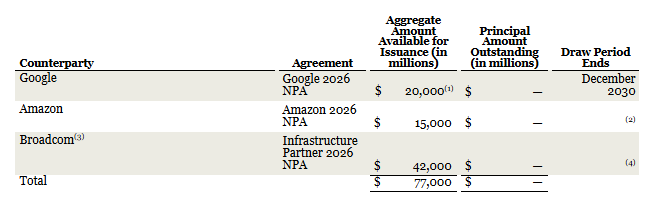
After completion of the offering and private placement, Amazon will hold about 14.7% of total shares outstanding, and Google about 13.7%, with the two combined at nearly 28.4%. Both hold non-voting shares, some from convertible bond conversions and this private placement. Google, Nvidia, AMD, Broadcom, Micron, Microsoft, and TSMC together subscribed $26 billion—these companies simultaneously play multiple roles as Anthropic shareholders, compute suppliers, and sales channels.
The positive significance of this structure lies in credit endorsement: core players in the supply chain entered at the issue price, objectively providing a layer of assurance for continuity of compute supply. At the same time, it also means that public market pricing of Anthropic's independent profitability will be intertwined over the long term with the industrial interests of these strategic parties. The prospectus discloses that in the first nine months of 2026, revenue from sales of access to Claude models through existing accounts of the three cloud service providers Amazon, Google, and Microsoft accounted for about 44% of revenue in the same period—when evaluating, both channel structure and customer structure need to be examined.
 The Weight of the $900.9 Billion Compute Commitment
Another focal point of market debate over Anthropic's valuation is its massive compute commitments.
As of the disclosure basis in the prospectus, the company's total signed purchase and lease commitments amounted to about $900.9 billion, almost entirely directed at compute and data centers, with payment periods extending to 2045; about $451.6 billion is expected to mature by the end of 2030, and about $70.7 billion will mature within the next 12 months. It should be clear that these are contractual commitments, not equivalent to current cash expenditures, but they will form rigid medium- and long-term payment obligations.
These long-term contracts need to be understood within industry logic: competition in AI models is highly dependent on certainty of compute supply. Anthropic had previously faced capacity constraints due to underestimating compute demand, and large-scale order locking is a compensatory arrangement for this gap. For a company whose revenue is still growing rapidly, this means both relatively high fixed costs over the next several years and, under the assumption of continued demand release, capacity preparation that can match the pace of competition. The key variable is whether revenue growth can cover this rigid expenditure before the concentrated payment period arrives.

Conclusion
The $83 pricing is a concentrated expression of public market pricing of AI assets in 2026: nearly $500 billion of demand, a compressed free float, and large subscriptions by industrial capital together form the background for this price. And the $1.5 trillion valuation corresponds to a bet that the "high investment, high growth" model will hold over the long term.
On the first day of listing, the price is more determined by structure and supply-demand; over the medium and long term, it depends on whether cash flow and profit margins can gradually validate the valuation assumptions. For Anthropic, what it needs to prove to the market is no longer "whether AI can generate revenue"—the $33.2 billion of revenue in the first three quarters has already given the answer; what truly needs continuous verification is whether this high-speed growth curve can demonstrate sufficient resilience in the squeeze between costs and competition.
As for what long-term value $1.5 trillion ultimately corresponds to, the answer is not in the first-day bell, but will be gradually written by the relative slope of revenue and costs in the coming quarters and over a longer operating cycle.
-
![]()
$55 Billion! Liang Wenfeng Becomes the World's Richest Large-Model Developer
-
![]()
Anthropic IPO Watch: A $1.5 Trillion Valuation and a Pricing Experiment in the AI Capital Era
-
![]()
What Are the Benefits of Becoming a DeepSeek Shareholder? | Juchao
-
![]()
The Wealth-Creation Myth Behind the Largest IPO in History
-
![]()
Chinese Brands Are Starting to Make Their Way into European Shopping Malls
-
![]()
China's Robotaxi Battle Heats Up in Dubai | Juchao
-
![]()
$952 Billion: Nvidia's Repurchase of a Guarantee Letter
-
![]()
A 50,000 Yuan C-Segment Car—Is Battery Swapping the Key to Stimulating Consumption?