Insta360 H1 Revenue Soars 50%, Yet Net Profit Plummets 90%; Nearly 2 Billion Yuan Spent on Memory Chip Procurement; Inventory Surges to 6.2 Billion Yuan Amid Negative Operating Cash Flow; Stock Price
 09/18 2026
 332
332
On the evening of August 27, Insta360 (688775) released its semi-annual report for 2026. This report, marking one year since its listing, revealed sustained revenue growth but a sharp decline in profits, signaling the most significant downturn since its public debut.
In June 2025, Insta360 made its debut on the Shanghai Stock Exchange's STAR Market, earning the title of the 'first panoramic camera stock.' This tech-intensive company, specializing in panoramic imaging technology, once garnered strong enthusiasm from the capital markets, with its market capitalization peaking at over 150 billion yuan. However, the 2026 semi-annual report disclosed that, despite continued revenue growth, net profit attributable to shareholders plummeted to 30.4073 million yuan, with net profit after extraordinary items (excluding non-recurring items) turning from profit to loss. Faced with intensifying industry competition, large-scale inventory buildup, and ongoing investments in new ventures, Insta360 is transitioning from high valuations to industrial realities.
1. Revenue Growth Fails to Offset Profitability Challenges
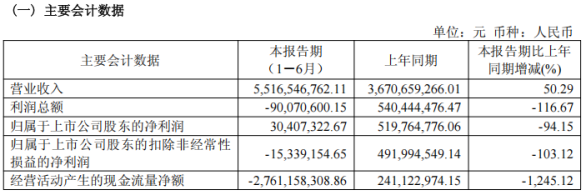
During the reporting period, Insta360 achieved revenue of 5.517 billion yuan, a 50.29% year-on-year increase; however, net profit attributable to shareholders dropped to 30.4073 million yuan, down 94.15% year-on-year. Net profit excluding non-recurring items stood at -15.3392 million yuan, a stark decline from 492 million yuan in the same period last year, marking a shift from profit to loss.

▲ Company Financial Report
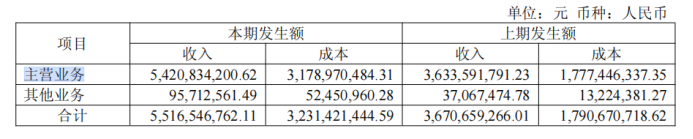
From a revenue structure perspective, Insta360's main business revenue reached 5.421 billion yuan, up 49.2% year-on-year. Consumer-grade smart imaging devices contributed 4.788 billion yuan, remaining the absolute mainstay, while accessories and other products generated 624 million yuan, a 34.6% year-on-year increase. The domestic market performed exceptionally well, with main business revenue reaching 1.984 billion yuan, nearly doubling. Overseas revenue amounted to 3.437 billion yuan, accounting for 63.40% of main business revenue, and remaining the company's most critical revenue source, though its growth rate lagged behind the domestic market.
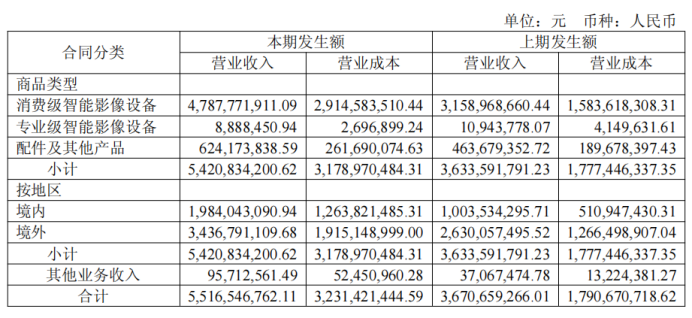
▲ Company Financial Report
The simultaneous increase in costs and expenses directly contributed to the coexistence of a revenue surge and profit plunge. Operating costs rose to 3.231 billion yuan, an 80.46% year-on-year increase, outpacing revenue growth by 30 percentage points. The gross margin fell from 51.22% in the same period last year to 41.42%, a decline of nearly 10 percentage points. R&D expenses reached 1.007 billion yuan, up 79.26% year-on-year; selling expenses were 1.017 billion yuan, a 61.96% increase; and administrative expenses stood at 249 million yuan, up 86.74% year-on-year.
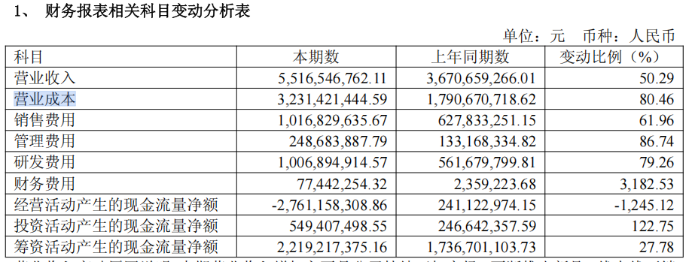
▲ Company Financial Report
In its semi-annual report, Insta360 attributed the profit decline to the sustained rise and high levels of DDR and other memory chip prices, which posed significant challenges to product costs. Additionally, substantial investments in R&D, production line construction, and market channel expansion for its new panoramic drone category negatively impacted overall profits before achieving economies of scale.
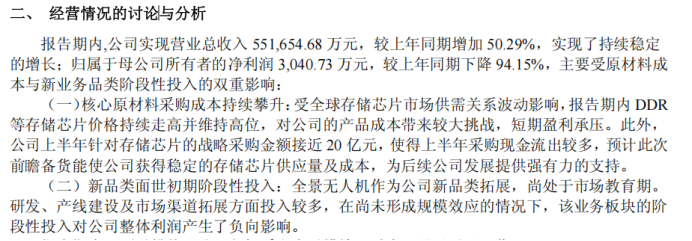
▲ Company Financial Report
Notably, while Insta360 maintained a net profit attributable to shareholders of 30.40 million yuan, net profit excluding non-recurring items turned negative. Among non-recurring items, changes in the fair value of financial assets contributed 47.24 million yuan, and government subsidies amounted to 7.25 million yuan. After excluding these factors, the company's main business did not achieve profitability in the first half of 2026.

▲ Company Financial Report
Changes in cash flow also warrant attention. Net cash flow from operating activities in the first half was -2.761 billion yuan, compared to a net inflow of 241 million yuan in the same period last year, a year-on-year decline of 1245.12%. Over a longer period, Insta360's net cash flow from operating activities was 762 million yuan, 1.172 billion yuan, and 1.386 billion yuan in 2023, 2024, and 2025, respectively, all positive. The significant negative turn in the first half of 2026 marks a notable change.
In response, Insta360 explained that cash flow pressures primarily stemmed from large-scale strategic stockpiling of memory chips, resulting in substantial cash outflows for procurement.
Insta360's short-term borrowings surged from 123 million yuan at the beginning of the period to 1.061 billion yuan at the end, an increase of 762.85%. Monetary funds at the end of the period were 1.462 billion yuan, roughly unchanged from the beginning, but the sharp rise in short-term borrowings indicates a change in the financial leverage structure. Total current liabilities were 6.544 billion yuan, including 3.891 billion yuan in accounts payable, 581 million yuan in contract liabilities, and 283 million yuan in employee compensation payable.
In terms of financial expenses, they reached 77.44 million yuan in the first half, up 3182.53% year-on-year, primarily due to increased interest expenses from exchange rate fluctuations and repurchase obligations. With a high proportion of overseas revenue, the impact of RMB exchange rate fluctuations against foreign currencies like the USD on financial expenses cannot be overlooked.
2. Shifting Dynamics in the Panoramic Camera Sector: Multiline Expansion Presents Both Opportunities and Challenges
Understanding the evolving competitive landscape is key to grasping Insta360's current situation.
In the panoramic camera segment, Insta360 maintains its global leadership. According to IDC's 'Global Handheld Smart Camera Market Tracker Report for Q1 2026,' global shipments of handheld smart cameras reached 4.14 million units in Q1 2026, a 33% year-on-year increase, with sales exceeding 10.5 billion yuan. Insta360 led in both sales volume and value in the panoramic camera market, with a sales value market share of 71%, an increase from 2025. Global shipments of panoramic cameras exceeded 500,000 units in the first quarter, a more than 55% year-on-year increase, with Insta360 accounting for over 68% of the shipment share.
However, the competitive landscape is evolving. Since launching its panoramic camera Osmo 360 in July 2025, DJI has quickly entered the sector, leveraging its brand and channel advantages. In the broader action camera market, encompassing panoramic, wide-angle, and thumb cameras, Insta360 and DJI hold approximately 41.2% and 43.8% of the sales market share, respectively, with the gap narrowing.
CICC previously noted in a research report that innovation diversity on both supply and demand sides in the imaging sector suggests competition is not a zero-sum game. The sequential expansion of both brands in the same category helps reach broader audiences and collectively expands the industry.
Insta360's performance in user ecosystem development is noteworthy. As of June 2026, the company's App monthly active users increased by 67% year-on-year, with total user-exported files rising by 126%. In Q2, the export rate of the cloud-based automatic editing feature 'Moment Pro' increased to 60%, and the number of paid cloud storage users rose by over 124% year-on-year.
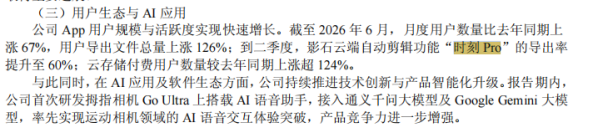
▲ Company Financial Report
In its semi-annual report, Insta360 stated that it was the first to integrate an AI voice assistant into its thumb camera Go Ultra, accessing large models like Tongyi Qianwen and Google Gemini, achieving a breakthrough in AI voice interaction in the action camera sector.
However, cultivating a second growth engine is a strategic focus for Insta360 and a key reason for profit pressures.
The company's new business matrix spans multiple product lines, including the panoramic drone Yingling A1, dual-camera gimbal camera Luna Ultra, wireless microphones, AI video conferencing all-in-one machines, and smartphone gimbals. Among these, panoramic drones are seen as the most critical category expansion, but their financial performance remains in the investment phase.
The 2026 semi-annual report revealed that four Yingling-related business entities collectively incurred losses of approximately 367 million yuan in the first half, with the core entity, Shenzhen Yingling Technology, accounting for nearly 290 million yuan in losses. Launched in December 2025, the Yingling A1 sold 30,000 units globally in its first month but announced an official price reduction in March 2026, with the standard package dropping from 6,799 yuan to 5,499 yuan, a nearly 20% decrease.
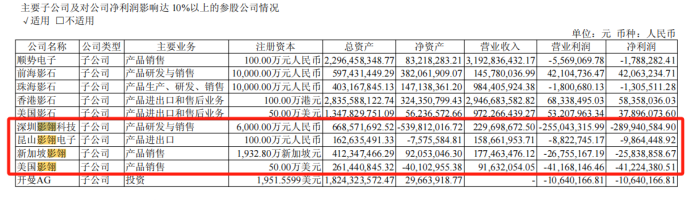
▲ Company Financial Report
Insta360 responded on an investor interaction platform that the Yingling panoramic drone is still in the market education phase, requiring substantial investments in R&D, production line construction, and market channel expansion. Before achieving economies of scale, these phased investments negatively impact overall profits. The company will closely monitor market feedback and strive to develop it into a new business growth driver.
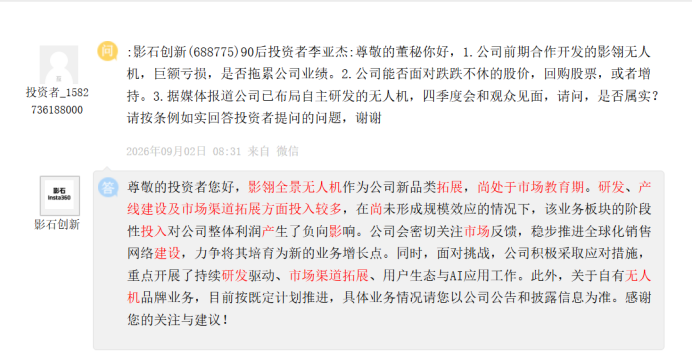
▲ SSE e-Interaction
Additionally, the consumer drone sector has long been dominated by DJI, with high brand recognition and channel barriers. Drone products require independent technical systems for flight control, obstacle avoidance, and power systems, which cannot be simply replicated from panoramic camera technology. The market feedback and price reduction strategy for the Yingling A1 may reflect the real challenges new entrants face in this sector.
However, Insta360's foray into gimbal cameras shows positive signals. The Luna Ultra dual-camera gimbal camera, released in June 2026, sold out within five minutes of launching on multiple e-commerce platforms and saw lines forming at offline stores. Equipped with an AI triple-core system, a Leica 1/1.3-inch super telephoto lens, and supporting 12x zoom and 6x lossless zoom, the product offers differentiated features. The company stated that the product is now available in major global markets, receiving positive market feedback, and is currently ramping up production.
3. Nearly 2 Billion Yuan in Memory Chip Procurement Raises Supply Chain Security and Inventory Impairment Concerns
Affected by fluctuations in the global memory chip market's supply-demand balance, prices for DDR and other memory chips have continued to rise and remain high. Insta360's strategic procurement of memory chips in the first half approached 2 billion yuan, with ending inventory book value reaching 6.212 billion yuan, nearly doubling from 2.919 billion yuan at the beginning of the period, and its proportion of total assets rising from 26.21% to 43.72%. Among these, the book balance of memory chips was 1.748 billion yuan, with raw materials and outsourced processing materials accounting for 66.25% of inventory.
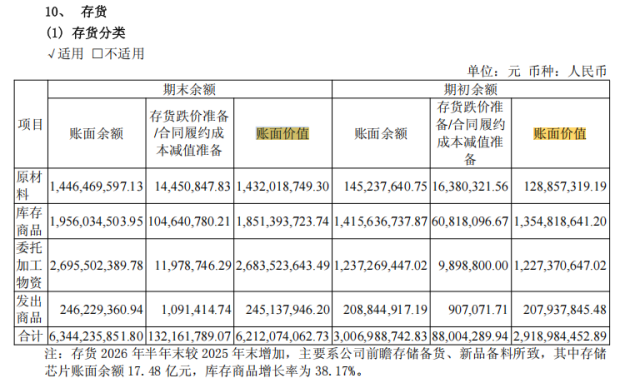
▲ Company Financial Report
Insta360 stated in its financial report that this proactive stockpiling is expected to secure a stable supply and cost control for memory chips, supporting subsequent development. This decision is seen as locking in supply and prices ahead of the memory chip price upcycle to mitigate risks of subsequent supply disruptions or further price increases.
 ▲ Company Financial Report
However, this strategy also has financial implications, as stockpiling consumes significant working capital. Financial reports show a shift from net cash inflow to substantial net outflow in operating cash flow in the first half, along with an increase in short-term borrowings. Moreover, inventory in the consumer electronics industry faces two levels of risk: if memory chip prices reverse and decline, high-cost stockpiles may face impairment losses; additionally, the rapid iteration of electronic products raises the possibility of certain materials becoming obsolete. During the reporting period, Insta360 recognized inventory impairment losses of 70.3588 million yuan, with ending inventory impairment allowances total
Three key variables will exert a direct influence on Insta360's performance in the latter half of the year. These include the ensuing trends in storage chip prices, DJI's competitive momentum within the panoramic camera market, and whether the Shadow Drone and Luna Gimbal Camera can progressively attain economies of scale. The company articulated in its interim report that it is committed to sustaining investment in research and development (R&D) while broadening its market channels. Notably, Insta360 has inaugurated its inaugural flagship store in Japan and has outlined plans to launch its flagship store in Times Square, New York, North America, in September 2026. Nevertheless, the efficacy of these strategic initiatives will necessitate verification through operational data in the forthcoming quarters.
Source: Consumer Daily - Jinzhao News
Image: Insta360
This article is an original work from
-
![]()
Insta360 H1 Revenue Soars 50%, Yet Net Profit Plummets 90%; Nearly 2 Billion Yuan Spent on Memory Chip Procurement; Inventory Surges to 6.2 Billion Yuan Amid Negative Operating Cash Flow; Stock Price
-
![]()
Second-Generation Doubao Phone Hits the Shelves: The Moment of Truth for AI Agent Smartphones
-
![]()
Second-Gen Doubao Phone Hits Shelves: Can AI Agent Phones Step Up?
-
![]()
How Long Can Domestic Foldable Screen Smartphones Laugh After Apple's Entry?
-
From Rent Collection to Vehicle Management, Didi Land's Hong Kong Stock Market Journey Still Has the Second Half to Go
-
![]()
The 'AI Apocalypse' Drama Staged by Five Individuals
-
![]()
Doubao Mobile Phone II: Can Its 'Knock' Feature Secure 380 Million Monthly Active Users Amidst Ecosystem Openness and Scheduling Rights Challenges?
-
![]()
Can Doubao Mobile Phone II, Which Has Learned to 'Knock,' Exchange 380 Million Monthly Active Users for Ecosystem Openness and Scheduling Rights?