Chang Jing Ultimately Led Roborock into the Competitive White Goods Market
 09/28 2026
 365
365
Since introducing its first washer-dryer combo, the H1, in 2023, Roborock is now in its fourth year of expanding its product categories.
At the IFA Berlin in September 2026, Roborock, once dubbed the "Tesla of Robot Vacuums" by the market, prominently displayed a mini washer-dryer combo capable of washing only 2 kilograms of laundry within its "Full-Scene Smart Cleaning Matrix."
Under a clear long-term strategy, the launch of the Z1 Mini Pro reflects Roborock's Stage thinking (phased thinking) to some extent: making products smaller and identifying more specific consumer needs. This model focuses on mini washing and drying, catering to the space constraints of renters and small households while also meeting the separate laundry needs of families with infants and for intimate clothing.
The transition from floor cleaning to balcony appliances seems logical. However, the white goods giants, who have dominated the washing machine market for half a century, won't reveal a historical parallel: over two decades ago, Dyson faced a similar tempting opportunity.
At the turn of the millennium, Dyson, renowned for its vacuum cleaners, launched the Contrarotator, a dual-drum washing machine featuring two counter-rotating drums that mimicked hand-washing as its core technological selling point. This groundbreaking technological evolution dazzled audiences, earning numerous design awards, but ultimately resulted in consecutive losses and a discreet discontinuation.
According to Dyson's own retrospective, the product succeeded engineering-wise and sold decently, but excessive manufacturing costs made the business unprofitable. Over two decades later, another hardware company famous for floor cleaning is embarking on a similar quest to explore the upper limits of the washing and drying market.
The company's semi-annual report shows that in the first half of 2026, Roborock's revenue reached 10.084 billion yuan, a 27.60% year-on-year increase, surpassing the 10 billion yuan mark for the first time since its listing.
Amid this impressive overall performance, robot vacuums—the primary growth driver—faced challenges in the domestic market. A breakdown reveals that domestic revenue increased by a mere 1.47% year-on-year to 4.012 billion yuan, with more growth coming from the higher-margin overseas markets.
As the industry's existing market starts to show saturation, domestic sales of robot vacuums declined by 4.0% in value and 4.6% in volume during the same period, marking the first negative growth in nearly a decade. The difficulty for Roborock to maintain its market position is changing, and its foray into washing machines—the first stop in its category expansion—has become a crucial battle it must win.
The question remains: How will Roborock overcome the same hurdles that tripped up Dyson?
I. Has Roborock "Figured It Out"?
Strictly speaking, Roborock, which initially entered the laundry white goods market riding the halo of being the "Tesla of Robot Vacuums," followed a script almost identical to Dyson's.
Dyson's product over two decades ago, the Contrarotator CR01, was a direct competitor to mainstream washing machines, boasting a substantial 7-kilogram washing capacity. Its design featured dual drums, dual motors with dual clutches, and planetary gears—essentially packing two washing machines into one. Priced at over a thousand pounds, three times that of mainstream models, it was daunting.
The commercial intent behind the product was straightforward: to offer consumers a better way to do laundry and persuade them to replace their existing machines. The issue was that the brand seemed to overlook that users would also have to abandon familiar brands, operating habits, and after-sales service.
Fast forward to 2023, and Roborock initially followed a similar path, attempting to disrupt consumer habits with technological superiority. With the H1, Roborock differentiated itself with zeolite drying technology and subsequently expanded into large-capacity combos and laundry sets, adhering to the same logic.
In hindsight, what tech companies perceive as innovation may not necessarily alter the competitive rules familiar to established white goods companies.
As mentioned in The Innovator's Dilemma, improving products along existing customer-approved metrics, even with significant technological breakthroughs, may only constitute "sustaining innovation." In competing for the same customer base, mature companies have both the incentive to defend their market and the resources to do so effectively.
The market soon provided feedback. According to third-party research, in 2023, the year of the H1's debut, Roborock's domestic online sales of washer-dryer combos amounted to only 90 million yuan, with a market share of around 0.2%. In the following year, 2024, online sales for this product line reached 300 million yuan. For a company with annual revenues exceeding 10 billion yuan, this business had relatively low visibility.
The slow growth of this business segment was not solely due to a high-profile strategic approach; the objective environment also squeezed Roborock's washing machine development space.
Against the backdrop of government subsidies prematurely exhausting demand for replacements, data from Aowei Cloud showed that in the first half of 2026, retail sales of washing machines turned negative, declining by 4.5% year-on-year. With urban households averaging 99.2 washing machines per 100 households, the incentive to upgrade was minimal.
In the existing market, each new large-capacity combo faces direct competition from traditional white goods giants like Haier and Midea.
Technology is the challenger's ace. Thus, Roborock began to adjust its strategy, pushing its existing mini washer-dryer lineup to the forefront.
The Z1 Mini Pro focuses on separate washing of intimate clothing, positioning itself more as "the second washing machine for the home." Whether for dedicated infant care in families with young children, specialized laundry for small households, or separate washing of undergarments for solo dwellers, it requires little additional market education.
Moreover, there are more clever calculations behind "small items." The compact size of the Z1 Mini series makes it easier to utilize existing space, while its top drainage design reduces reliance on floor drain locations, allowing flexible placement based on home layout and minimizing the need for partial demolition or renovation.
In doing so, Roborock has, to some extent, bypassed the most formidable distribution and after-sales barriers in the white goods industry. Having fully absorbed the lessons left by Dyson, the Z1 Mini series has accomplished its historical mission of opening up a second front for Roborock.
Public data shows that by July 2026, cumulative sales of Roborock's mini washing machines had surpassed 270,000 units. In the second quarter of 2026, Roborock's washer-dryer combo business reduced losses by approximately 180 million yuan year-on-year.
In contrast, Dyson's CR01 was discontinued within five years of its launch, never achieving profitability.
II. Apple at a "Discount"
As early as May 2024, Chang Jing began concentrating resources to develop a second growth curve, setting a timeline for the newly established washing machine division: "Open up the market in 2024 and Improve product categories (complete the product category) in 2025."
Roborock's washing and drying narrative has sidestepped the pitfalls Dyson encountered, giving Chang Jing's envisioned second growth curve a clearer shape. However, given the overall growth objectives of the group, the washing and drying business is not yet as glamorous as it appears on display.
With the Z1 Mini Pro completing the entire washer-dryer product line, the metric for evaluating the business has shifted from mere scale to profitability. Changes in the domestic robot vacuum market have made this task more urgent.
As mentioned earlier, in the first half of 2026, the domestic robot vacuum market experienced declines in both volume and value, with Roborock, as the market leader, being most affected. Focusing solely on the domestic market, whether Roborock's core business can sustain the long-term costs of exploring new categories warrants close attention—Roborock's washing and drying products must not only find the right market but also ensure that each unit sold generates sufficient profit to sustain the business.
In this regard, Apple, another hardware company known for its technological prowess, offers a reference path: achieving a distinctive user experience through technological breakthroughs, fostering consumer purchase preferences, and then leveraging scale to amortize R&D investments and improve procurement and manufacturing efficiency.
Consumers pay a premium but feel that the overall experience justifies the cost. The endpoint of this path is a unique form of "cost-effectiveness." For instance, the recently trending iPhone Duo captivated many users with just a smooth opening and closing animation.
Roborock's washing and drying Layout (strategy) could follow this logic. A year before introducing the mini washer-dryer-focused Z1 Mini series, Roborock intentionally sought sufficient premium pricing space through technology and high-end positioning while offering consumers tangible technological benefits.
For example, the Z1 Max series launched in April 2025 featured three models priced at 7,998 yuan, 9,998 yuan, and 12,998 yuan, respectively. More representative was the Z1 Plus released during the 618 shopping festival, priced at 7,999 yuan and integrating technologies such as zeolite low-temperature garment care and true steam wrinkle removal. It was the only product under 10,000 yuan in China at the time to receive dual green labels from the International Wool Textile Organisation.
Roborock aimed to sell a premium experience that consumers could afford and clearly perceive as different.
To solidify its market position, Roborock spared no expense. Technologically, it led the development of industry standards for "zeolite adsorption drying," positioning it as a third technological route distinct from heat pump and condensation methods. Marketing-wise, it signed Cyndi Wang, who gained renewed fame through the variety show Sisters Who Make Waves, as the "Brand Ambassador for Washing Machine Technology and Aesthetics."
In 2025, Roborock's selling expenses surged to 4.894 billion yuan, a roughly 65% year-on-year increase, significantly outpacing revenue growth. For an engineer-driven company once known for "not relying on marketing," this level of investment was a statement in itself.
However, Apple's uniqueness lies in its ability to integrate hardware, operating systems, applications, and services, creating user habits that carry over to subsequent products and other devices. Such an experience is difficult to compare with competitors based on a single hardware parameter.
Returning to Roborock's product lineup, robot vacuums are still in a cycle of continuous technological iteration, capable of collecting home map data via apps and even evolving toward embodied intelligence. Washing machines, however, are mature durable goods typically replaced every decade.
Without a software ecosystem to fall back on, Roborock's washing and drying business seems to follow a discounted version of Apple's path: technology tells the story, marketing builds brand perception, and scale reduces costs. So far, Roborock has only succeeded in the first two steps.
III. A Second "Apprenticeship" from Dyson?
Known for its engineer-driven culture, Roborock has built a technical reputation but lacks "credits" in brand storytelling. Here too, Roborock can learn from Dyson's path.
Dyson's story has a second act. After discontinuing its washing machine in 2005, Dyson chose to apply its "technology spillover" philosophy elsewhere.
In April 2016, after four years of development and approximately 50 million pounds in investment, the Supersonic hairdryer was launched. To better improve consumers' hair care experience, engineers even attended beauty school to learn how professional stylists blow-dry hair.
Within a month of its launch, the Supersonic became the best-selling hairdryer in the UK. In 2018, the Airwrap curler replicated this success using the same logic.
Reviewing these two products reveals similarities with the Z1 Mini series. They are relatively lightweight, bypass traditional white goods categories, and redefine the category through technology to capture premium pricing space.
However, Dyson's turnaround was not solely due to this. While the Supersonic's motor speed and airflow parameters were important, the threshold for convincing consumers to pay a premium lay in the professional endorsement from hairstylists, the unboxing ritual on social media, and the aesthetic narrative of being a "Design Museum collectible."
A true high-end brand is never merely the sum of functionality and price but a composite expression of technology, aesthetics, and storytelling. According to Liang Ning in Real Demand, product value consists of functional value, emotional value, and asset value. Hardware consumer goods like those from Roborock and Dyson lean heavily on functionality, but emotional value is the core of brand building.
Dyson relied on the brand momentum accumulated from three decades of vacuum cleaner success to cushion the failure of its washing machine and await new premium categories. From this perspective, the success of its hairdryer was merely a "withdrawal" from its decades of brand equity.
Using the same logic to evaluate Roborock, the outlook is not optimistic. Even if the launch of the Z1 Mini Pro is seen as its "Airwrap moment," Dyson had three decades of brand equity to draw from, whereas Roborock's account has far fewer reserves.
From this perspective, it's easy to understand why Roborock vies for industry standards and technological certifications in almost every category it enters, with marketing expenses rising in tandem.
In terms of products, Dyson possesses unique digital motors, while the Z1 Mini Pro faces joint encirclement from traditional white goods companies and emerging brands.
Pricing-wise, the Z1 Mini Pro's 2,999 yuan price tag sits just below the mid-to-high-end threshold. Above it are even more "premium" models like the Panasonic White Moonlight Mini, Haier Yunxi CP, and Xiaoji X1 Pro. With all players having fully positioned their mini washer-dryer product lines, Roborock remains a challenger in this segment.
This brings to mind a statement Chang Jing made in 2021: "Roborock is not a brand-marketing-driven company but does not rule out entering new sectors through technology spillover in the future."
Back then, Chang Jing likely did not anticipate that five years later, technology spillover would indeed lead into the red ocean of washing machines. On the other side of this red ocean await not only formidable opponents like Haier and Midea—which even Dyson struggled against—but also a lesson that Dyson has yet to fully learn: How much is "Roborock" worth beyond floor cleaning?
Dyson spent five years proving that a technology company could build the world's best washing machine and another decade demonstrating with hairdryers that the same technological philosophy could yield vastly different outcomes in a new battlefield.
For Chang Jing and Roborock, this branding lesson has only just begun.
-
In-depth Analysis | China's Top Three LiDAR Companies Shift Business Priorities as Growth Strategies Diverge
-
Trend丨Power Battery Supply Dynamics Shift as Automakers Dive into Core R&D
-
![]()
Apple May Re-enter Server Market as Internet Market Sees 'Fierce Competition'
-
Chang Jing Ultimately Led Roborock into the Competitive White Goods Market
-
Hot Topic | RSI Goes Viral from Silicon Valley to China: AI Starts to Participate in Training Its Next Version
-
![]()
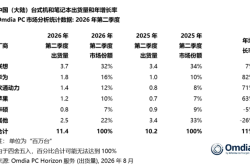
Huawei's PC Shipments Skyrocket by 82% in Q2 2026, Securing Second Place Behind Lenovo
-
![]()
Qualcomm Announces Official Renewal of Global Patent License Pact with Apple, Effective April 1, 2027
-
![]()
Find X10 Series: OPPO's Dilemma Between Affordability and Innovation Amidst Memory Price Hike and AI Competition