August Online Market for Consumer-Grade Action Cameras: Volume, Value, and Price All Rise Year-on-Year, with New Products Fueling High-End Expansion
 09/30 2026
 573
573
In August 2026, the enduring appeal of summer travel, combined with a persistent demand for outdoor activities such as cycling and camping, along with the密集 (dense, retained for context but translated meaningfully as "frequent" or "intensive" in a cultural context where it implies a high frequency or concentration) launch of new industry products, propelled the online market for consumer-grade action cameras to continue its rapid growth. Three critical metrics—retail volume, retail value, and average retail price—all experienced year-on-year increases.
Meanwhile, the market's pricing structure underwent a significant transformation, with the mid-range segment expanding steadily and the high-end segment experiencing a notable surge, driven by the introduction of new products. The following analysis delves into the overall market performance, pricing structure, and technological trends of action cameras, based on online monitoring data from Aowei Cloud Network (AVC).
I. Online Market Experiences Concurrent Growth in Volume, Value, and Price, with High-End Products Driving Average Price Increases
In August 2026, the online market for consumer-grade action cameras showcased a pattern of high-quality development, marked by simultaneous increases in volume, value, and price.
According to Aowei Cloud Network (AVC) data, retail volume in the online action camera market reached 696,000 units in August, a 17.7% year-on-year increase; retail value surged to RMB 1.93 billion, up 22.5% year-on-year.
The summer travel boom, coupled with sustained demand for outdoor activities and travel documentation, fueled steady market expansion.
Contrary to July's trend of "volume and value increases amidst declining average prices," August witnessed retail value growth significantly outpacing retail volume growth, primarily due to a year-on-year increase in average market prices.
The average online retail price of action cameras in August was RMB 2,779 per unit, a 4.1% year-on-year increase. This price hike was primarily attributed to a higher proportion of high-end products, with new product launches shifting the product mix towards the high end. The industry's growth transitioned from "volume compensating for price" to "concurrent growth in volume and price," indicating clear signs of value enhancement. 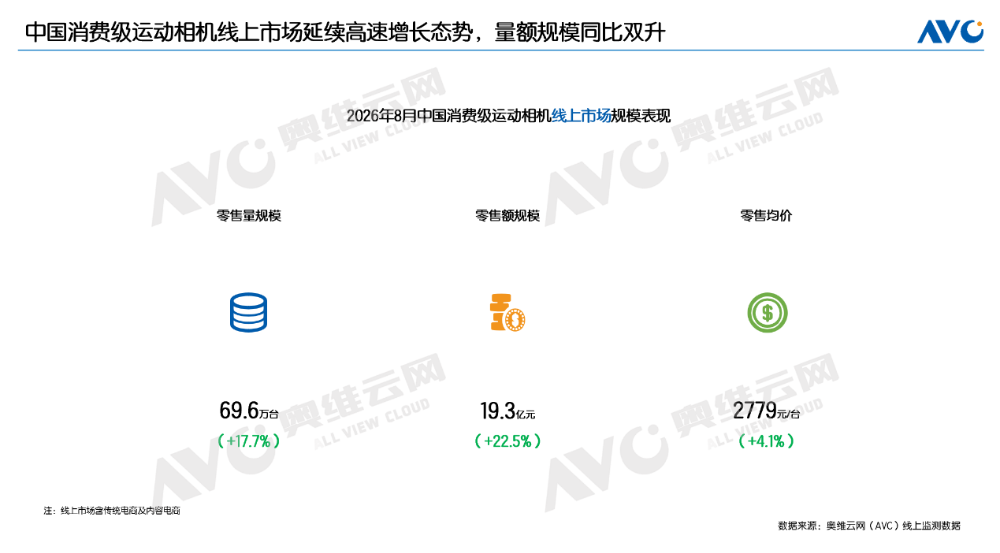
II. Profound Transformation of Pricing Structure: Mid-Range Expands Steadily, New Products Drive High-End Surge
From the perspective of price segment structure in traditional e-commerce channels, the action camera market in August continued its mid-range expansion trend while witnessing a significant rise in the high-end segment. The pricing structure now features a "solidified mid-range, surging high-end, and contracting traditional upper-mid-range." The mid-range segment's expansion momentum persisted.
According to Aowei Cloud Network (AVC) data, the retail volume share of the RMB 2,000-2,499 price segment reached 14.9%, an 8.9 percentage point year-on-year increase, making it the fastest-growing segment. The RMB 2,500-2,999 price segment accounted for 25.1% of retail volume, a 7.0 percentage point year-on-year increase, remaining the largest retail volume segment.
Together, these two mid-range segments accounted for 40% of total retail volume and 35.9% of total retail value, serving as the backbone of market growth and meeting the upgrade demands of both entry-level and upper-mid-range users.
The high-end segment emerged as the month's biggest highlight. The retail volume share of the RMB 4,000 and above segment reached 19.0%, a 9.4 percentage point year-on-year increase; its retail value share reached 29.0%, a 13.3 percentage point year-on-year increase, approaching nearly one-third of the total market.
The strong expansion of the high-end market was primarily driven by the frequent launch of industry flagship new products, with technological upgrades such as large-size sensors, high-specification video recording, and AI intelligence effectively stimulating consumer demand for replacements and upgrades.
The traditional upper-mid-range segment faced significant pressure. The RMB 3,000-3,499 price segment accounted for 9.7% of retail volume, a 16.0 percentage point year-on-year decrease, with its retail value share contracting by 21.0 percentage points, making it the most severely declining segment. The RMB 3,500-3,999 price segment accounted for 12.7% of retail volume, a 2.7 percentage point year-on-year decrease.
These segments are being squeezed from both above (by flagship new products) and below (by mid-range premium products), necessitating a redefinition of their value proposition.
The low-end market continued to contract, with the sub-RMB 1,000 price segment accounting for 6.4% of retail volume, a 7.8 percentage point year-on-year decrease. Entry-level demand continued to shift towards the RMB 2,000 and above segments, significantly cooling the atmosphere of "low-price competition" in the market, with consumption upgrading becoming the industry's main theme. 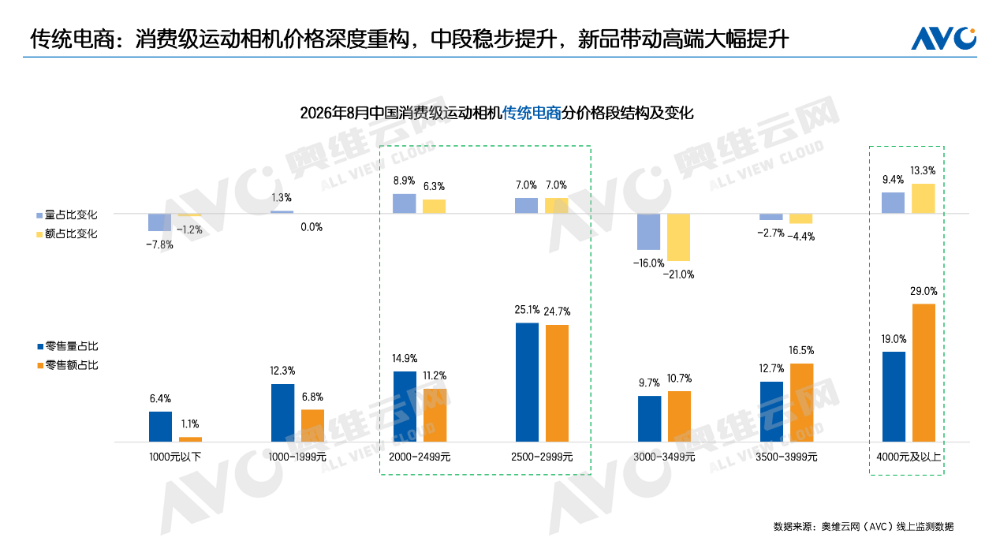
III. Technological Upgrades Drive Value Growth, with Industry Competition Moving into the "Experience + Intelligence" Realm
Overall, the growth logic of the online action camera market in August was clear: sustained demand across various scenarios laid the foundation for market scale, the mid-range segment catered to mass consumption upgrades, flagship new products drove high-end value growth, and industry average prices shifted from decline to increase, accelerating the market's transition from "scale-driven" to "value-driven" growth.
Current technological upgrades in action cameras are unfolding along three main lines:
1. Continuous breakthroughs in imaging performance, with larger sensors, 4K high-frame-rate, and even 8K recording capabilities gradually extending to mid-range products. Image quality and low-light performance have become key differentiators in product competitiveness.
2. Deepening of experience-enhancing technologies such as stabilization and battery life, with iterative improvements in stabilization algorithms and widespread adoption of replaceable batteries and fast-charging solutions significantly enhancing the outdoor recording experience.
3. Accelerated implementation of AI intelligence, with features such as smart editing, automatic tracking, and voice control lowering the barrier to content creation and transforming action cameras from "recording tools" to "creative partners."
Looking ahead, with the continued penetration of outdoor activities, Vlog creation, and travel documentation, as well as the further extension of cutting-edge technologies such as imaging, stabilization, and AI to mid-range price points, the action camera market is expected to sustain a trend of growth in both volume and price.
The decisive factor in industry competition will shift from a focus on single hardware specifications to a systemic comparison of comprehensive experiences encompassing "image quality, stabilization, intelligence, and ecosystem." The ability to form sustained technological iteration capabilities in both the mainstream RMB 2,000-3,000 segment and the flagship RMB 4,000 and above market will become key to competition in the next phase.
-
![]()
August Online Market for Consumer-Grade Action Cameras: Volume, Value, and Price All Rise Year-on-Year, with New Products Fueling High-End Expansion
-
![]()
Surging by 1.3 Trillion Yuan in a Single Day! Meta's AI Triumph Led by a Chinese AI Guru
-
The Hidden Risks in Second-Hand Transactions of Intelligent Driving Vehicles
-
Yutong Optics’ Array-Molded C-Lens Hits Monthly Shipments of Tens of Millions!
-
Survival Game of New Energy Vehicles Accelerating Industry Reshuffle
-
![]()
Why Doesn't a 58% Gross Profit Margin Lead to Growth? The IPO of an Optical Industry Giant
-
Qijing GT7 Fails to Make a Breakthrough, Liu Jiaming’s Debut Ends in Disappointment: GAC Group’s Premium Push Hits Another Snag
-
Sales Plummet Over 40% Again: Can Qian Yang’s JiaYue 07 Revive Roewe?