Memory Price Surge Deals Blow to Smartphone Industry! Global Smartphone Shipments Plunge by 20%, Samsung and Apple Secure a Combined 45% Market Share
 10/15 2026
 460
460
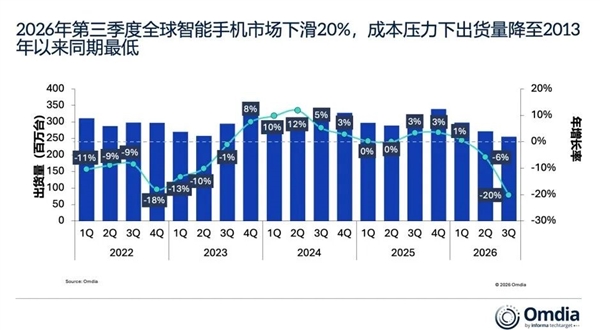
Kuaikeji, October 15 - According to the latest forecast data from market research firm Omdia, global smartphone shipments plummeted by 20% year-on-year in the third quarter of 2026, marking a substantial deterioration from the 6% decline witnessed in the second quarter.
Despite the fact that major manufacturers have rolled out their flagship new products and channels have begun to stock up for the year-end sales peak, global smartphone shipments still experienced a month-on-month decrease.
The persistent rise in memory and storage costs has emerged as a pivotal factor contributing to the market downturn. This has put a squeeze on the profit margins of smartphone manufacturers, compelling them to cut back on the shipments of low-margin models.
It is worth noting that the market downturn has further deepened the polarization within the industry.
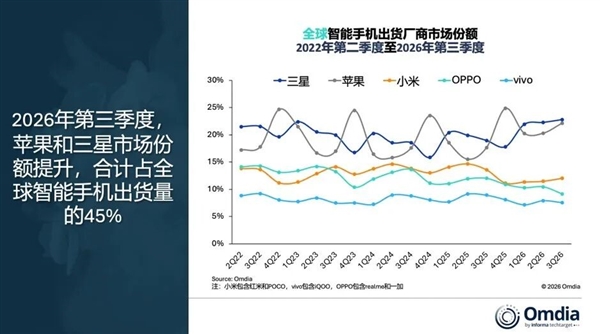
Samsung and Apple together command a 45% share of the global smartphone market, up approximately 8 percentage points from the same period last year, showcasing their robust resilience to risks.
In terms of specific rankings, Samsung maintains its global leadership with a 23% market share. Although its shipments have decreased year-on-year, its market share has still risen.
Samsung's diverse product range and well-established global channel network have played a role in cushioning the impact of the market downturn.
The Galaxy Z Fold8 and Flip8 series, which were launched in August, have further cemented its position in the high-end market.
Apple takes the second spot with a 22% market share, trailing Samsung by just 1 percentage point.
The sustained demand for the iPhone 17 series and the release of the iPhone 18 Pro series in September have aided Apple in sustaining its market momentum.
Moreover, the launch of Apple's inaugural foldable smartphone, the iPhone Duo, has further diversified its product lineup and opened up fresh avenues for entering the foldable market.
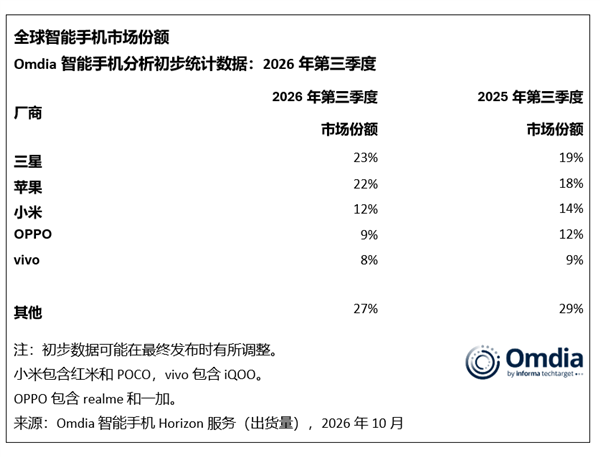
Among domestic manufacturers, Xiaomi holds onto the third position globally with a 12% market share, OPPO (including realme and OnePlus) ranks fourth with a 9% share, and vivo makes it into the top five with an 8% share.
Omdia highlights that as memory costs continue to climb, profit margins for smartphones across all price brackets are being compressed, with entry-level products, which are more sensitive to price fluctuations, being particularly severely affected.
To tackle cost pressures, smartphone manufacturers are gradually recalibrating their business strategies. They are moving away from the sole pursuit of shipment volumes and instead placing greater emphasis on raising average product prices and optimizing their product mix to safeguard profitability.
Omdia predicts that even with the launch of flagship new products, promotional campaigns, and the year-end shopping frenzy spurring demand in the fourth quarter, it will still be challenging to fully counterbalance the ongoing supply-side pressures.
-
![]()
Can Gemini 4 Argon Transform Videos into 3D Simulated Scenes and Revolutionize XR Spatial Computing?
-
![]()
Anxious Yin Qi Takes a Gamble on AI Smartphones
-
![]()
Yin Qi's Bold Gamble: The Smartphone That Aims to Redefine AI Interaction
-
![]()
Toyota's Defense and Rebirth Amidst the Rise of Local Brands | Cover Story: Japanese Automakers at a Crossroads in Transition (Part Two)
-
![]()
New Box-Shaped Champion Hits Market at 125,900 Yuan: Unveiling the Strength of the All-New Traveler 7
-
![]()
AI Competition Intensifies, Personal Agents Fuel the Fire
-
![]()
Memory Price Surge Deals Blow to Smartphone Industry! Global Smartphone Shipments Plunge by 20%, Samsung and Apple Secure a Combined 45% Market Share
-
What a Shock! Domestic Smartphone Sales Can’t Keep Up with the Apple iPhone18 Pro