iPhones Worth $100 Million Plunge into the Sea, as Apple’s Market Cap Soars Past $5 Trillion
 10/19 2026
 332
Xingkongjun noticed that overnight, major social media platforms were inundated with images purportedly showing iPhones being salvaged from the sea. As a frequent user of AI-generated art and videos, he quickly spotted inconsistencies in the images.

However, this incident was not a fabrication—it did indeed occur.
According to reports, between October 13 and 14, a Singapore-flagged container ship, the GFS Pride, was attacked in the southern part of the Strait of Hormuz. The vessel caught fire and subsequently sank. It had departed from Dubai carrying approximately 2,500 containers. Thankfully, all 21 crew members were rescued without any injuries.

The Iranian Revolutionary Guard claimed that the ship had deviated into an unauthorized and dangerous route, triggering a mine and causing the fire. However, maritime reports offer a different account, stating that an unidentified projectile first struck the hull.
Netizens humorously dubbed this cargo as "genuine water-damaged goods."
The reported loss from this shipment exceeds $100 million.
Apple's customer service response was understated: While acknowledging that individuals had seen related reports on social media, the company stated that it had not received any official notifications yet.
What does a $100 million loss mean for Apple?
In its most recent fiscal quarter, Apple reported total revenue of $109.417 billion, averaging $1.2 billion per day or approximately $50 million per hour. Thus, a $100 million loss roughly equates to two hours of revenue.
The loss of a shipment of phones is equivalent to two hours of Apple's operating income.
On the same day the ship sank, Apple achieved a milestone it had previously failed to reach six times.
1. Market Cap Surpasses $5 Trillion
On October 14, Apple's stock price closed at a record high of $342.96, pushing its market capitalization past the $5 trillion mark for the first time, reaching approximately $5.005 trillion.
This marked the seventh time Apple's market cap crossed the $5 trillion threshold during trading. The previous six instances were brief intraday highs, with the stock price falling back by the close.
Apple became the second company globally, after Nvidia, to close with a market cap exceeding $5 trillion. Nvidia's market cap at the time was around $5.3 trillion.
When Tim Cook took over as CEO 15 years ago, Apple's market cap was approximately $350 billion. Since then, it has surpassed the $1 trillion, $2 trillion, $3 trillion, and $4 trillion milestones.
Now, the gap between Apple and Nvidia is narrowing—partly due to Apple's rise and partly because Nvidia's stock has dropped nearly 6% over these trading days.
On one hand, $100 million worth of goods sink into the sea; on the other, a $5 trillion valuation emerges. These two events, occurring in the same week, seem like deliberately arranged contrasts.
2. $109.4 Billion Earnings Report
Apple's fiscal third quarter of 2026, ending June 27, saw revenue of $109.417 billion, up 16% year-on-year. Net profit was $29.789 billion, up 27% year-on-year. Earnings per share were $2.02, beating market expectations of $1.89.
iPhone revenue for the quarter reached $54.2 billion, compared to $44.5 billion last year, a 22% increase.
Mac revenue grew by 29%, a rare high growth rate in recent years. Cook stated on the earnings call that both iPhone and Mac performances far exceeded expectations.
As Apple's cash cow, the iPhone accounted for 49.5% of total revenue, with nearly half of the company's revenue relying on this single product line. Services revenue was $30.7 billion, accounting for 28%.
Regionally, the Americas contributed $45.781 billion, Europe $29.395 billion, and Greater China $18.816 billion, up 22.4% year-on-year, accounting for 17% of total revenue.
This marked the first time in six years that Apple achieved record quarterly revenue across all geographic regions, as emphasized repeatedly by Cook on the call.
Of course, this report had a flaw: while Greater China's revenue did not decline, it fell short of analysts' expectations of $19.5 billion. Services revenue of $30.7 billion also missed the expected $31.3 billion.
Xingkongjun is more concerned with another metric: gross margin at 50.1%.
Apple's gross margin typically hovers around 40%. Even with rising storage costs, the margin increased, showcasing Apple's market dominance.
3. iPhone: Only the Expensive Models Launch
Apple's September 9 event, titled "Surprise and Shine," marked Ternus's first show as CEO.
Only two phones were unveiled: the iPhone 18 Pro and iPhone 18 Pro Max, priced at $1,199 and $1,299, respectively, both $100 more expensive than their predecessors.
The standard iPhone 18 did not appear.
Also absent was the iPhone 18e. These two models were delayed until spring 2027, marking Apple's first time removing its volume-driving base models from the fall lineup.
This represented a true rhythmic adjustment in Apple's product history: launching the most expensive models first, followed by the cheaper ones.
Xingkongjun believes this decision is more significant than the Duo's foldable screen, as it directly rewrites the sales curve.
First, the data: On launch day, approximately 322,800 units were sold domestically, 130% of the iPhone 17 Pro series' sales during the same period last year. First-week sales reached nearly 1.3 million units, about 115% of the previous generation's same period.
By Week 39, domestic sales cumulatively reached about 1.7623 million units, surpassing 2 million units including the National Day holiday, with Pro Max activations exceeding 760,000 units in a single week.
While China saw explosive sales, the U.S. market weakened. There's a practical reason behind this.
Users who bought the iPhone 15 three years ago are now due for an upgrade. Meanwhile, flagship models from Xiaomi, OPPO, and Vivo have seen price hikes exceeding $200, raising consumers' price expectations and making the $1,199 iPhone seem less expensive.
With no standard model launched, users who would have bought the base version were passively upgraded to the Pro.
Another overlooked variable: older models are propping up sales. The iPhone 17 series sold approximately 174 million units in the 12 months after launch, about 18% higher than the previous generation during the same period. This means a significant portion of Apple's sales this year came from discounted older models, not the two new $1,199+ phones.
4. The Enigma of Order Cuts
In mid-October, contradictory signals emerged in the market.
Xingkongjun previously analyzed the impact of Apple's order cuts on Luxshare Precision and Blue Technology.
Reports claimed Apple asked suppliers to reduce October component orders by 15% to 20%, citing price hikes suppressing demand.
Conversely, J.P. Morgan's report called this a normal post-launch adjustment, noting stronger demand for the 18 Pro in China compared to the 17 Pro, albeit slightly. The real drag came from the absent standard model, which they expected to lower iPhone revenue by 2 percentage points.
Supply chain sources stated that while Pro orders decreased, Pro Max orders increased, with no substantial change in total volume.
Xingkongjun's view: The order cuts themselves aren't important; the timing is. Apple has never faced order cut rumors in mid-October before—this is the first year.
5. Duo: A $1,999 Experiment
On October 16, the iPhone Duo opened for pre-sale, launching in over 70 countries on October 23 and entering 28 more markets on October 30.
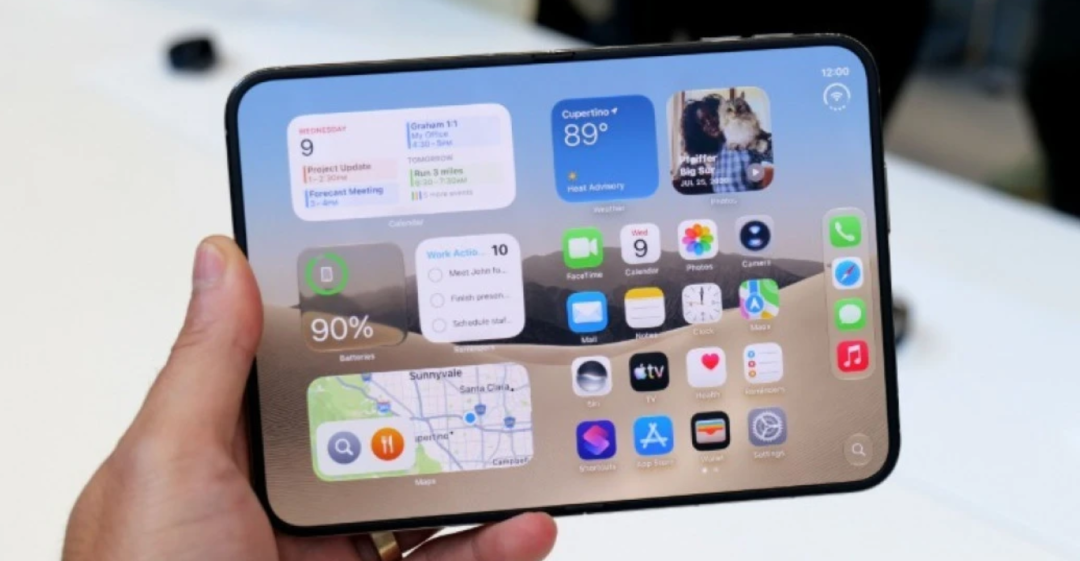
This marks Apple's first foldable phone and its most expensive iPhone yet.
Starting at $1,999, it's $800 more expensive than the iPhone 18 Pro and $700 more than the Pro Max.
For comparison, the Samsung Galaxy Z Fold8 and Google Pixel 11 Pro Fold are priced about $100 lower. Apple entered a new category and set the highest price point.
Estimates suggest that if supply is adequate, the iPhone Duo could sell about 6 million units in 2026.
At an average selling price of around $1,900, 6 million units would generate about $11.4 billion, roughly 10% of Apple's quarterly revenue.
This figure is significant but not enough to justify a $5 trillion valuation. For Apple, foldable phones are about raising average selling prices in the short term and proving its ability to innovate in new categories long term.
Moreover, supply remains a variable. Rumors of production bottlenecks persist, and Apple even prepared a leasing program for this device, a first in iPhone history.
On November 2, Apple will release its Q4 FY2026 earnings report.
This report will answer many questions.
-END-
Disclaimer: This article is based on the public company attributes of listed companies and relies primarily on information disclosed by the companies in accordance with their legal obligations (including but not limited to interim announcements, periodic reports, and official interaction platforms) as the core basis for analysis and research. Shiyu Xingkong strives to ensure fairness in the content and viewpoints presented but does not guarantee their accuracy, completeness, or timeliness. The information or opinions expressed in this article do not constitute any investment advice, and Shiyu Xingkong assumes no responsibility for any actions taken based on this article.
Copyright Notice: The content of this article is original to Shiyu Xingkong and may not be reproduced without authorization.
-
![]()
Does China’s Intelligent Driving Sector Possess a Competitive Moat? Who Will Survive the Intense Competition?
-
![]()
Don't Push Mathematicians Too Hard, AI
-
![]()
AI Phones: The Challenge of Breaking Through Ecosystem Barriers
-
![]()
The Differences Between Kimi and DeepSeek Are Becoming More Pronounced
-
![]()
As the Era of Lavish AI Spending Fades, Is the AI Race Taking a New Turn?
-
![]()
The Entire Internet Ridicules Tesla’s Flying Car—Don’t Be Short-Sighted
-
![]()
How to De-escalate China-EU Trade Tensions and Enhance Sharing of Hybrid Technology Benefits?
-
![]()
Cook Lauds China’s Unique Manufacturing Prowess: Apple’s Reliance Now Unavoidable