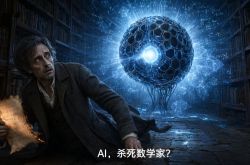
Don't Push Mathematicians Too Hard, AI
 10/19 2026
 475
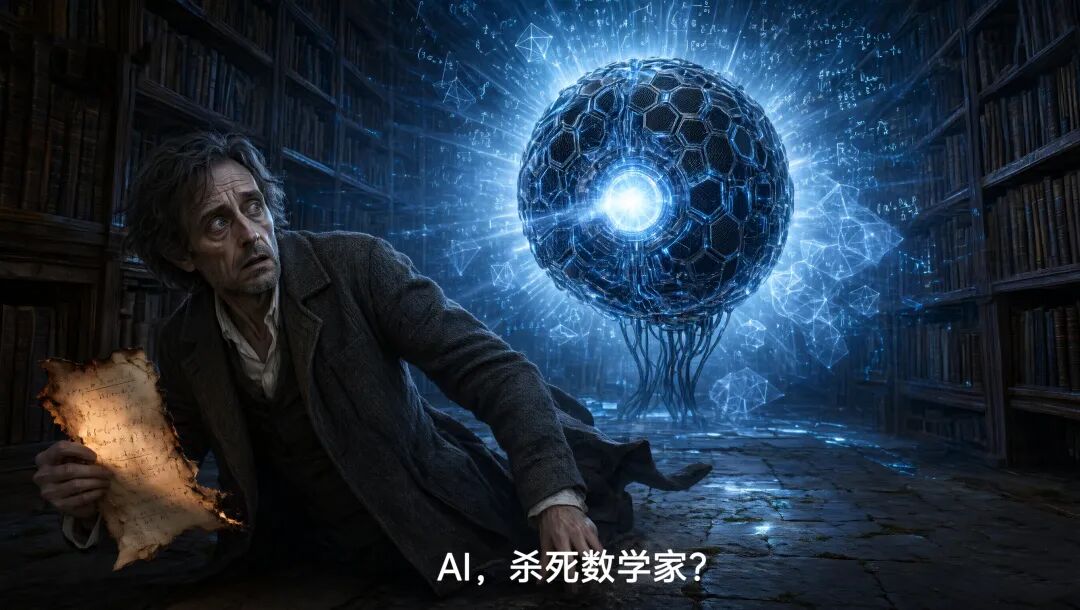
Stop it, OpenAI. Mathematicians are protesting outside.

Author: She Zongming
"Physics has never existed, nor will it ever exist."
In The Three-Body Problem, Yang Dong, a top theoretical physicist, left this last testament before committing suicide.
The external backdrop to Yang Dong's suicide was the interference of the Trisolarans' sophons, which made the results of particle collisions in global high-energy particle accelerators completely random and irreproducible. This led to the collapse of faith among many top physicists worldwide, triggering a wave of suicides among physicists.
Yang Dong was no exception. The bizarre experimental data that emerged during her experiments to verify the superstring model made her question her entire existence.
Now, while AI is far from being the sophon sent by humanity itself, this "silicon grandson" is pushing many of the world's top mathematicians to the brink of collapse.
Not long ago, Steven Strogatz, an applied mathematician at Cornell University, broke down in tears during a media interview:
The year 2026 will be remembered either as a year of miracles for mathematics or as a year of disaster.
Wei Zhewei, a young mathematician and associate dean of the Gaoling School of Artificial Intelligence at Renmin University of China, wrote in an article that these two outcomes are likely to coincide in the same year. In his view, this is the golden age of mathematics and the lost age of mathematicians.
Upon hearing this, one cannot help but feel a twinge of sympathy for mathematicians like Wei Dongyi.
01 /
How disheartened are mathematicians? The change in attitude towards AI by math god Terence Tao offers a glimpse.
Half a year ago, Tao, a leading figure in Lean formalized mathematics and a Fields Medal winner, was the most representative "AI cheerleader" in the mathematical community.
He recommended AI to everyone, using it to search for literature, write code, draw diagrams, and frequently live-streamed on his blog about "how ChatGPT and I solved another problem by Erdős," making him one of the earliest academic heavyweights to integrate AI into his research workflow.
In March this year, he publicly urged his peers at the IPAM conference to "not be too rigid," stating that AI is already "ready for primetime" in mathematics and theoretical physics. During an interview with MIT Technology Review, he excitedly declared that "mathematics is undergoing a Copernican revolution." Even in OpenAI's promotional videos, his presence could be seen.
With such an enthusiastic attitude, one might think that Sam Altman, Dario Amodei, and Jensen Huang had collectively sponsored him.
But six months later, the tone changed dramatically.
It was Tao who, at SAIR, condemned model manufacturers, saying, "They're simply crazy. AI companies are accelerating endlessly without knowing what will happen afterward. They must slow down. There's no reason to go this fast, absolutely none."
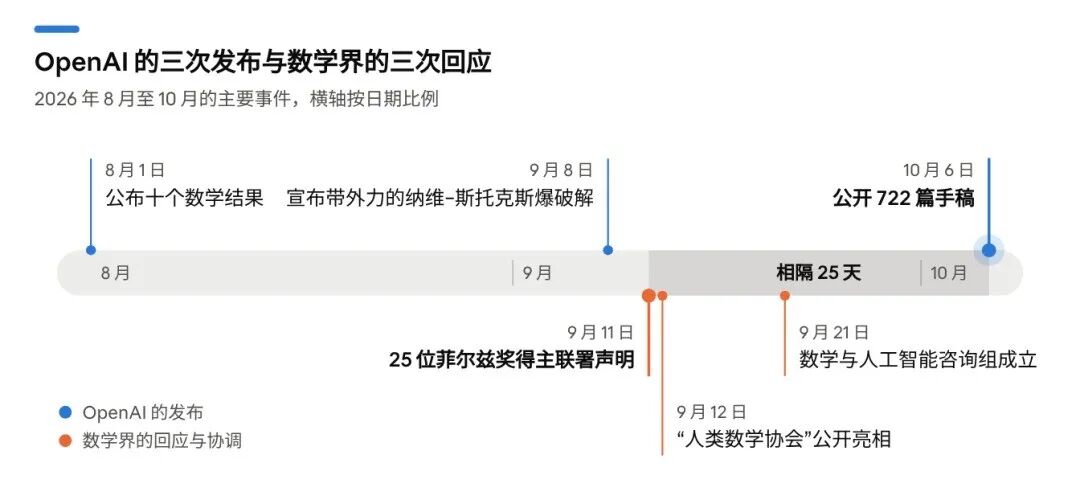
It was also Tao who, in September, co-signed an open letter with 25 Fields Medal winners, including Peter Scholze and Deng Yu, criticizing OpenAI for using mathematical problems as benchmarks.
And it was still Tao who, a few days ago, took the lead in publishing a joint statement by the Association of Human Mathematicians (AHM) on his blog, declaring a "global collective action by the mathematical community to fully resist OpenAI."
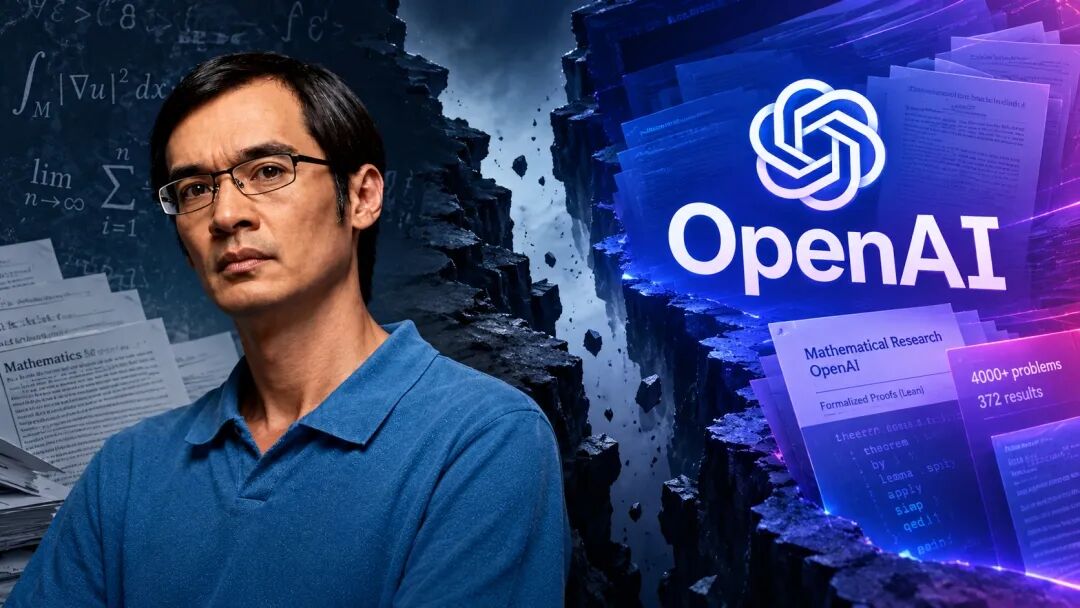
From hitting the gas pedal hard to slamming on the brakes, he's not afraid of breaking the brake pedal.
Tao's puzzling actions at first glance seem like a tribute to Lao Luo's famous scene in Starbucks.
The uninformed might wonder, "What are you doing?"
Those in the know will understand: This is like correcting the model in time when residuals explode during linear regression.
In plain terms, Tao, who previously summarized that "small-scale AI is strong, medium-scale AI reinforces incorrect intuitions, and large-scale AI provides inspiration," has realized the deep-seated harm of AI's "brute-force miracles" to mathematics.
You might ignore warnings about the dangers of nuclear bombs from others, but not from Oppenheimer.
You might dismiss many people's concerns about "AI killing mathematics" as alarmist, but not Tao's.
02 /
Why can't Tao and his peers remain calm like Maduro?
The direct reason is that OpenAI, which treats mathematical problems as performance benchmarks, keeps dancing on the mathematicians' pain points repeatedly:
On September 8, OpenAI announced that it had solved the three-dimensional Navier-Stokes equation, one of the seven Millennium Prize Problems.
On October 6, OpenAI publicly released 722 mathematical manuscripts generated by its models, covering 372 series of results, including long-standing unsolved famous problems such as the quasi-Riemann hypothesis, the four-dimensional hang-gliding problem, and the unique game conjecture.
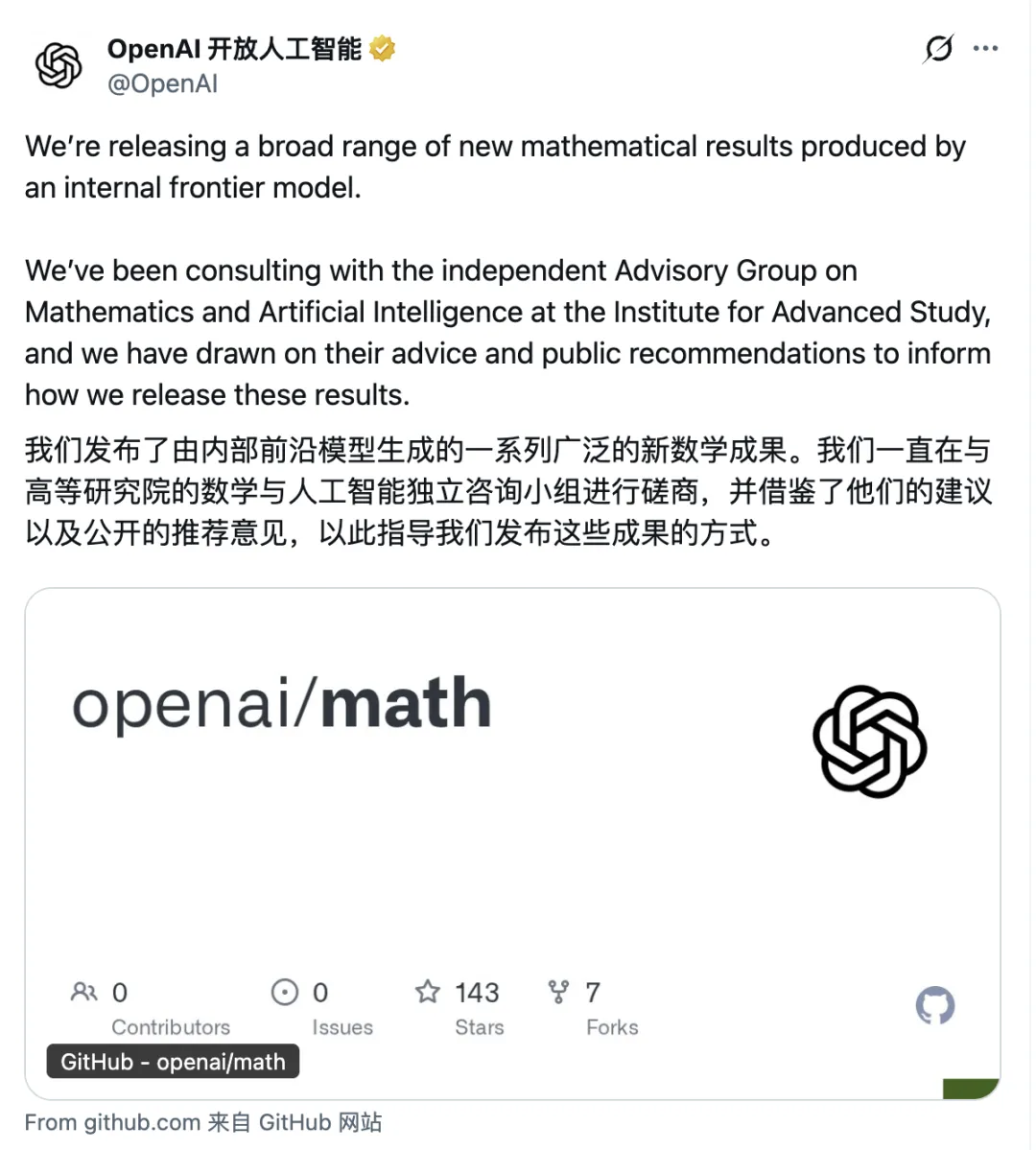
A few days ago, OpenAI's Astra model organized a group of AI agents and researchers to collaborate live on GitHub, significantly improving the historical lower bound of integer multiplication within 24 hours. The lower bound of integer multiplication is widely recognized as one of the most challenging problems in mathematics.
Putting these together, Tao's statement that "mathematics is undergoing a Copernican revolution" suddenly becomes tangible.
Except it's a revolution against mathematics itself.
To be honest, when I first saw Tao and his peers criticizing and resisting, many people would habitually think: Are these top mathematicians worldwide panicking because their rice bowls are about to be taken away? After all, RSI is expanding the impact of silicon-based substitution to these experts.
Some might even imagine a scene: A group of mathematicians toiling away to explore profound truths, only for AI to chuckle and casually provide answers in a few strokes.
Initially, I thought this was just a stress reaction from carbon-based superbrains being surpassed by machine supercomputers—Einstein, Riemann, Maxwell, and Tao are biological computing power singularities, human intelligent supercomputers, while ChatGPT and Claude are machine supercomputers. OpenAI solving mathematical problems that mathematicians couldn't is a direct reflection of machine supercomputers catching up.
But upon closer inspection of the mathematicians' "last-ditch resistance," I realized I was judging these great minds who worry about all of humanity with a foolish heart.
Their unease stems less from an existential crisis and more from seeing another, more terrifying crisis.
Fields Medal winner Cédric Villani "collapsed" upon seeing OpenAI solve the Millennium Prize Problems, calling it "a catastrophe never seen before in the mathematical community."
Theoretical computer scientist Scott Aaronson lamented that mathematics is facing a "Mathocalypse."
With phrases like "never seen before" and "catastrophe," do you still think they're exaggerating?
03 /
According to many people's thinking, isn't it a good thing that AI helps humans solve problems that humans can't solve?
Think of it this way: If solving mathematical problems is like eating, then AI is like those online mukbang stars who can eat violently, induce vomiting, and gain weight quickly.
But as Teacher Qin Shaoyou said, "Do you know what fresh crucian carp marinated in aged liquor for years tastes like? Do you know what it feels like to have female crabs with round bellies filled with fat? Do you know what it feels like to have duck eggs piled up, which are nothing special, yet you still want them on your plate? Do you know how the customs of Huainan involve bottling and preserving methods passed down through generations?"
As seasoned foodies know, the joy of eating lies in savoring the flavors, not just filling your stomach.
Mathematics is the same. AI is a super problem-solver, good at solving problems, but mathematics is never just about solving problems.
Half of a mathematician's work is proving, but the more important other half is asking good questions, creating new concepts, establishing new frameworks, and inspiring new insights. Riemann proposed the Riemann hypothesis, and Galois created group theory not to solve specific problems but to open doors to new mathematical worlds.
The Leiden Declaration on Artificial Intelligence and Mathematics, released in June this year with the support of the International Mathematical Union (IMU), states: Mathematics is not just about automatically generating theorems but about transparency in human understanding and proof.
In short, mathematical research requires knowing not only the "what" (providing answers) but also the "why" (understanding why it's solved this way, what's next, and what conclusions can be drawn). Therefore, formulating hypotheses, generating proofs, repeated verification, explanation, peer review, and integration into scientific theories are the standard paths of mathematical research. Mathematics has endured for over two millennia because mathematicians have established a social mechanism of "understanding-verification-inheritance."
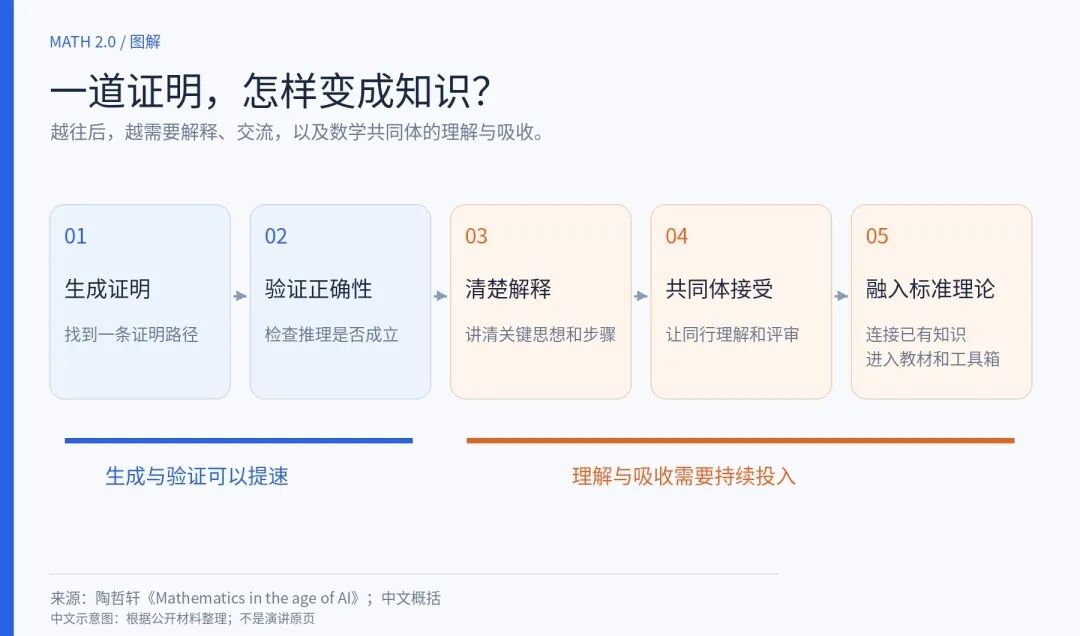
This determines that AI doesn't understand the beauty of mathematics, just as day doesn't understand night, 33D doesn't understand A-cup.
Tao recently said, "AI is ending the romantic era of mathematics," expressing this very idea.
AI pursues output speed and can only splicing (piece together) existing theories, combine known tools, and solve existing problems within the realm of existing knowledge to achieve significant results. Asking it to create groundbreaking intellectual achievements like calculus or group theory is beyond its capabilities.
The mathematical community pursues reproducible, understandable, and inheritable intellectual growth, with intuition, inspiration, and acuity being indispensable supports for discovering new knowledge.
Mathematics is like mountain climbing. Reaching the summit is important, but finding the right climbing sticks, discovering the optimal route, and appreciating the scenery along the way are also important.
04 /
AI's brute-force problem-solving brings several harms:
1. The results provided by AI are too vast for humans to digest, leading to what Tao calls "proof indigestion."
Tao believes that traditional mathematical research is like a gentle faucet flowing with clean water, while current AI is like a high-pressure fire hose, gushing massive (massive amounts). Opening the AI valve inevitably leads to "impedance mismatch" in the human brain.
A detail is that after OpenAI batch-released the manuscripts, mathematicians reluctantly opened the files and found them filled with incomprehensible constructions, vague reasoning steps, and inexplicable literature citations. Dana Moshkovitz, a scholar who has long studied the unique game conjecture, said she had to use another AI tool to barely read them.
2. AI introduces radioactive contamination to mathematical research, producing a mix of true and false conclusions.
Among the 722 manuscripts released by OpenAI, only about 42% completed Lean formalized verification, and multiple flaws were found in several. The official voluntarily withdrew 3 and revised 14.
Michael Harris, a mathematics scholar at Columbia University, lamented that this would produce large amounts of symbolic garbage, leading to a "knowledge collapse": "Replacing a culture evolved through historical experience with a monetizable alternative culture is a particularly insidious form of knowledge collapse."
3. AI fosters existential confusion among mathematicians and encourages shortcut dependency in mathematics.
When problems that humans have struggled with for decades or centuries are solved by AI at a cost of a few hundred yuan in computing power, many mathematicians will inevitably be surrounded by doubts: What's the point of your relentless pursuit?
In Chinese academia, which has long been influenced by Goodhart's Law and driven by paper metrics, if AI is a problem-solving expert, then fine, I'll use AI to batch (batch-generate) propositions and proofs, chase quantity, and grab first publications, ignoring the curiosity, long contemplation, and trial-and-error exploration that originally belonged to mathematics. Who cares?
The resulting scenario would be: AI-generated conclusions in excess → degradation of understanding ability in the next generation of mathematicians → collapse of innovation capacity in the mathematical community.
In that case, do you think we'll still see mathematicians like Wang Hong or Deng Yu?
05 /
At this point, many might blurt out, "AI is killing mathematicians."
This narrative has a "counter- wish-fulfillment fiction (anti-climactic yet satisfying) feel," but it secretly switches the evaluation criteria: It measures cutting-edge mathematics by problem-solving standards and defines mathematical achievements by "whether the answer is calculated."
AI won't kill mathematicians, but AI's brute-force problem-solving will indeed harm mathematics.
Mathematics has already weathered three shocks: non-Euclidean geometry overturned spatial common sense, set theory shattered theoretical foundations, and computers broke the traditional paradigm of human calculation.
But this time, the impact of AI is unprecedented—the mathematicians' warning of a "Mathocalypse" is not unfounded.
Tao and his peers calling for a boycott of OpenAI is a defense against AI's critical hit (critical hit) on mathematics.
But viewing this resistance as a raging fire of Luddism is narrow-minded.
Tao and his peers are not originalists of "handcrafted" mathematical research clinging to "ancient methods." Their prescription is not a blanket rejection of AI but a constructive plan: reform the evaluation system, withhold publication if authors cannot complete expert-level clear reports; abandon the obsession with "first proofs" and shift towards explanation, verification, and knowledge integration; enforce mandatory labeling of AI use...
It assumes that AI is an accelerator but not an oracle. It has great potential but should stop where it cannot go.
Peter Scholze's words express the sentiments of many mathematicians:
"AI wants to accelerate everything, but I see no intrinsic value in acceleration itself."
Although I'm somewhat of a "spiritual AI accelerationist," I quite agree with Tao's message to model manufacturers:
"Stop solving mathematical problems. This isn't some global crisis. Slow down!"
Translated into my familiar commentary language: AI, please slow down and wait for your ethics...
To go further, stop it, OpenAI. Mathematicians are protesting outside. While their protests may not be binding, don't forget your origins—you were nurtured by mathematics.
Heed the advice of short drama writers to "establish rules first," and the path will only get wider.
Let's talk about martial arts ethics and not bully mathematicians too much.

Operated by | Li Wan. Welcome to share on Moments. Reproduction requires permission. For advertising cooperation, please contact us.
Please stay tuned.
-
![]()
Can Beijing Hyundai's Ioniq V Disrupt the New Energy Vehicle Market?
-
Token Export: A New Frontier in Business Opportunities
-
![]()
UBS: Chinese Automakers March into Europe, Replicating Japan's Playbook from 50 Years Ago?
-
Why Are iPhones So Popular? It’s Not About Showing Off
-
![]()
Does China’s Intelligent Driving Sector Possess a Competitive Moat? Who Will Survive the Intense Competition?
-
![]()
Don't Push Mathematicians Too Hard, AI
-
![]()
AI Phones: The Challenge of Breaking Through Ecosystem Barriers
-
![]()
The Differences Between Kimi and DeepSeek Are Becoming More Pronounced