Does China’s Intelligent Driving Sector Possess a Competitive Moat? Who Will Survive the Intense Competition?
 10/19 2026
 407
Produced by Zhineng Zhixin
In June this year, the Ministry of Industry and Information Technology revealed that the adoption rate of new vehicles equipped with integrated driving assistance systems in China has surpassed 60%. As the number of vehicles with these systems grows, advanced driving assistance systems (ADAS) are steadily becoming a standard feature for consumers when selecting a car.
The competition in China’s intelligent driving market is increasingly characterized by automakers engaging in long-term investments: integrating advanced driving assistance systems into vehicles, selling them, and then continuously maintaining and upgrading these systems.
Algorithms play a pivotal role in determining how a vehicle perceives and responds to road conditions. Automakers must not only sustain investments but also identify revenue streams to offset these costs. Questions arise about the extent to which hardware costs can be reduced, how many vehicles can share software development expenses, how system upgrades will be validated, and how to determine the causes of accidents.
The industrial strengths of China’s intelligent driving sector precisely define its competitive moat in this field!
Part 1: Data Closed-Loop: Scale Precedes Profitability
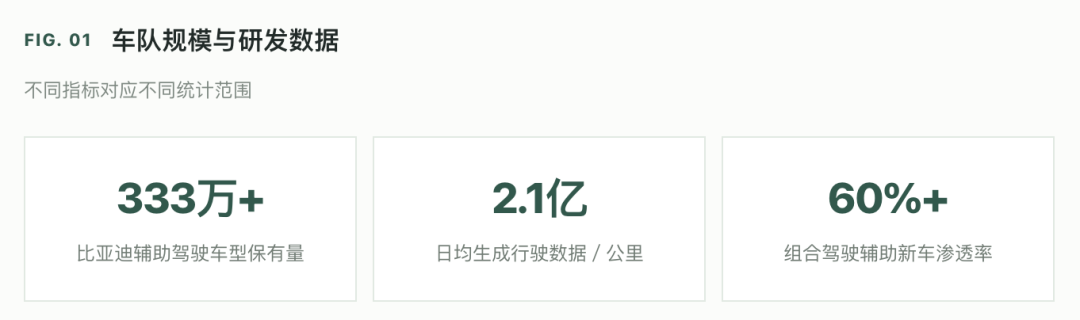
Much like the adoption rate of new energy vehicles, the penetration rate of new vehicles equipped with integrated driving assistance systems in China has exceeded 60%, transforming intelligent driving from an optional extra to a must-have feature. Consumers now factor it into their price comparisons, and it has been added as a new line item on vehicle specification sheets.
BYD’s semi-annual report disclosed that as of the end of June, the number of vehicles equipped with advanced driving assistance systems had surpassed 3.33 million, with the “Divine Eye” system generating over 210 million kilometers of data daily.
The scale of the intelligent driving vehicle fleet determines the diversity of road types, traffic participants, and abnormal scenarios that a company can encounter.
Mileage alone does not equate to capability. Companies must sift through vast amounts of daily driving data to identify valuable training segments, pinpoint the reasons for failures, update models, and then use simulation, testing environments (such as specific venues), and road testing to verify these changes.
While repetitive road conditions provide a statistical basis, rare and dangerous scenarios truly test the skills of screening and validation. More data does not necessarily translate to more useful data. The dense mix of pedestrians and vehicles, non-motorized traffic, and complex intersections in Chinese cities offers unique training material for model development.
Leveraging this scale, BYD included a commitment to urban navigation safety in its semi-annual report, becoming the first automaker globally to provide dual guarantees for urban navigation and intelligent parking.
The key to monetizing this scale lies in whether experiences can be translated into improvements in the next software version.
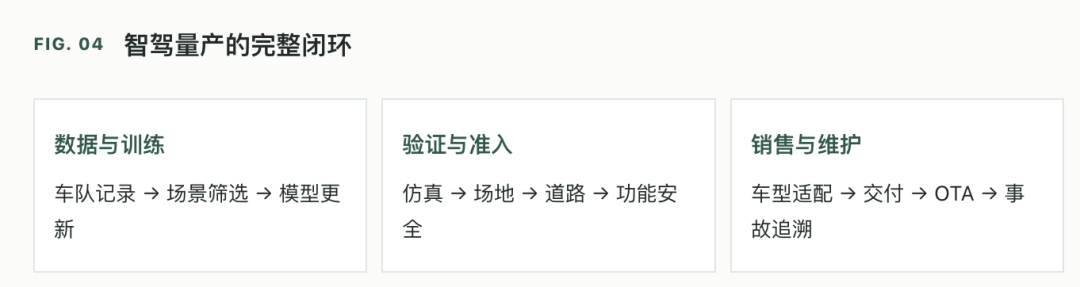
Why has the development of intelligent driving increasingly become an issue of organizational productivity, requiring algorithms, data, chips, vehicle control, and testing teams to focus on the same problem?
A single model update can trigger changes in braking that simultaneously affect safety, comfort, and user trust. The mass production team must address all these impacts collectively.
The industry summarizes the competitive elements as data, algorithms, and computing power. However, the ability to continuously iterate these three elements together hinges on organizational capability. Single-point breakthroughs cannot sustain mass production.
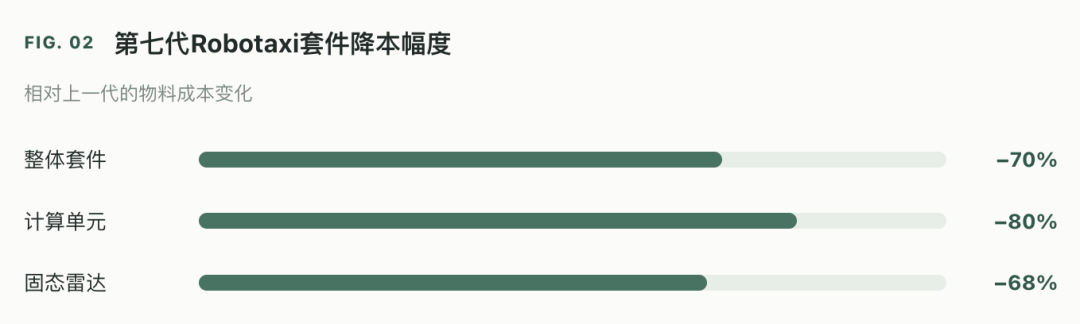
China’s supply chain has demonstrated its cost-reduction prowess, initially in the Robotaxi sector.
Pony.ai’s seventh-generation autonomous driving kit reduced material costs by 70% compared to the previous generation, with computing units decreasing by 80% and solid-state LiDAR by 68%. Cost reduction requires overcoming several hurdles, including sensor selection, computing platforms, vehicle-grade reliability, procurement, and vehicle integration.
Only when suppliers and automakers can collaborate on solutions can redundant hardware be eliminated while maintaining product performance. Cost amortization relies on volume. As scale increases, research and validation expenses can be spread across more vehicles.
This capability enables intelligent driving to be incorporated into lower-priced vehicles. However, the trade-off is that profitability pressures are simultaneously transmitted back to companies.
With features included with the vehicle, consumers pay less in software fees, but hardware, research and development, cloud training, and after-sales expenses remain on the automakers’ books. Selling vehicles is not profitable, and maintaining them incurs costs. Each additional vehicle sold brings both more revenue and more future software maintenance responsibilities.
Cui Dongshu from the China Passenger Car Association disclosed that from January to July this year, the automotive industry’s profit was 216.2 billion yuan, a year-on-year decrease of 20%, with a sales profit margin of 3.6%. In July alone, the profit margin dropped to 2.4%, the lowest for the same period since 2022. Price wars and technological investments have not translated into increased profits.
L3 mass production is turning safety verification into a more explicit market entry requirement.
In December 2025, the Ministry of Industry and Information Technology conditionally approved two vehicle models equipped with L3 functions from Changan and ARCFOX. The approved functions are constrained by specified roads, operating conditions, and maximum speeds, with designated entities conducting on-road pilot testing. Market entry is progressing along specific vehicle models, functions, and operating ranges.
GB 44721—2026 “Safety Requirements for Autonomous Driving Systems of Intelligent Connected Vehicles,” released on July 30, 2026, will be implemented on July 1, 2027, applicable to vehicles equipped with L3 and L4 systems.
The standard covers requirements for driving tasks, system backup response, and human-machine interaction, with safety verified through simulation, testing environments, and road testing.
For companies, entering the L3 market requires simultaneously building capabilities in safety management, testing and validation, and product operation monitoring.
Part 2: Division of Labor and Global Expansion: Who Can Sustain Delivery?
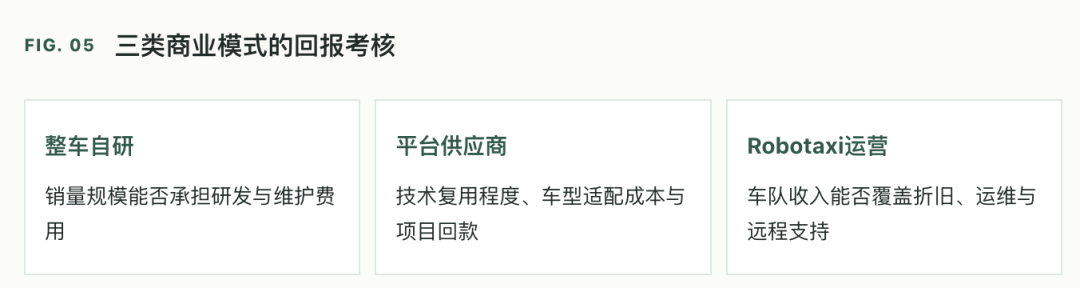
In-house development by OEMs is suitable for companies with sufficient sales volume, R&D resources, and product integration needs.
In-house development enables tighter coordination between intelligent driving, vehicle control, cabin interaction, and product planning. However, it also requires companies to continuously invest in teams and technology roadmaps. When sales volume is insufficient, the R&D expenses allocated to each vehicle will be higher.
Platform suppliers rely on multiple clients and models to amortize development costs.
Huawei, Momenta, and Horizon Robotics compete in segments such as complete vehicle solutions, driving software, and computing platforms, respectively.
Their opportunities arise from automakers’ demand for mass production efficiency. Their operational quality depends on the degree of technology reuse, adaptation costs, and client structure. As solutions mature, suppliers must also strive for more stable licensing and service revenues.
Robotaxi returns are calculated based on operational results.
Vehicle purchase, depreciation, insurance, cleaning, energy replenishment, maintenance, and remote support must all be covered by fleet revenues. Order density, empty travel distance, and daily operational hours directly impact the operational results in a city.
Summary
In simple terms, while everyone is making progress in this round of advanced driving assistance systems, the competitive moat lies in continuing the intense competition. However, commercial returns are lacking. If you believe there is a competitive moat, continue forging ahead. If not, you may slow down, as the benefits of continued investment are minimal!
-
![]()
Can Beijing Hyundai's Ioniq V Disrupt the New Energy Vehicle Market?
-
Token Export: A New Frontier in Business Opportunities
-
![]()
UBS: Chinese Automakers March into Europe, Replicating Japan's Playbook from 50 Years Ago?
-
Why Are iPhones So Popular? It’s Not About Showing Off
-
![]()
Does China’s Intelligent Driving Sector Possess a Competitive Moat? Who Will Survive the Intense Competition?
-
![]()
Don't Push Mathematicians Too Hard, AI
-
![]()
AI Phones: The Challenge of Breaking Through Ecosystem Barriers
-
![]()
The Differences Between Kimi and DeepSeek Are Becoming More Pronounced