Actual Controller Imprisoned! Raisecom's Private Network Communication Case Concludes with First-Instance Verdict
 09/16 2026
 342
342
Recently, the first-instance verdict has been delivered in the 'private network communication case' involving Raisecom's (603803.SH) actual controller. Both Li Yuejie, the company's actual controller, and Zhu Chuncheng, a director, have been sentenced to one and a half years in prison.
Securities Star observed that despite the criminal ruling being finalized, Raisecom has been grappling with losses. Due to factors such as reduced operator investments and pricing pressures from centralized procurement, the company's traditional broadband business has witnessed a decline in both revenue and gross profit margins. Additionally, increased asset impairment losses have further eroded its current net profit. Amidst the communications industry's shift towards computing power, Raisecom is focusing on innovative ventures such as government and enterprise digitalization, as well as operator digitalization. However, the growth in performance from these sectors remains constrained, making it challenging to significantly boost revenue in the short term. Amidst these ongoing losses, the company has also been subjected to 'clearance-style' reductions in shareholder holdings.
01. Actual Controller and Director Both Receive Prison Sentences
The announcement disclosed that Raisecom directors Li Yuejie and Zhu Chuncheng received 'Criminal Judgments' from the court, both being sentenced to one year and six months in prison for the crime of illegally disclosing important information, along with fines amounting to 1 million yuan each.
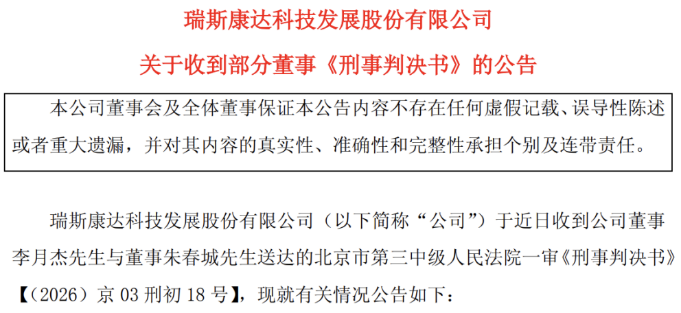
It is worth noting that Li Yuejie and Zhu Chuncheng were initially co-actual controllers of Raisecom, with their concerted action agreement set to expire on April 20, 2025, and not to be renewed thereafter. Li Yuejie and Ren Jianhong have since signed a new 'Concerted Action Agreement,' designating Li Yuejie and Ren Jianhong as the new actual controllers of the company.
Prior to the announcement of the first-instance verdict (in June 2026), Li Yuejie resigned from his positions as chairman and legal representative of the company, with Han Meng assuming these responsibilities. Subsequently, in July, Song Xianjian, a company director and deputy general manager, resigned for personal reasons.
Securities Star noted that the criminal case's roots can be traced back to 2018. According to the China Securities Regulatory Commission (CSRC) investigation, starting in 2018, Raisecom utilized its wholly-owned subsidiary Shenlan Xuntong as a platform for private network communication business operations. It managed upstream and downstream contract signing and raw material procurement with enterprises controlled or designated by Sui Tianli, the actual controller of Haigao Communication.
However, Shenlan Xuntong's private network communication business was, in reality, a false self-circulating operation. Shenlan Xuntong joined the private network communication business chain under the guise of a production enterprise but essentially functioned as a funding provider. It paid substantial advance payments to upstream suppliers while only collecting minimal advance payments from downstream customers. After delivery, downstream customers would pay the remaining balance to Shenlan Xuntong, thereby providing advance funds for Sui Tianli's side.
In terms of business model, Raisecom operated on a 'production based on sales' principle, initially signing sales contracts with downstream parties. Subsequently, it back-calculated procurement unit prices based on pre-agreed gross profit margins and signed procurement contracts with upstream parties in matching quantities. These actions led to false records in Raisecom's 2019 and 2020 annual reports, with the company cumulatively inflating revenue by 633 million yuan and total profit by 117 million yuan over the two-year period.
The case took nearly three years to resolve, involving regulatory and judicial authorities. In November 2022, the CSRC initiated an investigation into Raisecom for suspected illegal information disclosure. In September 2023, the CSRC issued an 'Administrative Penalty Decision,' imposing fines on the listed company and related personnel. In July 2025, public security authorities took criminal enforcement measures against Li Yuejie and director Zhu Chuncheng, culminating in the recent first-instance verdict.
02. Broadband Network Business Continues to Decline
As a provider of optical network products and system solutions, Raisecom primarily offers customers solutions and technical services for information and communication infrastructure construction, as well as digital and intelligent transformation and upgrading.
Securities Star observed that the company's performance has been lackluster in recent years. In 2023, affected by reduced downstream industry investments and intensified competition, the company's revenue declined. Simultaneously, factors such as factory relocations driven by policy changes and impairment of long-term equity investments in joint ventures resulted in losses that have persisted to the present.
In the first half of 2026, Raisecom's revenue showed signs of recovery, yet the company remained unprofitable. During this period, revenue reached 656 million yuan, up 21.71% year-on-year, while net profit attributable to shareholders was -4.5473 million yuan, with the loss narrowing year-on-year. Despite profitability in the first quarter, the company's first-half loss was primarily attributed to the second quarter, which incurred a net loss of 11.3894 million yuan.
By business segment, during the reporting period, revenue from transmission equipment, data communication equipment, broadband network equipment, and software products was 210 million yuan, 118 million yuan, 112 million yuan, and 111 million yuan, respectively, accounting for 32.03%, 18%, 17.03%, and 16.92% of total revenue.
Among these, broadband network equipment, as a traditional pipeline business, has experienced a continuous decline in resource allocation within operators, with significant reductions in related centralized procurement scale, pricing, and frequency, further constraining the market space for traditional broadband products. Against this backdrop, the company's broadband network equipment business revenue declined by 2.5% year-on-year, with the business gross profit margin at 9.19%, a sharp drop of 13.37 percentage points year-on-year. Dragged down by this business, the company's first-half consolidated gross profit margin was 42.42%, down 1.42 percentage points year-on-year.
In addition to the declining gross profit margin, asset impairment losses have significantly impacted Raisecom's net profit. As of the end of June 2026, the company's accounts receivable and inventory stood at 650 million yuan and 655 million yuan, respectively, together accounting for over 77% of current assets, a relatively high proportion. During the same period, the company's credit impairment losses and asset impairment losses were 10.6711 million yuan and 12.4544 million yuan, respectively, up 157.69% and 647.36% year-on-year.
Amidst these ongoing losses, Raisecom's cash flow performance has also been a cause for concern. In the first half of 2026, the net cash flow generated from operating activities was -60.712 million yuan, continuing to be in a 'bleeding' state.
03. Government and Enterprise Business Fails to Significantly Boost Revenue
In the first half of 2026, as growth in mobile internet data consumption slowed and competition in the domestic operator market intensified, the competitive landscape in the communications equipment segment where Raisecom operates became increasingly challenging.
Specifically, in the first half of 2026, the communications equipment industry, driven by AI computing infrastructure, exhibited characteristics of 'rising volume and prices with structural differentiation,' with explosive growth in the optical communications industry chain and accelerated commercialization of 5G-A. However, traditional telecom revenue faced pressure, and the industry underwent a profound transformation from 'connection construction' to 'computing power empowerment.'
Securities Star noted that while maintaining steady development in traditional operator market businesses, Raisecom is focusing on expanding into the government and enterprise business market, as well as innovative businesses such as operator digitalization ICT.
In the first half of 2026, Raisecom Digital, as the core carrier of Raisecom's government and enterprise business, deepened its presence in key industries such as power and transportation, achieving year-on-year revenue growth. However, this business currently has a relatively small revenue scale, with limited contribution to the company's overall performance. The half-year report showed that Raisecom Digital's revenue was 39.2614 million yuan, accounting for less than 6% of total revenue, with a net loss of 3.1219 million yuan for the period.
In terms of innovative businesses, Raisecom is closely following operators' investment directions to create a 'second growth curve,' focusing on innovative technologies and products such as data center switches, DCI-BOX, quantum OTN, and FTTR. However, as mentioned in the company's response to the 2025 annual report inquiry letter, due to the impact of research and development, testing, and promotion cycles, related products have not yet made significant performance contributions.
Securities Star also noted that amidst these ongoing losses, Raisecom has faced 'clearance-style' reductions in shareholder holdings. Relevant reduction announcements showed that from May to August 2026, shareholder Feng Xuesong reduced his stake in the company by a total of 8.303 million shares, or 1.95%, through concentrated bidding transactions and block trades, cashing out a total of 86.2697 million yuan. After this round of reductions, Feng Xuesong no longer holds any shares in the company. (This article is first published by Securities Star, author | Li Ruohan)
- End -
-
![]()
Volkswagen Group 'Downsizes' in a High-Stakes Gamble for Survival
-
![]()
Official Announcement: Seres Reclaims Leadership of AITO Brand from Huawei!
-
![]()
Only Three Traditional Fuel Models Make the Cut: A Review of SUV Sales in August
-
Hillhouse and Lei Jun Place Their Bets! Jinzhwei Racks Up 640 Million Yuan in Cumulative Losses Over Three and a Half Years—Can It Stage a Turnaround with AI Agents?
-
![]()
"Taiyi Shenglian": Can It Reforge Nezha’s Golden Form?
-
The Fastest Runner Hits the Brakes First: The AI Safety Business Finally Finds Its Payers
-
![]()
What Signals Are Sent by This Major Collaboration Between FAW and GAC?
-
![]()
FAW and GAC Forge Alliance, Charting a Win-Win Path for China's Auto Industry Across Regions