What Signals Are Sent by This Major Collaboration Between FAW and GAC?
 09/16 2026
 377
377
A New Model for Central-Local SOE Integration in the Automotive Sector
A single announcement has sparked significant industry attention by revealing a landmark transaction.
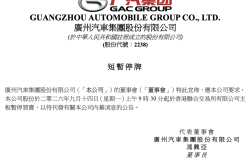
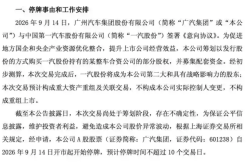
On the evening of September 14, Guangzhou Automobile Group Co., Ltd. (hereinafter referred to as "GAC Group") officially issued the "Announcement on the Suspension of Trading for Planning Major Asset Restructuring" (hereinafter referred to as the "Announcement"). The announcement revealed that on the same day, GAC Group signed a Letter of Intent with China FAW Co., Ltd. (hereinafter referred to as "FAW Co., Ltd.") to acquire a portion of the equity in a joint-venture automotive company held by FAW Co., Ltd. through the issuance of shares, along with raising supporting funds. Preliminary estimates indicate that upon completion of this transaction, FAW Co., Ltd. will become GAC Group's second-largest and strategically influential shareholder. However, the exact number of shares FAW Co., Ltd. will hold in GAC Group will only be determined after both parties sign the formal agreement.
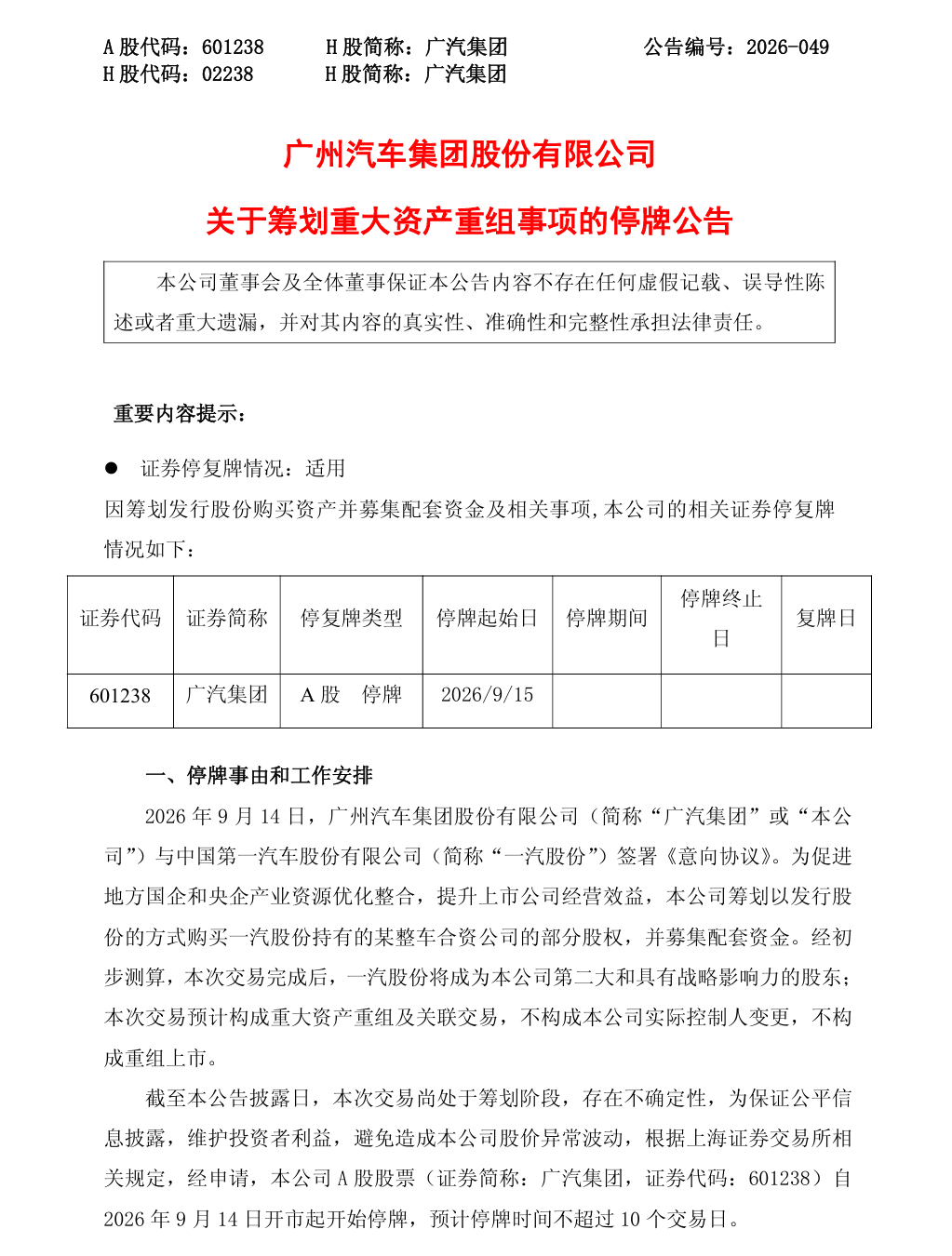
The announcement did not disclose the name of the target company, but sources close to FAW Co., Ltd. revealed to the media that the target company is likely FAW Toyota. This suggests that FAW Co., Ltd. will contribute a portion of its equity in FAW Toyota, which GAC Group will exchange for newly issued shares. Currently, FAW Toyota's equity structure consists of 50% held by FAW Co., Ltd., 45.7706% by Toyota Motor Corporation, and 4.2294% by Toyota China. Industry insiders speculate that after GAC Group's equity participation, FAW Toyota and GAC Toyota will be integrated to form a new sales entity.
Notably, this collaboration explores a novel approach to central-local SOE integration in the automotive industry, differing from previous methods: it is neither a takeover of local SOEs by central SOEs nor a simple asset transfer, but rather a new method of "issuing shares to purchase assets." Regardless of the final outcome, this will serve as a valuable experiment in China's efforts to promote mergers, acquisitions, and cross-regional integration within the automotive sector.
“Share-for-Share” Exchange: Meeting Mutual Needs
This is a well-conceived "share-for-share" exchange, where GAC Group issues additional A-shares to acquire a portion of the equity in a joint-venture company held by FAW Co., Ltd. In return, FAW Co., Ltd. obtains equity in GAC Group by transferring this portion of joint-venture assets, thereby becoming a shareholder in this listed automotive platform in South China. Both parties stand to achieve complementarity in areas such as market, technology, and products.
For FAW Co., Ltd., exchanging existing joint-venture assets provides a strategic entry point into the industry. According to public data, China FAW's cumulative sales in the first half of the year reached 1.518 million vehicles, with a noticeable gap in the penetration rate of new energy vehicles among its Chinese brands compared to mainstream automakers. GAC Group's strengths in independent brand operation, new energy transition, and overseas exports can precisely complement FAW Co., Ltd.'s shortcomings. Through its shareholder status, FAW Co., Ltd. can form substantive collaborations with GAC Group in areas such as R&D synergy, supply chain sharing, and overseas channels.
For GAC Group, this is also an exploration aimed at improving its current loss-making situation. According to financial report information, GAC Group reported a net loss attributable to shareholders of RMB 8.784 billion in 2025, which widened to approximately RMB 4.467 billion in the first half of 2026. While its independent brands maintained growth, the losses from its joint-venture businesses cannot be overlooked.
Some commentators believe that by introducing FAW Co., Ltd. as the second-largest shareholder, GAC Group is not receiving a direct cash injection but rather the endorsement of central SOE-level resources and policy momentum. Against the backdrop of intensive industry integration policies, the policy influence and resource integration capabilities brought by a central SOE shareholder hold strategic value for GAC Group. Meanwhile, incorporating FAW Toyota would mean that GAC Group's voice within the Toyota system would upgrade from a "Southern partner" to an "integrated platform," directly helping to stabilize Toyota's strategic positioning in China. Notably, according to media reports, before GAC Group released the announcement, Wen Dali, the Party Secretary, Committee Member, Director, and Executive Deputy General Manager of GAC Toyota, as well as Wang Jun, the Committee Member and Deputy General Manager, were both transferred to other positions. This may be preparation for the subsequent integration between the two parties.
Exploring a New Path for "Central-Local" Integration
From an industry perspective, this collaboration extends beyond simply complementing the strengths and meeting the needs of the two automakers.
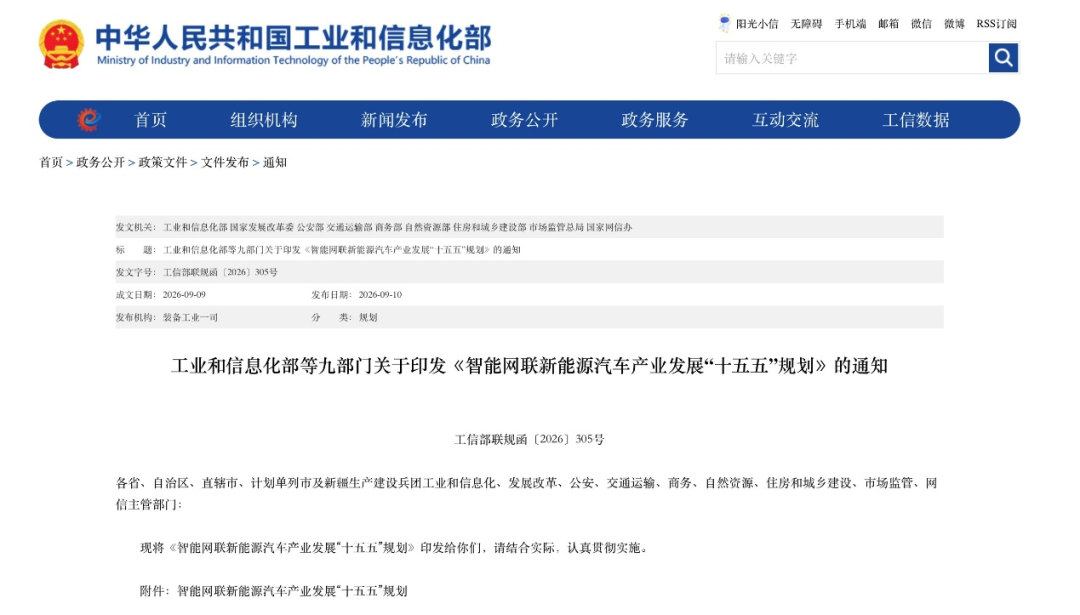
On September 11, nine departments including the Ministry of Industry and Information Technology released the "15th Five-Year Plan for the Development of the Intelligent Connected New Energy Vehicle Industry," explicitly proposing to increase the intensity of mergers, acquisitions, and cross-regional integration of automotive enterprises in accordance with the law, and to deeply promote the reform of group management in automotive production enterprises. On the same day, at a press conference held by the Ministry of Industry and Information Technology, Shao Ji, Deputy Director-General of the Industrial Development Department of the National Development and Reform Commission, stated that they would actively support large enterprise groups in carrying out reforms, promote mergers and acquisitions between enterprises in a market-oriented and law-based manner, and support key enterprises in effectively integrating R&D, production, and other resources to avoid homogeneous competition in product design and technological R&D.
The restructuring between GAC Group and FAW Co., Ltd. is a beneficial attempt in this context. Since the automotive industry entered a new era of high-quality development, China has been actively promoting mergers, acquisitions, and resource integration among automotive enterprises to improve industrial development efficiency and help create a number of world-influential automotive groups. While there have been precedents for central SOE restructurings, successful cases are rare. This time, through the method of "issuing shares to purchase assets," FAW Co., Ltd. enters GAC Group as a strategic shareholder, achieving deep binding while maintaining GAC Group's independent operation. This will undoubtedly be a positive exploration for the restructuring and integration of the automotive industry.
Its exemplary significance lies in providing a template for central-local integration with less resistance and stronger operability. Both parties retain their brand and operational independence, achieving synergy in R&D, procurement, and production capacity through equity ties, rather than undergoing a high-friction merger at the organizational structure level. On the other hand, if the integration of North and South Toyota proceeds smoothly as industry speculation suggests, Toyota will form a unified sales and product planning system in China, reducing internal friction from "twin models." This also serves as a reference for other foreign brands with multiple joint ventures in China. However, the extent to which this strategy can be successfully implemented remains to be seen.
Uncertainties Remain
As stated in the announcement, this transaction is still in the planning stage and is subject to uncertainties. Currently, both parties have signed a Letter of Intent, and the formal transaction agreement has not yet been signed. Specific equity ratios, pricing, and governance arrangements are subject to change. Moreover, since the target assets involve an overseas listed company, the delayed disclosure itself indicates the complexity of the transaction structure.
Li Yanwei, an expert from the China Automobile Dealers Association, publicly stated that further integration between the two parties still faces multiple challenges. For example, issues such as the relationship between central and local state-owned assets, who holds actual control, where the headquarters and tax revenues will be located, and who will make major investment decisions will directly affect the depth of restructuring and synergy between the two parties. On the other hand, there is significant overlap in joint-venture assets, and changes in capital relationships at the group level may affect joint-venture agreements, related-party transactions, technological boundaries, and competition governance.
Regarding the industry's speculation about the "merger of North and South Toyota," some industry experts have expressed concerns. They believe that North and South Toyota have long operated with dual entities and dual channels, and their two independent dealer networks have formed their respective interest patterns. Channel integration means that the interests of some dealers may be redivided, and the resistance should not be underestimated. In addition, how to smoothly transition the user reputations and service systems accumulated by FAW Toyota and GAC Toyota will also be a major test for this collaboration.
Regardless of the outcome, the collaboration between FAW Co., Ltd. and GAC Group, by applying the tool of "issuing shares to purchase assets" to the strategic restructuring between central and local SOEs in the automotive industry, represents a new paradigm of "exchanging assets for equity and promoting joint operations through equity." This is no longer a simple "merger" or "takeover," but rather an attempt to achieve deep synergy through equity ties while maintaining the independent operation of both parties. It provides a "third path" exploration sample for the integration of China's automotive industry and is highly likely to become an exemplary case of equity-based joint operations with landmark significance in the history of China's automotive industry.

Image: Sourced from the Internet
Article: Auto Review
Layout: Auto Review
-
Apple’s iPhone Duo: Is a Chinese Company the Key to Its Success?
-
![]()
FAW Set to Become GAC’s Second Largest Shareholder
-
![]()
Toyota and Audi Harmonize Structures, Joint Venture Brands Bid Adieu to the 'One Fish, Two Dishes' Era
-
![]()
Volkswagen Group 'Downsizes' in a High-Stakes Gamble for Survival
-
![]()
Official Announcement: Seres Reclaims Leadership of AITO Brand from Huawei!
-
![]()
Only Three Traditional Fuel Models Make the Cut: A Review of SUV Sales in August
-
Hillhouse and Lei Jun Place Their Bets! Jinzhwei Racks Up 640 Million Yuan in Cumulative Losses Over Three and a Half Years—Can It Stage a Turnaround with AI Agents?
-
![]()
"Taiyi Shenglian": Can It Reforge Nezha’s Golden Form?