Why Can Foldable Screens Fold? The Secret Lies in These Two Layers
 09/28 2026
 495
495
What enables the foldable screen phone in your hand to withstand hundreds of thousands of bends?
01 Why Does Glass Bend?
Ordinary glass shatters easily, but the ultra-thin flexible glass (UTG) used in foldable screens is just 30 microns thick—about one-third the width of a human hair.
When materials bend, the outer side deforms more severely. For the same bending radius, thicker materials experience greater surface strain. Thinning the glass significantly reduces the flexibility required for bending.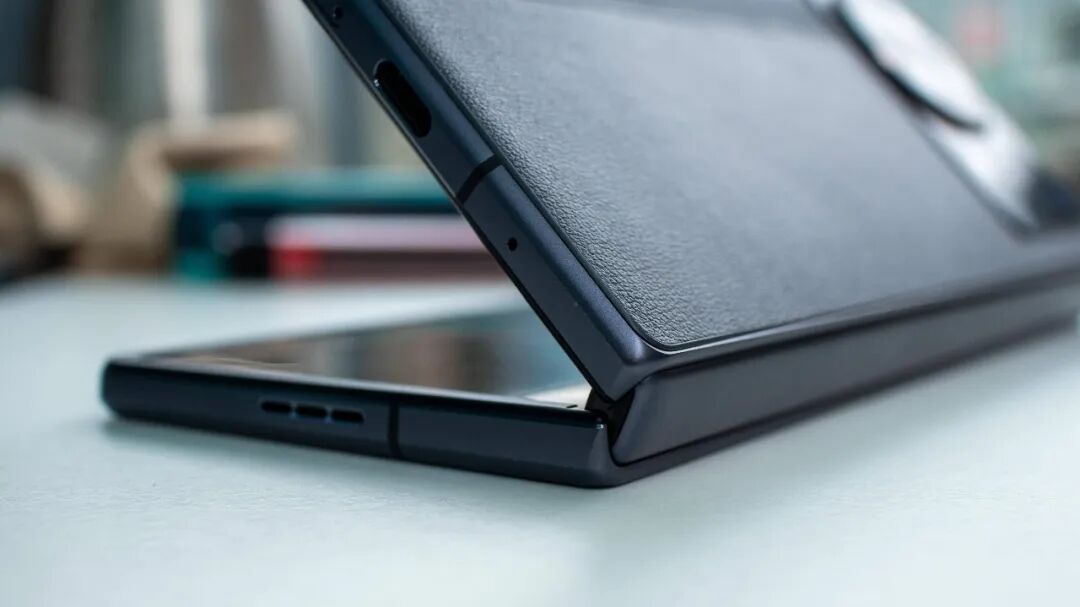
Image source: Internet
But thinness alone isn’t enough.
Engineers also employ ion-exchange strengthening technology, replacing smaller ions on the glass surface with larger potassium ions to create a layer of compressive stress that presses inward.
This compressive stress layer acts like a tight-fitting suit for the glass, preventing tiny cracks from opening and spreading.
02 Hinges Make Screens Fold Smoothly
Glass can bend, but the hinge determines how and to what arc it bends.
Early foldable screens used U-shaped hinges, causing sharp bends and deep creases. Later, waterdrop-shaped hinges became mainstream, creating a curved space resembling a water droplet when folded, expanding the bending radius from 2-3mm to 4-6mm.
Slower bending distributes stress more evenly, naturally reducing creases. The hinge itself is a precision mechanism. Take the OPPO Find N6, for example: its bionic symmetrical four-axis structure, combined with chip-level 3D printing technology, improves the flatness of key hinge components by 75%.
Huawei optimizes crease performance in a more compact body through the dual-rail linkage design of its TianGong hinge system.
03 Why Are Creases Fading?
Creases are essentially irreversible deformations accumulated in the bent area of the screen.
Beyond the waterdrop hinge’s stress dispersion, material advancements also play a role.
The Celestial Memory Glass on the OPPO Find N6 uses deep chemical strengthening, boosting bending resistance to 338% of traditional flexible glass. It achieves 99.9% shape self-repair after bending, with creases quickly fading when unfolded. Durability benchmarks are also rising.
Samsung Display has increased its internal bending test standard from 200,000 to 500,000 cycles, meaning a typical user opening/closing 100 times daily could theoretically use it for over 10 years.
Extreme testing for leading products has reached 2 million bends.
From 30-micron glass to hinges expanding the bending radius from 2mm to 6mm, and self-repairing coatings—foldable screens can bend not because of a single magical material, but because glass, hinges, and coatings simultaneously push engineering limits.
#FoldableScreenPhones
-
![]()
Detailed Explanation of Zhuoyu ZYT World: While the Industry is Still Reviewing Recordings, Zhuoyu has Already Thrown AI into the 'GTA World' for Driving Practice
-
![]()
Beware the High Estimated Price Trap When Trading In Your Old Phone
-
![]()
Why Can Foldable Screens Fold? The Secret Lies in These Two Layers
-
![]()
Dissecting NVIDIA's Latest Autonomous Driving World Model: AlpaDreams
-
![]()
Has End-to-End Technology, Having Evolved to Its Present State, Still Left Edge Scenarios as an Insurmountable Challenge for Autonomous Driving?
-
![]()
Exploring Doubao: What Can the Current In-Cabin Large Model Really Do?
-
![]()
Final Decision: Why Are There So Many New Car Launches Prior to the Mid-Autumn and National Day Holidays?
-
![]()
The Era of Performance Involution Is Over! Domestic Flagship Phones Shift Focus from Benchmarks to Imaging and On-Device AI as Key Differentiators