Double 11 Growth Strategies Amidst Fading Tax Breaks and Scaled-Back Subsidies
 10/12 2026
 422
422
The 18th Double 11: Precision Strategies in the Post-Boom Era
Author|Yixiu
Editor|Xiaobai
Illustrations|AI Generated
Produced by|Qiangdiao Next
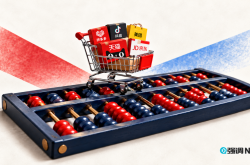
JD.com's Double 11 flash sales officially commence today, setting the stage for this year's grand shopping event. Tmall will launch its pre-sales on October 15th, followed by flash sales on the 20th. The 18th iteration of Double 11 has transformed into a shopping extravaganza spanning over a month. By the time November 11th rolls around, many shoppers may have already received and unwrapped their purchases, leaving them with fewer purchasing decisions to make. Tmall continues to offer direct official discounts, while Douyin maintains straightforward single-item discounts and a 15% official price reduction. Platforms are reducing the reliance on group-buying strategies (where shoppers combine orders to meet discount thresholds), but the competition for orders remains fierce. From January to August this year, nationwide online retail sales of goods saw a 4.3% increase, with only a 1.1% rise in consumable goods. With major promotions starting earlier, consumers' wallets aren't getting any thicker.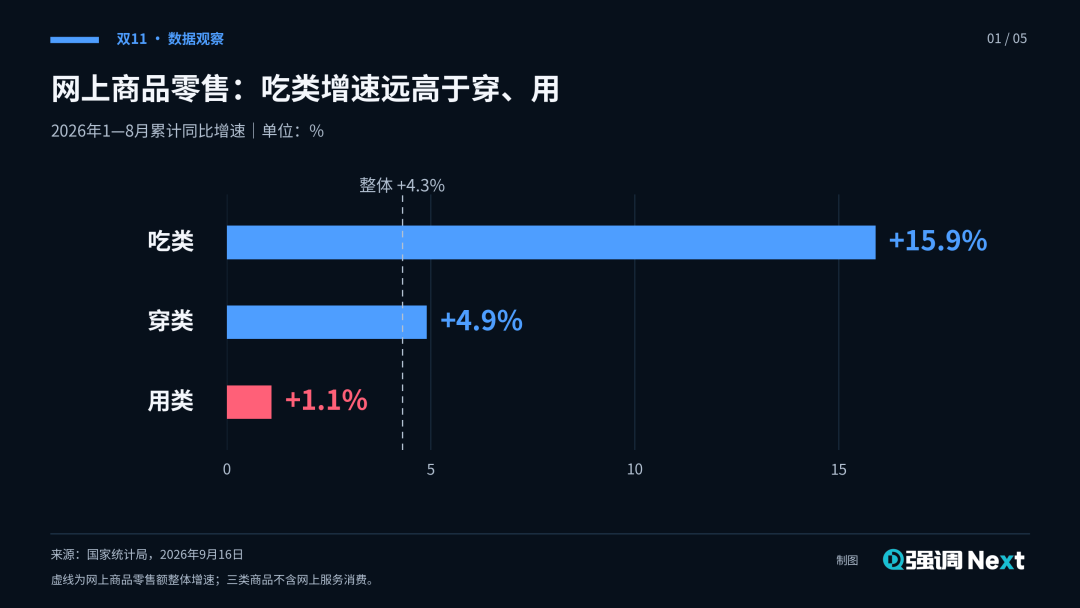
This year's more notable changes are occurring behind the scenes for merchants.
Platform subsidies are now tied to advertising investments, content platforms allocate traffic based on settlement performance, and AI is starting to play a role in shopping guides and product placements. Taobao and JD.com aim to sustain transaction volumes, while Douyin and Xiaohongshu strive to convert more content traffic into actual orders.
This Double 11 season revolves around where consumers complete their purchases and how much merchants are willing to invest in these transactions.
Platforms Provide Subsidies, Merchants Allocate Budgets
Official discounts directly impact product prices—and costs. Tmall's required discounts are shouldered by merchants, with some offers being stackable. Suppose a product sells for 100 yuan with a cost of 70 yuan. If the merchant bears a 15% discount, the gross profit drops from 30 yuan to 15 yuan. To maintain the same total gross profit, sales must double, not accounting for advertising and fulfillment expenses.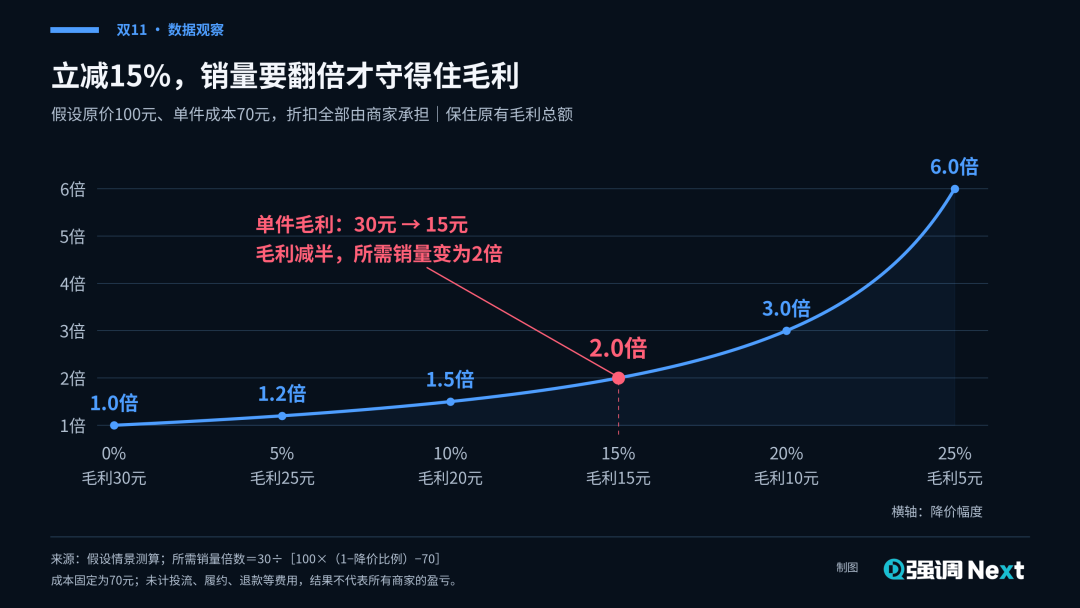
Merchants need orders, and platforms offer support but with specific conditions attached.
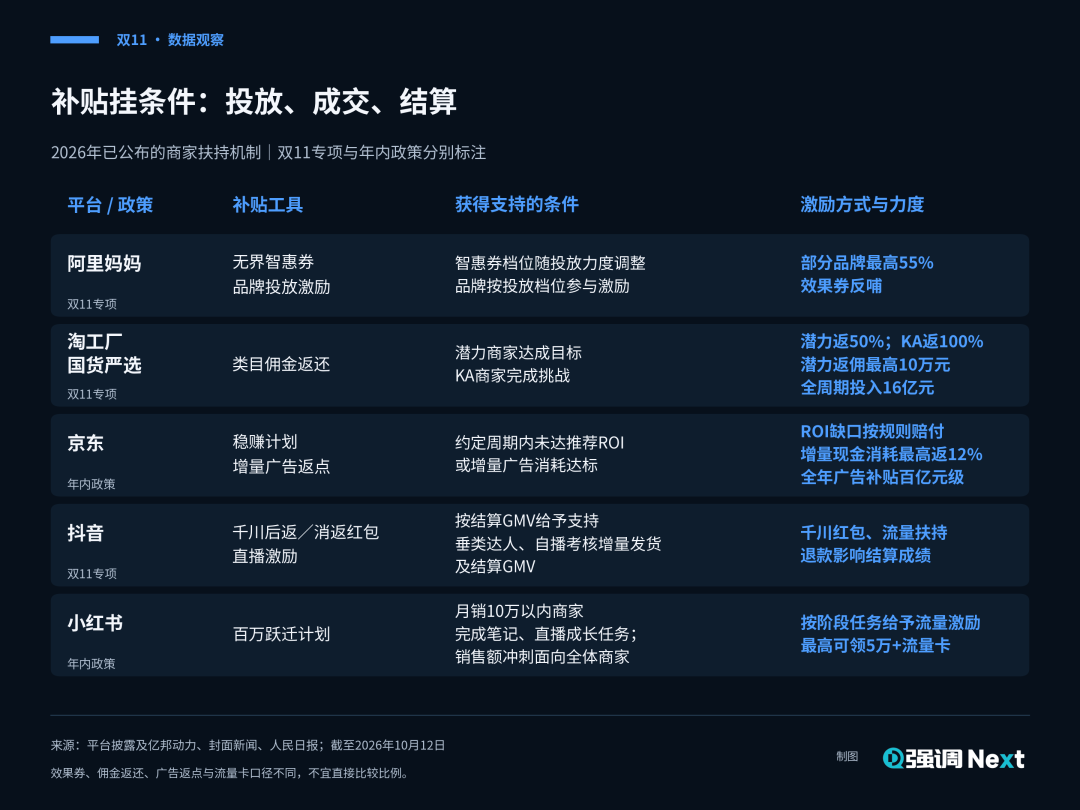
Among the 1.6 billion yuan in full-cycle investments announced by Taobao Factory and Guohuo Yanxuan, potential merchants meeting certain standards can receive a 50% refund on category commissions, while key account (KA) merchants who succeed in challenges can receive a full refund.
Alibaba's Moments' "Boundless Smart Coupons" for this year's Double 11 determine subsidy tiers based on merchants' advertising investments. Some brands investing at corresponding tiers can receive up to 55% in effective coupon rebates.
Alibaba's Q4 FY2026 earnings report has revealed that subsidies for some merchants are linked to their platform investments, aiming to boost merchants' willingness to invest. This mechanism is being heavily utilized during this year's Double 11 promotions.
JD.com opts to provide guarantees for eligible advertising placements. The annual Chunxiao Plan increases advertising subsidies from the billion-yuan level to the ten-billion-yuan level. The "Steady Profit Plan" compensates for shortfalls in achieving system-recommended target return on investment (ROI) within agreed periods according to rules; if incremental ad spend meets standards, merchants can receive up to a 12% rebate. While promotion rewards (advertising ROI) are guaranteed, product profit remains for merchants to calculate themselves.
Clear revenue changes underlie this strategy. JD.com's self-operated revenue decreased by 5.4% in Q2, while platform and marketing revenue increased by 8.3% to 30.86 billion yuan, with JD.com Retail's operating profit margin reaching 4.6%. The company cites the strong performance of higher-margin service revenue as one contributing factor.
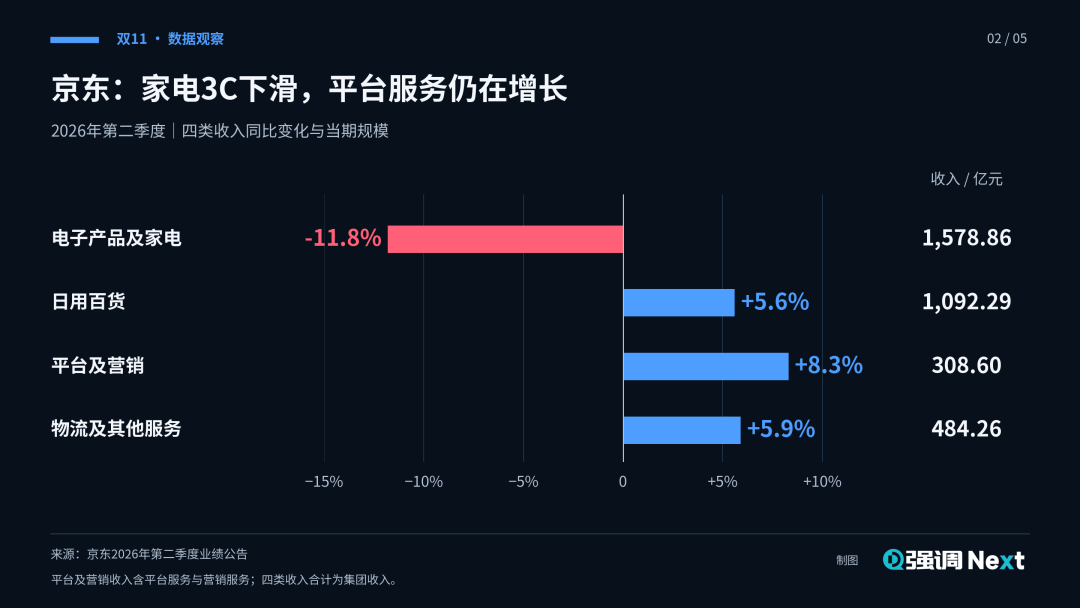
Platforms can boost service revenue contributions when goods sales growth slows. Double 11 is thus both a product promotion and a battle for merchants' budgets. Advertising rebates and investment guarantees are all vying for the same pool of funds.
Douyin Expands Entry Points, Xiaohongshu Aims to Capture Orders Post-Inspiration
Douyin's Double 11 plan this year extends beyond a single app. Platform consumption coupons cover Douyin, Doubao, Hongguo Short Drama, Toutiao, Fanqie Novel, and other ByteDance products, attempting to funnel users from different scenarios into transactions. Its advantage has expanded from short videos stimulating purchase desire to reaching users with products during questions, searches, and daily browsing.
Traffic allocation comes with finer conditions. Some live streaming incentives are issued based on settled gross merchandise volume (GMV); vertical influencers and self-broadcasting merchants must also demonstrate incremental shipping and settlement performance to receive support like Qianchuan consumption return red envelopes. Assessments focus on orders actually shipped and settled, with refunds affecting the rewards merchants ultimately receive.
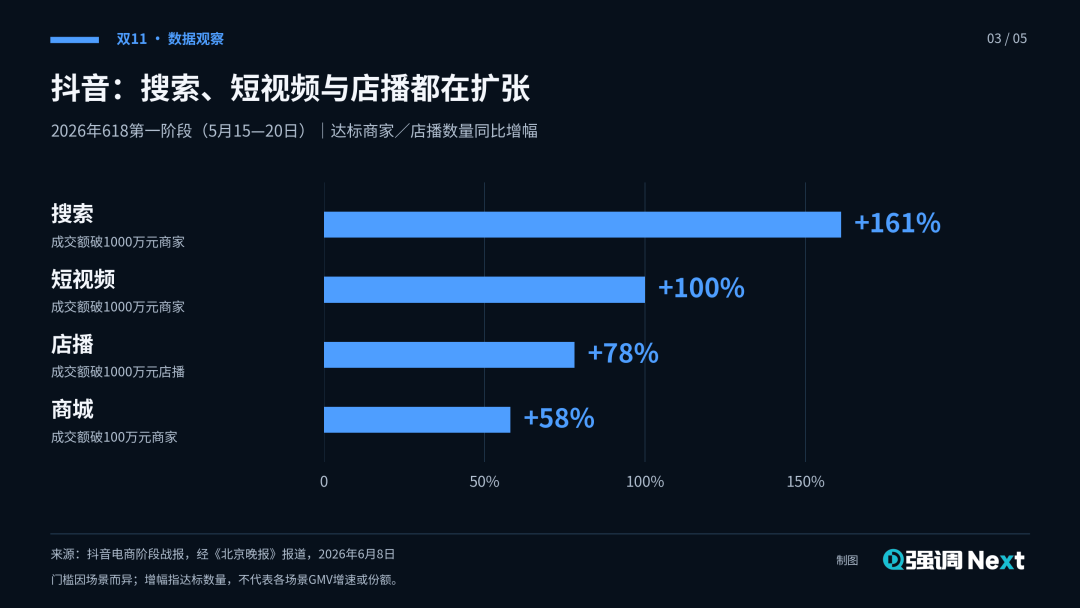
During the first phase of this year's 618, the number of store broadcasts on Douyin with turnover exceeding 10 million yuan increased by 78% year-on-year. Brands broadcasting themselves and the mall handling searches give Douyin the opportunity to extend a purchase inspired by content into the next active search for products. It needs to prove that after users remember a specific live stream room, they are also willing to return to the mall to make purchases.
Xiaohongshu faces different challenges. Users research products here, but orders may go elsewhere.
The "Hongmao Plan" and "Hongjing Plan" already connect notes with Taobao, Tmall, and JD.com. Xiaohongshu disclosed that during last year's Double 11, over 100 single products achieved turnover exceeding 10 million yuan on other e-commerce platforms through "inspiration-to-purchase" links. This shows that inspiration can drive business, but also that transaction platforms still handle crucial conversion steps.
Xiaohongshu gains advertising business through off-site collaborations while building its own markets, buyers, and store broadcasts. Both paths can coexist, but in-site conversion capabilities determine how much transaction value it can retain. For brands, there's no need to relocate mature Tmall or JD.com stores just to acquire users on Xiaohongshu.
In May, Xiaohongshu prematurely terminated the "Million Commission-Free Plan" and introduced the "Million Transition Plan." The official program sets note and live streaming growth tasks for merchants with monthly sales under 100,000 yuan, offering traffic incentives for completing stage goals, with a maximum of over 50,000 yuan in traffic cards. Support has shifted from reducing store opening costs to pushing merchants to continuously publish content, broadcast, and convert sales.
Entering Double 11, Xiaohongshu must validate whether this operating model can capture demand after inspiration. Products like apparel, beauty, and home furnishings can explain differences through styling, ingredients, and usage scenarios, with buyers also helping consumers choose. It doesn't need to chase the lowest prices across all standard products, but recommendations must lead to reliable products and services; otherwise, users will still return to familiar platforms to pay.
AI Begins to Influence Product Visibility
The more new entry points exist, the more critical product recommendation methods become.
Douyin's merchant backend Compass opens a Doubao section for this year's Double 11, supporting inquiries into business scale and high-frequency shopping demands through the Doubao channel. This is closer to operations than simply announcing AI application monthly active users: merchants can finally observe what users ask and how much business this entry point generates.
Taobao's Qianwen Shopping Assistant and JD.com's Intelligent Shopping Guide are doing the same. Consumers used to input keywords and browse product lists; now, they might directly state their budget and purpose. Platforms must decide how to respond, while merchants must ensure their product information is accurate enough to be recommended.
In September, JD.com upgraded its Jingmai AI Operations Center, integrating over 60 tools. According to platform-published controlled tests, materials optimized according to product information standards saw order costs decrease by 15% to 27% compared to ordinary AI-generated materials, with detail page conversion rates increasing by 0.56 percentage points. The platform is already evaluating AI effectiveness based on actual transactions, beyond material quantity.
This evolves competition from "who can generate images" to "who masters product and transaction data." Many similar materials will quickly be replicated by peers, and only systems close to real orders can more easily judge which content drives purchases. The influx of inquiries, clicks, and transactions during Double 11 will accelerate this round of validation.
AI won't automatically free merchants from traffic costs. Store broadcasting reduces some influencer commissions, and digital hosts lower broadcasting costs, but consumers still need to be directed into live stream rooms. Savings may continue to flow into platform advertising. If AI only accelerates material production and budget consumption, merchants' total customer acquisition costs may not decrease.
Instant Retail Competes for High-Value Orders Amidst Thinning National Subsidy Dividends
Instant retail competes over a different shopping process: how long consumers are willing to wait after placing an order.
Taobao Flash Sale and JD.com Instant Delivery already participated in Double 11 last year. Syntun monitored instant retail sales of approximately 67 billion yuan during Double 11 in 2025. To continue competing for this market this year, platforms need to improve their order mix.
Alibaba's latest quarterly earnings report disclosed that while Taobao Flash Sale maintained its market share, unit economic efficiency improved quarter-over-quarter, mainly due to increases in average order value and fulfillment efficiency, with expansion into high-average-order-value catering orders and non-food categories underway. Double 11's digital, beauty, and daily necessities categories provide opportunities to expand non-food orders.
Higher average order values can increase revenue per order, while delivery costs may not rise proportionally with product prices. However, whether nearby stores have stock and can pick items in time determines if an order is ultimately fulfilled. For instant retail, inventory accuracy directly impacts subsidy efficiency.
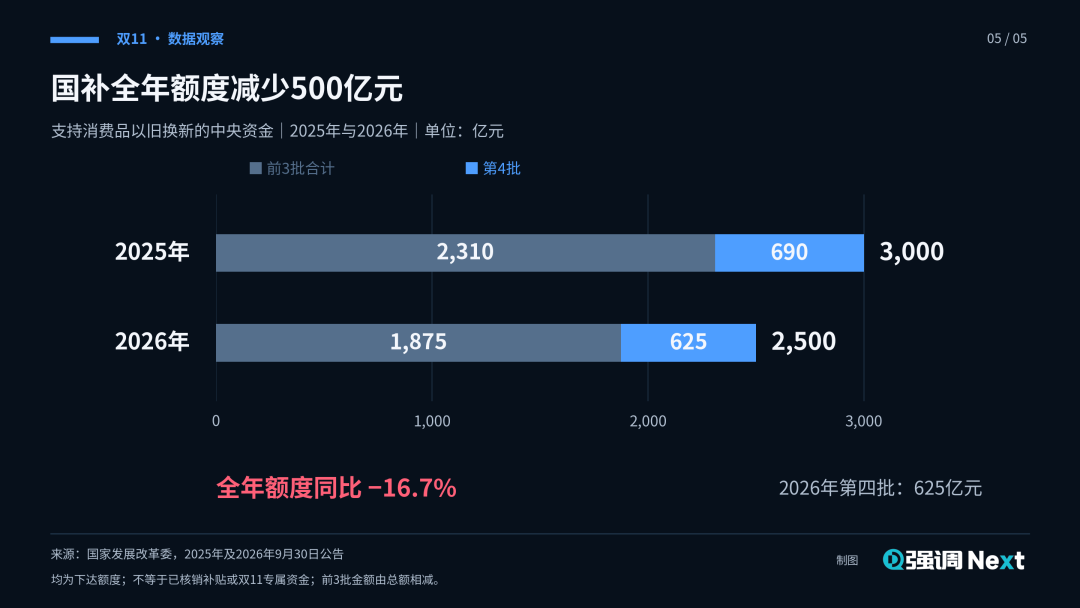
Traditional e-commerce also needs to select increments more carefully. On September 30th, the fourth batch of 62.5 billion yuan in national subsidies was allocated, with all 250 billion yuan in central government funds for the year now in place. Compared to 300 billion yuan in 2025, the total has decreased by about 16.7%.
JD.com's Q2 revenue from electronics and home appliances decreased by 11.8% year-on-year, while revenue from daily necessities increased by 5.6%. The high-base pressure from strongly subsidized categories is already reflected in earnings reports.
This year, JD.com's Double 11 must both accommodate home appliance and 3C upgrades and expand daily category consumption. Taobao has 64 million 88VIP members, offering brand goods and flash sale services to the same user base. Pinduoduo continues to extend support to industrial belts and agricultural regions, striving to maintain price advantages through source supply. Each platform has different strengths and cannot rely on the same subsidies to solve growth issues.
Meituan relies more on local stores and delivery networks. Q2 core local commerce operating profit recovered to 5.67 billion yuan, with a profit margin of 7.9%, still lower than 21% in Q1 2025. This division includes in-store travel and other businesses, so profit recovery doesn't mean instant delivery has thick profits to spend. Increasing non-food orders during Double 11 is an opportunity to improve its revenue structure.
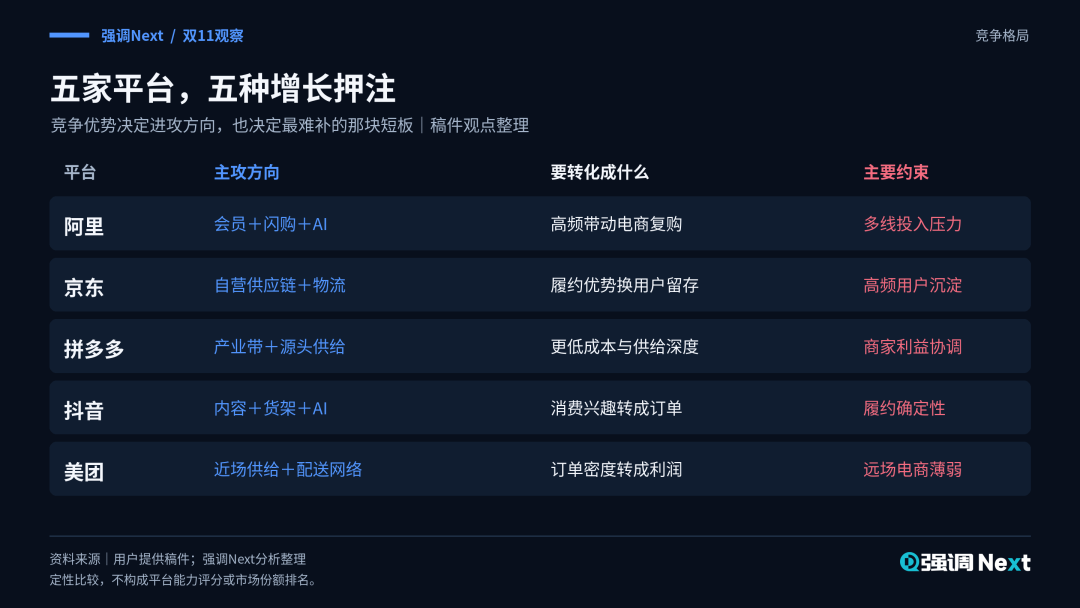
According to earnings call reports, Taobao Flash Sale aims to achieve positive unit economics on a monthly basis by FY2027 and overall profitability by FY2029. This year's Double 11 falls along this profitability path, with order value, fulfillment efficiency, and purchase intent after subsidy withdrawal being more important than a single peak.
After the promotion ends, merchants will also recalculate their orders. How much sales have increased must be viewed alongside advertising, discount, and refund expenses. Platforms can increase service revenue when self-operated sales slow, but merchants must cover these costs with product profits. The same Double 11 growth report may not yield the same results for both sides.
Note: All data in this article comes from public sources and does not constitute investment advice.
- END -
-
![]()
GAC Serves as a Mediator: FAW Toyota and GAC Toyota to Jointly Unlock New Growth Potential for Joint Venture Automakers
-
From Global 'Best' to Continuous Decline: The Systematic Exodus Amid South Korea's Stock Market Plunge
-
![]()
AI Influences New Trends in Mobile Phones, Foldable Screens May Become Mainstream
-
![]()
AI Drives New Smartphone Trends: Foldable Screens Poised for Mainstream Adoption
-
![]()
Surge in 'Cloud Usage' by Agents Prompts Cloud Providers to Shift Strategies
-
![]()
OpenAI and Anthropic Kick Off the 'Model War'
-
![]()
Double 11 Growth Strategies Amidst Fading Tax Breaks and Scaled-Back Subsidies
-
![]()
Revenue Surges to 2.621 Billion with Growth, Yet Profit Slides 15% to 200 Million: How Does Electric Connector Technology Steer Between Consumer Electronics and Automotive Sectors?