FAW Set to Become GAC’s Second Largest Shareholder
 09/16 2026
 522
522
On the evening of September 14, GAC Group released a trading halt announcement, revealing that it had entered into a Letter of Intent Agreement with China FAW Group Co., Ltd. (hereinafter referred to as “FAW”). The agreement outlines plans for GAC to acquire a portion of the equity in a vehicle joint venture currently held by FAW, via share issuance, and to raise supporting funds. Upon completion of the transaction, FAW is set to become GAC Group’s second largest shareholder with strategic influence. This transaction is expected to constitute a major asset restructuring and related-party transaction, without involving a change in the actual controller or a restructuring listing. Trading in GAC Group’s A-shares has been suspended since the market opening on September 15, with the suspension expected to last no more than 10 trading days.
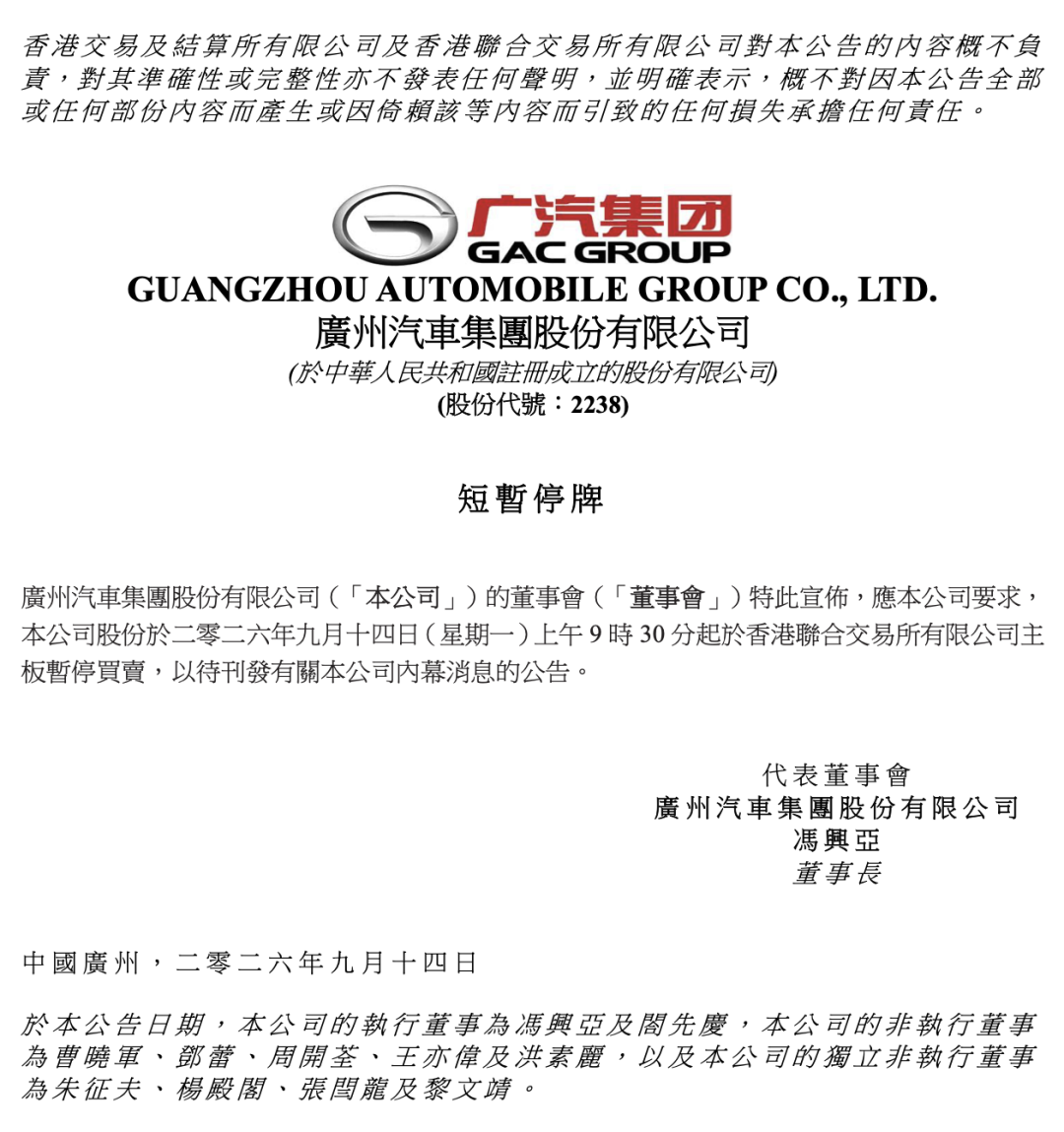
The announcement did not directly reveal the name of the target company, only stating that “due to the involvement of an overseas listed company in this restructuring target, the disclosure of the target asset’s name is temporarily suspended.” However, multiple sources suggest that the target is FAW Toyota Motor Co., Ltd. Currently, FAW holds a 50% stake in FAW Toyota, Toyota Motor Corporation holds 45.77%, and Toyota China holds 4.23%.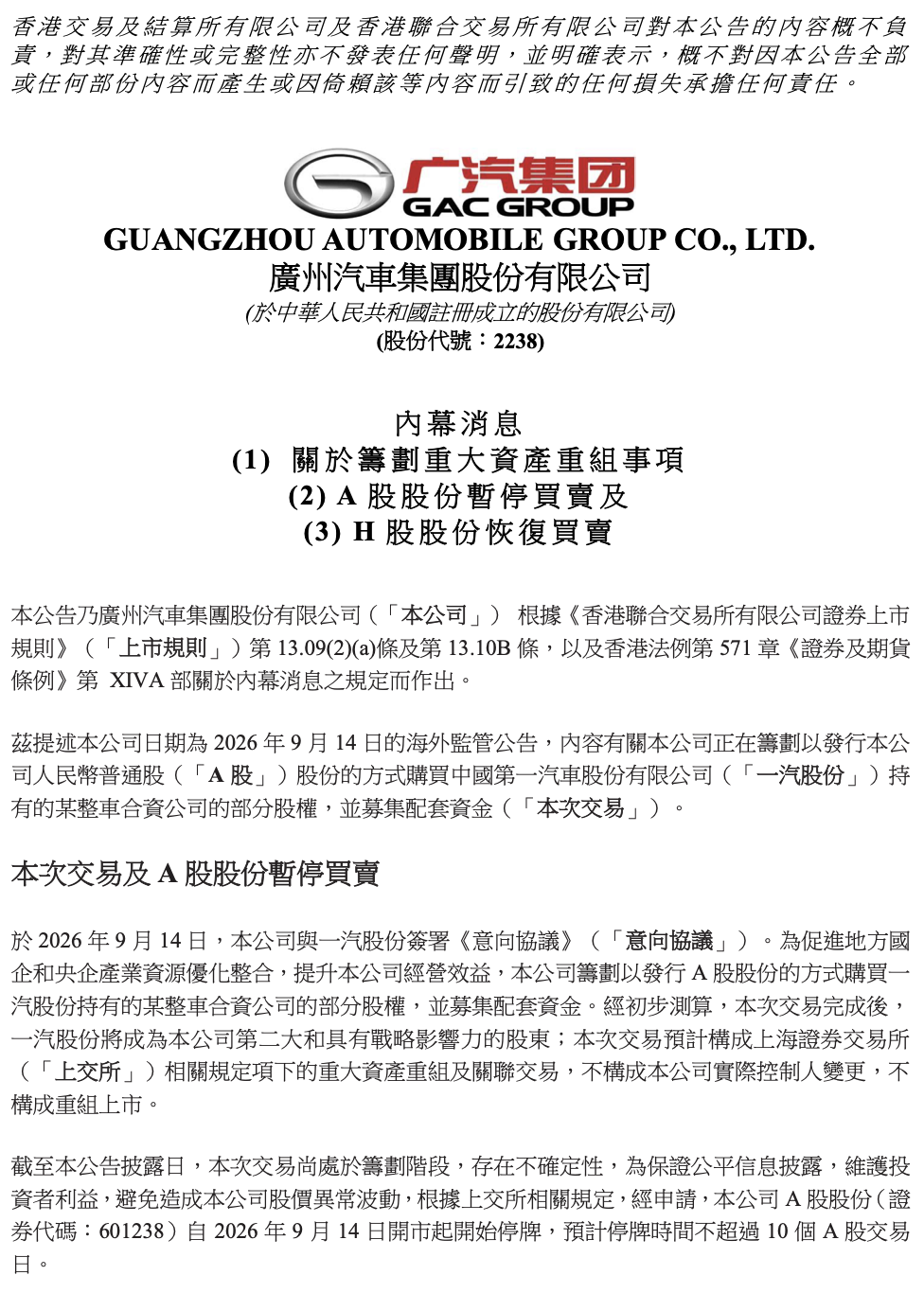
The backdrop to this transaction is the unsustainable internal friction between North and South Toyota over an extended period. FAW Toyota and GAC Toyota operate under a dual-entity, dual-channel model, with two independent R&D, marketing, and dealer networks functioning in parallel. Under Toyota’s “twin-car strategy,” the main products of North and South Toyota are essentially “sister cars” built on the same platform and positioned similarly, directly fostering internal competition. For instance, the FAW Toyota Corolla Cross and GAC Toyota Frontlander are twin models on the same platform, equipped with the same 2.0L powertrain, and their price ranges significantly overlap. Similarly, the Corolla and Levin, RAV4 and Wildlander, Avalon and Camry are all examples of the same technology being introduced by two factories, vying for the same customer base in the same city.
Market data has already signaled pressure. In the first half of 2026, Toyota’s sales in China reached 694,700 vehicles, marking a year-on-year decrease of 17.1%. Among these, FAW Toyota’s cumulative retail sales were 273,700 vehicles, down 27% year-on-year, while GAC Toyota’s sales were 341,100 vehicles, a decrease of 6.3% year-on-year. In August alone, FAW Toyota sold 54,993 vehicles, a 21.4% year-on-year decline, and GAC Toyota sold 52,368 vehicles, a 20.7% decrease. The approximately 1,400 dealers of North and South Toyota have seen their average monthly sales per store drop to around 87.5 vehicles, indicating significant pressure on channel survival.
For GAC, the “bleeding” in its joint venture segment is currently the most pressing issue. In 2025, GAC Group’s total operating revenue was RMB 96.542 billion, a year-on-year decrease of 10.43%. Its net profit attributable to shareholders was a loss of RMB 8.784 billion, turning from profit to loss. Annual sales were 1.7215 million vehicles, a year-on-year decrease of 14.06%. Breaking it down, GAC Honda’s sales fell to 351,900 vehicles, a 25.22% year-on-year decrease; Trumpchi sales decreased by 23.02%; Aion sales decreased by 22.62%. Among the entire group, the only segment still growing was GAC Toyota, with 756,000 vehicles, a 2.44% year-on-year increase. Joint venture assets that can contribute stable profits and cash flow are crucial for GAC to stabilize its fundamentals.
For FAW, the core rationale behind investing in GAC is to “exchange assets for equity.” FAW has not yet achieved a group-wide listing, and its core passenger vehicle assets have long remained non-listed. By exchanging a portion of FAW Toyota’s equity for tradable shares in GAC Group, FAW not only activates its heavy assets but also gains strategic influence in GAC’s board of directors while gaining access to the capital market. FAW’s full-year revenue in 2025 exceeded RMB 541.5 billion, with sales of 3.302 million vehicles, approximately five times the size of GAC. However, in terms of new energy transformation and market-oriented operations, GAC’s magazine battery, Aion’s pure electric platform, and its South China supply chain system are precisely what FAW lacks.
Rumors of a merger between North and South Toyota have been circulating for a long time, with multiple clues emerging previously. In early 2025, reports surfaced that “Liu Changqing, Assistant General Manager of FAW, would move south to take over as General Manager of GAC Group.” Although this did not materialize, high-level interactions between the two sides significantly increased. In 2025, Toyota China appointed its first Chinese General Manager, Li Hui, while transferring Guangqi Toyota’s General Manager, Hiroyuki Fujiwara, to head FAW Toyota—a rare move within the Toyota system to have a “Guangqi person” manage FAW Toyota. On July 28, 2026, Nie Qiang, General Manager of FAW Toyota Sales Co., Ltd., was suddenly transferred to the Hongqi brand, with no successor announced for over a month, leaving the position of General Manager of a sales company vacant for an extended period. Additionally, the Executive Deputy General Manager and Deputy General Manager of GAC Toyota were also transferred earlier. These personnel changes have been interpreted by the outside world as a prelude to the integration of North and South Toyota.
According to relevant sources, the core plan for the merger of North and South Toyota is to establish Toyota (China) Sales Co., Ltd., strongly promoted by the Japanese side of Toyota. The proposed equity structure of the new sales company is 50% owned by Toyota, 25% by FAW, and 25% by GAC. After the merger, only global models will be retained among the sister models of both sides, and the dealer channels will be fully connected, allowing the sale and maintenance of all Toyota models. This model has received strong support from Toyota.
However, it should be noted that this transaction is currently only at the letter of intent stage, and no formal transaction contract has been signed yet. The final transaction plan, equity ratio, scope of target assets, and valuation are still subject to audit and evaluation, approval by the board of directors and general meeting of shareholders, as well as necessary regulatory procedures, and there are uncertainties. GAC Group also clearly stated in the announcement that “this transaction is still in the planning stage and there are uncertainties.”
From an industry perspective, the signal released by this transaction is noteworthy. On September 11, the Ministry of Industry and Information Technology and eight other departments issued the “15th Five-Year Plan” for the Development of the Intelligent Connected New Energy Vehicle Industry, explicitly proposing to increase the intensity of mergers, acquisitions, and cross-regional integrations of automotive enterprises in accordance with the law. On the same day, Shao Ji, Deputy Director-General of the Industrial Development Department of the National Development and Reform Commission, stated that they would actively support large enterprise groups in promoting mergers and acquisitions in a market-oriented and law-based manner to avoid homogeneous competition. The capital linkage between GAC and FAW marks the first time such a large-scale automotive industry capital link has been formed between a central enterprise and a local state-owned enterprise, and its subsequent development will provide an important reference for industry integration.
-
![]()
When a Decade-Old Feishu Meets a Newborn Doubao Work: What’s the Outcome?
-
![]()
Seres Faces Pressure to Mature, as New Energy Vehicle Sector Braces for Major Realignment
-
![]()
Can Feishu Lead the Way? Will Qianwen and WorkBuddy Seal the Deals?
-
After shouting 'transfer to human agent' more than ten times, why is it still saying, 'Dear customer, I understand how you feel?'
-
Is Hongmeng’s Five-Realm Strategy Shifting to Four? Are Seres and Huawei Going Separate Ways? Actually, It’s a Synergistic Evolution
-
Leapmotor: A Stealthy Achiever Excels Without Boasting
-
![]()
Reward AI Avoids Robot Data, OM-1 Zero-Shot "Body Swapping": Smooth Packaging and Cable Unplugging with Two Hands
-
![]()
From Dandong to the Arctic Route: Liaoning’s Quest to Carve a Distinctive Niche in the Commercial Space Sector