The Year's Most Unexpected "Power Couple": Not Sun Yuchen and Jing Tian, but Huawei and Seres?
 09/17 2026
 504
504
By: Xiangshan Finance
In September 2025, on CCTV, Zhang Xinghai smiled and said to Yu Chengdong, "We have no reservations about partnering with Mr. Yu and Huawei. This time, we're going all in with Huawei."
"No reservations," "going all in with Huawei"—just a month later, everything changed.
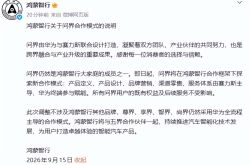
On September 15, Cailian Press first reported rumors of a "split," followed by official announcements from both sides: from that day on, product development, marketing, sales, and service would shift from Huawei's lead to Seres', with Huawei retreating to a "supporting" role.
Their partnership shifted from a deep collaboration to a more arms-length relationship.
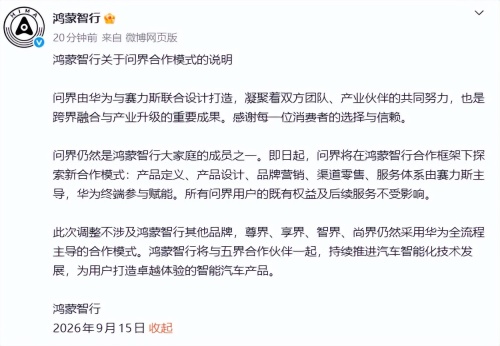
Once upon a time, this deep collaboration was a success story in the industry.
Back then, Huawei was repeatedly rejected by automakers with the "soul theory," but Seres boldly bet everything.
With this gamble, Seres transformed from an obscure Dongfeng Xiaokang to a high-end industry player overnight.
One might think this was a meeting of kindred spirits, akin to Boya finding Ziqi.
But just as Beijing, Shanghai, and Guangzhou don't believe in tears, the business world doesn't believe in fairy tales.
Likewise, the capital market may not believe in promises like "the future will surely be brighter."
By the close on September 16, Seres' A-share price hit a low of 43.61 yuan, a recent nadir.
Is Seres starting to "control its own destiny?"
Just as many netizens enjoy "eating melons" (online gossip), people can't help but ask: Who made the first move when this "power couple" reached this point?
A bold guess: The answer might be Seres. Let's carefully examine the core reasons, perhaps three:
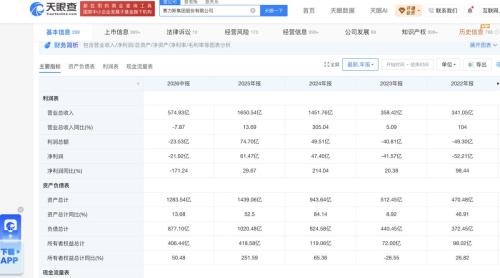
First, Seres swung from profit to loss in the first half, weakening the financial foundation of their deep collaboration.
In the first half, Seres lost 1.717 billion yuan, compared to a profit of 2.941 billion yuan last year.
With profits unreliable, Seres naturally sought to cut costs and expenses, especially as raw material prices rose.
Chairman Zhang Xinghai calculated in June: Storage chip prices soared from 20 yuan to nearly 100 yuan, while lithium carbonate prices jumped from 80,000 yuan per ton to 180,000 yuan, pushing up AITO's average manufacturing cost per vehicle by 15,000 to 20,000 yuan.
On one hand, they lost money on every sale; on the other, they had to subsidize Huawei per the agreement.
It's understood that Seres pays Huawei a 2% technology licensing fee and an 8% channel marketing service fee for every vehicle sold.
At such times, it's reasonable for Seres to try to reduce these payments, though in business partnerships, like marriage, the more meticulous the accounting, the weaker the bond.
Second, Seres still desires to "control its own destiny."
When SAIC raised the "soul theory," Seres may have been tempted but had no choice then.
In 2021, it was a second-tier automaker selling less than 100,000 vehicles annually, on the brink of bankruptcy.
It was Huawei's deep involvement that allowed AITO to start from scratch: deliveries surpassed 400,000 units by July 2024, reaching 1 million by January 2026—just 18 months from 400,000 to 1 million.
Financials also improved: According to Tianyancha App, net profits from 2024–2025 totaled nearly 12 billion yuan, not only offsetting losses of about 9.8 billion yuan from 2020–2023 but also turning a profit with a high-end AITO.
Consider that Li Bin struggled for a decade, losing over 100 billion yuan, to build NIO into what it is today.
In these profitable years, Seres hasn't stopped moves to "stand independently" from Huawei.
One aspect is building its own brand channels. Since 2024, Seres has accelerated channel independence, announcing self-built flagship stores in August, seen as key to strengthening its brand image and reducing reliance on Huawei's channels.
By the end of 2025, it had 380 operating user centers covering 218 cities, achieving 100% coverage in third-tier and above cities.
Additionally, during its Hong Kong IPO, Seres stated that 20% of net proceeds (about 14.016 billion HKD) would go to "diversified new marketing channel investments."
Another aspect is seeking new partners. This year, Seres deepened cooperation with ByteDance, launching the new brand Saido Auto—ByteDance handles the cockpit, Yuanrong Qixing handles intelligent driving, clearly distancing itself from Huawei's intelligent driving.
Now, Seres has its "soul," and Huawei has its own.
Third, Huawei's influence isn't what it used to be, with diminishing marginal benefits from over-binding.
Last month, the "best cicada under 10 million" meme went viral, exposing Yu Chengdong and Huawei to reputational risk.
The "best toy under 10 million" meme originated from AITO, with Yu promoting the AITO M9 as the "best car under 10 million."
Huawei's influence now brings some negative effects.
Is Seres' move a form of "PR decoupling?"
Some might ask: Why not Huawei first?
For Huawei, this loosening has more obvious downsides.
The most direct impact is reduced payments from Seres; deeper is the loss to Harmony Intelligent Automotive's (HIA) reputation—AITO has been its sales cornerstone, contributing 420,000 units in 2025 (70%+ of HIA's total), its "flagship brand."
With the "flagship brand" flying solo, the family's prestige suffers.
Of course, Huawei gains clarity in strategic positioning—not building cars, but becoming the Bosch of the auto industry.
Notably, during the announcement, HIA emphasized that the adjustment doesn't involve the other four brands (Zunjie, Shangjie, Zhijie, Xiangjie), which remain fully guided by Huawei.
The message is clear: Resources are freed up to fully back these four brands.
Did Seres "lighten up" too early?
Seres' desire to reduce Huawei reliance isn't new—just unexpected so soon.
For long, their relationship resembled a court and vassals: nominally, Seres was the OEM, Huawei the supplier, but Huawei held the reins.
However, history shows "weakening control" requires timing.
Ming's Jianwen Emperor abolished five vassals within a year, too hasty, provoking Yan's "Jingnan Campaign."
Han's Wudi used the "Push Enfeoffment Edict," trading strategy for time.
So, timing in weakening control is everything.
Seres loosened ties with Huawei in one fell swoop but must consider: Is this step too hasty? Can it bear the consequences?
Loosening brings immediate benefits: reduced marketing fees to Huawei, likely turning a profit this year.
But long-term, choosing asset-light operations now seems like trading short-term financial ease for long-term competitive moats.
Buffett says buying stocks is buying companies, and good companies widen their moats.
Seres isn't without moats—previously seen as Huawei itself.
But data shows Seres' moat is "Huawei + AITO": In H1 2026, HIA sold 242,216 units, with AITO contributing 162,740 (67.19%), the absolute mainstay.
Two years after HIA's launch, AITO remains the sales pillar, indicating its own brand effect.
Like many cola brands, only Coca-Cola became a giant.
But AITO's brand power still largely stems from Huawei's "flagship brand" halo, lacking independent appeal.
Especially in upcoming L3 competition, it still needs Huawei's tech and Yu's promotion.
On September 16, Yu announced on Weibo that Zhijie RX received an L3 autonomous driving road test license, conducting real-world tests on complex roads like urban expressways.
Though Huawei isn't as adored as before, and Yu faces online ridicule, AITO still feels soulless without him.
Ideally, Seres should wait until AITO builds its own appeal—until consumers buy AITO for "AITO" itself—before weakening control, perhaps the Pareto optimal solution.
Now, Seres loosened ties as AITO grew but wasn't fully mature, timing seems early.
More critically, public perception is shifting: AITO increasingly resembles Huawei's Hi mode—Huawei provides tech and intelligent driving, automakers handle manufacturing and branding.
In other words, AITO's "Huawei content" may now match Avita's, even falling below.
Avita has Chang'an's 40-year automotive heritage; Seres evolved from Chongqing Xiaokang, mainly making minibuses.
Without the "Huawei halo," consumers may reassess AITO's product strength.
Meanwhile, other brands are eyeing AITO's market.
AITO's retreat leaves room for Zhijie, Xiangjie, and Zunjie to compete.
Additionally, Seres' second growth engine, Saido Auto, hasn't launched any products yet.
Loosening ties with Huawei now raises uncertainty when Saido most needs support and credibility.
Simply put: Even if deep Huawei cooperation meant high marketing costs and losses, AITO's sales provided stable, reliable cash flow for Saido.
Now, with Saido unestablished and AITO still tied to Huawei, diluting cooperation is like changing generals mid-battle—a military taboo.
Industry-wide, certainty is everything now.
Automotive competition has entered its final phase. In H1 2026, China's auto industry profit margin was ~3.8%, with vehicle manufacturing at ~1.5%, both decade lows.
The first half was harsher than ever.
Thus, GAC and FAW's September 14 integration announcement aimed to boost certainty and stability.
Yet Seres chose to add uncertainty amid fierce competition, unsure where it will lead.
For dealers, with Huawei's endorsement fading, is joining AITO still worthwhile?
For consumers, as Seres' "Huawei content" drops, is its product worth the price?
A chain reaction has begun...
Weakening control isn't impossible, but doing it too early, before removing vassal influence, removes a crutch.
This seems unlike Zhang Xinghai's style.
He's used this strategy before—deep Huawei binding then regaining control—like his decade-plus journey to fully acquire Dongfeng Xiaokang after partnering with Dongfeng in 2003.
Back then, Yu'an Group (led by Zhang) and Dongfeng Auto formed "Dongfeng Yu'an" (Dongfeng Xiaokang), 50-50 ownership: Dongfeng provided brand endorsement, production qualification, and channels; Xiaokang handled operations.
Similar to today's AITO-Huawei setup—brand dividends and some profits remained tied to the partner.
But Zhang was patient.
Not until 2019 did Xiaokang (Seres' predecessor) propose a major asset restructuring, acquiring Dongfeng's remaining 50% stake via share issuance, achieving full independence.
That took 16 years.
With Dongfeng Xiaokang, Zhang could afford a slow approach; why rush with Huawei?
A bold guess: His age and succession plans may explain it.
Born in 1963, Zhang is now 63—at China's male retirement age.
Time isn't on his side for another 16 years.
This year, power shifts at Seres became clearer:
On June 8, Zhang stepped down as Seres Auto chairman, replaced by Zhang Zhengping, who oversees R&D, production, and sales of passenger vehicles like AITO.
Zhang gradually retreats, his son Zhang Zhengping steps up.
He could finish the long Dongfeng battle himself, but the Huawei game theory must be resolved before handing over, paving the way for the next generation.
From this view, the pace of weakening control involves business judgment but also a father's urgency to secure his legacy before retirement—a touching display of paternal love.
Notably, Zhang Zhengyuan, Zhang Xinghai's nephew, leads Saido.
Now, shedding "Huawei," the true burden falls on this cousin pair—Zhang Zhengping guards AITO's core; Zhang Zhengyuan explores Saido's future.
Zhang has laid the path; the brothers must now unite, as AITO still has strong cards to play.
Seres Has Its Own Trumps
Of course, Zhang wouldn't act now without aces:
First, the "Iron Triangle" supply chain remains intact.
Last month, Seres stated in investor relations: "No AITO without Huawei, Yinwang, or CATL."
This emphasizes AITO's foundation—Huawei's intelligent driving, Yinwang's vehicle tech, and CATL's batteries.
Seres only loosens the cooperation model, not the supply chain; the best global tech still powers AITO, unchanged.
More importantly, Seres excels at integration: Buying parts and tech is common; integrating them well is rare.
On September 12, the AITO M9 Ultimate Extended Edition began nationwide deliveries. Zhang declared: "Appearance can be copied, dimensions cloned, parts procured, specs matched—but native integration, full lifecycle responsibility, and closed-loop validation with millions of users are irreplaceable by simple assembly."
He added a vivid metaphor: "Chips, batteries, suspensions, and vision sensors are ingredients, but overall architecture, precise tuning, vehicle calibration, accurate verification, safety lifecycle, and service are the automaker's true culinary skills and timing. Ingredients are buyable; skills must be honed."
In other words, giants like Huawei and CATL are merely the "ingredients
The share repurchase was executed in an open and straightforward manner, with the repurchased shares being canceled as a means to reward shareholders. This approach undoubtedly represents the most pragmatic stance on shareholder returns.
The consolidation of power is a high-risk move, yet SERES has at least revealed its strategy: maintaining a robust supply chain, continuously enhancing product capabilities, improving services, and rewarding shareholders.
The strategy is now out in the open; the outcome will hinge on how effectively it is implemented.
Frankly, this move towards independence is more akin to a rite of passage, a decisive step forward with no turning back.
Eventually, AITO will need to learn to stand on its own feet after the initial support from Huawei diminishes, and SAIDO will also have to emerge from its nascent stage to explore the broader world.
The million-yuan AITO M9 has already demonstrated that this Chongqing-based automaker, which began its journey with minibusses, is capable of crafting top-tier vehicles in China.
Therefore, let's extend a bit more patience and applause to them—after all, SERES, which once staked everything on Huawei, has a knack for turning the seemingly impossible into reality.
What lies ahead may be even more thrilling than we can envision.
Disclaimer: The information presented in this article is derived from the company's statutory disclosure documents and publicly accessible materials. The author offers no assurances regarding its completeness or currency. Investing in the stock market entails risks; please proceed with caution. The content herein is intended solely for commentary purposes and does not constitute investment advice. The decision to invest rests with you, and you assume all associated risks.
-
The Crux of AI Phones Resides in AI
-
![]()
Burying Yesterday's Expertise: An AI Self-Reflection by a DeepSeek Engineer
-
![]()
The Year's Most Unexpected "Power Couple": Not Sun Yuchen and Jing Tian, but Huawei and Seres?
-
Automotive Industry Major Reshuffle Countdown: Nine Departments Chart the Course for 2030, Weak Contenders Exit, Strong Ones Merge
-
![]()
Insta360: At the Dawn of a New Valuation Era
-
GAC Group’s Compelling Advantage: Exactly What FAW Seeks
-
Insta360: At the Dawn of a New Valuation Era
-
![]()
China’s Autonomous Delivery Vehicles Set Foot in Europe