Insta360: At the Dawn of a New Valuation Era
 09/17 2026
 513
513
【Tide Business Review/Text】
About a week ago, the stock price of Insta360 Innovation, a burgeoning star in the tech innovation landscape, dipped below RMB 100.
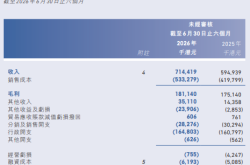
Having plummeted from RMB 377 over a year ago to nearly RMB 100 now, this decline has inevitably sparked widespread market discussion. Moreover, Insta360’s recent semi-annual report data mirrored a similar downward trend, with revenue reaching RMB 5.517 billion in the first half of 2026, marking a 50.29% year-on-year increase. Yet, the net profit attributable to the parent company stood at a mere RMB 30.4073 million, down 90% year-on-year.
Where have the profits vanished? What has befallen Insta360?
To address these two burning questions in the market, it is crucial to focus on two pivotal aspects: firstly, how Insta360 has utilized its profits; secondly, how the market should perceive Insta360.
Recently, market discussions have been rife, and the answers seem evident: the profits reflected in Insta360’s semi-annual report are largely a consequence of strategic decisions. For instance, inventory surged to RMB 6.212 billion, and R&D investment exceeded RMB 1 billion, accounting for nearly 20% of revenue. Additionally, to mitigate supply chain volatility, Insta360 strategically procured memory chips worth nearly RMB 2 billion.
Under the conventional logic of the securities market, this semi-annual report appears unfavorable, with shrinking profit margins and high inventory levels. Consequently, pessimistic sentiments have begun to permeate.
But is this the complete narrative?
Perhaps the traditional “yardstick” employed by the market can no longer accurately gauge the true essence of this company.
When a company in the midst of transformation—shifting from a singular hardware business to a comprehensive technology ecosystem—is still shoehorned into the valuation model of traditional manufacturing, the misalignment extends beyond pricing to perception.
With all negative factors already factored in, Insta360 stands at the precipice of a new valuation paradigm.
01 Great Companies Have All Undergone a 'Valuation Revolution'
Looking back at business history, an intriguing pattern emerges: almost all great companies have undergone a 'secondary valuation' by the market.
The initial valuation is often predicated on past successes, tinged with enthusiasm and bubbles. When the bubble bursts and stock prices plummet, the market is compelled to reevaluate the company's intrinsic value. The second valuation truly delves into the core of the enterprise.
Amazon serves as the most quintessential example.
In 2000, the dot-com bubble burst. Amazon's market value evaporated by over 90%, with its stock price plummeting from a peak of nearly $200 billion to about $3.6 billion by year-end. At that time, Wall Street criticized and ridiculed Amazon, alleging that its 'long-termism' was merely a facade for 'long-term losses.'
Under the old framework, Amazon was perceived as an unprofitable online bookstore and an internet bubble with no future.
However, Bezos did not slash R&D or halt investments in logistics and technology. Under immense pressure, he reinvested every dollar earned into AWS (Amazon Web Services) and infrastructure.
Years later, when AWS's profits began to soar and the loyalty of Prime members became a formidable moat, the market finally adopted a new yardstick.
They no longer measured Amazon by 'retail profit margins' but revalued it based on 'cloud computing potential' and 'customer lifetime value.'
Amazon's second valuation did not occur because it suddenly improved; rather, the market finally learned to measure it with a new yardstick.
The same narrative unfolded with Tesla.
From 'building cars on PPT' to becoming the world's most valuable automaker, Musk endured ridicule, short-selling, and a decade of questioning. For a considerable period, the market valued Tesla using the PE ratios of traditional automakers, concluding that it was severely overvalued and a massive bubble.
Until people realized that Tesla was not merely selling cars but 'AI + energy + software' mobile terminals. When the iteration speed of FSD (Full Self-Driving) surpassed that of all traditional automakers and the closed-loop energy network gradually took shape, the market's valuation logic underwent a complete reconstruction.
Tesla's second valuation marked a perceptual awakening.
Then there's Netflix.
When transitioning from DVD rentals to streaming, Netflix's stock price plummeted by over 70%, users complained vociferously, and the media predicted its demise. However, Reed Hastings withstood the pressure and persevered with the transition.
When the number of streaming users exploded and content became a core asset, the market finally revalued Netflix using 'subscription-based + SaaS valuation.' Its market value multiplied several times over.
These stories convey a profound message:
Secondary valuation is the rite of passage for great companies.
It often entails painful crashes, prolonged skepticism, and solitary perseverance. But it is this baptism that purges speculative capital and leaves behind true long-term believers.
02 An Old Yardstick Cannot Measure New Innovations
In the narrative of capital markets, the valuation framework dictates asset pricing.
For an extended period, Insta360 has been pigeonholed by the market as a 'consumer electronics hardware company.' Under this old framework, the market's logic is simplistic and crude: focus on gross profit margins, net profit margins, inventory turnover, and PE (price-to-earnings) ratios.
Applying this old yardstick to measure Insta360 naturally leads to a pessimistic conclusion.
Hardware is a challenging business. Product lifecycles are short, supply chain fluctuations are significant, and once ensnared in a price war, profits become razor-thin. When Insta360's gross profit margins declined due to chip price hikes and strategic inventory stockpiling, alarms sounded under the old framework.
However, the blind spot of the old framework is that it only perceives Insta360 as 'selling hardware' while overlooking that it is 'constructing an ecosystem.'
Hidden within the first-half financial report of 2026 is a truth obscured by the income statement: Insta360's App monthly active users grew by 67%, and paid cloud storage users surged by 124%.
What does this signify?
It signifies that Insta360 is transitioning from one-time hardware transactions to enduring user relationships. With over 10 million devices shipped globally, these 10 million touchpoints are being transformed into high-frequency interactive digital assets. Overseas revenue accounting for 63.40% underscores its global market penetration.
From the perspective of SaaS (Software as a Service) or internet platforms, this 124% growth in paid cloud storage users represents Insta360's true 'second curve.' However, under the old yardstick, this growth is entirely overshadowed by the decline in hardware profits.
The market fixates on Insta360's 'inventory' while forgetting that in the balance sheet of tech companies, sometimes 'inventory' is the 'ammunition' for the future.
When a company's core value is shifting from 'hardware manufacturing' to 'technology platform + user ecosystem,' continuing to value it using PE is akin to measuring height with a weighing scale.
No matter how substantial the measured number is, it is devoid of meaning.
03 What Should Insta360's 'New Yardstick' Measure?
Returning to Insta360.
With a 74% drop in stock price and a less-than-stellar income statement, this is precisely the opportune moment for the market to conduct a 'secondary valuation.'
So, what should the new yardstick for measuring Insta360 be?
Firstly, focus on the conversion rate of R&D investment, not absolute profits.
In the first half of 2026, Insta360 invested RMB 1.036 billion in R&D, accounting for nearly 20% of revenue. To hardware companies, this is a profit-devouring black hole; to tech companies, it is the foundation for building barriers.
Insta360 is simultaneously advancing multiple new categories, including panoramic cameras, gimbal cameras, wireless microphones, custom chips, drones, and more. Each category necessitates underlying technological support.
The market should not inquire, 'How much did you earn this year?' but rather, 'Did each yuan of R&D investment create new value more cost-effectively than last time?'
If Insta360's optical, chip, and algorithm capabilities can be modularly reused, and if new products can stand on the shoulders of old ones, then this enhancement in R&D efficiency is a far more compelling metric than short-term profits.
Secondly, focus on the robustness of the user ecosystem, not hardware sales.
The vulnerability of the hardware business lies in the one-time realization of user value upon device sale.
However, Insta360's App MAU growth of 67% and paid cloud storage growth of 124% indicate that Insta360 is cultivating a unique relationship.
Which moments did users capture? Which automatic edits did they accept? How did they adjust the results? These authorized, anonymized feedbacks are forming a profound understanding of user recording preferences.
The more users engage, the more accurate the understanding becomes; the more accurate the understanding, the higher the retention; the higher the retention, the stronger the willingness to pay. This is a virtuous cycle.
The market should value Insta360 based on 'customer lifetime value (LTV)' and 'ecosystem stickiness,' not 'hardware shipments.'
Thirdly, focus on the depth of technological barriers, not the breadth of product categories.
In the consumer electronics realm, long-term technological barriers are rare. Chips can be reverse-engineered, functions can be imitated, and supply chains can diffuse.
Insta360's moat lies not in the quantity of SKUs but in its 'ability to continuously create thresholds.'
Identifying needs earlier, deploying technology earlier, and commercializing products earlier. By the time competitors arrive, Insta360 has already moved to the next intersection.
This 'time difference' premium is Insta360's true value.
Fourthly, focus on the ability of organizational evolution, not just scale expansion.
Insta360's management admitted in their letter to shareholders that the matrix organization had previously led to reduced efficiency and slow bottleneck capability building. Now, they are reconstructing the organization based on 'business purposes' and 'modules,' building shared capability platforms.
This is an extremely crucial signal.
After a company scales, high-quality collaboration becomes scarcer than technology or capital. Insta360 needs to achieve a state where 'the more products it has, the lighter the company becomes.'
If Insta360 can establish an internal 'capability asset sheet,' tracking the reuse rate of common modules, the proportion of new products adopting mature modules, and the sunk costs of failed projects, then its innovation productivity is improving.
This is the foundation for supporting the next decade of growth.
04 Lighten the Load and March Forward
A declining stock price exerts pressure on management but is not necessarily detrimental to the company's long-term development.
High valuations often come with lofty expectations. To sustain a high stock price, companies may be compelled to pursue short-term profits, curtail long-term investments, or even distort their actions.
When the bubble bursts and the stock price returns to a reasonable range, companies can instead lighten their load.
Speculative capital has departed, and the opportunities that remain are for long-term believers who will accompany the company through cycles.
-
Insta360: At the Dawn of a New Valuation Era
-
![]()
China’s Autonomous Delivery Vehicles Set Foot in Europe
-
![]()
Industry-Academia Synergy! Hongshi Intelligent Partners with Tsinghua University to Overcome Key Hurdles in MicroLED Optics
-
![]()
Chengfeng Technology Shines at CIOE 2026: Bolstering the ‘Chinese Core’ of AI Optical Interconnection with Cutting-Edge Nanoscale Optical Inspection
-
![]()
Lens Revenue Rockets 42%! What’s Behind Artini Optical’s HK$13.38 Million Loss?
-
![]()
Can Seres Reclaim AITO’s Leadership? Will the ¥1.7 Billion Loss Be Reversed?
-
![]()
3 Billion Yuan: Can Neta Cars Stage a Remarkable Comeback?
-
Huawei and Seres 'Part Ways'? Seres Takes the Lead in Five Key Areas, Huawei Steps into a Supportive Role