Evergrande Auto, a Company Without Car Production, Posts 500,000 Yuan Gross Profit in Six Months
 09/21 2026
 387
387
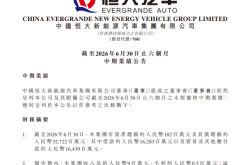
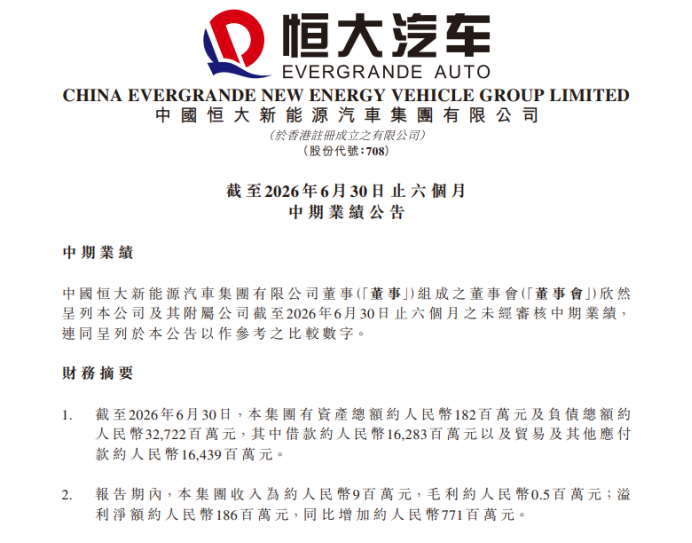
Recently, Evergrande Auto, which had largely faded from the public's memory, reappeared in the spotlight after disclosing its mid-2026 financial report through the Hong Kong Stock Exchange. The report revealed that as of June 30 this year, the company's total assets stood at approximately 182 million yuan, while its total liabilities soared to nearly 32.722 billion yuan. In terms of liability breakdown, loans accounted for approximately 16.283 billion yuan, and trade and other payables totaled approximately 16.439 billion yuan. During the reporting period, the group reported revenue of 9 million yuan and a gross profit of 500,000 yuan; its net profit reached 186 million yuan, marking a year-on-year increase of 771 million yuan.
It is worth noting that Evergrande Auto has completely halted operations related to automobile manufacturing. According to the announcement, the company is no longer involved in the production of complete vehicles. Instead, it plans to restructure its business around the battery and vehicle manufacturing-related patented technologies it retains, with a focus on lithium-ion battery trading as its core new business segment. During the reporting period, this battery trading business commenced external sales, generating revenue of 8.73 million yuan with a gross profit margin of approximately 5.98%, which fell within the company's target range of 5% to 8%. This has become Evergrande Auto's primary source of income at this stage.
The foundation of this new business is, in fact, the technological assets accumulated by Evergrande Auto through its early strategy of aggressive acquisitions. In 2019, Evergrande Auto acquired CENAT New Energy for 1.06 billion yuan, gaining access to the ternary soft-pack technology developed by a team led by the "Father of Lithium-Ion Batteries" from Japan. Later, through the acquisition of National Electric Vehicle Sweden AB (NEVS), it inherited patents such as Saab's battery cooling technology, amassing over a thousand battery-related patents. Today, its domestic factories have either been sold off or declared bankruptcy, leaving only its Hong Kong headquarters and NEVS to operate under an asset-light model.
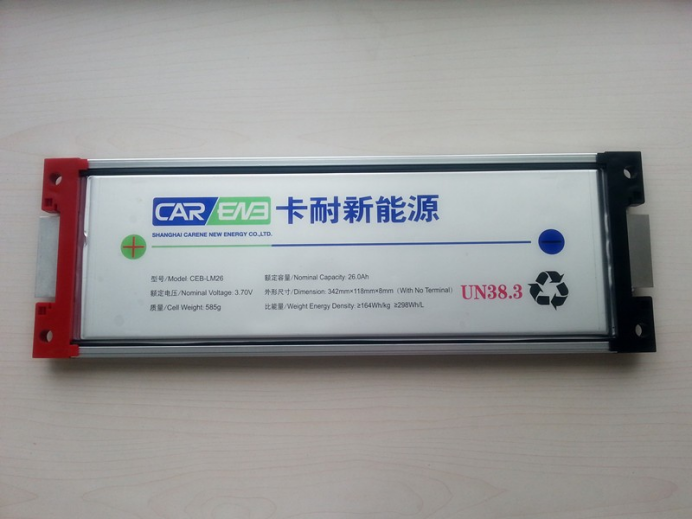
Originally intended to support the mass production of complete vehicles, these technologies now serve as the most direct lever for the new business, becoming Evergrande Auto's last resort. However, unlike ordinary cell traders who merely engage in buying and selling, Evergrande Auto's battery trading business follows an asset-light technology matching (supporting) route.
The company has not built its own cell factories nor tied up capital in inventory. Instead, it targets small and medium-sized clients in Europe and Southeast Asia operating in the electric two-wheeler, energy storage, and small home appliance sectors. It procures products of corresponding specifications from mainstream domestic cell manufacturers and, leveraging its own battery patent technology capabilities, simultaneously provides value-added services such as cell quality grading and screening, UN38.3 hazardous materials transportation certification, and MSDS compliance documentation. This approach enables it to achieve higher gross profit margins than ordinary traders.
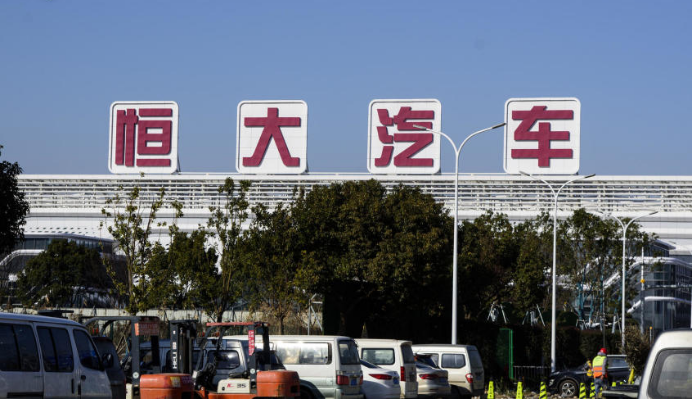
Looking back at its business trajectory over the past two years, Evergrande Auto's battery-related layout has progressed slowly. In 2024, the company primarily provided battery engineering technical services to European clients through NEVS, generating approximately 25.37 million yuan in revenue for that segment, while battery trading remained in the planning stage.
In 2025, Evergrande Auto's technical service revenue declined year-on-year to approximately 12.87 million yuan. The battery trading business entered a full preparation phase, establishing operational rules driven by orders and requiring full cash settlement from new clients. Procurement actions were fully synchronized with confirmed client orders, minimizing inventory risks. It was not until the first half of 2026 that this long-prepared business officially commenced external deliveries, achieving its first revenue stream of 8.73 million yuan.
Amid its business transformation, Evergrande Auto has simultaneously implemented cost-cutting measures, including adjusting its organizational structure and staffing, as well as reducing various operating expenses. The company aims to alleviate the pressures of sustained operations by reducing its heavy asset manufacturing business. Currently, Evergrande Auto remains suspended from trading, with the Hong Kong Stock Exchange setting a deadline for resumption at the end of this month.
On one hand, the company is negotiating small-scale financing with potential independent investors to cover basic operational expenses such as intermediary and compliance costs. On the other hand, it is communicating with the liquidation team of its parent company, China Evergrande Group, regarding an overall debt restructuring plan. The liquidators have stated that they will not initiate liquidation proceedings against Evergrande Auto at this stage.
For Evergrande Auto, automobile manufacturing has become a thing of the past. Currently, the company's core mission is to sustain a listed platform burdened with 32.722 billion yuan in liabilities using 182 million yuan in assets and limited new business operations.
(Image sourced from the internet; removal upon infringement notice)
-
![]()
From Didi Shrimp to Doubao Car: Why Are Automakers Obsessed with Integrating AI into Vehicles?
-
![]()
Stellantis, Which Incurred a €223 Million Loss Last Year, Is Pinning Maserati's Future on China
-
![]()
Evergrande Auto, a Company Without Car Production, Posts 500,000 Yuan Gross Profit in Six Months
-
![]()
Facing Fierce Competition, Pricing Emerges as the Top Challenge for the Brand-New Hongqi H7
-
![]()
For Seres, Enduring Short-Term Pain Is Preferable to Long-Term Misery
-
Why Is Assessing Xiaomi's Business in India Increasingly Challenging?
-
Copper Prices Plunge: Unraveling the Logic Behind AI-Driven Metals
-
Reassessment of Three Key Values: Seres Presses Ahead, the Market Holds the Key