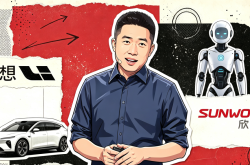
Li Xiang's Investment Ambitions: Becoming Second Largest Shareholder of Sunwoda and 'Sweeping Up' Robot Companies
 09/21 2026
 475
475
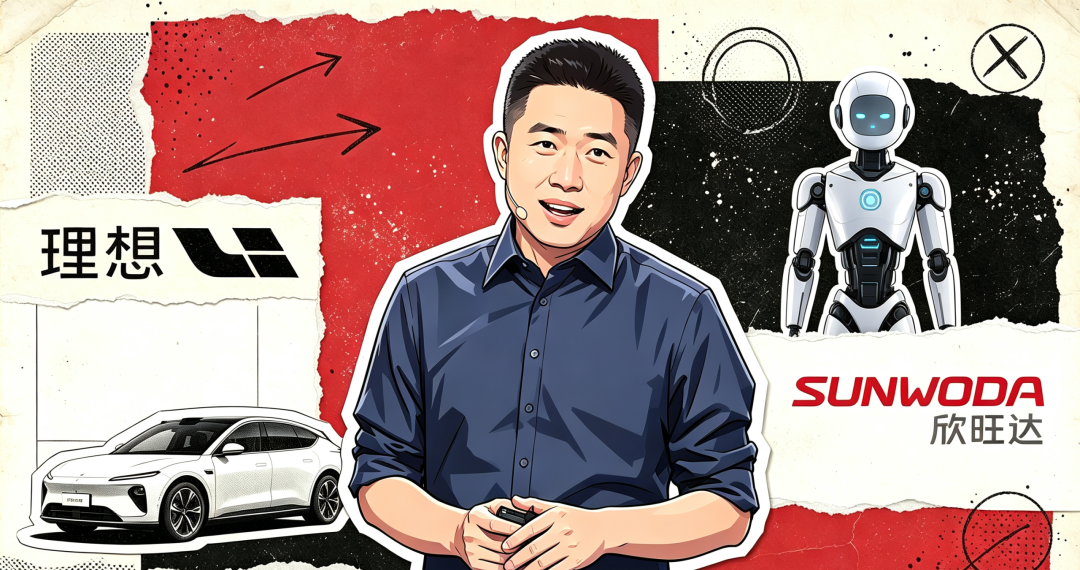
Li Auto Becomes Second-Largest Shareholder of Sunwoda

Click to Listen to This Podcast
Li Xiang Strikes Again with Investments!
In September 2026, details of Sunwoda's latest C++ round of financing were disclosed, with Li Auto planning to invest RMB 2.65 billion to increase its stake in Sunwoda Electric, acquiring an 8.79% share.
After the transaction, entities related to Li Auto will indirectly hold 11.17% of the shares, becoming the second-largest shareholder of Sunwoda Electric and driving the valuation of this power battery unicorn to surpass the RMB 30 billion mark.
This is not Li Xiang's first bet on Sunwoda.
As early as 2022, Li Auto invested RMB 400 million to become a shareholder of Sunwoda Automotive Battery; in 2025, the two sides established a battery joint venture with a 50:50 equity ratio. By 2026, Li Auto has invested another RMB 2.65 billion, transforming itself from a battery customer to a significant shareholder of its supplier.
Meanwhile, Li Auto's capital reach is extending from batteries to autonomous driving and then to embodied AI, with successive Layout (investments) in Xinuofuture, Qianjue Robotics, and Xieyue Intelligence, steadily expanding its capital portfolio...

Turning Suppliers into Allies
This year, Sunwoda Electric's financing pace has been remarkably rapid, with three rounds completed in three months.
RMB 1.68 billion in Series C financing in May, RMB 805 million in Series C+ financing in July, and RMB 2.65 billion in Series C++ financing in September, bringing the total financing to RMB 5 billion and expanding the shareholder base to 97.
Li Auto's RMB 2.65 billion investment is the largest single amount, directly acquiring 8.79% of the shares post-capital increase. Entities related to Li Auto will indirectly hold a combined 11.17% equity in Sunwoda Electric, becoming the second-largest shareholder.
In fact, the cooperation between Li Auto and Sunwoda has long been evident. As early as 2017, Sunwoda was an early power battery supplier for Li Auto.
In 2022, Li Auto's related entity, "Jiangsu Chehejia Co., Ltd.," invested RMB 400 million in Sunwoda Automotive Battery, holding a 3.22% stake. A notable detail is that, according to Chen Hui, General Manager of Sunwoda's Li Auto Business Unit, Li Auto initially planned to invest only RMB 200 million, but Li Xiang himself proposed increasing the investment to RMB 400 million at the investment decision meeting.
Thus, as early as 2022, Li Auto was already one of Sunwoda's shareholders. Sunwoda even established a dedicated business unit for Li Auto in 2023, expanding its workforce to approximately 1,700 employees within two years.
Subsequently, in 2025, cooperation deepened further, with Li Auto increasing its procurement share from Sunwoda Electric to about 30% and jointly establishing Shandong Li Auto Battery Co., Ltd., each holding a 50% stake. This company is responsible for manufacturing Li Auto's self-developed batteries, with the produced cells directly used in this year's entire Li L8 lineup.
And this year, with another RMB 2.65 billion investment, the relationship between Li Auto and Sunwoda has become deeply intertwined.
First is cost control. For an automaker, batteries are one of the highest-cost components and one of the core parts that most easily affect the product experience. By deeply binding with Sunwoda, Li Auto can secure more stable procurement prices and capacity guarantees amid fluctuations in lithium carbonate prices.
Second is technological customization. Giants like CATL find it difficult to allocate excessive R&D resources for the customized needs of a single automaker. Sunwoda, however, is willing to establish a dedicated business unit for Li Auto and even share data. This "ODM-style" deep binding grants Li Auto customization rights that other battery companies cannot offer.
Simply put, Li Auto is responsible for defining "what I want," while Sunwoda handles "how to make it," giving Li Auto more influence over its supply chain.
Of course, Li Xiang does not put all his eggs in one basket.
While heavily investing in Sunwoda, Li Auto maintains a five-year strategic cooperation with CATL. With CATL on the left and Sunwoda on the right, Li Auto pursues a triple approach of self-research, joint ventures, and external procurement.
Beyond batteries, Li Auto's capital reach has long extended to all aspects of smart cars. As early as 2017, it supported and invested in two rounds of autonomous driving supplier Zhixing Technology, guiding it all the way to a Hong Kong stock listing; in 2018, it led the investment in Neolix, becoming its second-largest shareholder; there's also Yihang Intelligence, Optoelectronic Sensing... Li Auto's investment portfolio is quietly filling in the gaps in smart cars.

Li Xiang Builds a 'Second Growth Curve'
If investing in batteries and autonomous driving is about stabilizing the present, then Li Xiang's recent dense (intensive) investments in embodied AI are more like seeking the next technological frontier beyond automobiles.
Earlier this year, Li Xiang made his judgment: "In the next 3-5 years, competition among mid-to-high-end smart cars will essentially be competition in embodied AI." Li Xiang indeed follows through, with successive Layout (investments) in embodied AI projects such as Xinuofuture, Qianjue Robotics, and Xieyue Intelligence from 2025 to 2026.
Notably, Xieyue Intelligence, established in February 2026, deserves attention because its founding team all came from Li Auto. Founder Chen Wei is Li Auto's former Chief AI Scientist and Head of Base Model, while another founder, Zhang Xiao, is Li Auto's former Head of the Second Product Line and a key contributor to the L9 product strategy.
Just two months after its establishment, Xieyue Intelligence completed its first round of financing jointly invested by Matrix Partners China and Li Auto.
This investment has a very distinct characteristic: investing in technology, but even more so in people.
During his time at Li Auto, Chen Wei drove projects such as the self-developed intelligent cockpit and the MindGPT large model, making Li Auto one of the early automakers to apply self-developed large language models to automotive products. Zhang Xiao, an early employee of Li Auto, was the core definer of the product strategy for Li Auto's L9, known for its "fridge, TV, and sofa" features.
Together, their combined capabilities address one of the most critical gaps in embodied AI companies: understanding both the "brain" and the "product."
This is why Li Auto favors Xieyue; the two sides already have a long-standing organizational relationship and trust foundation.
For Li Auto, there is no need to cram all robot R&D capabilities internally. Full self-research means enormous R&D investment, organizational costs, and trial-and-error costs; complete non-investment risks missing the next technological cycle. Thus, Li Xiang chooses the lightest positioning approach: developing core capabilities in-house while investing in external teams through capital. Talent may leave the company, but industrial relationships remain intact.
Li Auto is not the only automaker adopting this strategy; it has become a trend across the automotive industry.

Automotive CVC Becomes a New Competitive Variable
In the first half of 2026, domestic financing in the embodied AI sector exceeded RMB 46 billion, with 38 embodied AI companies receiving investments from automakers. Among traditional automakers, SAIC Motor invested in 13, BAIC in 9, and Geely in 6.
If Li Xiang's approach resembles "point-based positioning," traditional automakers are closer to systemic Layout (investments) relying on large industrial groups.
SAIC Motor, a traditional automaker giant, has its Shangqi Capital and Hengxu Capital deeply rooted in the VC and PE circles for years, managing hundreds of billions in assets. Since launching strategic direct investments in 2021, SAIC has invested over RMB 18 billion, driving 24 invested companies to achieve IPOs. Nearly 70% of its new investments in 2025 flowed into AI, humanoid robots, and reusable high-end manufacturing for automobiles.
BYD follows a typical "self-research + investment" route, similar to Li Auto's current strategy.
While investing in companies like Passini and Zhiyuan Robotics, BYD is also self-developing humanoid robots, internally codenamed "Yao, Shun, Yu." Li Ke, Executive Vice President of BYD Group, revealed that the project started as early as 2022, planning to deploy 20,000 humanoid robots in its own factories by 2026, targeting a unit price below RMB 200,000.
BYD also leverages its vast manufacturing system to provide training grounds for robots. Robots continuously perform tasks such as grasping components, handling, assembly, and quality inspection in factories, thereby iterating their models.
Thus, when Li Auto invests in robot companies, it is not necessarily "crossing boundaries." From a broader industrial chain perspective, the perception, algorithms, computing power, data, and software capabilities accumulated in autonomous driving can naturally migrate to robots; while factory training scenarios can, in turn, feed into robot models.
Morgan Stanley also analyzes in its latest report: The re-rating of Chinese automotive stock valuations may require the gradual development of non-automotive businesses, such as physical AI and humanoid robots, and capital markets are willing to fund such developments.
Considering this, Li Xiang's identification of embodied AI as a second growth curve is reasonable.
Li Xiang once stated that globally, no more than three companies can simultaneously Layout (invest) in base models, chips, operating systems, and embodied AI, and Li Auto must be one of them. The subtext: car manufacturing is just the starting point; the true endgame is to become a "physical AI company."
However, a more practical challenge lies in the fact that while the embodied AI sector is flush with hot money, commercialization still requires time. In 2025, there were over 300 financing events in the embodied AI sector, with funding exceeding RMB 40 billion, but truly scalable delivery remains rare. Automakers choosing investment over direct entry is a pragmatic approach but may risk missing the window of opportunity.
The RMB 2.65 billion capital increase in Sunwoda will certainly not be the endpoint of Li Xiang's investment portfolio. What investment moves will come next? We wait and see.
Reference Articles:
Li Xiang Invests in Maoming's Richest Man, Investment Circle
Breaking: Li Auto Increases Stake in Sunwoda Electric with RMB 2.65 Billion Investment, Becoming Second-Largest Shareholder, Daily Economic News
Li Auto and Sunwoda Establish Joint Venture; 'Li Auto-Branded' Batteries to Launch Next Year | 36Kr Exclusive, 36Kr
The Secret to Li Xiang's Hundreds of Millions in Stock Profits, China Business Journal
Embodied AI Investment Landscape: Why Automakers Favor Founders with 'Engineering Experience,' TMTPost
THE END
-
Apple Finds Itself in a Tight Spot: iPhone18 Pro's Camera Trails Behind Huawei's Year-Old Model
-
![]()
Li Xiang's Investment Ambitions: Becoming Second Largest Shareholder of Sunwoda and 'Sweeping Up' Robot Companies
-
![]()
Why Has OPPO Slowed Down When the Entire Industry is Rushing into AI?
-
![]()
BYD Plans to Construct 20,000 Stations, Sunwoda Aims for 10,000 Stations: The Boom of Flash Charging in China
-
![]()
Chinese Computing Power Expands Its Global Reach in ASEAN
-
![]()
Analysis of Competitive Strategies for Home Appliance Enterprises in the Stock Market: The 'Four Alls and One Diversification' Approach
-
![]()
Gross Margin Dips Below 10%, Li Auto Temporarily Sets Aside Its 'Competitive Edge'
-
YC's Latest Insight: Harness Matters More Than the Model