Geely Acquires 30% Stake in NIO Energy: NIO and Geely Strike a Deal on Charging and Battery Swap Transaction Restructuring, Paving the Way for Industry-Wide Standardization?
 09/30 2026
 473
473
NIO Transfers a 30% Stake in Its Energy Subsidiary to Geely in a Deal Valued at Approximately RMB 4.8 Billion, with Post-Investment Valuation Reaching RMB 16 Billion; NIO Also Secures a 10% Stake in Haohan Energy
Exploring the Future Implications of the Charging and Battery Swap Collaboration Between NIO and Geely
Produced by Zhineng Technology
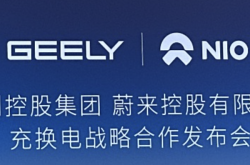
On the morning of September 28, both NIO and Geely Holding Group made official announcements. Geely agreed to exchange 100% equity in YiYi Interconnection, along with RMB 640 million in cash, for a 30% stake in NIO Energy. The post-investment valuation of NIO Energy was set at RMB 16 billion.
This marks the official completion of a cross-asset and equity transaction. 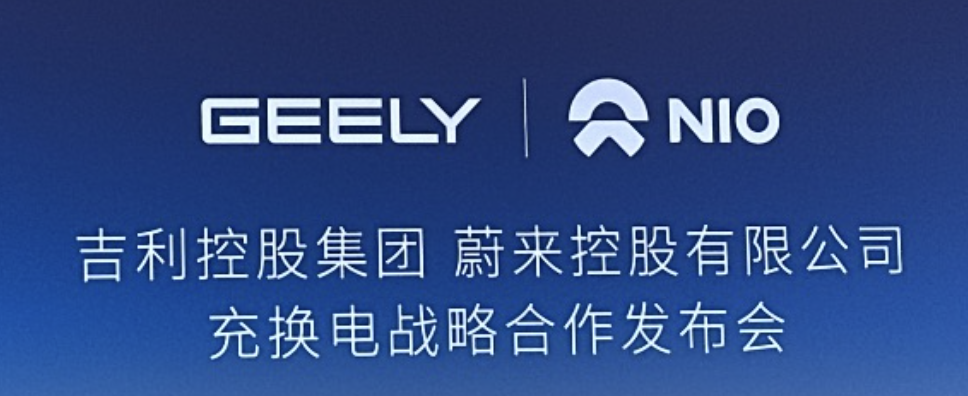
In March 2025, NIO and CATL entered into a strategic cooperation agreement focused on battery swapping. At that time, CATL announced plans to invest up to RMB 2.5 billion in NIO Energy.
Now, over a year later, Geely has emerged as the first industrial capital investor to join NIO Energy's shareholder lineup.
Through a clear asset and equity exchange, Geely and NIO have comprehensively addressed the integration of battery swap assets, including key issues such as battery standardization, network control, and investment cost allocation.
What are the key points of interest?
Geely's total investment consideration amounts to approximately RMB 4.8 billion, with cash comprising only a minor portion. Based on the valuation, Geely's total stake is valued at RMB 4.8 billion.
This valuation is calculated by multiplying the post-investment valuation of RMB 16 billion by 30%.
Out of this total, RMB 640 million is paid in cash, while the remaining approximately RMB 4.16 billion represents the implied valuation of 100% equity in YiYi Interconnection.
Consequently, NIO Energy's pre-investment valuation is estimated to be around RMB 11.2 billion.
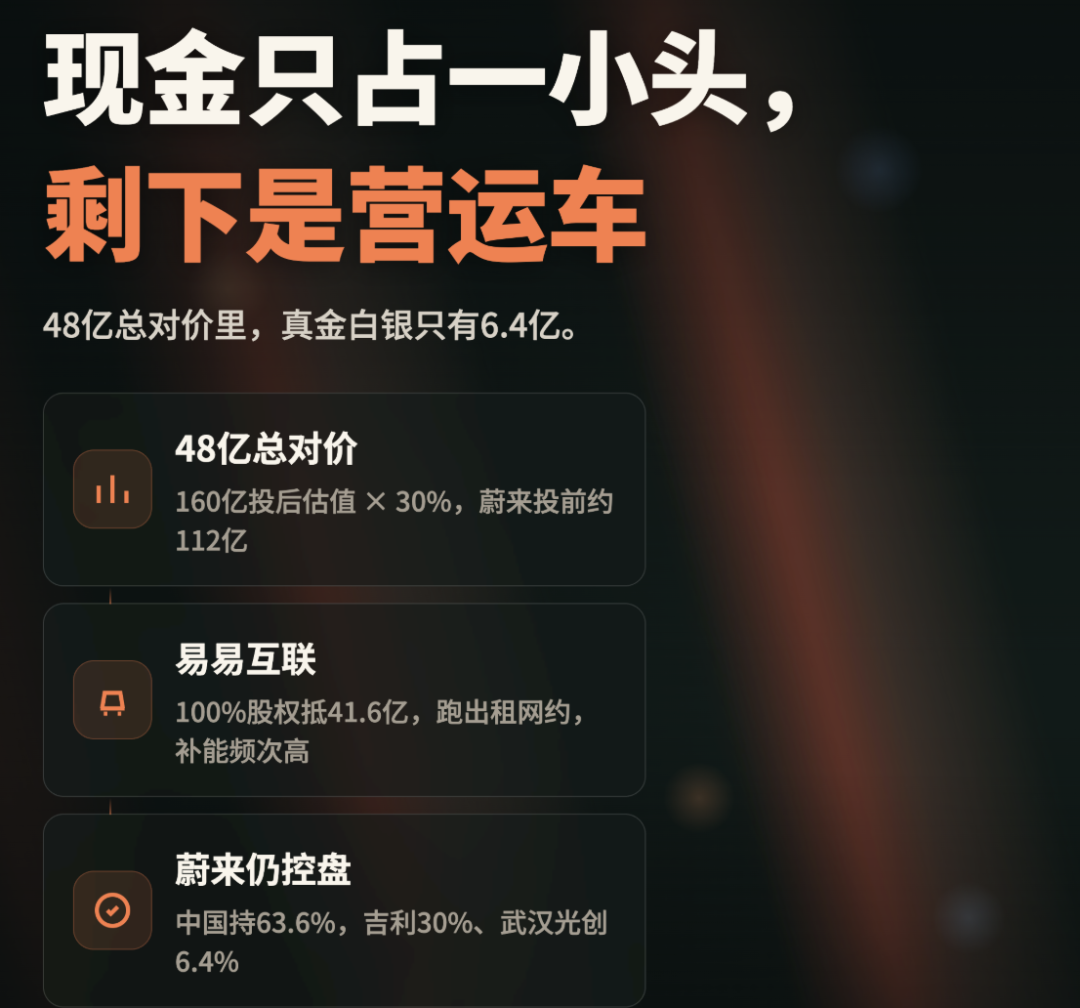
YiYi Interconnection Brings Tangible Operational Assets, Not Just Empty Promises. YiYi Interconnection operates within the commercial vehicle sector, including taxis and ride-hailing services.
These vehicles travel long distances daily and require frequent energy replenishment, providing a more consistent and reliable stream of orders for battery swap stations compared to private vehicles.
For NIO Energy, securing additional verbal cooperation agreements holds little value; what is truly scarce are real, operational vehicles that can enhance the utilization rate of individual stations.
NIO Maintains Control: NIO China Retains a 63.6% Stake, Geely Acquires 30%, and Wuhan Guangchuang Fund Holds 6.4%.
This scenario echoes the March 2025 cooperation announcement, where CATL stated it was "advancing" a strategic investment of "up to RMB 2.5 billion" in NIO Energy.
At that time, NIO and CATL aimed to enable seamless battery swapping between different vehicle brands across their respective networks. This endeavor involved not just the mechanical aspects of battery swap stations but an entire vehicle and energy ecosystem.
Every detail, including battery pack dimensions and weight, locking mechanisms, high- and low-voltage interfaces, thermal management, BMS communication, health identification, station-vehicle-cloud coordination, as well as battery asset valuation and responsibility allocation, needed to be meticulously aligned.
The NIO ecosystem revolves around its proprietary vehicle models and BaaS (Battery as a Service), whereas CATL's Chocolate Battery Swap initiative seeks to establish a cross-automaker public standard using No. 20 and No. 25 battery swap blocks.
Both companies have already invested heavily in existing infrastructure, and aligning with the other's standards would necessitate significant revisions to vehicle platforms, battery structures, and backend systems.
In August 2026, NIO's fifth-generation battery swap station went live, with Firefly integrating into NIO's own fifth-generation system, rather than the Chocolate Network.
In January 2026, the two companies signed another five-year comprehensive deepening cooperation agreement to continue collaborating on long-life batteries, battery swap compatibility, BaaS, and standardization efforts.
NIO Energy oversees the operation of charging and battery swap networks, while Wuhan Weineng manages battery asset leasing. CATL's involvement is channeled through Wuhan Weineng, indicating a profound level of cooperation between NIO and CATL at the battery level. 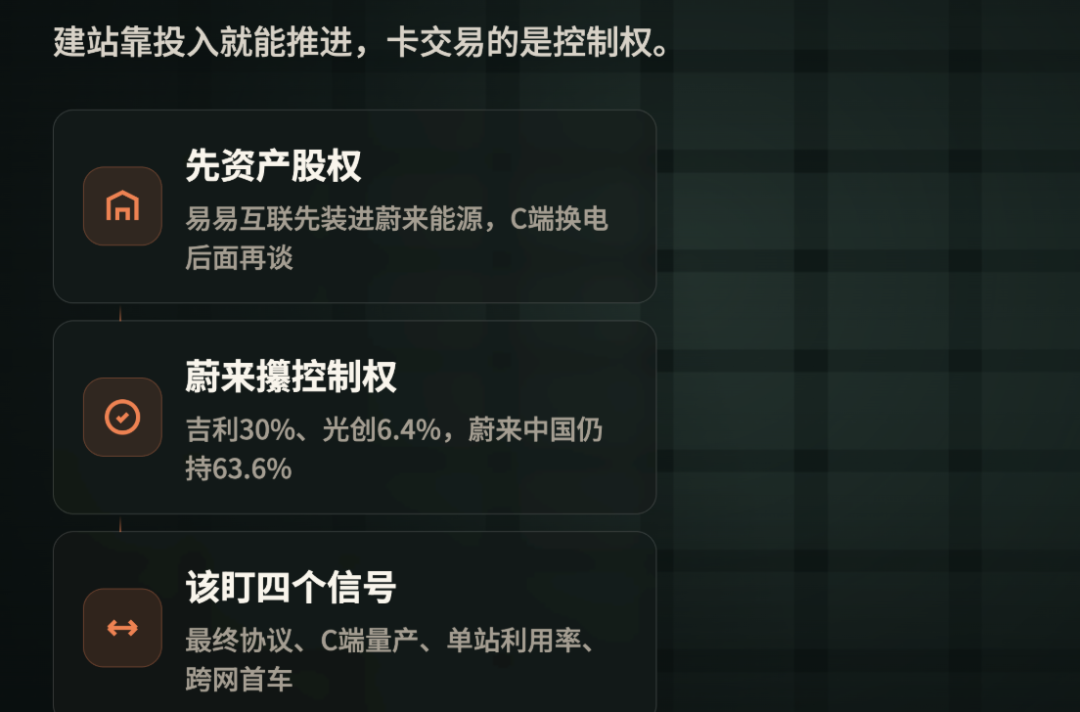
The collaboration between Geely and NIO commences with asset equity integration, with YiYi Interconnection being the first to merge into NIO Energy. The application of battery swap technology in Geely's consumer (C-end) vehicle models will be discussed at a later stage.
C-end vehicle models and related services are currently in the preliminary planning phase and require further consultation among all stakeholders. Capital and assets can be transferred first, with interfaces and standards being gradually implemented in vehicles over time.
The crux of the transaction revolved around defining battery standards, determining network control, and allocating investment costs.
CATL aims to establish its public standard as the ecological centerpiece, while NIO is focused on maintaining dominance over its proprietary three-brand network and energy replenishment experience. The interests of the two parties do not fully align.
Conclusion
The cooperation between Geely and NIO underscores the futility of maintaining separate battery swap standards among automakers. Moving forward, battery swap standards within the industry have been unified, leaving only two dominant players: NIO and CATL.
-
![]()
Dongfeng's Independent Brands Make Significant Strides
-
![]()
Breaking News: Next-Gen AI Model Release Scrapped! OpenAI Pulls the Plug
-
![]()
Two Chinese Women Close a $55 Billion Deal, with Employees Set to Share in $5.5 Billion
-
![]()
Geely Acquires 30% Stake in NIO Energy: NIO and Geely Strike a Deal on Charging and Battery Swap Transaction Restructuring, Paving the Way for Industry-Wide Standardization?
-
Hongmeng Zhixing Launches a Vehicle Directly Targeting Xiaomi YU7!
-
![]()
AUDI's European Presence: Sparking Anxiety and Redefining Global Market Strategies
-
![]()
Ideal i9: Is It the "Fireman" for Ideal?
-
Pharmaceutical Giant Doubles Down on AI