Navigating the Complexities: A Closer Look at Global Market Access Rules for Chinese Automakers
 10/08 2026
 465
465
As Chinese automakers expand their global footprint, they are increasingly confronted with intricate access regulations. The transition from a straightforward 'car-selling logic' to a more nuanced approach of 'studying, adapting to, and even shaping rules' has become imperative.
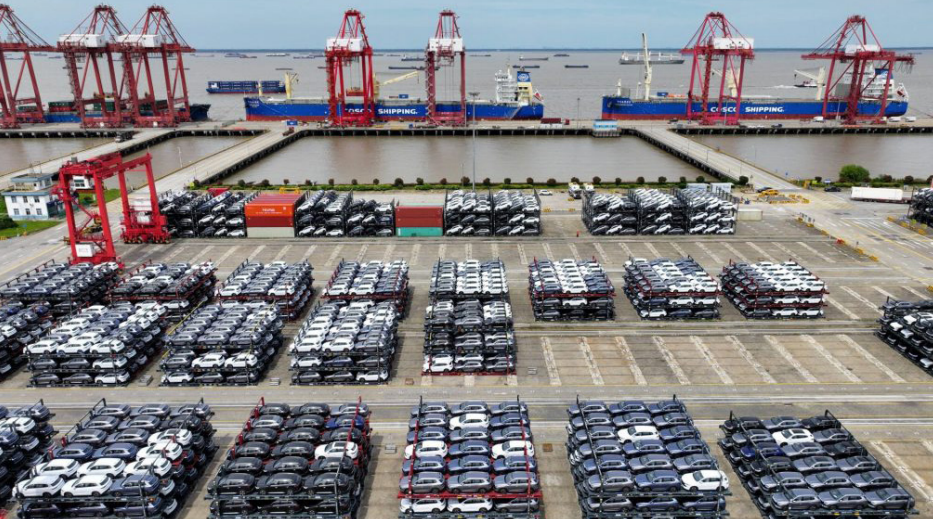
In recent years, Chinese automotive exports have witnessed a remarkable surge. With more Chinese automakers venturing into markets across Europe, Southeast Asia, the Middle East, and Latin America, the determinants of a vehicle's overseas success are evolving. Gone are the days when product quality, pricing, and distribution were the sole competitive edges. Today, factors such as tariffs, local production requirements, supply chain sourcing, data security, and after-sales service are emerging as critical barriers to market entry and sustained operations.
This shift signifies that Chinese automakers are entering a unique phase in their globalization journey. While many markets remain open to competition, the 'entry exam' has become increasingly multifaceted.
So, how has the entry exam become more challenging?
Tariffs and trade protection measures continue to be the most prevalent initial hurdles. For instance, the U.S.'s Section 301 tariffs on Chinese goods and the EU's anti-subsidy duties on Chinese-made electric vehicles exemplify efforts to raise import costs and erode price advantages. For companies, this translates into a clear financial challenge: assessing cost increases, profit margins, and the viability of a 'pure export' model.
However, tariffs are not insurmountable. Take the EU as an example; current anti-subsidy measures primarily target Chinese-made electric vehicles. Companies can explore alternative entry strategies by adjusting their product mix, powertrain types, and production layouts. Consequently, some regional markets are imposing systemic access requirements, seeking to reshape not just entry but also the manner in which companies operate within their borders.
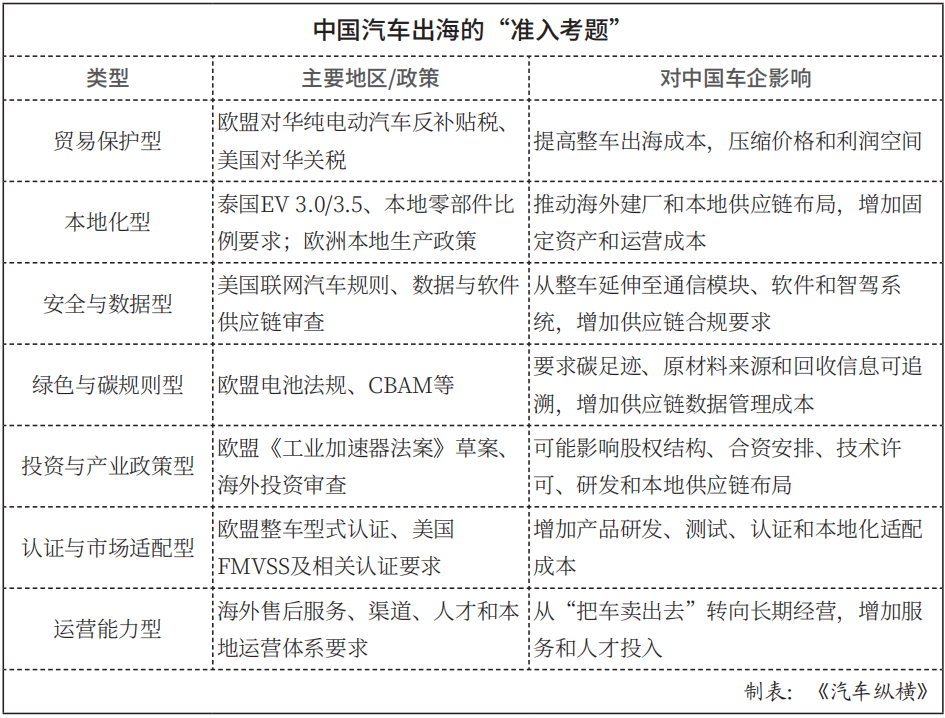
Consider Thailand's evolving new energy vehicle (NEV) policies. The current EV3.0 policy incentivizes NEVs through reduced import tariffs, excise taxes, and purchase subsidies, while mandating companies to offset imports with local production. The import-to-local production ratio, initially set at 1:1, will increase to 1:1.5 in 2025, 1:2 in 2026, and further to 1:3 in 2027 under EV 3.5.
In essence, companies targeting the Thai market must shoulder increasingly heavy local production obligations to reap market benefits. These requirements extend beyond complete vehicles to encompass the supply chain. Thailand's Board of Investment has introduced 'Made in Thailand' certification and local component usage ratios for NEV projects, mandating 40% local content for pure electric vehicles and 45% for plug-in hybrids. The policy focus has shifted from 'where to sell cars' to 'where to produce and procure'.
The experience of Neta Auto underscores the practical pressures of such localization requirements. As one of the first automakers to enter Thailand and participate in EV incentives, Neta initially gained an advantage. However, as market competition intensified and operational pressures mounted, a mismatch emerged between local production commitments and actual capabilities. Production targets went unmet, and subsidy disbursements were blocked. The Thai government later allowed some EV 3.0 companies to transfer unfulfilled production commitments to the EV 3.5 framework, but subsidies remain withheld until capacities are supplemented.
This highlights that localization is no longer a mere promise but a comprehensive calculation that companies must undertake when going global. Import scale, local sales, capacity planning, financial health, and supply chain development are all indispensable considerations. Moreover, the meaning of localization is quietly upgrading. Previously, going global for Chinese automakers primarily meant shipping cars overseas. Today, localization extends from manufacturing capability to comprehensive R&D, testing, engineering, and supply chain integration.
Chery's recent move in the UK exemplifies this trend. On August 19, Chery announced plans to establish an R&D center at UTAC Millbrook's vehicle testing base in Bedfordshire, UK, slated to open in late autumn 2026. Initially focused on chassis and driving assistance system development and tuning for the UK market, future plans include expanding to autonomous driving and artificial intelligence.

Notably, this move was not driven by any mandatory access rules but was initiated by the company itself. As R&D, testing, and product tuning begin to localize overseas, companies must embed not just production but the entire product development chain. The exam for going global is shifting from 'how much in tariffs to pay' to 'how much to produce, procure, and build in industrial capability locally'. When the questions change, so does the difficulty.
Expanding Boundaries of Access
Generally, tariffs and localization rules alter 'how cars enter', whereas safety, green, and investment regulations emerging across regional markets pose another question: what kind of cars deserve entry?
The U.S. changes are the most direct. In January 2025, the U.S. Department of Commerce's Bureau of Industry and Security (BIS) formally issued final rules on connected vehicles, imposing restrictions on connected vehicles and related hardware/software with 'sufficient ties' to China or Russia. The rules cover in-vehicle communication system hardware and autonomous driving system software, with software restrictions taking effect in the 2027 model year and hardware restrictions in the 2030 model year. Even if vehicles are produced domestically in the U.S., sales may still be halted if manufacturers are deemed to have sufficient ties to China or Russia as defined by the rules.
What does this mean? Previously, companies only needed to prove product compliance with local technical and safety standards. Today, in the intelligent connected vehicle domain, regulators are scrutinizing communication modules, in-vehicle software, autonomous driving systems, and even the supplier networks behind them. Origin is no longer a protective charm; 'what's inside the car' has become a new access question.
Europe is implementing stringent green rules. The EU's Carbon Border Adjustment Mechanism (CBAM) officially took effect in 2026, initially covering cement, steel, aluminum, fertilizers, electricity, and hydrogen. While not directly impacting complete vehicles and power batteries, the carbon emission accounting and cost changes in upstream materials exert unavoidable pressure on the automotive industry.
More direct impacts come from the EU's new Battery Regulation. This law requires electric vehicle batteries to establish carbon footprint declarations and gradually introduces carbon footprint performance classes, maximum emission thresholds, recycled material usage ratios, and digital battery passports. Carbon footprint class requirements will start on August 18, 2026, with digital passports becoming mandatory from February 18, 2027.
The biggest difference between such rules and tariffs is that companies cannot resolve them through one-time cost calculations or building a single factory. These rules require continuous tracking of raw materials, production processes, energy use, and recycling information, forming verifiable data. Thus, these access rules are shifting focus from the vehicles themselves to the internal workings of the supply chain. Tariffs look at price, localization at origin, while safety and green rules examine product composition, data, and sourcing.
Furthermore, Europe's access discussions are extending to investment structures and industrial capabilities. In March 2026, the European Commission proposed a draft Industrial Accelerator Act, imposing additional conditions on foreign direct investment in certain emerging strategic industries. The draft targets foreign investments where the source country accounts for over 40% of global manufacturing capacity in the relevant industry and meets a 100 million euro investment threshold, setting value creation conditions. Investors must satisfy at least four of six conditions, including foreign investor ownership not exceeding 49%, forming joint ventures with EU entities, licensing intellectual property and know-how, conducting R&D in the EU, hiring and training EU employees, and increasing EU local supply chain procurement. The bill remains in the legislative process and is not yet finalized.
The notable aspect of this design is not just the 49% ownership cap but that it bundles market entry, investment structure, technological capability, and local industrial value creation into a single policy framework. Consequently, the idea of 'market access in exchange for technology' is surfacing in European policy circles. Some European policymakers and industry figures argue that instead of simply blocking Chinese NEV and battery companies from Europe, Europe should leverage its market attractiveness to guide Chinese companies to invest, conduct R&D, establish partnerships, and retain some technologies and industrial capabilities locally. Sebastian Hellmann, a German expert on China, and Michael Kascske, former CEO of Zeiss, have proposed that Chinese companies exchange European market access through European-controlled joint ventures, explicitly advocating 'market access in exchange for technology transfer'.
Of course, this thought process does not mean the EU has implemented a unified 'market-for-technology' system. Indeed, the Industrial Accelerator Act remains a draft, and its design does not mandate joint ventures for all foreign companies but retains flexibility by requiring satisfaction of four out of six conditions. However, the policy direction is noteworthy: Europe is attempting to transform foreign investment from mere capital inflows into local R&D, employment, supply chain, and technological capability building. Consequently, the costs companies must bear extend from tariffs and local factories to R&D, intellectual property, joint venture arrangements, and local supply chain expansion.
Global Competence Tests Beyond Rules
Of course, despite the expanding scope of access rules, whatever their evolution, what ultimately faces scrutiny is companies' systemic capabilities.
Recently, Wan Gang, Honorary President of the China Association for Science and Technology, pointed out an easily overlooked shortcoming in an exclusive interview with Xinhua's 'Xinhua In-Depth': overseas localized after-sales service systems. Some Chinese automakers going global still fundamentally operate with a 'car-selling' mindset. However, they lag significantly behind mature overseas automakers in customer operations, vehicle usage services, long-term communication, and brand maintenance. Meanwhile, marketing, service, and management talent for international markets remain far from sufficient.
Wan Gang proposed two solutions: establishing localized production bases to directly address trade barriers and improving overseas after-sales service systems while collaborating with universities to cultivate R&D, marketing, and service talent. Both paths point to the same direction: going global requires exporting not just a car or a factory but an entire operating system capable of sustained local functioning.
This aligns with the preceding rule changes. When markets only required selling cars, product and price were the sharpest weapons. When markets demand local production, supply chain integration, R&D adaptation, and long-term commitment, companies must develop the ability to co-evolve with local markets.
Moreover, the 'exams' posed by different markets are far from identical.
The U.S. focuses on safety and supply chain compliance. Companies must calculate tariffs while thoroughly understanding compliance boundaries for connected vehicle hardware and software. After all, U.S. connected vehicle rules extend supervision to in-vehicle software and communication systems.
The EU presents a comprehensive exam. How to absorb tariffs, arrange local production, track battery carbon footprints, manage raw material and supply chain data—each is a mandatory question. If investment rules like the Industrial Accelerator Act are finalized, equity arrangements, local R&D, technology licensing, and supply chain contributions may also enter companies' decision-making.
Southeast Asian markets like Thailand directly 'test' localization execution. Import scale, sales growth, capacity planning, and local supply chain development must be calculated holistically. For smaller or financially pressured companies, any disconnect between localization commitments and actual capabilities can turn policy incentives—once used to secure market opportunities—into reverse pressure.
The UK presents a different landscape. Access policies have not yet formed systemic restrictions like the U.S. and EU, but market competition alone sufficiently compels companies to proactively enhance localization. Chery's establishment of an R&D center in the UK, localizing chassis and driving assistance system development, exemplifies this proactive market adaptation.
Thus, what truly warrants vigilance is the composite challenge formed by overlapping rules.
After all, tariffs can be calculated, local factories planned, and R&D centers funded. However, data security, carbon footprints, supply chain transparency, equity structures, technology cooperation, after-sales service, and talent development cannot be resolved through one-time investments. They demand a continuous learning and adjustment capability for global operations.
Previously, Chinese companies excelled at problem-solving: reducing product costs, expanding production scales, and compressing delivery cycles. These are hard skills with formulas to follow and benchmarks to pursue. Today, entering global markets also means understanding constantly revised local rules, building a cross-cultural organization, managing a long supply chain fraught with geopolitical risks, and continuously seeking optimal solutions amid technological, data, environmental, and investment variables.
Going global is no longer merely about selling cars; rather, it hinges on an automaker's ability to sustain stable operations in unfamiliar markets over the long haul.
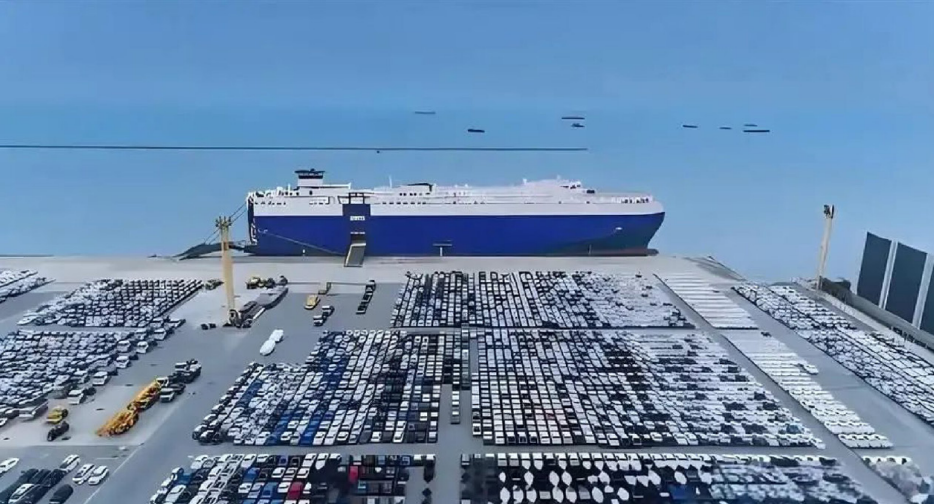
For the Chinese automotive industry, which is now deeply immersed in the waters of globalization, the most pressing task may no longer be simply passing a specific entry exam. Instead, it lies in comprehending the scoring logic behind the exams of different markets: what aspects they assess, why they do so, and how the assessment criteria will evolve in the future. This is an indispensable course of study.

Image: Sourced from the Internet
Article: Auto Review
Layout: Auto Review
-
![]()
Diversifying Production Capacity Amid Pressure and Hedging Against Price Wars: Chinese Automakers Seize Overseas Growth Opportunities
-
From Selling Server Racks to Selling Tokens: Where Has AIDC's Valuation Anchor Shifted?
-
![]()
Porsche’s 2035 Vision: Amid Layoffs and Model Streamlining, a Steadfast Commitment to Fuel-Powered Vehicle R&D
-
![]()
Global Market: Fuel Vehicle Sales Share Dips Below 50%. Is BYD Poised to Overtake Toyota Soon?
-
![]()
During Long Holidays, EV Charging Stations at Highway Service Areas Are in High Demand. Should Range-Extended and Plug-In Hybrid Vehicles Give Way?
-
![]()
September Auto Sales: Traditional Powerhouses BYD, Chery, Geely Maintain Lead; Leapmotor Holds onto New Energy Crown
-
![]()
Should Chinese Automakers Establish Factories in the U.S.: A Boon or a Bane?
-
![]()
Navigating the Complexities: A Closer Look at Global Market Access Rules for Chinese Automakers