September Brings Seismic Shifts to China’s Independent Auto Market: SAIC and Leapmotor Join Elite Ranks, Top 5 Expands to Top 7! Three Firms Report Negative Growth Year-to-Date | Mirror Pro
 10/12 2026
 526
526
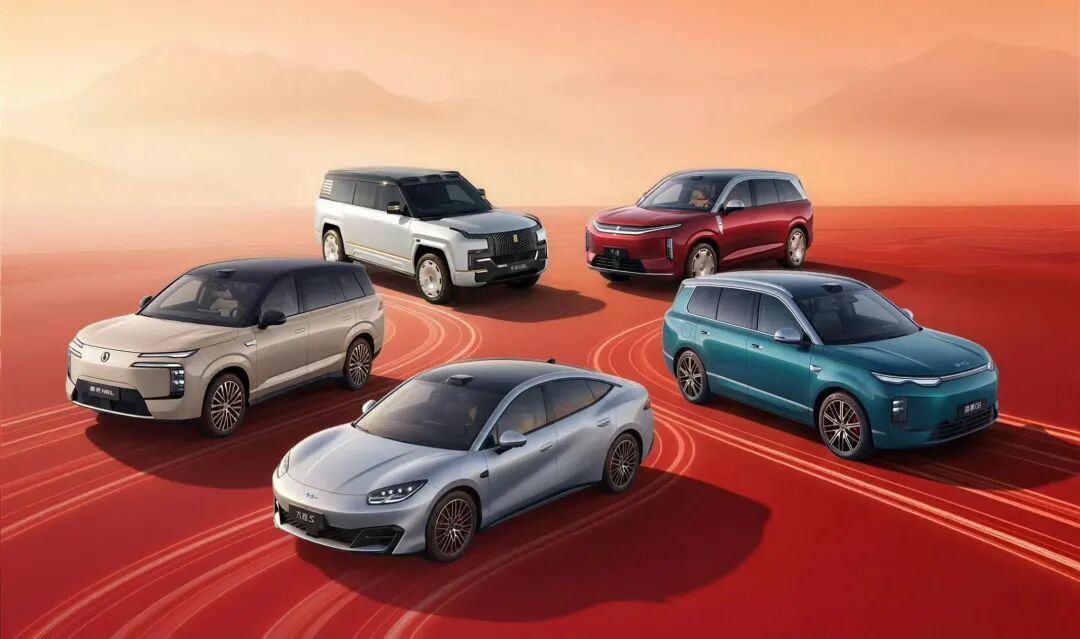
September has witnessed unprecedented upheaval in China’s independent automotive market in recent years, with the established top five expanding to a formidable seven. Using monthly sales of 100,000 units as a benchmark, the leading independent automakers now include BYD, Geely, Chery, Changan Automobile, Great Wall, SAIC Motor Passenger Vehicles, and Leapmotor—with SAIC and Leapmotor as the newest entrants. Leapmotor secured a spot in the top six last month. In September, riding the wave of the traditional peak sales season, all these automakers achieved positive month-on-month growth.
Among them, BYD claimed the top spot with over 460,000 units sold. Chery and Geely remained in a tight race, each selling nearly 300,000 units and ranking second and third, respectively. Changan Automobile hovered around 200,000 units, followed by Great Wall, SAIC Motor Passenger Vehicles, and Leapmotor. SAIC Motor Passenger Vehicles returned to the 100,000-unit mark in November of last year. Leapmotor broke through the 100,000-unit threshold for the first time in July this year, becoming the only new energy vehicle (NEV) manufacturer among the top performers to achieve this milestone.
From a year-to-date sales perspective, BYD’s cumulative sales exceeded 3 million units. Geely and Chery both surpassed 2 million units. Changan Automobile gradually fell behind Geely and Chery, with cumulative sales nearing 1.4 million units. Meanwhile, Great Wall, SAIC Motor Passenger Vehicles, and Leapmotor each sold less than 1 million units. Great Wall maintained last year’s level, while SAIC and Leapmotor, though at the lower end among the leading companies, demonstrated the strongest growth, increasing by about 50%.
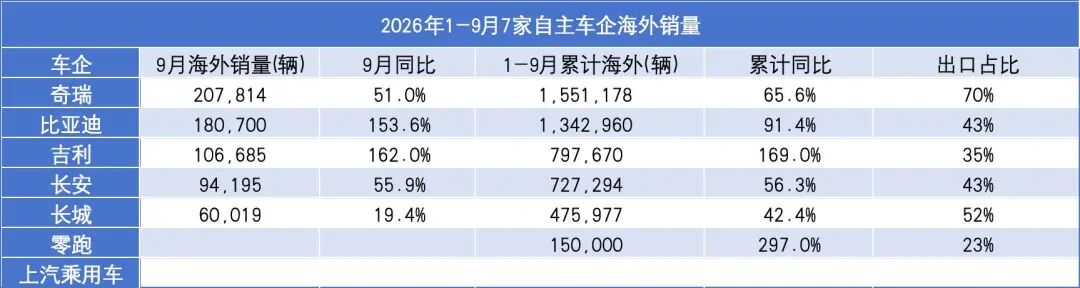
In terms of sales composition, new energy vehicles and exports remained the primary drivers of overall growth. Facing pressure from domestic sales, leading automakers like BYD, Chery, and Geely have shifted their growth focus from the domestic market to overseas markets.
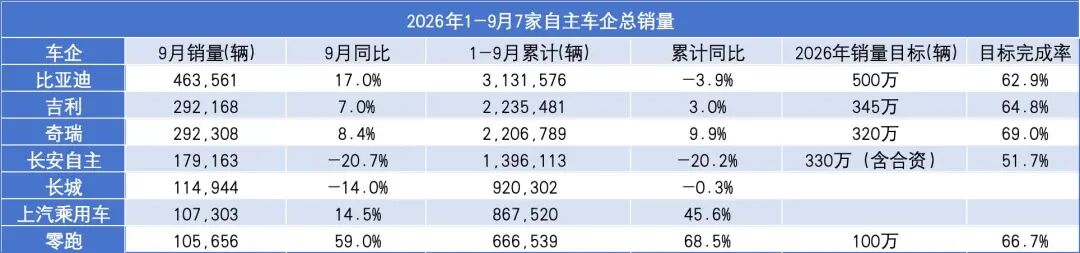
Specifically, BYD sold 463,561 units in September, marking a 17.0% year-on-year increase and a 5.28% month-on-month rise. This marked the second consecutive month of positive year-on-year growth. Cumulative sales for the first three quarters reached 3,131,576 units, still down 3.9%. Domestic sales were 1,788,616 units, a 30% year-on-year decline. In contrast, overseas sales surged from 700,000 units last year to 1.34 million units, nearly doubling year-on-year. Overseas sales now account for 43% of total sales, up from 21% last year.
Chery and Geely remained in close competition. Chery Group sold 292,308 units in September, a 4.2% year-on-year increase, leading Geely by a slim margin of 140 units. Cumulative sales for the first three quarters reached 2,206,789 units, up 9.9% year-on-year. Geely sold 292,168 units in September, a 7.0% year-on-year increase. Its cumulative sales for the first three quarters were 2,235,481 units, up 3% year-on-year.
However, significant differences exist in the sales structures of Chery and Geely. Firstly, Chery’s sales and growth are primarily driven by overseas markets. Cumulative exports for the first three quarters reached 1,551,178 units, a 65.6% year-on-year increase, surpassing last year’s total exports. Overseas sales now account for 70% of Chery’s total sales. However, Chery’s position as the “export leader” faces challenges from BYD. Geely, on the other hand, focuses more on the domestic market, with domestic sales nearly double those of Chery. Nevertheless, Geely has also been actively expanding overseas markets in the past two years, with exports reaching 797,670 units in the first three quarters, a 169.0% year-on-year increase—the highest growth rate among the companies—accounting for about 35% of total sales.
Secondly, in terms of new energy vehicles, Geely has a larger scale and higher penetration rate. For example, Galaxy’s monthly sales have consistently exceeded 100,000 units, and its high-end brand Zeekr reached a new high of 37,216 units in September. Cumulative new energy sales for Geely in the first three quarters were 1,326,364 units, a 13.6% year-on-year increase, with a penetration rate of nearly 60%. In contrast, Chery’s new energy sales were 858,524 units, a 46.1% year-on-year increase, with a penetration rate of about 38%. Overall, both companies are steadily advancing their new energy businesses, showing growth trends.
Changan Automobile has gradually fallen behind Chery and Geely over the past two years. In September, Changan Automobile sold 179,163 units, a 20.7% year-on-year decline but a 10.17% month-on-month increase, showing some momentum during the traditional peak sales season. Cumulative sales for the first three quarters were 1,396,113 units, a 20.2% year-on-year decline—the largest monthly decline among the top seven.
The main reason for Changan Automobile’s sales decline is the shrinking market share of its traditional fuel vehicle segment, represented by Changan UNI, coupled with sluggish growth in the new energy vehicle segment. Cumulative new energy sales for Changan in the first three quarters were 709,256 units, a 2.1% year-on-year decline, with a penetration rate of about 42%. Sales of brands like Shenlan and Avatr declined significantly in September compared to last year. To integrate resources, Changan has initiated organizational adjustments for Shenlan and Avatr, the impact of which on sales remains to be seen. However, exports have been a bright spot for Changan in the first three quarters, with exports reaching 727,294 units, a 56.3% year-on-year increase, accounting for 43% of total sales.
Great Wall’s monthly sales have remained around 100,000 units in recent years. In September, Great Wall sold 114,944 units, a 14.0% year-on-year decline but a slight 1.36% month-on-month increase. Cumulative sales for the first three quarters were 920,302 units, a slight 0.3% year-on-year decline, barely maintaining last year’s level. In terms of new energy vehicles, Great Wall sold 261,967 units in the first three quarters, a 5.9% year-on-year decline, with a penetration rate of 28.5%—the lowest among the companies. In terms of exports, Great Wall sold 475,977 units in the first three quarters, a 42.4% year-on-year increase, accounting for about 52% of total sales.
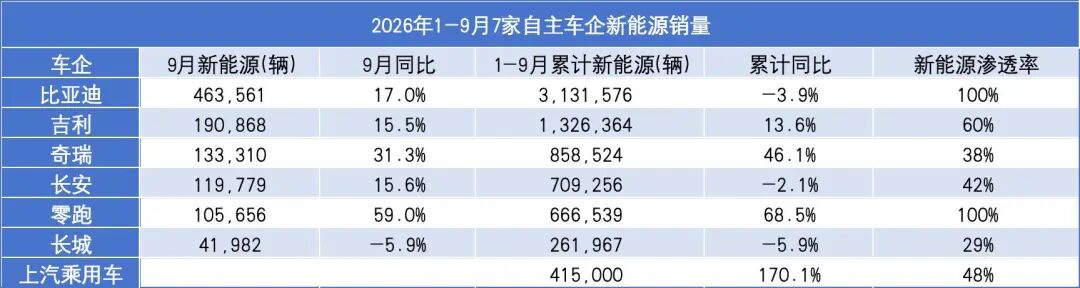
SAIC Motor Passenger Vehicles, driven by the MG brand, has seen a steady recovery in sales. It sold 107,303 units in September, a 14.5% year-on-year increase and a 2.96% month-on-month rise. The MG4 family and MG 07 were the main drivers of this growth. Cumulative sales for the first three quarters were 867,520 units, a 45.56% year-on-year increase. Cumulative new energy sales were 415,000 units, a 170.1% year-on-year increase. However, SAIC has not disclosed overall export data. Its main export brand, MG, along with several models from Roewe and IM Motors, are also sold overseas under the MG brand. Europe is SAIC’s largest overseas market, with cumulative MG sales in Europe exceeding 280,000 units in the first three quarters, a 23% year-on-year increase.
Leapmotor is the only new energy vehicle manufacturer among the top seven independent automakers. In September, Leapmotor delivered 105,656 units, a 59% year-on-year increase and a 2.45% month-on-month rise, marking the third consecutive month of exceeding 100,000 units. Cumulative deliveries for the first three quarters were 666,500 units, a 68.5% year-on-year increase. Unlike the other six automakers that operate multiple brands, Leapmotor achieved this result with a single brand’s four product lines (A, B, C, D), covering a price range of 60,000 to 300,000 yuan. Next, Leapmotor’s higher-end second brand is also on its way.
Exports are also key to supporting Leapmotor’s rapid sales growth. Relying on Stellantis’ channels and products like T03, C10, and B10, Leapmotor’s exports exceeded 150,000 units in the first three quarters, a nearly 300% year-on-year increase, surpassing the annual target of 150,000 units ahead of schedule. Exports now account for 23% of total sales. In the final three months, Leapmotor should have no difficulty achieving 200,000 overseas exports.
Finally, let’s examine the target completion rates for the first three quarters among several automakers (excluding Great Wall and SAIC Motor Passenger Vehicles, which have not announced their sales targets). As of the end of September, none of the six automakers achieved a target completion rate exceeding 70%, with five of them, excluding Changan, falling within the 60%-70% range.
Among them, Chery had the highest target completion rate. Its 2026 group sales target is 3.2 million units, with a completion rate of 69%. Leapmotor followed, with a 2026 annual target of 1 million units and a completion rate of 66.7%. Geely came next, with a 2026 sales target of 3.45 million units and a completion rate of 64.8%. BYD’s 2026 sales target is 5 million units (not officially announced, according to media reports), with a completion rate of 62.9%. Changan’s sales target is set at 3.3 million units, with a completion rate of 51.7%.
Overall, Chery and Leapmotor still have a chance to achieve their sales targets with a final push. However, Geely, BYD, and Changan face larger gaps. Taking BYD as an example, it still has a gap of 1.86 million units, requiring an average of over 620,000 units per month in the fourth quarter. Changan faces an even greater challenge, needing to achieve an average of 530,000 units per month—a feat that may only be feasible next year. Nevertheless, all independent automakers have become stronger.
-
![]()
Sub-$150 Entry-Level Smartphones on the Brink of Vanishing: When Will the Storage Shortage Ease?
-
![]()
September Brings Seismic Shifts to China’s Independent Auto Market: SAIC and Leapmotor Join Elite Ranks, Top 5 Expands to Top 7! Three Firms Report Negative Growth Year-to-Date | Mirror Pro
-
![]()
The Era of Lightweight Integration in Existing Assets Arrives! GAC's Entry into FAW-Toyota Holds Multiple Implications
-
![]()
Observations on the Integration of Public and Private Communication Systems in Heilongjiang's Two-Way Radio Systems: What Changes Are Happening in Private Network Communications Behind 86 Projects
-
![]()
The Truth Behind the Surge in Smartphone Prices: Will the Trend Persist Beyond Autumn?
-
![]()
AITO Auto Sets Sights on European Market Entry by 2027: EU Whole Vehicle Type Approval Process Underway
-
Reflection on the AI Evolution of TCL, Hisense, Skyworth, and Others: How to Trigger High-Frequency User Demand?
-
![]()
[Electric Equipment] Great Wall Heavy Industry’s GT105E All-Electric Wide-Body Truck Makes Its Debut in Hainan Mining Region