August Sees 67% New Energy Penetration! Domestic Retail Feels the Squeeze as Exports Soar
 10/13 2026
 345
345
In September 2026, the domestic automotive market stepped into the traditional "Golden September" sales cycle. While domestic retail sales faced challenges, the supply side remained robust. Exports to overseas markets surged, intensifying domestic competition while fueling strong growth driven by international demand. Both retail and wholesale penetration rates reached unprecedented levels. Overseas markets emerged as the primary force for offsetting domestic retail pressures, accompanied by ongoing adjustments in the internal product structure of the market and further polarization among different technology routes and brand groups.
Domestic Retail Under Pressure, Yet Penetration Rate Hits New High
The retail penetration rate of new energy vehicles continued its upward trajectory, with 1.084 million new energy passenger vehicles sold domestically in September. This marked a 16.7% year-on-year decrease but a 7.8% month-on-month increase. From January to September, cumulative retail sales of new energy passenger vehicles reached 7.758 million, reflecting a 12.8% year-on-year decline. In contrast, retail sales of conventional fuel-powered passenger vehicles stood at 530,000 units in September, down 43% year-on-year and 0.3% month-on-month. The fuel vehicle market continued its contraction, although conventional hybrid vehicles bucked the trend with a 25% year-on-year and 19% month-on-month increase.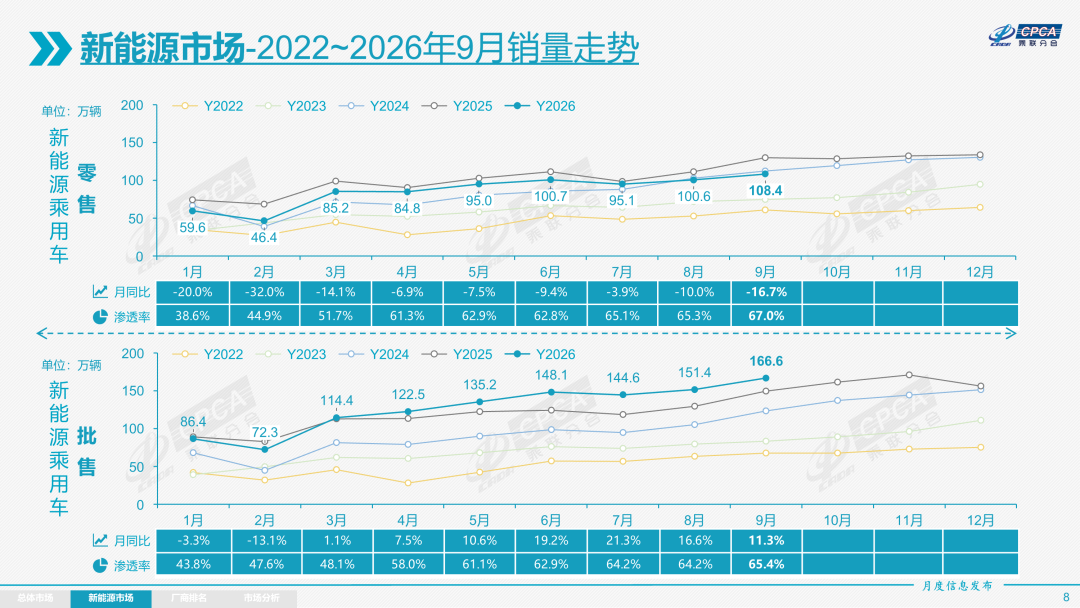
In September, the domestic retail penetration rate of new energy passenger vehicles soared to 67%, up 1.7 percentage points month-on-month and 9.1 percentage points year-on-year, setting a new historical benchmark. Electrification progress varied significantly across brand groups: domestic brands achieved an 84.5% penetration rate; luxury brands reached 44.9%; and mainstream joint ventures increased to 15.9%, indicating a sluggish electrification transformation among the latter.
The market share landscape shifted, with domestic brands accounting for 64.5% of new energy retail sales in September, a 5.7 percentage point year-on-year decline. Mainstream joint ventures captured 4.8%, up 1.6 percentage points year-on-year. New forces contributed 23.6%, a 3.4 percentage point year-on-year increase, with brands like Leapmotor and NIO driving growth in this segment.
The product mix of new forces models continued to shift towards pure electric vehicles, with pure electric sales accounting for 75%—a significant increase compared to previous years. The mid-range home market, priced between 100,000 and 150,000 yuan, emerged as the core growth area for new forces. New energy brands incubated by traditional automakers performed strongly, capturing 15% of the market share—a 2.3 percentage point year-on-year increase. Brands such as Zeekr, eπ Tech, Aion, Arcfox, and Voyah gained momentum, enriching the market's competitive landscape.
Polarization Persists in Production and Sales
Production and Wholesale Sales Grow, with Exports Compensating for Domestic Retail Shortfalls
Against a backdrop of weakening domestic retail sales, production and wholesale sales maintained growth driven by overseas orders, underscoring the resilience of the industry's supply side.
In September, production of new energy passenger vehicles reached 1.655 million units, up 9.8% year-on-year and 8.3% month-on-month. From January to September, cumulative production hit 11.413 million units, a 9.7% year-on-year increase, with sustained capacity releases preparing for fourth-quarter market demand.
Wholesale sales data directly reflect automakers' shipment volumes. In September, wholesale sales of new energy passenger vehicles reached 1.666 million units, up 11.3% year-on-year and 10% month-on-month. From January to September, cumulative wholesale sales totaled 11.448 million units, a 9.4% year-on-year increase. In September, wholesale sales of conventional fuel-powered passenger vehicles reached 880,000 units, down 32% year-on-year but up 5% month-on-month. The wholesale penetration rate of new energy passenger vehicles reached 65.4%, a 12 percentage point year-on-year increase, indicating automakers' continued focus on new energy businesses.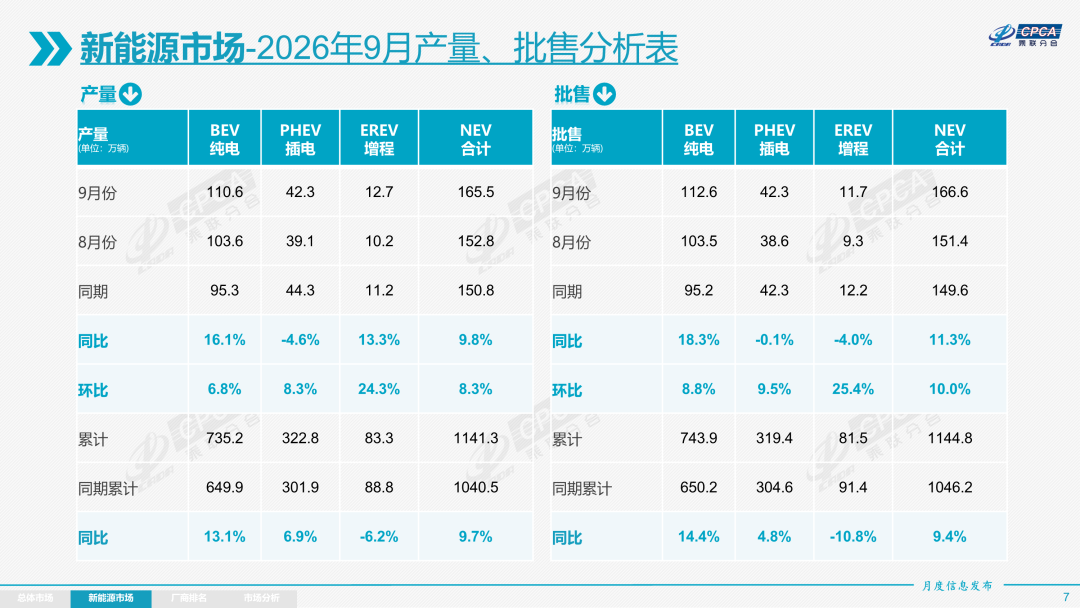
Market resources continued to concentrate among leading companies. In September, 22 new energy manufacturers achieved monthly wholesale sales exceeding 10,000 units—an increase of 2 companies year-on-year and 3 companies month-on-month—collectively accounting for 94.4% of the new energy market share. Leaders such as BYD, Geely, Chery, Leapmotor, and Tesla China dominated shipment volumes, widening the gap between tiers of companies. In September, 23 models achieved wholesale sales exceeding 20,000 units—an increase of 2 models from the previous month—with models like the BYD Song, Model Y, BYD Yuan UP, and Geely Starwish leading the rankings. New energy models dominated the best-seller list.
In terms of model segments, B-class electric vehicles showed strong growth momentum. In September, wholesale sales of B-class electric vehicles reached 329,000 units, up 21% year-on-year and 9% month-on-month, accounting for 29% of the pure electric market share—a slight year-on-year increase. The A00-class economy electric vehicle market faced pressure, with wholesale sales of 78,000 units in September, down 51% year-on-year but up 28% month-on-month, accounting for only 7% of the pure electric market share—a significant 10 percentage point year-on-year decline. A0-class models became the foundation of pure electric sales, with wholesale sales of 396,000 units, accounting for 35% of the pure electric market share—a 10.0% year-on-year increase. A-class electric vehicles had wholesale sales of 266,000 units, accounting for 24% of the pure electric market share. Long-term growth in the automotive market hinges on the popularization of entry-level economy electric vehicles.
Technology Landscape Continues to Polarize
Pure Electric Vehicles Maintain Strong Growth, Plug-In Hybrids Remain Stable, and Extended-Range Electric Vehicles Show Month-On-Month Improvement
In September, different technology routes within the new energy sector continued to diverge. Pure electric vehicles (BEVs), as the main growth driver, maintained double-digit growth. Narrowly defined plug-in hybrid vehicles (PHEVs) remained stable, while extended-range electric vehicles (EREVs) showed significant month-on-month recovery but still faced a slight year-on-year decline.
Pure electric vehicles (BEVs) were the core driver of market growth, with wholesale sales of 1.126 million units in September, up 18.3% year-on-year and 8.8% month-on-month, accounting for 67.6% of total new energy wholesale sales—a 4 percentage point year-on-year increase—solidifying their dominant market position.
Narrowly defined plug-in hybrid vehicles (PHEVs) met the demand for multi-scenario family travel, maintaining market stability. In September, wholesale sales of PHEVs reached 423,000 units, a slight 0.1% year-on-year decrease but a 9.5% month-on-month increase, accounting for 25.4% of total new energy wholesale sales.
Extended-range electric vehicles (EREVs) showed significant month-on-month recovery, with wholesale sales of 117,000 units in September, down 4% year-on-year but up 25.4% month-on-month, with their market share rebounding to 7%.
Conventional hybrid vehicles performed independently, with wholesale sales of 125,000 units in September, up 51% year-on-year and 17% month-on-month. Toyota continued to dominate the conventional hybrid market, while domestic hybrid products from Geely, SAIC Motor, Changan, and Dongfeng rapidly emerged, achieving breakthroughs in overseas markets.
Brand Landscape Continues to Evolve
Overseas Expansion Capabilities Become a New Dividing Line
As domestic market competition intensifies, overseas markets have become crucial for domestic automakers to unlock growth potential and balance operational risks. In September, exports of new energy passenger vehicles surged.
In September, exports of new energy passenger vehicles reached 558,000 units, up 163.5% year-on-year and 7.7% month-on-month. From January to September, cumulative exports totaled 3.887 million units, a 138.8% year-on-year increase. In September, exports of conventional fuel-powered passenger vehicles reached 359,000 units, up 14% year-on-year but down 3% month-on-month. Exports of new energy passenger vehicles accounted for 60.8% of total passenger vehicle exports—a 21 percentage point year-on-year increase—indicating that China's automotive exports have fully entered a new energy-dominated phase.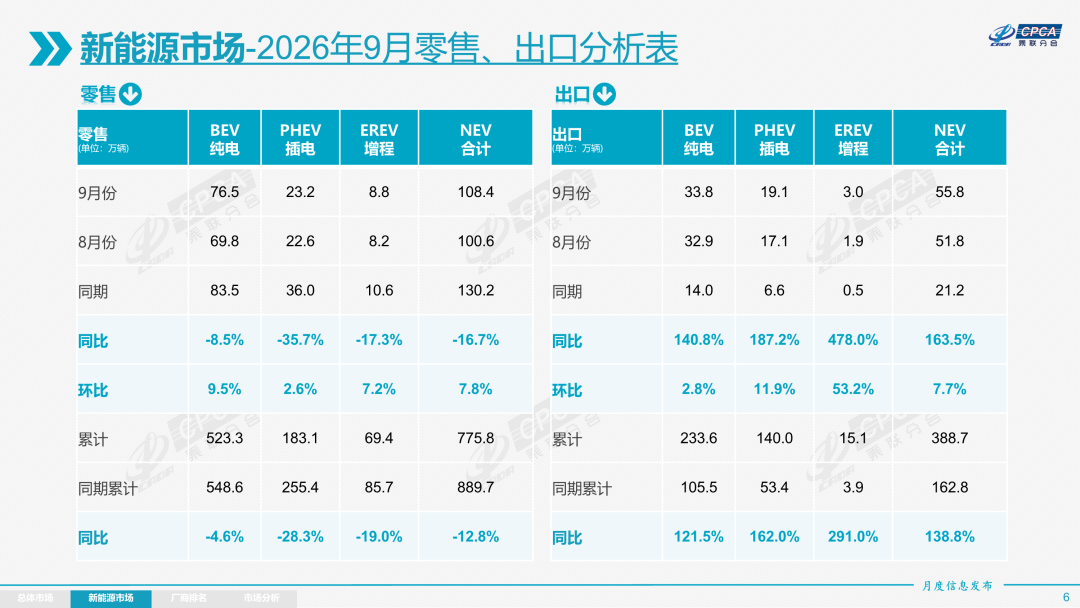
The export product mix continued to optimize: pure electric vehicles remained the mainstay of exports, accounting for 60.5% of new energy exports, with A00+A0-class economy pure electric vehicles accounting for 57.9% of pure electric exports, reflecting growing overseas recognition of economy models. Narrowly defined plug-in hybrid products accelerated their overseas expansion, accounting for 34.2% of new energy exports, rapidly gaining traction in many developing countries. Extended-range electric vehicles accounted for 5.3% of overseas exports, continuing to increase from the previous year. Despite trade policy interference in some overseas countries, exports of domestic narrowly defined plug-in hybrid models in developing countries continued to expand rapidly.
Domestic brands emerged as the main force in overseas expansion, with companies such as BYD, Chery, Geely, Tesla China, SAIC Motor, Changan, and Leapmotor performing prominently in exports. Localized production layouts overseas continued to advance, with the CKD (completely knocked down) assembly model widely adopted. Great Wall Motor and SAIC-GM-Wuling had high proportions of CKD exports, while Leapmotor and SAIC Motor also pushed forward with localized production, helping Chinese brands establish roots in overseas regional markets.
Industry Landscape Restructuring Accelerates
Leading Companies Consolidate Advantages, Market Concentrates Among Scaled Manufacturers
The new energy market has entered a phase of intense competition among existing players, with the industry's competitive landscape continuously reshaping and increasing pressure on small and medium-sized manufacturers. In September, the number of manufacturers with new energy wholesale sales exceeding 10,000 units continued to increase, with leading companies expanding their advantages through product matrices, supply chains, and overseas expansion capabilities. BYD maintained its lead by leveraging both pure electric and plug-in hybrid technologies, while Geely, Chery, Leapmotor, Tesla China, and Changan followed closely, creating a clear tiered structure.
In the domestic retail market, brands such as BYD, Geely, Leapmotor, Tesla China, and Changan led in retail sales, with a sufficient number of brands achieving retail sales exceeding 20,000 units, reflecting diversified brand participation in market competition.
The electrification transformation of the domestic passenger vehicle market is clearly underway, with the fuel vehicle market continuing to shrink and conventional hybrids becoming one of the few growth points within the fuel vehicle segment. Domestic retail sales face short-term pressure, but stable production supply and strong overseas export growth support the industry's fundamentals. With the arrival of the traditional fourth-quarter sales peak, coupled with new product launches and promotional activities by automakers, the domestic new energy terminal market is expected to see further recovery, while overseas business will continue to serve as the core engine of industry growth.
-
![]()
Global Market Share of Pure Gasoline Vehicles Dips Below 50%: Is the Gasoline Car Era Nearing Its End?
-
![]()
The Whole Story of the 2026 'Rushed Vehicle' Controversy: From a Live Stream Joke to a Public Naming by People's Daily
-
![]()
V4 Flash Scores Impressively, But DeepSeek Hasn't Revealed All Its Cards Yet
-
![]()
MiniMax is set to tell a new story
-
![]()
Feishu’s Strategic Shift: Is Doubling Down on Entry Points for China’s AI-Powered Office Tools the Right Call?
-
Toyota’s North and South China Operations Merge, GAC Toyota Appoints New Chinese Executive
-
![]()
Zunjie V800 Brake Pedal Third-Party Test Results Unveiled: Withstands 3000N Longitudinal Force Without Damage
-
Domestic Mobile Phone Brands in Disarray as Market Slides 20%: Samsung and Apple Surge Amidst Domestic Decline!