JPMorgan Chase Throws Three Buckets of Cold Water on the Auto Industry
 10/14 2026
 400
400
At a pivotal moment, a few metaphorical buckets of cold water have been cast from across the ocean, dampening spirits in the automotive sector.
The traditionally robust period of September and October should have marked the peak season for automotive sales. However, when the China Passenger Car Association (CPCA) released its data, it shattered the high-growth aspirations of many, bringing them back to reality.
From January to September, retail sales of domestic passenger vehicles reached 13.334 million units, marking a year-on-year decrease of 21.7%. In September alone, nationwide retail sales of passenger vehicles were 1.702 million units, a significant 24% decline compared to the previous year. New energy vehicle (NEV) retail sales stood at 1.141 million units, with a penetration rate soaring to 67.1%, nearly accounting for two-thirds of the market. Yet, sales still fell by 12%. Leading manufacturers, responsible for over 70% of market sales, saw their retail targets for September grow by less than 10% month-on-month.
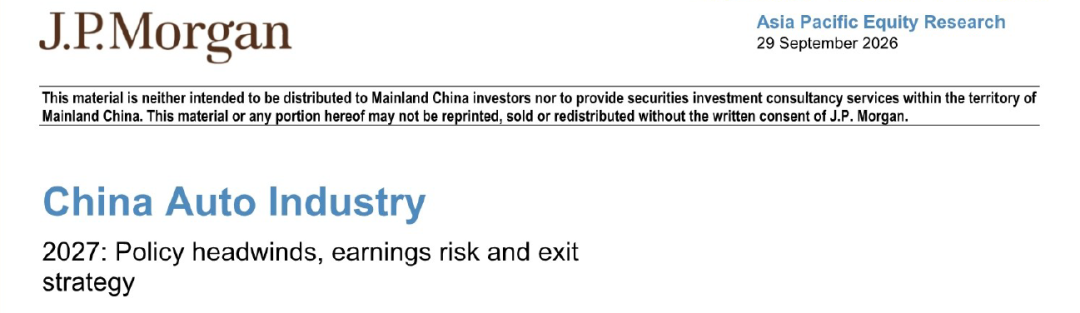
Amidst this backdrop, JPMorgan Chase, situated on the other side of the ocean, released a 52-page industry report titled '2027: Policy Headwinds, Profit Risks, and Exit Strategies.'
The title alone suggests a dampening of enthusiasm at a critical juncture.
Where Will Growth Originate?
The report commences with a bold prediction: JPMorgan Chase forecasts that domestic retail sales of passenger vehicles will reach 18.96 million units in 2026, a 21% decrease from 2025. In 2027, sales will decline further by 5% to 18.01 million units.
Based on current CPCA data, these figures remain within a reasonable range if no significant policy changes occur by the end of the year.
Fortunately, robust overseas exports are temporarily buoying the industry. The data speaks volumes: domestic automaker exports are projected to surge from 6.04 million units to 9.7 million units, representing a staggering 61% annual increase. With the domestic market declining and the overseas market growing, the offsetting effect will result in only a slight 5% decrease in total wholesale vehicle volumes in 2026, appearing relatively stable.
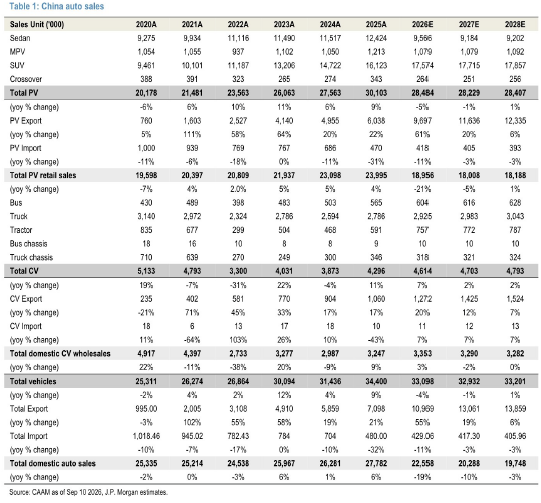
JPMorgan predicts that the balance will be completely disrupted in 2027. The growth rate of overseas exports will sharply cool to 20%, while the domestic market continues to bottom out, causing both growth engines to stall simultaneously.
From an industrial structure perspective, the NEV penetration rate has reached a historic high of 67.1%. Further increases in NEV penetration will no longer equate to continued high-speed growth in the overall automotive market. The growth spurred by the rapid expansion of the NEV market in the past will stagnate starting next year.
For all automakers and supply chain companies, 2027 will not be a year of recovery but a decisive year of competing for existing market share and eliminating weaker players.
Regarding the market trend in 2027, the report outlines two scenarios: If policies provide support, demand will remain stable; without policy stimulus, demand will decline by 5%.
In recent years, a key question in the automotive industry has been whether NEVs can replace fuel vehicles. Now, an increasingly important new question arises: How many vehicles can the overall market accommodate? Where will future growth come from? This raises issues of total demand and supply.
This leads to the second core topic of the report—overseas expansion.
Only new markets can absorb excess production capacity and bring fresh growth. Expanding overseas has become a common strategy for all automakers.
In JPMorgan Chase's view, the logic of Chinese automotive overseas expansion has undergone a qualitative shift—from the initial 'simple pursuit of shipment scale' to a comprehensive focus on the 'sustainability and profitability of overseas market share expansion,' with electrification technology serving as the core driving force.
JPMorgan Chase points out that in the first seven months of 2026 (excluding mainland China), Chinese automakers' overall share in global overseas markets rose to 8.2% (compared to 6.4% in the same period in 2025); passenger vehicle exports reached 5.35 million units, a 72.5% year-on-year increase.
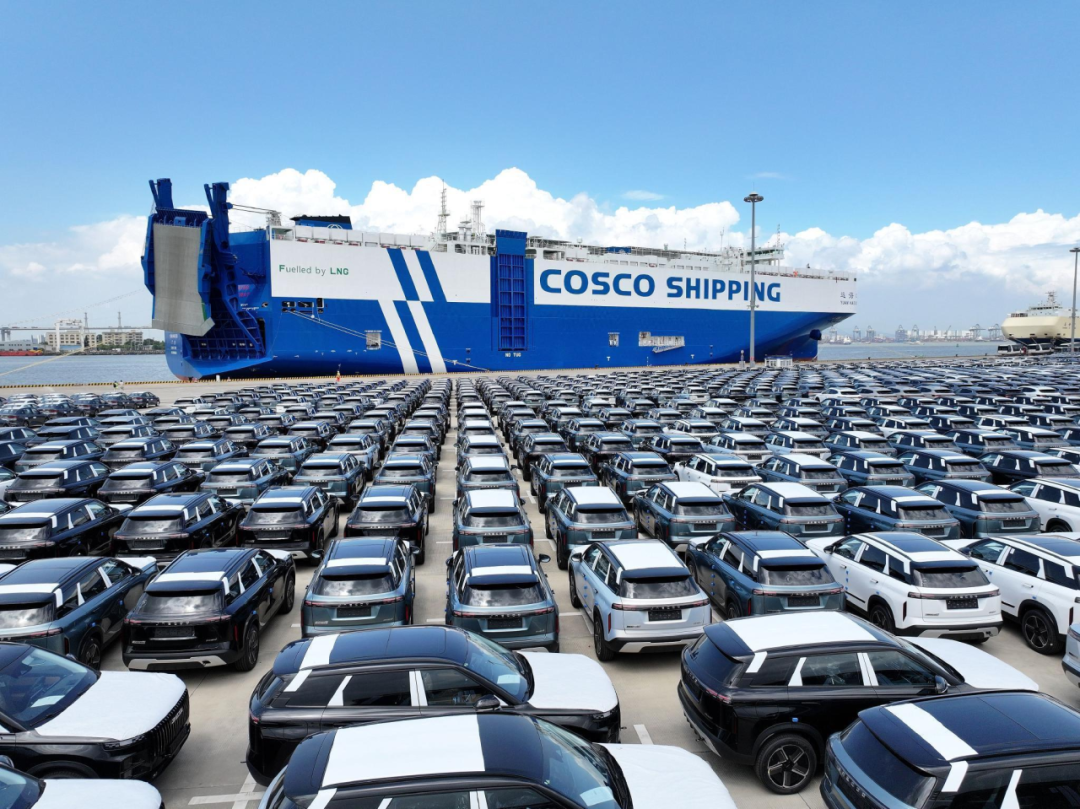
In the European NEV market, Chinese brands' market share rose to 19% in the first seven months of 2026 (with BYD's single-brand share rising to 7.5%), with an even more remarkable performance in plug-in hybrid electric vehicles (PHEVs).
In the first seven months of 2026, Chinese automakers accounted for 44% of the overseas PHEV market share and 23% of the battery electric vehicle (BEV) market share (according to the report's scope). Within Europe, Western Europe's PHEV share was around 36%, while Eastern Europe (excluding Russia) reached as high as 64%.
At 44% and 64%, Chinese automakers are no longer acting as 'new entrants' but as 'disruptors.' However, extreme growth inevitably invites extreme restrictions, an unchanging law in global industrial competition.
Containment Looms
Based on experiences from the past few years, automakers have found a solution: if the domestic market is too competitive, they expand overseas.
However, while exports can alleviate the contradiction between domestic demand and supply, they cannot completely resolve it. Overseas markets are not just larger versions of the domestic market. This path of breakthrough is being increasingly blocked and tightened.
The European Union's 'Industrial Acceleration Act' (IAA) ties subsidies to local content requirements, with implementation expected as early as mid-2027; reductions in export tax rebates are seen as potential bargaining chips in Sino-European negotiations, with a timeframe pointing to the second half of 2027; and pending proposals suggest voluntarily limiting Chinese brands' hybrid vehicle market share in the EU to 15%.

Additionally, local content requirements, battery procurement rules, minimum pricing, quotas, European manufacturing certification, and carbon fleet regulations are piling up, continuously raising the barriers to overseas expansion.
Localization has become the only key to surviving overseas expansion.
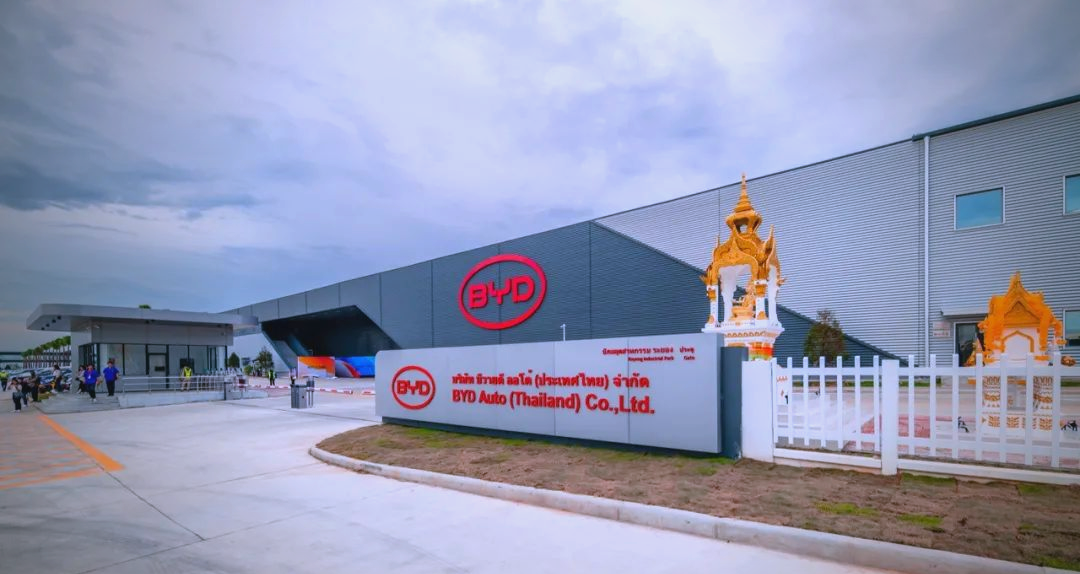
In JPMorgan Chase's report, different approaches to localization by domestic automakers are outlined: BYD focuses on heavy-asset, full-industry-chain self-construction, with layouts in Thailand, Hungary, and Brazil, solidifying its foundation for breaking into Europe; Chery adopts a mixed approach, combining self-construction, joint ventures, and KD assembly, with overseas production capacity planned to exceed 630,000 units by 2027; Geely pursues a light-asset cooperation model, partnering with local enterprises to share production capacity; while Leapmotor and XPeng leverage overseas giants for contract manufacturing and channel resources, entering the European market at low cost.
However, localization is no shortcut. Huge expenditures, prolonged ramp-ups, labor barriers, approval challenges, high energy costs, and union negotiations—each stage is a life-or-death test.
From JPMorgan's perspective, barriers are forcing companies to invest heavily in overseas factory construction, but the sustainably worsening profitability cannot support such heavy-asset investments. This may affect corporate profit margins. The report also names several automakers, which will not be detailed here.
It is worth noting that the overseas expansion of Japanese automakers in 1986 bears a striking resemblance to today's situation. European countries once completely locked out Japanese models through share quotas and import limits, forcing Toyota, Honda, and Nissan to localize production with heavy assets to secure survival space.
Back then, France set a 3% share cap for Japanese vehicles, Italy allowed only 2,000-4,500 units annually, and the UK limited the share to around 11%; in open markets without local automotive industries (Belgium, Denmark, Ireland, Greece), Japanese brands quickly captured 20-40% of the market share.
Europe canceled all import quotas for Japanese vehicles on December 31, 1991, paving the way for the European single market.
History never repeats itself, but it always rhymes.
For automakers, European operations must anticipate tax increase scenarios in 2027. All overseas expansion plans can no longer cling to the illusion of breaking through with low prices.
Profit Crisis Lurks
Current automotive profitability is already determined overseas. Over 90% of Chery's profits come from overseas markets, while Geely's overseas profit share is approaching half. Overseas markets have become the last profit stronghold for automakers to resist domestic competition.
If declining demand is a visible risk, then profit erosion is an invisible but even more fatal industry injury.
Since the beginning of the year, capital market expectations for domestic automakers' profitability have been revised downward by over 40% as a whole.
However, market pessimism remains incomplete. JPMorgan Chase's forecast is even more severe, with its proprietary profit model projecting figures 10%-11% lower than market consensus expectations.
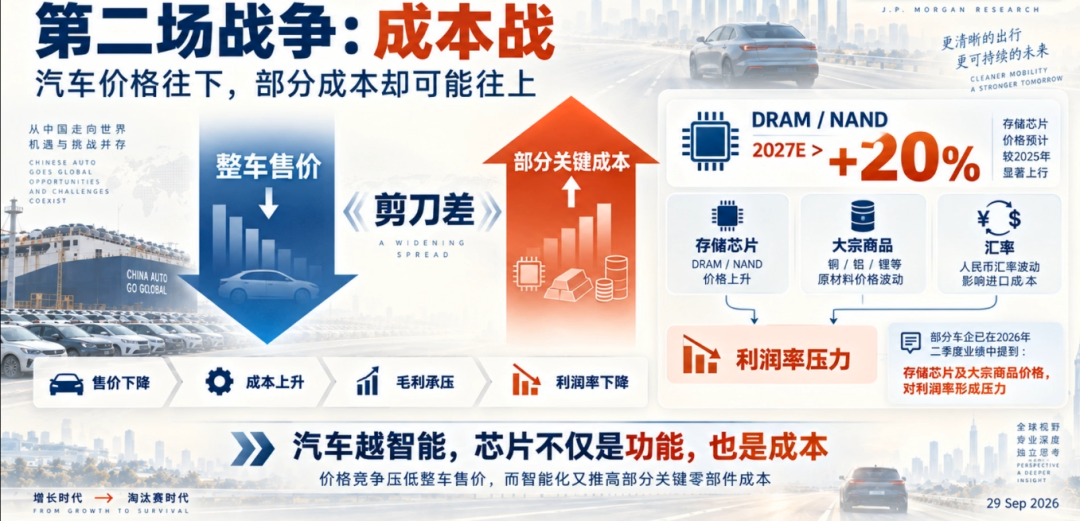
In addition to the silent but ongoing price war at the consumer end, a cost crisis is quietly approaching.
JPMorgan Chase's semiconductor team warns that prices for DRAM and NAND memory chips could surge by over 20% in 2027. Today's smart vehicles are essentially walking smart devices, with cockpits, domain controllers, and intelligent driving systems heavily reliant on memory chips. The pressure from chip price hikes will inevitably be fully passed on to the vehicle end. Combined with fluctuations in commodities like copper and aluminum and exchange losses from a strengthening RMB, automakers' gross margins are being eroded, and profitability is continuously compressed.
In the past, automakers relied on negative cash conversion cycles, occupying funds from suppliers and dealers for light-asset operations. Now, this buffer is rapidly depleting. BYD's cash conversion cycle turned from -18 days to +11 days, Geely's narrowed from -37 days to -6 days, and Chery's shrank from -52 days to -23 days.
Automakers' financial flexibility has significantly diminished, while downstream dealers are struggling even more. Zhongsheng Group, a leading dealer group, saw its free cash flow turn negative in the first half of 2026 and could only sustain operations by clearing inventory at a loss.
The solution to breaking the deadlock in the domestic market lies in deep supply-side integration. JPMorgan also highlights the recent business collaboration and integration between FAW Group and GAC Group, viewing it as a clear policy signal. In the future, inefficient production capacity, weak brands, and homogeneous enterprises in China will inevitably be accelerated out of the market.
From JPMorgan Chase's perspective, the Chinese automotive industry is at a critical turning point of 'domestic contraction and overseas obstruction.' In 2027, the industry will face multiple pressures, including weak demand, rising costs, policy uncertainty, and trade barriers.
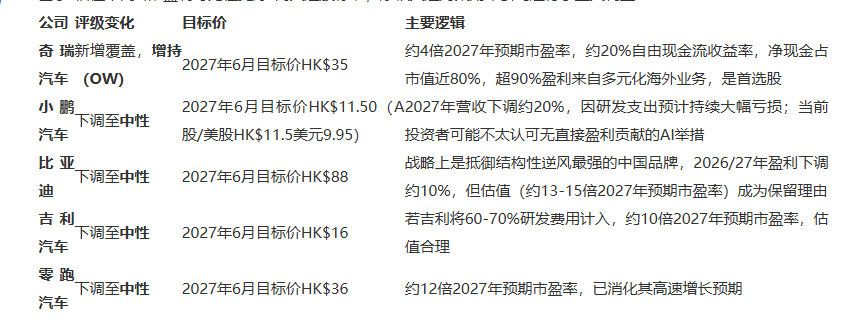
JPMorgan Chase's investment advice is concentrated on preferring heavy trucks over passenger vehicles; within passenger vehicles, focusing on stocks with attractive valuations and high profit visibility, such as Chery Automobile, Sinotruk, and GAC Group; while generally downgrading previously popular stocks like BYD, Geely, Leapmotor, and XPeng.
This also reflects the capital market's shift from a 'growth narrative' to a focus on 'profit quality.'
Perhaps the few buckets of cold water poured by JPMorgan Chase can help clarify the industry's logic for next year.
Note: The images are sourced from the internet. If there is any infringement, please contact us for removal.
-END-
-
![]()
JPMorgan Chase Throws Three Buckets of Cold Water on the Auto Industry
-
![]()
SAIC Volkswagen Unveils New Leadership: Prioritizing Fuel Vehicle Market Penetration and Accelerating EV Market Pursuit, with the 8X Targeting Market Dominance
-
![]()
September Sales Analysis: Top Five Independent Chinese Automakers Excel, with BYD Leading and All Expanding Overseas
-
AI with a Defined Trajectory is Energizing the Entire Industry Ecosystem
-
【Daily Science and Technology Innovation】ArcSoft: Why is Half of Its Revenue Invested in R&D? What is the Invisible Champion of Mobile Algorithm Betting On?
-
![]()
The Paris Motor Show is Set to Disrupt the European Luxury Car Market Again
-
![]()
When Plug-in Hybrid and Extended-Range Vehicles Flood the Fully Electric Era: Are You Prepared to Be the "Cannon Fodder"?
-
![]()
Unitree Admits Mistake, DeepSeek Steps In