From Connected Vehicles to All-Domain Collaboration: 6G Ushers in the Next Era of Automotive Connectivity
 10/14 2026
 371
371
While most automakers worldwide are still scaling up the deployment of 5G-connected vehicle models, the industry is already turning its attention to the next generation of connectivity technologies beyond 5G. Mobility Global, a global automotive data and consulting firm, predicts that by the 2030s, 6G will propel automotive connectivity into a new phase. By then, IoV will no longer be limited to transmitting data from individual vehicles; instead, vehicles, roads, and clouds will collaborate in real-time for perception and decision-making.
5G has laid the foundational connectivity capabilities for intelligent vehicles, including enhanced mobile broadband, low-latency V2X communications, edge computing, network slicing, over-the-air (OTA) updates for entire vehicles, and cloud-native software-defined vehicles (SDVs). These are the core supports provided by 5G. However, as L4 and L5 high-level autonomous driving gradually become a reality, the limitations of the existing 5G system are starting to emerge. An autonomous vehicle generates terabytes of sensor data daily, and safety decisions must be made within milliseconds. On densely populated urban roads with millions of terminals accessing the network simultaneously, 5G networks face immense loads. To overcome the communication bottlenecks for high-level autonomous driving, international standardization organizations like 3GPP (3rd Generation Partnership Project) and the industry chain have already begun laying out the technical framework for 6G IoV in advance.
China is also advancing 6G vehicle-road collaboration. The IMT-2030 (6G) Promotion Group under the Ministry of Industry and Information Technology has conducted multiple rounds of specialized technical trials. China is also the first country globally to allocate 6G test frequency bands, with a focus on vehicle-road collaboration and integrated air-space-ground scenarios. Multiple national-level IoV pilot zones and "vehicle-road-cloud integration" demonstration projects have been launched in China, with mass production of vehicle models equipped with C-V2X functionality continuing to increase. These efforts have laid an industrial foundation for a smooth transition to 6G in the future.
▍Four Core Capabilities of 6G
Research by Mobility Global indicates that 6G will transform the communication foundation of intelligent mobility through four key technical capabilities.
1. From Individual Vehicle Data Exchange to All-Domain "Collective Perception"
In many IoV applications, 5G aims to achieve end-to-end latency below 10 milliseconds. 6G will reduce latency to sub-millisecond levels, with microsecond-level responses possible in core safety scenarios. Data throughput will also see a significant boost. Vehicles will be able to share real-time sensor data such as camera feeds, LiDAR point clouds, and radar maps almost instantaneously.
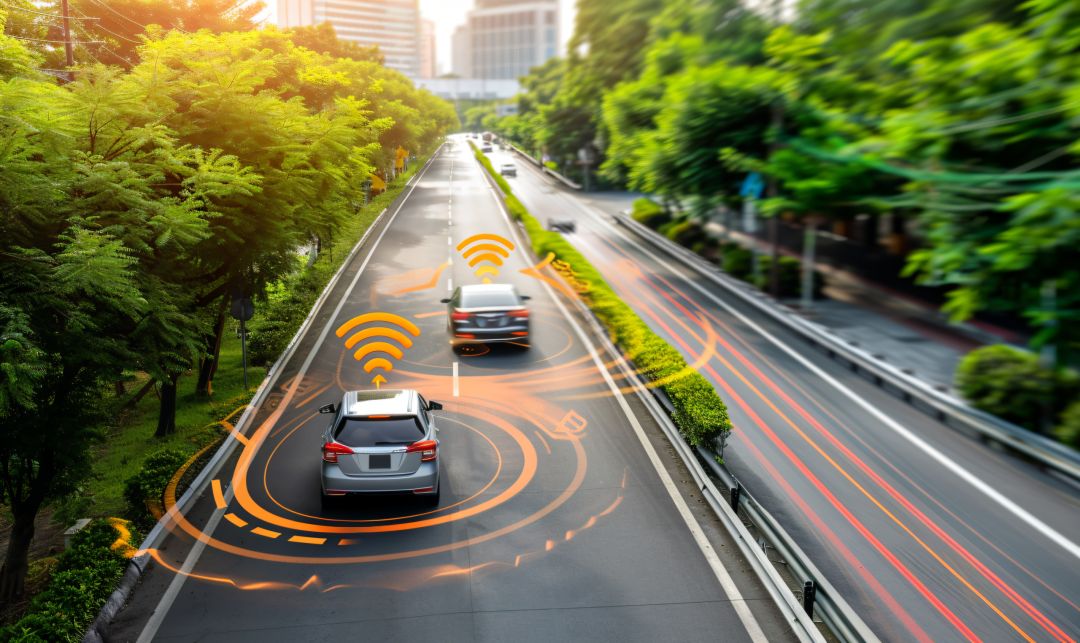
The core value of this capability lies in enabling "collective perception." Vehicles, roadside infrastructure, and other traffic participants can share environmental information. Vehicles can detect hazards in blind spots and perceive road conditions beyond the range of their own sensors. New applications such as collaborative perception networks, group-coordinated driving, and digital road infrastructure will also have a foundation for implementation. Traditional V2X, which could only send simple alert messages, will evolve into a complete collaborative traffic system.
2. AI-Native Integration into Network Architecture
Compared to 5G, the most fundamental change in 6G is the direct integration of AI capabilities into the underlying network architecture. Future networks will not merely be channels for data transmission; they will also predict traffic congestion, prioritize safety-related communications, dynamically allocate network resources based on vehicle movements, and optimize traffic routes.
For automakers, 6G will provide more stable connected services, dynamically predict network quality, and enable contextualized intelligent communications. It will also support intelligent scheduling of autonomous vehicle fleets and dynamic allocation of edge computing resources. As a result, the commercial operation of large-scale high-level autonomous driving will have a network foundation.
3. Integrated Sensing and Communication: Roadside Base Stations as a Second Perception Eye
6G features integrated sensing and communication (ISAC) technology. Cellular base stations can simultaneously handle both communication and environmental sensing, transmitting data while capturing real-time information on traffic density, vehicle trajectories, pedestrian movements, and road conditions.
This adds a layer of roadside perception redundancy beyond onboard sensors. Where cameras, radars, and LiDAR fall short or lack accuracy, roadside base stations can compensate. Autonomous driving in complex conditions such as tunnels, rain, or fog will become significantly safer.
4. Integrated Air-Space-Ground Networking: Eliminating Coverage Dead Zones
Signal dropouts in tunnels, suburban areas, and remote highway sections have long been a major pain point for IoV deployment. 6G will connect ground cellular networks, low-Earth orbit satellites, high-altitude platforms, and roadside units to form a seamless, global communication network. The system will automatically switch to the optimal link based on the vehicle's location, with minimal noticeable impact for occupants.

The 5G Automotive Association (5GAA) has already completed real-vehicle validation of satellite communication scenarios, accumulating practical experience for the air-space-ground integrated 6G architecture. China's 15th Five-Year Plan for communications development also explicitly calls for promoting satellite direct connections to vehicle terminals and building a globally covered intelligent vehicle network.
▍6G Enables Digital Twins in IoV
6G is expected to enable real-time digital twin systems for entire vehicles and traffic systems, allowing continuous bidirectional synchronization of vehicle health data, multi-dimensional sensor information, driving behavior, battery conditions, and real-time road conditions.
With digital twins, automakers can proactively predict component failures, validate vehicle software versions through online simulations, manage vehicle fleets holistically, and continuously iterate autonomous driving algorithms. As the global automotive industry shifts toward software-defined vehicles, these capabilities align perfectly with the transformation direction.
In-Vehicle Connectivity Transforms from a Cost Center to a Profit Channel
In the 6G era, in-vehicle communications will no longer be just a supporting feature for vehicles; they will become a business capable of generating sustained revenue. Automakers can introduce a range of value-added services, such as high-level collaborative safety travel subscriptions, dynamic real-time auto insurance, AI intelligent co-pilots, continuous high-definition map updates, in-vehicle cloud computing power, and intelligent scheduling for freight fleets. The automobile, once a mere mode of transportation, will evolve into a mobile terminal connected to the global digital ecosystem.

However, the transition from 5G to 6G will not happen overnight. For a long time to come, multiple standards—including 5G-A, 5G RedCap, 6G, C-V2X, satellite non-terrestrial networks, and edge computing—will coexist and integrate. Mobility Global predicts that by 2030, 100% of new vehicles will come standard with in-vehicle connected terminals, but 5G communication Telematics Control Units (TCUs) will still dominate market shipments.
▍Automakers' Practical Challenge: Mismatch Between Vehicle Lifecycle and Communication Standard Iterations
Mobile communication standards iterate every few years, while the actual service life of mass-produced vehicle models often spans more than a decade. How will these vehicles adapt to future next-generation communication technologies? This is a question all original equipment manufacturers (OEMs) must answer.
The industry's solution is to develop modular, software- and hardware-upgradable in-vehicle communication units (TCUs) that can be remotely updated, abandoning fixed hardware designed for a single communication standard. By the early to mid-2030s, the first commercial 6G in-vehicle solutions will be deployed. Their value will extend beyond just faster internet speeds. Communication, integrated sensing and communication, artificial intelligence, edge computing, and satellite networks will further converge, with network capabilities becoming an integral part of the vehicle's native intelligence.
While 5G solves the issue of "individual vehicle connectivity," 6G aims to connect vehicles, roadside infrastructure, and the cloud into a collaborative system for all-domain perception and joint decision-making. Although it will take time for this system to scale, technical pre-research and standard-setting efforts are already underway across the global supply chain.
Typesetting 丨 Zheng Li
Source 丨 Mobility Global
Image Source 丨 Qianku.com
-
![]()
Top 20 Cities for Startups in Six Key Future Industries: First Three Quarters of 2026
-
![]()
Apple "Returns Home", Siri Unlocks New Possibilities
-
![]()
Bypassing Optical Waveguides? TDK Leads the Way in Retinal Direct Projection Optical Tech
-
![]()
From Connected Vehicles to All-Domain Collaboration: 6G Ushers in the Next Era of Automotive Connectivity
-
Aian N60 Under Sales Pressure, S600 Fails to Revive Hyper: Zhang Xiong’s Dual-Brand Strategy Falters in Early Stages
-
![]()
BYD's Da Han Redefines Flagship Standards with 1,000+ km Range and Standard Rear-Wheel Steering
-
"Buy One, Get One Free" Marketing Gambit Flops, Unveiling AUDI Brand's Sales Struggles
-
![]()
iPhone Duo Sparks Excitement! Will Under-Display Cameras Make a Triumphant Return? RedMagic Holds Firm for Six Years