Four Departments Jointly Convene Meeting, Urging Over 30 Car Companies to 'Enroll in Remedial Courses'
 10/19 2026
 491
Automakers are accelerating their pace, yet regulators have suddenly slammed on the brakes.
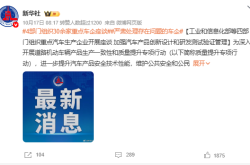
The four departments have convened a symposium with more than thirty automakers. On the day the news broke, the automotive industry's chat groups were buzzing with more activity than usual. The consultation draft was unveiled on October 10th, and a mere five days later, on October 15th, over 30 major automakers were summoned. This rapid turnaround suggests that regulators are not affording the industry the luxury of 'slow digestion.'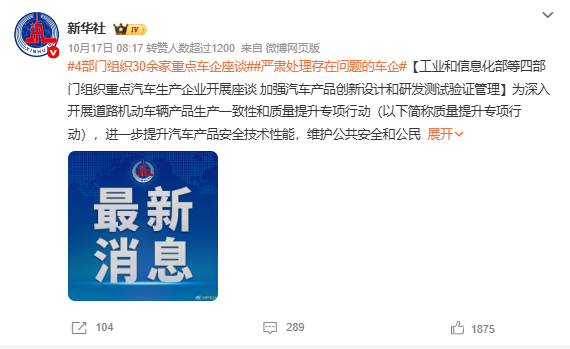
Fifty-one new key technical parameters have been introduced, with 41 focusing on innovative design and 10 dedicated to R&D testing verification. Environmental adaptability verification must span no less than one year, encompassing 'two winters and one summer.' The mileage for reliability verification must not fall below 30,000 kilometers.
The specifics are highly detailed and unequivocal. Newly submitted products must undergo comprehensive multi-dimensional testing, with environmental adaptability verification lasting no less than one year, including 'two winters and one summer.' The mileage for reliability verification must also meet or exceed 30,000 kilometers. False or exaggerated advertising is strictly prohibited, as is the use of scenarios that violate traffic rules to advertise product functions.
In essence, consumers will no longer serve as unpaid test drivers.
Over the past few years, the vehicle manufacturing cycle has been drastically shortened from 36 months to 18 months or even less. Testing mileage has been reduced from 5 million kilometers to 1 million kilometers. Some automakers conduct only 20% of their testing in real-world conditions, relying on simulations for the remaining 80%. While simulations can expedite the process, they cannot replicate the real-world material fatigue, such as whether air springs will collectively leak in the sweltering 40°C heat of Chongqing, or if the brake pedal will snap during emergency braking.

Consumers are purchasing cars, not beta testing privileges.
The blogger posits that the message from the symposium is unmistakable—while speed can be encouraged, the底线 (lit. 'bottom line,' here meaning the fundamental standard) of safety verification must not be compromised. Brake pedals cannot be updated via OTA, vehicle structures cannot be updated via OTA, and crash safety certainly cannot be updated via OTA. How can an industry that is unwilling to even complete 'two winters and one summer' of testing expect ordinary people to entrust it with the safety of their families? I wonder if everyone concurs with the blogger's perspective. Feel free to leave a comment and join the discussion... #FourDepartmentsOrganizeSymposiumWithOver30Automakers#
-
![]()
Can Car Companies Achieve Their Annual Sales Targets in Under 80 Days?
-
![]()
Is the 2027 Qiyuan Q05 with Enhanced Range a Good Purchase?
-
![]()
Liu Pei, XPENG’s Ex-VP of Sales, Makes a Comeback at Dongfeng Peugeot Citroen
-
![]()
Third-Quarter Problem Summary: Multiple Tesla Model Y L Owners Report Rear Suspension Droop
-
![]()
Four Departments Jointly Convene Meeting, Urging Over 30 Car Companies to 'Enroll in Remedial Courses'
-
![]()
Is Anthropic Really Worth $2 Trillion?
-
![]()
SAIC Volkswagen ID.ERA: The Art of Catching Up
-
![]()
Changan’s Leadership Overhaul: Zhu Huarong Relinquishes Chairman Role, Zhao Fei Ascends; Ye Pei Elevated to President | Mirror Pro