Can Car Companies Achieve Their Annual Sales Targets in Under 80 Days?
 10/19 2026
 491
Recently, the China Passenger Car Association (CPCA) unveiled domestic passenger vehicle sales data for the first three quarters of 2026. With three-quarters of the year now behind us, the market performance of major automakers during this period has become increasingly clear, making it an opportune moment to reassess the sales targets set at the beginning of the year.
According to CPCA statistics, from January to September, cumulative retail sales in the domestic narrow passenger vehicle market reached 13.334 million units, marking a year-on-year decrease of 21.7%. This indicates a downturn in the overall automotive market compared to the same period last year.
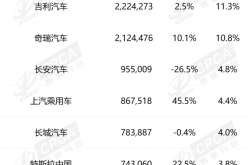
The broader market slowdown is mirrored in the sales performance of major automakers. Analyzing the sales data from the first three quarters, many automakers are experiencing sluggish growth or even year-on-year declines. Specifically, BYD sold 3.0785 million passenger vehicles from January to September, a 4.4% decrease compared to the previous year. Geely Auto delivered 2.2243 million units, showing a 2.5% year-on-year increase. Chery Group achieved sales of 2.1245 million units, up by 10.1%. Meanwhile, Changan Automobile sold 955,000 units, a 4.8% decrease year-on-year. These figures highlight that while some automakers have managed to sustain growth, it has not been without challenges, and even leading players are feeling the pressure.
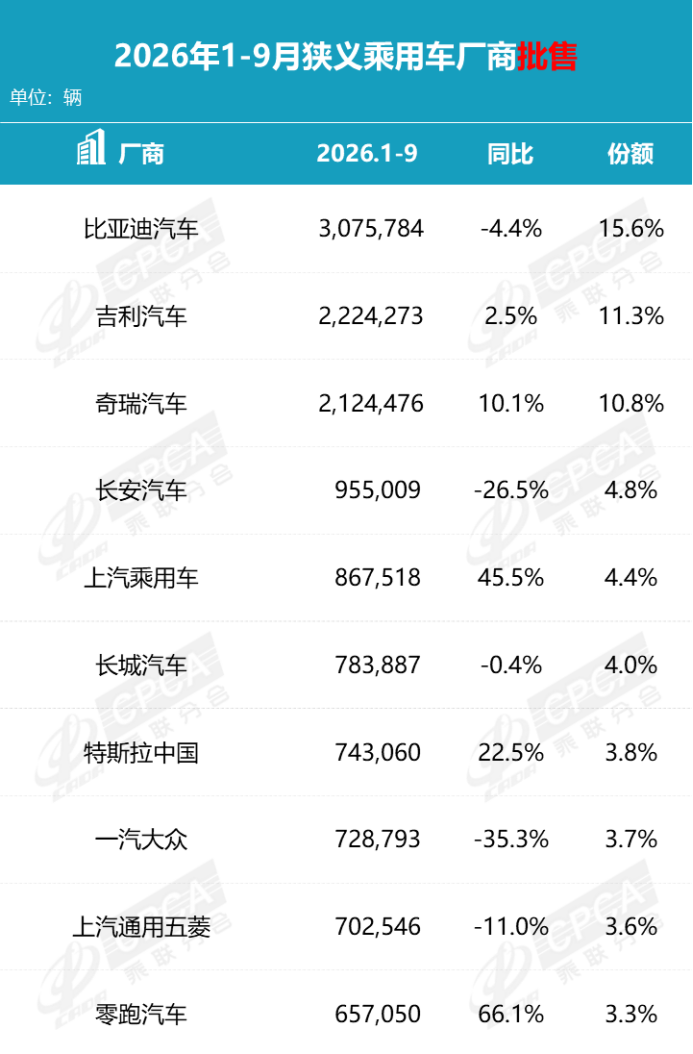
Despite the overall subdued market, there are bright spots. Leapmotor, for instance, sold 657,100 units during the same period, achieving a significant 66.1% year-on-year increase. Tesla China also performed well, selling 743,100 units, up by 22.5% year-on-year. However, automakers maintaining such high double-digit growth remain in the minority.
More significant than sales fluctuations is the progress each automaker has made toward their annual targets. Based on a target range of 4.5 to 5 million units, BYD's completion rate for the first three quarters stands at approximately 61.57% to 68.41%. Geely, Chery, and Leapmotor have achieved completion rates of 64.47%, 66.39%, and 65.71%, respectively, all still falling short of their annual goals.
Under normal circumstances, automakers should have completed at least 70-75% of their annual sales targets by the end of the third quarter to ensure a strong finish by year-end. However, many are hovering around a 65% completion rate, below the stable threshold of 70%. This means the sales gap from the first three quarters must be closed in the final three months. With only one quarter left, catching up will be no easy feat.
It is clear that many automakers are facing sluggish sales growth this year and are struggling to meet their annual targets. The dual pressure of sales performance and target achievement is posing significant challenges.
The primary culprit is the ongoing price war, which has, to some extent, impeded sales growth for automakers, trapping them in a predicament where it is easy to cut prices but difficult to boost sales volume. To vie for a limited market share, automakers have been increasing terminal discounts in an attempt to stimulate sales through price reductions. In August 2026, the average discount per passenger vehicle nationwide was 23,000 yuan, with sedans offering discounts of up to 24,500 yuan. However, discounts amounting to tens of thousands of yuan are no longer surprising, and consumers have grown accustomed to price reductions, adopting a "wait-and-see" attitude. Moreover, when one automaker reduces prices, others swiftly follow suit, erasing any price advantage almost immediately.
In the end, automakers are sacrificing profits without witnessing significant sales improvements. The strategy of "trading price for volume" has clearly lost its effectiveness.
Meanwhile, the new energy vehicle market has become fiercely competitive. An average of about 100 new models are launched each month, translating to at least three new models per day, with multiple competitors vying for market share at nearly every price point. With a constant influx of new models, consumers are spoiled for choice, but market demand has not increased proportionally. Simply put, the automotive market has entered a phase of stock competition, where the market pie is not expanding, but the number of automakers vying for a share is. With limited purchasing demand being continuously divided, it is naturally difficult for automakers to drive sales growth.
To compound the issue, purchase subsidies have lost their former potency this year. Since 2026, the new energy vehicle purchase tax exemption has been halved, and trade-in subsidies have shifted from fixed amounts to being calculated as a percentage of the vehicle price with an upper limit. The reduction in purchase incentives has added another layer of concern for some consumers, increasing pressure on an already weak market.
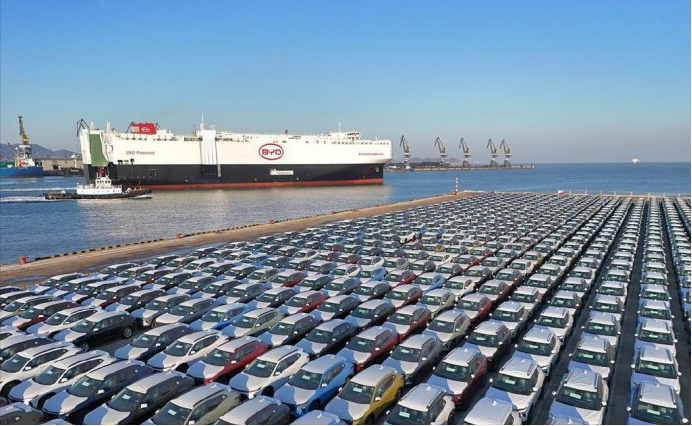
With sluggish domestic sales, automakers are naturally turning their attention overseas. However, despite strong export performance by many automakers, export growth is still insufficient to offset the decline in domestic sales. BYD serves as a case in point. In the first three quarters, its cumulative sales reached 3.0785 million units, a 4.4% year-on-year decrease. Although its passenger vehicle and pickup truck exports neared 180,000 units in September, a 153.9% year-on-year increase, its domestic sales did not keep pace. That month, its domestic sales were approximately 276,800 units, a 13% year-on-year decrease. The strong overseas sales were not enough to drive overall sales into positive growth.
Additionally, automakers themselves bear some responsibility. At the beginning of the year, many automakers, still buoyed by the previous year's sales growth, were overly optimistic about the market outlook and set relatively ambitious sales targets. However, as market growth has slowed, these targets have now become a significant burden.
Under the combined pressures, many automakers have fallen short of expected sales performance in the first three quarters and still have a considerable gap to close to meet their annual targets. With only the final quarter remaining, even with the traditional year-end sales peak, it will not be easy for automakers to bridge the sales gap in just three months. Moreover, with weak market demand and an ongoing price war, expecting a year-end promotional surge to turn things around is unrealistic.
(Image sourced from the internet. Removal upon infringement notice.)
-
![]()
【Intelligentization】Li Auto’s Chip Subsidiary Secures RMB 1.625 Billion in First-Round Financing
-
![]()
Weekly Stock Review | Chinese Automakers Shine at Paris Auto Show, Auto Stocks Rally from Low Points
-
![]()
What Is Porsche's Strategy Behind Layoffs and a Re-emphasis on Fuel-Powered Vehicles?
-
![]()
Is the Claim ‘US AI Enhances Productivity, Chinese AI Focuses on Entertainment’ Misleading?
-
![]()
September SUV Sales Analysis: Two Toyota Fuel-Powered Models Make It to the Top 10
-
![]()
Can Car Companies Achieve Their Annual Sales Targets in Under 80 Days?
-
![]()
Is the 2027 Qiyuan Q05 with Enhanced Range a Good Purchase?
-
![]()
Liu Pei, XPENG’s Ex-VP of Sales, Makes a Comeback at Dongfeng Peugeot Citroen