Why Does the Great Wall Gain More Recognition Abroad Than at Home?
 10/26 2026
 389


While domestic sales decline, overseas revenue soars, showcasing the Great Wall's ability to repackage its traditional strengths for global markets.

On August 25, Great Wall Motor released its 2026 semi-annual report, revealing key figures: In the first half of 2026, the company sold 575,800 vehicles, a 1.22% year-on-year increase; revenue reached 102.101 billion yuan, up 10.58% year-on-year, surpassing 100 billion yuan in a half-year period for the first time. However, net profit attributable to the parent company was 2.465 billion yuan, down 61.11% year-on-year.
The semi-annual report highlighted a divergence in core indicators: sales remained largely stagnant, revenue increased by 10%, and profits dropped by 60%. These seemingly contradictory figures reflect a strategic shift: Great Wall's market focus is increasingly tilting overseas. In the first half, overseas sales accounted for over half of total sales; revenue from overseas markets surged by about 56.8% year-on-year, while domestic revenue declined by about 18.8%. With little growth in total sales, overseas markets have become the primary driver of revenue growth for Great Wall. Meanwhile, the company's gross profit margin remained steady at 18.37%, nearly unchanged from the previous year, while the sharp decline in net profit was mainly due to deferred recovery of overseas tax policy subsidies and exchange rate fluctuations.
As overseas markets transition from a supplementary to a primary growth driver for Great Wall, questions arise: Why are the same Great Wall products selling less domestically but more overseas?
01 Great Wall's Strengths Are No Longer Rare Domestically
First, consider Great Wall's two traditional strengths: SUVs and off-road vehicles.
SUVs have long been a cornerstone of Great Wall's success. Official data shows that in 2016, Haval series sales reached 933,000 units. Among them, the Haval H6 maintained the top spot in domestic SUV sales for 45 consecutive months, with monthly sales exceeding 80,000 units in December 2016, setting a new record for domestic SUV monthly sales. Great Wall's total vehicle sales exceeded 1 million units in 2016, reaching 1.07 million. The company explicitly cited "focusing on the SUV category" as a core operational feature in its annual report.

Image Source: Great Wall Official Website
The H6's success was built on a period of rapid expansion in China's SUV market. In 2016, Chinese SUV sales reached 9.047 million units, still in a high-growth phase. Great Wall's concentrated SUV product lineup allowed it to capitalize on this demand.
Later, Great Wall replicated a similar strategy in the off-road market with the Tank 300. Before its launch in late 2020, the hardcore off-road vehicle segment was relatively niche, with either high prices or limited product choices. The Tank 300 combined a boxy design, body-on-frame construction, four-wheel drive, and a relatively affordable price, lowering the consumption threshold and expanding niche off-road demand. The Tank thus became Great Wall's new flagship brand.
Today, these two familiar markets for Great Wall are crowded with increasing competition. By 2025, Haval H6 sales had dropped to about 86,000 units. In the first seven months of 2026, cumulative H6 sales were about 18,000 units, accounting for only about 0.45% of the SUV market. CAAM data shows that in the first half of 2026, the top ten SUV manufacturers accounted for 66.7% of the market, with Great Wall, Changan, and Li Auto seeing year-on-year sales declines. Similar changes are occurring in the off-road market. In the first half of 2026, the Tank 300 sold about 19,900 units, with 4,800 new energy versions, totaling about 24,800 units; however, BAIC's Beijing Off-Road BJ40, with both fuel and extended-range versions, sold nearly 29,600 units. Great Wall remains a leading manufacturer, but its past clear competitive advantages in SUVs and off-road vehicles are no longer prominent.
To make matters worse, the "boxy" design, once deeply associated with off-road vehicles, is now being adopted by more mainstream SUVs. Reports indicate that in the first half of 2026, there were 42 "boxy" models on the market, with total retail sales of about 447,600 units. In June 2026, body-on-frame boxy SUVs designed for urban and family use sold nearly 65,000 units, accounting for 72.4% of the entire boxy market.
Great Wall's original strengths remain, but tags like SUV, off-road, and boxy design are being replicated by more brands, turning past distinctiveness into common industry capabilities.
At the same time, consumer criteria for purchasing vehicles are expanding. McKinsey's 2025 survey shows that Chinese consumers are increasingly willing to pay for new technologies rather than just price cuts, with plug-in hybrids, extended-range electric vehicles, intelligent driving, and scenario-based experiences influencing purchasing decisions. By 2026, 69% of respondents already considered advanced intelligent driving features like urban NOA as standard for vehicle purchases.
Great Wall is not standing still. In the first half, its intelligent driving system, Coffee Pilot 3, was mass-produced in models like the Ora 5 and Menglong PLUS; Coffee Pilot 4, equipped with a VLA model, was introduced in models like the Blue Mountain, Tank 700, and Wey V9X. In China Automotive Technology and Research Center's L2+ evaluation, Great Wall's new energy model, the Wey Gaoshan 8, scored the highest grade G+ in all four indicators, with a score of 100.8, close to the Li Auto i6's 107.7 and Avatr 06's 97.4.
But while Great Wall is enhancing its intelligence, competitors are doing the same; while Great Wall is developing new energy, competitors are iterating. The SUV, four-wheel drive, and mechanical capabilities that once determined success have not failed, but with intelligent driving, cabin experience, family attributes, and price all entering the competition, a single strength is increasingly unlikely to solely determine consumer choices.
Great Wall's past advantages remain, but they are no longer as scarce.
02 In a New Market, Old Strengths Become Selling Points
While under pressure domestically, Great Wall's overseas business shows distinct growth.
In the first half of 2026, Great Wall's domestic sales were 286,700 units, down 22.53% year-on-year; overseas sales were 289,000 units, up 45.46% year-on-year. Domestic sales decreased by 83,400 units, while overseas sales increased by 90,300 units, with overseas growth nearly offsetting the domestic decline. SUVs were the most typical category: domestic sales were 194,200 units, down 31.66% year-on-year, a drop of about 90,000 units; exports were 249,700 units, up 51.57% year-on-year, an increase of about 85,000 units.
The revenue structure also changed. In the first half of last year, Great Wall's revenue from the Chinese market was 56.445 billion yuan, while overseas revenue was 35.890 billion yuan; this year, domestic revenue dropped to 45.814 billion yuan, while overseas revenue increased to 56.288 billion yuan. In just one year, overseas revenue shifted from significantly lagging to surpassing domestic revenue, accounting for about 55% of the group's total revenue.
Looking at categories, the main drivers of overseas growth were precisely the SUVs, off-road vehicles, and pickups that Great Wall has specialized in for years. In the first half, Haval's global sales were 327,700 units, with 205,400 units sold overseas, up 45.04% year-on-year, with overseas sales contributing over 60% of Haval's total; Tank's global sales were 90,200 units, with 34,500 units sold overseas, up 57.64% year-on-year. During the same period, Great Wall's SUV exports increased by 51.57%, and pickup exports increased by 27.50%. These categories, already in a red ocean in China, remain highly competitive in some overseas markets.

Image Source: Internet | Financial Growth Trend Illustration
Russia is the most typical example. In the first half of 2026, Haval sold 84,100 units in Russia, ranking second among all automotive brands, just behind the local brand LADA, and first among foreign brands. The Haval Jolion sold 35,500 units in the first half, also one of the top-selling foreign models in Russia. Great Wall entered Russia relatively early, launching the Tula Factory project in 2014 and starting production in 2019, completing the full manufacturing process including stamping, welding, painting, and final assembly. So when some European and American automotive brands exited Russia after 2022, Great Wall, with its existing local factory, distribution network, and brand foundation, quickly captured some of the demand and formed a sizable business. In the first half of this year, Great Wall Motor Russia LLC achieved revenue of 20.810 billion yuan and net profit of 1.047 billion yuan.
Australia is inherently a market that favors SUVs and pickups. Data from the Australian Automotive Dealers Association shows that in the first half of 2026, SUVs accounted for 64% of local new vehicle sales. In Australia, SUVs like the Hyundai Kona, Mazda CX-30, and Kia Seltos generally start at 34,900–37,900 Australian dollars, while the 2026 Haval Jolion starts at about 27,000 Australian dollars, offering both fuel and hybrid powertrains. In the first half, Great Wall's hybrid vehicle sales reached 7,226 units, up 29.3% year-on-year, ranking fourth among hybrid brands in Australia. The "low price + SUV + multiple powertrains" combination, no longer scarce in China, still forms a clear differentiation in Australia.
Some Southeast Asian markets have strong demand for SUVs and pickups, and Great Wall also has local production advantages. Great Wall already has three overseas vehicle production bases in Thailand, Brazil, and elsewhere, and has set up local assembly plants in countries like Malaysia and Pakistan. The combination of model preferences, local manufacturing, and existing distribution networks makes it easier for Great Wall's traditionally strong products to enter these local markets.
Great Wall's overseas growth is not simply because "overseas markets are less competitive," but because different markets offer it different opportunities, amplifying its original product advantages.
03 Overseas Growth Brings Incremental Gains but Also Risks to Financial Reports
However, Great Wall's overseas advantages will not last indefinitely.
The first layer of risk comes from Great Wall's own overseas structure. Russia is currently one of Great Wall's most important overseas markets, with its Russian subsidiary alone generating 20.8 billion yuan in revenue in the first half. Meanwhile, Great Wall explicitly states in its semi-annual report's risk response section that it aims to continue expanding into Europe and emerging markets to reduce reliance on a single market; and to promote localized production and supply chain support in overseas factories to address geopolitical risks and trade barriers.
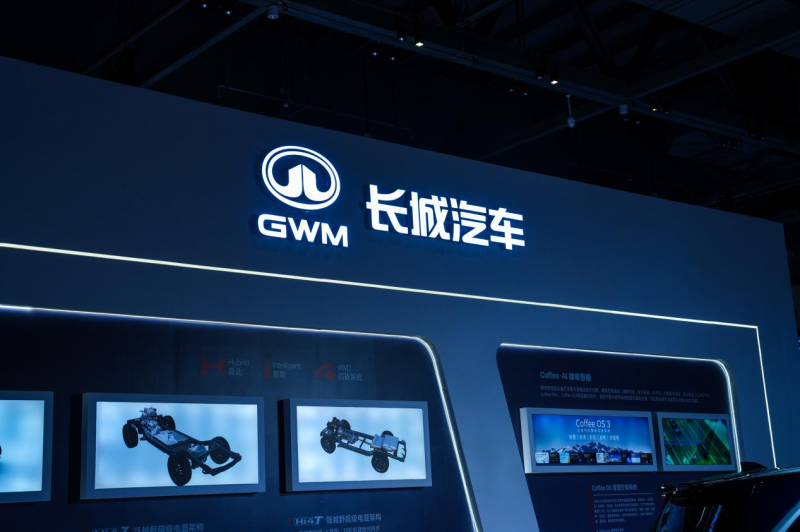
Image Source: Great Wall Official Website
Exchange rate risks are already directly reflected in the income statement. As the proportion of overseas business grows, the impact of exchange rate fluctuations on Great Wall's performance becomes increasingly difficult to ignore, with related exchange gains or losses directly affecting financial expenses. In the first half of 2026, Great Wall's financial expenses were 280 million yuan, compared to -1.692 billion yuan in the same period last year. The company explicitly states that the year-on-year increase in financial expenses was mainly due to exchange rate fluctuations.
Overseas expansion itself also requires continuous investment. The semi-annual report shows that in the first half of 2026, "overseas automotive projects" added about 1.421 billion yuan in construction in progress, with an ending balance of about 2.055 billion yuan; as of the end of June, overseas assets had reached 56.299 billion yuan, accounting for 24.48% of total assets. During the same period, nearly 200 new overseas stores were added, with the sales network exceeding 1,600 outlets. Compared to simple exports, Great Wall is continuing to invest in local production, sales channels, and supply chain construction, increasing the funds and resources required for overseas operations.
A more critical long-term risk comes from domestic peers. This round of overseas growth is not unique to Great Wall. CAAM data shows that in the first half of 2026, Chinese automotive exports reached 5.096 million units, up 65.3% year-on-year; during the same period, BYD's overseas passenger vehicle and pickup sales were about 789,400 units, up 68% year-on-year, Chery exported 943,800 units, up 71.5% year-on-year, and Geely exported over 474,000 units, up 158% year-on-year. As more Chinese automakers accelerate their overseas expansion, the differentiation Great Wall currently enjoys in some overseas markets may gradually dilute, just as it has domestically.
If more Chinese brands bring their domestically mature new energy, intelligence, supply chain, and cost capabilities overseas, competition intensity in overseas markets will continue to rise. At that point, Great Wall will face a familiar question: Once its original strengths become standard among peers, what will it rely on to maintain a competitive edge?
Overseas markets have indeed opened up new growth space for Great Wall, but how long this space can be sustained ultimately depends on whether Great Wall can find a new advantage before its old ones are diluted by peers again.
(Images and public data sources in this article are from the internet and public industry platforms. If there is any infringement, please contact us for timely revisions.)
-
![]()
Massive Exchange Losses! Lens Technology’s Profits Plummet in First Three Quarters—Will the iPhone Duo Mark a New Turning Point?
-
![]()
2026 World Intelligent Connected Vehicles Conference: Transitioning from Spec Benchmarking to Safety Benchmarking, the Industry Steps into a New Era of Regulatory Oversight
-
![]()
Hundreds of Billions Fully Invested in AI, Yet No Returns in Sight
-
![]()
ByteDance's Automotive Ambitions Come to the Fore
-
![]()
$12.9 Billion: Nvidia Buys an 'Insurance Policy'
-
![]()
iPhone Duo: Is It a Thorn in Ternus's Side?
-
![]()
Why Does the Great Wall Gain More Recognition Abroad Than at Home?
-
![]()
Mercedes-Benz Refuses to Be a Bystander and Revolutionizes Itself