Automotive SiC Still in Adjustment Phase as ON Semiconductor Posts 23% Net Profit Growth to $314 Million, AI Data Center Revenue Up 175%
 11/05 2026
 447
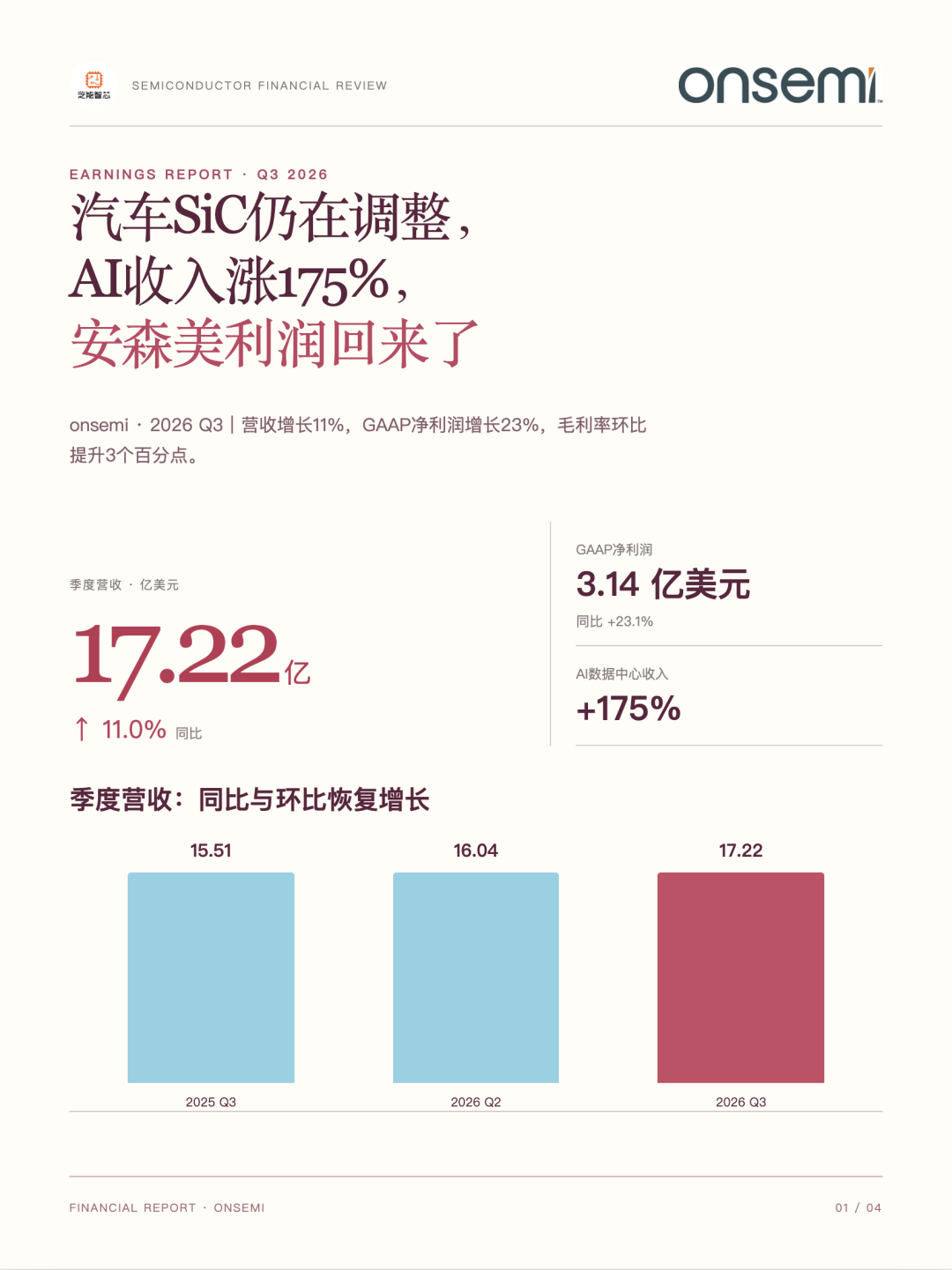
ON Semiconductor Q3 2026 Financial Highlights:
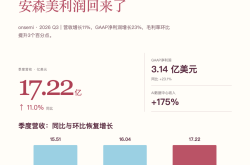
◎ Revenue: $1.7223 billion, up 11% year-over-year;
◎ GAAP net profit attributable to shareholders: $313.9 million, up approximately 23% year-over-year;
◎ Gross margin: 41.4%, up 3 percentage points from 38.4% in the previous quarter;
◎ Free cash flow: $489 million, accounting for 28% of revenue.
The inventory correction for automotive SiC is not yet complete. Over the same period, AI data center revenue surged 175% year-over-year and 39% quarter-over-quarter, driving profit growth. ON Semiconductor raised its 2030 AI data center revenue target by $500 million to over $3 billion.
Product mix, capacity optimization, and new markets have significantly reshaped ON Semiconductor's profitability curve.
Part 1: 11% Revenue Growth Supports 23% Profit Growth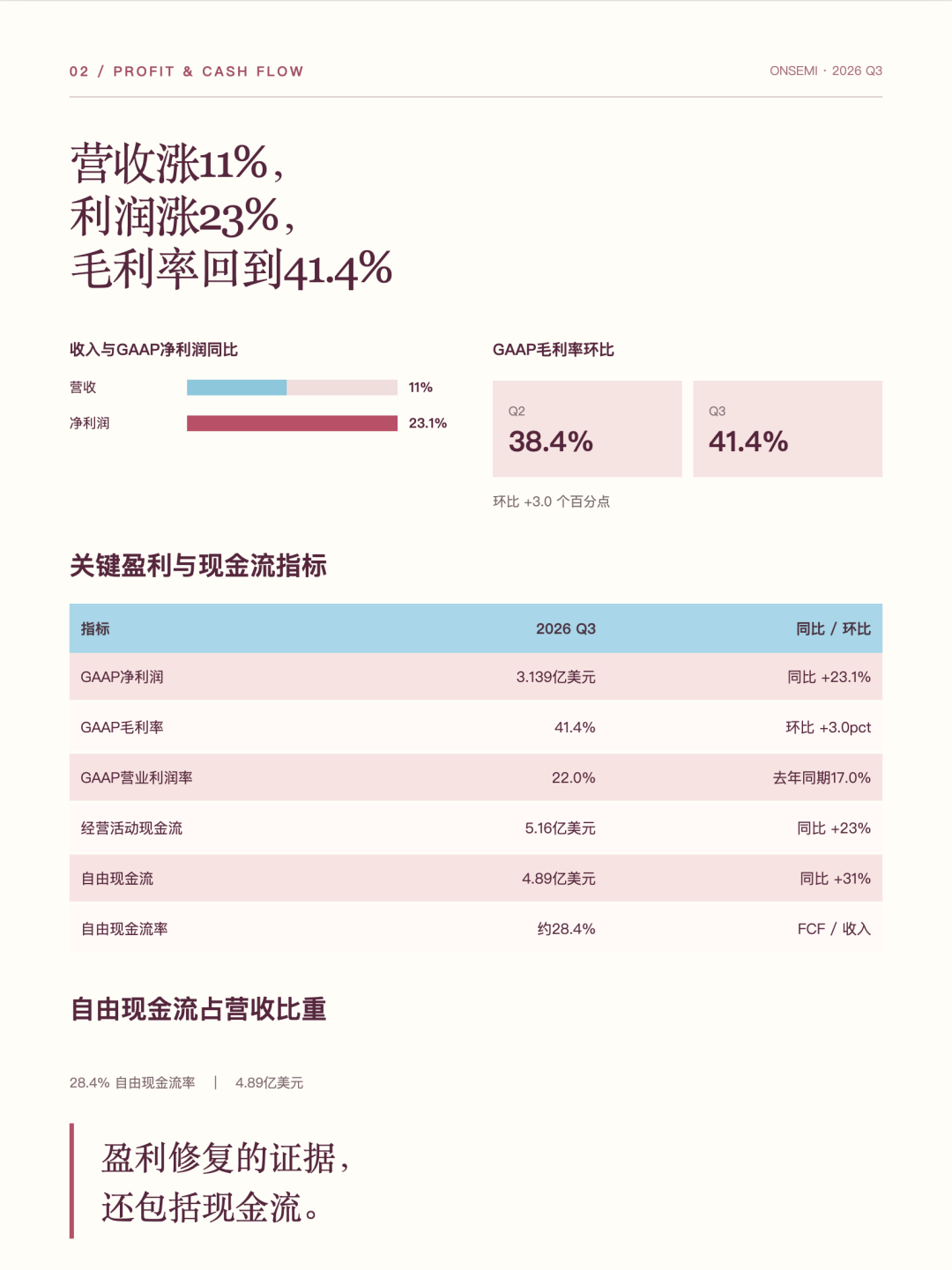
ON Semiconductor released its third-quarter results on November 2.
◎ Revenue: $1.7223 billion, compared with $1.5509 billion in the same period last year, up approximately 11% year-over-year; compared with $1.6035 billion in the previous quarter, up 7.4% quarter-over-quarter.
◎ GAAP net profit attributable to shareholders: $313.9 million, compared with $255.0 million in the same period last year, up approximately 23.1% year-over-year and 38.4% quarter-over-quarter.
◎ GAAP gross margin rose from 37.9% in the same period last year to 41.4%, an increase of 3.5 percentage points year-over-year;
◎ Operating margin rose from 17.0% to 22.0%, marking the fifth consecutive quarter of gross margin expansion on a quarter-over-quarter basis.
Revenue growth was not particularly fast, but profit grew rapidly. The difference lies in gross margin and operating leverage, driven by product mix and factory cost structure:
The share of high-value-added products increased, capacity utilization and production line configuration were readjusted, and unit fixed costs were diluted.
When automotive power devices were under pressure from 2025 through the first half of 2026, the market's impression of ON Semiconductor remained stuck on slowing orders and inventory buildup. The third quarter told a different story.
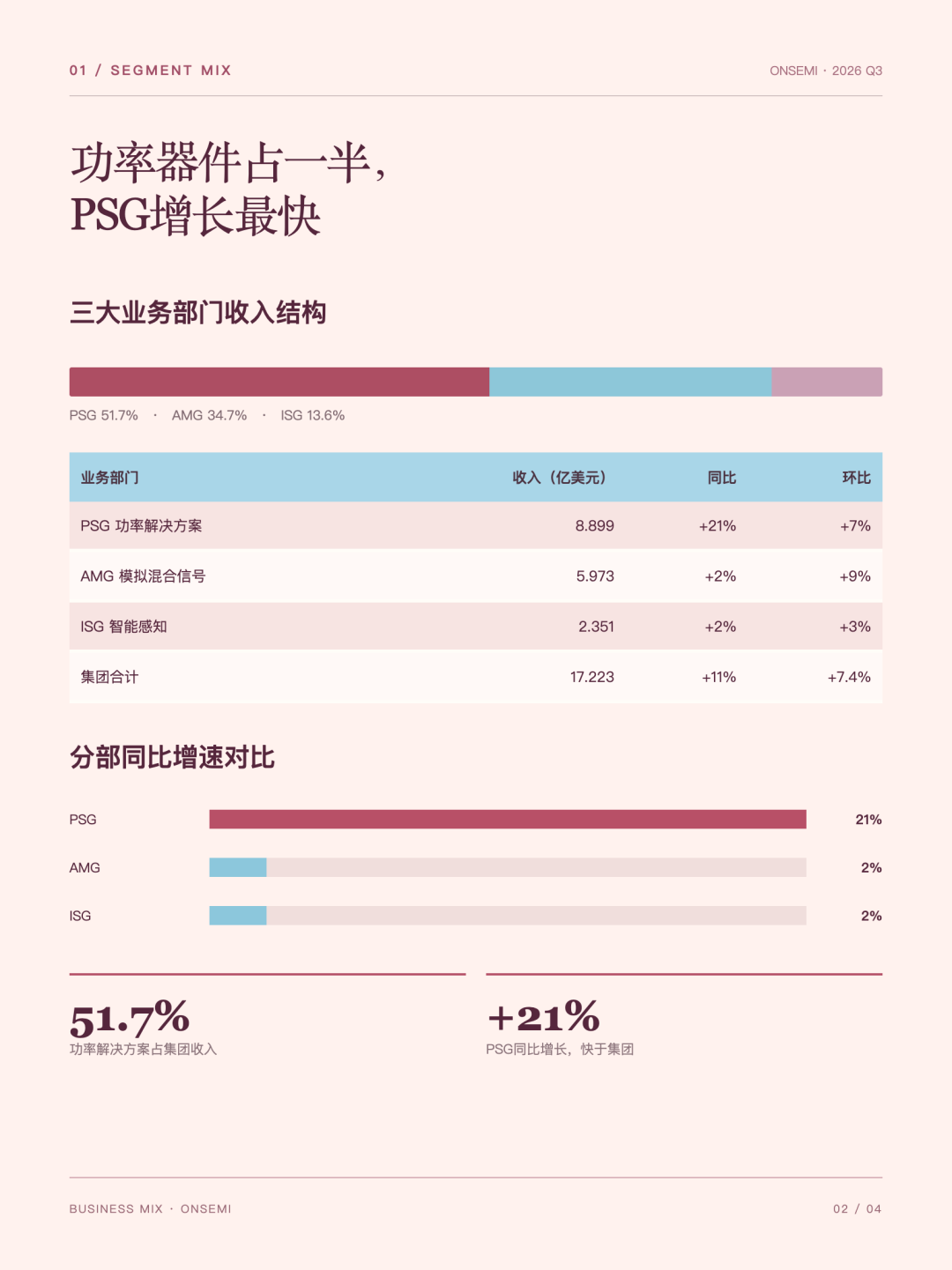
◎ PSG (Power Solutions Group) revenue: $889.9 million, up 21% year-over-year and 7% quarter-over-quarter, accounting for approximately 51.7% of total group revenue and serving as the main source of year-over-year incremental revenue;
◎ AMG (Analog and Mixed-Signal Group) revenue: $597.3 million, up 2% year-over-year and 9% quarter-over-quarter;
◎ ISG (Intelligent Sensing Group) revenue: $235.1 million, up 2% year-over-year and 3% quarter-over-quarter.
Demand for power devices has expanded beyond automotive traction inverters into industrial power supplies, energy infrastructure, and data centers. Analog and mixed-signal products follow system power management trends, while intelligent sensing serves automotive cameras and industrial vision applications.
In recent years, 800V electric vehicles, high-voltage main drive inverters, and fast-charging systems pushed silicon carbide into the spotlight. SiC MOSFETs offer lower losses than silicon IGBTs under high switching frequencies and high-temperature conditions, delivering higher efficiency and power density to vehicles.
Integrating SiC into vehicle platforms also requires addressing device reliability, drive protection, packaging and thermal management, supply chain stability, and system cost.
After price competition in the electric vehicle market intensified, sales of some models fell short of plans, and customers began adjusting component inventories. Power semiconductor manufacturers faced a slowing order rhythm while bearing declining capacity utilization.
SiC materials, epitaxy, wafer processing, and packaging and testing are all capital-intensive. Insufficient utilization directly pressures gross margins.
ON Semiconductor reconfigured its existing power device technology and capacity toward industrial, energy, and AI power supply applications, bringing significant improvement to gross margin, with operating quality returning to an expansion range.
Part 2: Beyond Automotive — AI Power Supply Takes Over as Growth Driver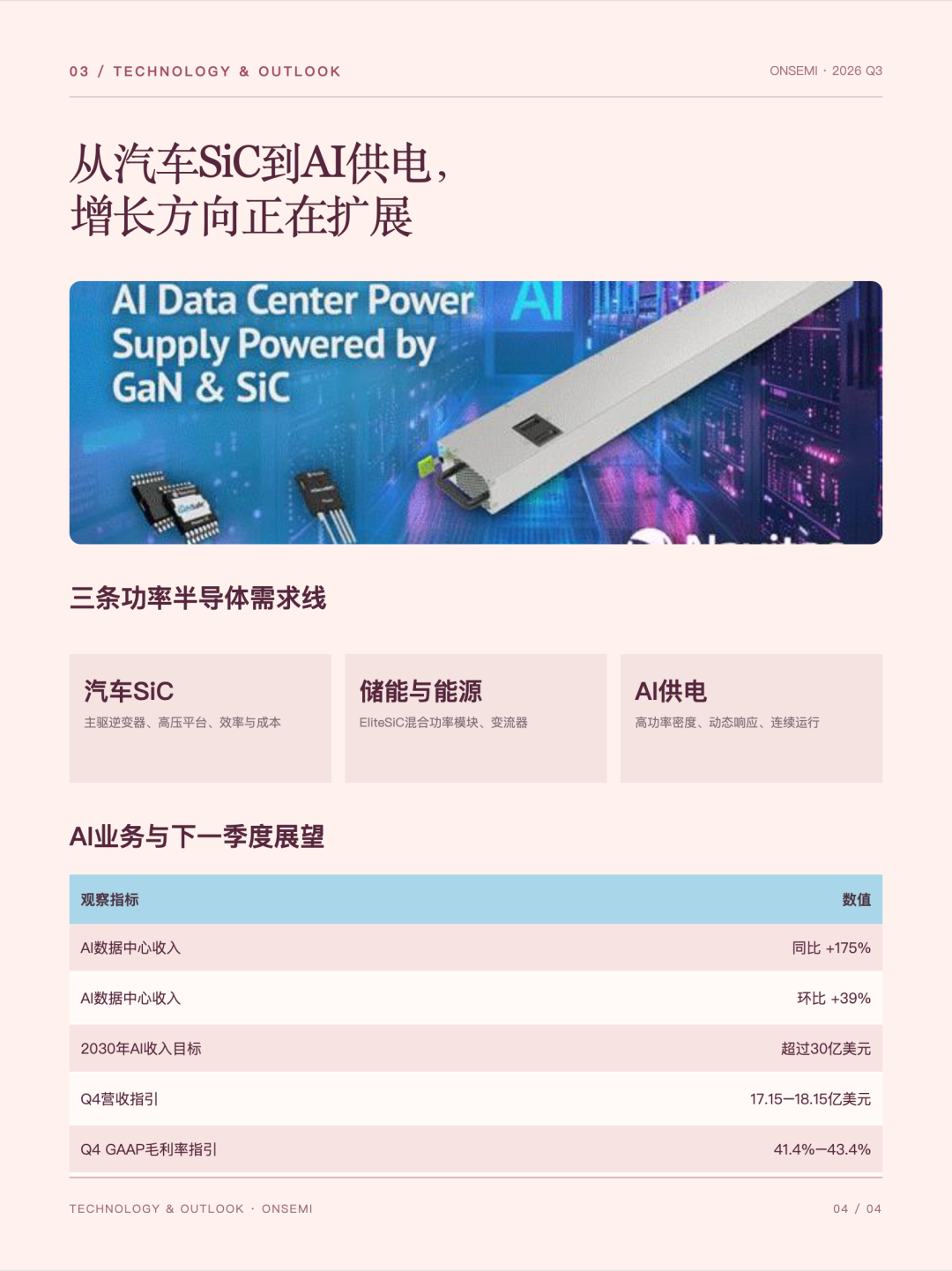
Third-quarter AI data center revenue grew 39% quarter-over-quarter and 175% year-over-year.
As AI server power density rises, the weight of data center power supplies, board-level power conversion, thermal management, and protection devices increases accordingly.
Compared with traditional electric vehicle inverters, data centers impose a different set of requirements on efficiency, size, continuous operation stability, and power distribution. ON Semiconductor has brought its power devices, mixed-signal control, and advanced packaging capabilities into this scenario — a shift larger than simply switching to a new customer.
The company announced a proposed acquisition of Ferric to supplement next-generation AI processor power supply capabilities, and raised its 2030 AI data center revenue target to over $3 billion.
This quarter, ON Semiconductor disclosed that Sungrow adopted its EliteSiC hybrid power module technology to address power demand growth brought by AI, renewable energy, and electrification; the company also carried out technical cooperation with Subaru on the embedded power platform EPP.
Energy storage converters, photovoltaic inverters, data center power supplies, and electric vehicle drives have different topologies and operating conditions, power losses, thermal management, costs, and long-term reliability requirements.
For the Chinese market, the Sungrow case is more tangible than global power semiconductor growth figures.
Whether it can enter the industrial and energy customer system directly affects capacity utilization and product mix.
Third-quarter operating cash flow was $516 million, up 23% year-over-year; free cash flow was $489 million, up 31% year-over-year, with a free cash flow margin of approximately 28.4%.
Fourth-quarter revenue guidance is $1.715 billion to $1.815 billion, with a midpoint of $1.765 billion, up approximately 2.5% from the third quarter; GAAP gross margin guidance is 41.4% to 43.4%.
Management is maintaining gross margin above 40% through factory efficiency improvements and product mix adjustments. Regarding the revised terms of the proposed acquisition of Synaptics, mergers and acquisitions will continue to expand product capabilities.
Summary
Automotive power devices remain ON Semiconductor's foundation, while energy and AI power supply are pushing the business focus outward.
ON Semiconductor will only be considered firmly established once automotive customer inventories return to normal levels, SiC capacity utilization climbs back up, and the absolute revenue scale of the AI business can be demonstrated to investors.
-
![]()
More Than a Car Key: AI Agents Drive Into Cars as vivo Teams Up with BYD to Redefine the Smart Cockpit
-
![]()
A $500 Million Company Lasted Only Three Months: Former Feishu VP Shi Kaiwen Resigns and Joins StepFun
-
![]()
Automotive SiC Still in Adjustment Phase as ON Semiconductor Posts 23% Net Profit Growth to $314 Million, AI Data Center Revenue Up 175%
-
![]()
Keboda, the Single-Item Champion in Vehicle Lighting Control, Sees Lighting Control Revenue Drop by 479 Million Yuan in Q3, Net Profit Down 47.17%; Intelligent Driving Domain Controllers Up 72.29%
-
AI Marketing: The 10 Fastest-Growing and Most Profitable Companies
-
![]()
Chinese Companies Going Global: Don’t Put on a Stern “Strict Father” Face
-
![]()
The Sky Has Fallen on the Wait-and-See Crowd! Blogger Reveals Manufacturers Are Stockpiling and Locking Up Production Capacity—No Hope of Phone Price Drops for the Next Three Years
-
![]()
Tech Stocks Plunge Across the Board, but Industry Giants Say "Don't Panic"