America's High Walls Are Crashing Down on Its Own Cars
 11/06 2026
 368
Introduction
The wall keeps getting higher, yet Detroit's competitiveness has not risen in tandem.
Recently, the US auto industry is anxious again. The Alliance for Automotive Innovation (AAI), which represents major automakers such as Ford, GM, and Stellantis, fears that upcoming political changes could disrupt their plans. It is urging Congress to pass a bipartisan bill during next week's brief session that would permanently restrict Chinese vehicle imports.
In fact, the bill has already been making its way through the legislature. In July this year, it passed the Senate Commerce Committee, and the House version has more than 100 co-sponsors. The bill would restrict the import, manufacture, and sale of connected vehicles, software, and hardware linked to foreign entities such as China, with vehicle and software restrictions taking effect in 2027 and hardware restrictions in 2030.
However, some lawmakers object to the bill's 15% Chinese ownership threshold, fearing the rules could affect non-Chinese brands such as Mercedes-Benz, which holds nearly 20% Chinese equity. The bill's fast-track approval was postponed from September to November.
Now, some worry that if the Democrats win control of the legislature, the bill may not pass before Congress adjourns in December. The US market already maintains high tariffs on Chinese electric vehicles, and current regulatory rules also constrain the sale of China-related connected vehicles in the US.
In other words, the outcome of subsequent votes on the bill will determine future US auto market access rules and the competitive landscape for major automakers.
01 The Catch-Up Window Won't Stay Open Forever
Faced with the global expansion of Chinese auto brands, the US auto industry's approach in recent years has been to rely on trade barriers and regulatory rules to keep Chinese cars out, rather than competing through technological iteration and efficiency improvements.
In 2024, Biden imposed a 100% tariff on Chinese electric vehicles. After Trump took office, he repealed previous emissions regulations and EV subsidy policies, effectively encouraging automakers at the regulatory level to continue producing large-displacement fuel vehicles, while pushing Congress to consider the Connected Vehicle Security Act of 2026, attempting to use data security requirements to restrict China-backed connected vehicles, software, and hardware from entering the US market.
Industry insiders say the ones directly affected are ordinary American consumers. The average price of a new car in the US market is currently about $50,000, while Chinese electric and hybrid models typically sell for only half that price in the Mexican market, and even less in other emerging markets.
Many American consumers, in order to buy more cost-effective models, even drive across the US-Mexico border to purchase Chinese-made cars in Mexico and drive them back to the US.

A related Wall Street Journal report confirmed this phenomenon. One media commentator noted that this protectionist policy deprives most American consumers of the right to buy globally cost-effective cars, ultimately forcing Americans to spend more money on products with worse performance and features.
The deeper impact falls on the US auto industry itself. Due to the long-term lack of external competition, Detroit automakers' incentive to reduce costs has weakened, and technological iteration and product optimization have slowed, widening the gap with the global first tier.
Today, this strategy of shutting Chinese cars out of the US market has limited effect. Cox Automotive analysts say it's only a matter of time before Chinese automakers enter the US market; they are extremely patient and have long completed their preliminary layout.
For example, Chery has publicly stated it will enter the US market at the "right time," with the window expected in two to three years. Geely, through its Volvo brand, has a complete vehicle plant in South Carolina, which can use existing capacity to circumvent tariff restrictions, and brands such as Zeekr and Lynk & Co can later build on this foundation to enter the US market. Multiple Chinese automakers have already established design and R&D centers in the US, building local teams in advance.
Surrounding markets are also changing. In the first half of 2026, Chinese-made cars accounted for 17% of vehicle deliveries in Mexico, up 30% year-on-year. GAC Group is about to start vehicle assembly operations in Mexico, and BYD and Geely are both evaluating building plants in Mexico. Canada's recently signed trade agreement allows 49,000 Chinese vehicles to be imported annually at very low tariffs, and BYD is also considering a vehicle plant in Canada, forming an encirclement of the US market from the North American supply chain side.
What worries Detroit automakers even more is the uncertainty at the US policy level. Trump said in January this year that if Chinese auto companies are willing to build plants in the US and provide jobs, he welcomes such investment. This remark directly triggered collective panic among domestic automakers.
In contrast, Ford President Jim Farley publicly warned that fully opening up to Chinese automakers would be a "devastating" shock. He later proposed a compromise requiring Chinese automakers entering the US market to adopt a joint venture format controlled by US companies.
Unlike the US, international auto brands that compete fiercely with Chinese automakers in the European market have been forced to complete their own electrification technology upgrades. These brands are also interested in entering the lucrative US market, further changing the competitive landscape.
More and more industry commentary points out that relying solely on protectionist barriers cannot forever maintain Detroit automakers' comfort zone. The real path to help the US auto industry maintain its global position is to introduce coherent industrial support policies, coordinate regional trade rules with Canada and Mexico, fill the blue-collar skilled worker training gap, and solve the industry's skilled talent shortage.
If short-sighted protectionist policies continue and automakers are allowed to indulge in the short-term profits of large-displacement fuel vehicles, the US auto industry will only fall behind again in the global electrification wave, and Detroit's former glory will become a historical memory.
02 Detroit Automakers May Not Be Safe
Judging from recent industry data and corporate financial reports, the global market positions of the three traditional US automakers—GM, Ford, and Stellantis—continue to decline. The auto industry that once supported hundreds of thousands of jobs in the US Midwest and accounted for a significant share of GDP has now been left behind.
Data shows that in 2025, China's global auto share was 35.6%, compared with only 14% in 2020. During the same period, the global market share of the US Big Three shrank to 12%, in stark contrast to their industry position more than half a century ago. In 1950, three-quarters of the world's cars were produced in the US; today that share has fallen to about one-eighth.
Looking at performance in specific regional markets, Detroit automakers' decline is evident in almost every major battleground. In Europe, Chinese brands' new car registrations surpassed mainstream Japanese brands for the first time last quarter. GM withdrew from the European market as early as 2017 due to prolonged losses, selling the Opel brand to PSA Group, which later merged into Stellantis. Ford's market share in Europe has fallen sharply; it previously stopped small car production, and several subsequent EV models failed to gain market recognition.
In the Chinese market, GM's market share has dropped by nearly half over the past decade, and Ford's share has shrunk by two-thirds. American brands that once held an important position in the Chinese market have been completely pushed to the margins by rapidly rising domestic brands.
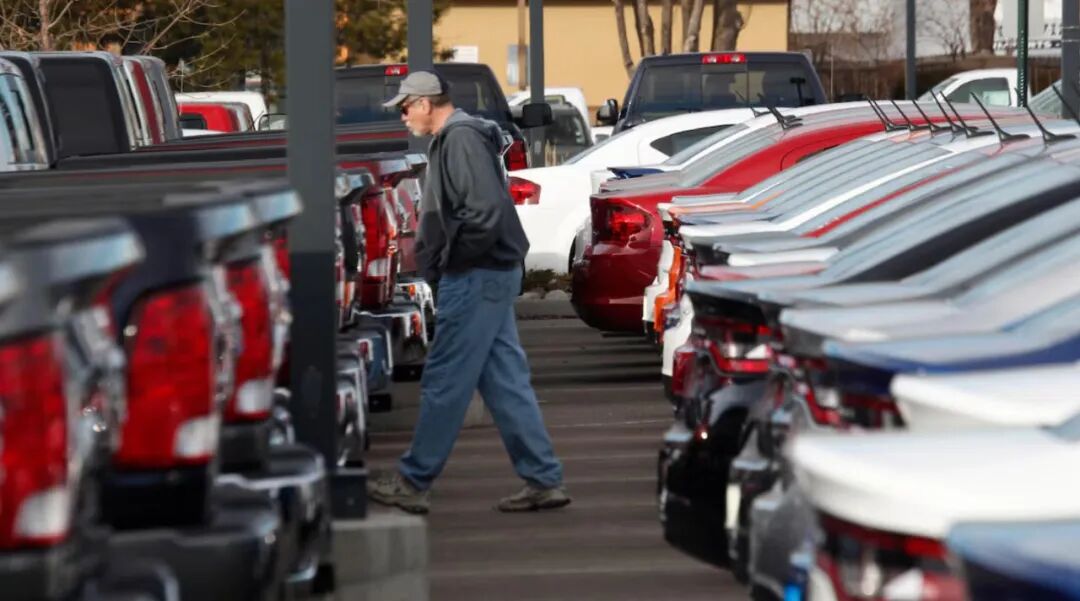
It should be noted that GM ranked first globally in 2004 with annual sales of 8.4 million vehicles; last year its total sales were only 6.2 million, falling to fourth globally. Ford also dropped from third globally that year to seventh. Even in the US domestic market, the Big Three's combined market share has fallen from over 90% to around 40%. Stellantis sold only 1.3 million vehicles in the US last year, less than half of 2004.
Jefferies analysts noted in a research report that the three major US automakers have been contracting their businesses in recent years, betting almost all resources on highly profitable large pickups and SUVs in the North American market. These models currently have high profits but are heavily polluting, with high fuel and maintenance costs, and their market size continues to shrink.
These automakers also misjudged market trends. In particular, GM was slow to recognize the lasting market potential of hybrid models, investing heavily in pure EV research and development, which instead allowed competitors such as Toyota to gain an advantage with hybrid technology.
The core contradiction lies at the corporate management level. The Big Three have not invested enough profit in next-generation model development, cost control, and product reliability improvement. Instead, they continue to channel benefits to Wall Street shareholders, carrying out large-scale dividend and share buyback plans.
For example, after completing a $6 billion share buyback, GM announced a new buyback plan of up to $20 billion, triggering dissatisfaction from the United Auto Workers. UAW President Shawn Fain publicly called it "legalized mass looting" and said the union is prepared to strike again when the 2028 labor contract expires. Stellantis, which previously stabilized investor confidence through dividends, also suspended dividend payments due to financial difficulties.
Coupled with the repeated flip-flops in US auto industry policy in recent years, the risks for Detroit automakers have been further amplified. Trump's sudden termination of EV support policies caused Ford, GM, and Stellantis to record a combined asset impairment of more than $50 billion—nearly $20 billion for Ford, $26 billion for Stellantis, and $8 billion for GM. The pure EV plans on which the three had invested substantial resources were forced to shrink.
Ford discontinued the electric version of its once highly anticipated best-selling pickup F-150 Lightning, and GM and Stellantis also abandoned plans to launch electric versions of large pickups. On top of that, Trump's additional tariffs on trading partners disrupted the North American auto supply chain. Subsequently renegotiated trade rules raised local content requirements for auto parts, and each policy change cost Detroit automakers billions of dollars in additional losses.
In addition, persistently high fuel prices and inflationary pressure have pushed up automakers' production and operating costs. Under multiple factors, Detroit's traditional stronghold appears stable but has actually lost its first-mover advantage in the global electrification transition, and declining long-term competitiveness has become an industry consensus.
Chicago Magazine wrote in a report that the US urgently needs to wake up and use its economic strength to support advanced industries so they are not marginalized on the global stage. Foolish approaches won't work; it's time for the US to seriously think about the future of its industries.
Editor: Cao Jiadong | Editor: He Zengrong

THE END
-
Thank You, Chinese Apple Fans, for Giving Apple's New CEO Two Big Gifts!
-
![]()
You Paid for the Flagship Model—But What You Get May Be a Watered-Down Version
-
![]()
Model Factories Are Bleeding, Cloud Vendors Are Counting the Money
-
Trump Loses Midterm Elections, U.S. Stocks Wipe Out Over $2 Trillion in One Night, AI Bubble Bursts, China's Chance to Overtake Has Come
-
![]()
Why Did OpenAI Label Its Own New Model GPT-6 Cyber with a "Critical" Warning?
-
![]()
$1.8 Trillion! The AI Investment Frenzy Is Running Red-Hot
-
![]()
Baolong Technology, a Leader in Air Suspension, Posts 12.07 Million Yuan Q3 Loss, but Non-Recurring Net Profit Rises 53% to 51.71 Million Yuan
-
![]()
Xiaomi Auto Tops 50,000 Again in October: Stock Surges 18% in Just 4 Days!