Tesla's All-Electric Pickup Cybertruck Is About to Be Discontinued: 70,800 Units Sold in 33 Months, Production Line to Be Freed Up for Cybercab in Mid-2027
 11/09 2026
 552
Produced by Zhineng Technology
On November 6, Musk announced that Tesla will gradually wind down the Cybertruck production line at Giga Texas in mid-2027 to make room for Cybercab.

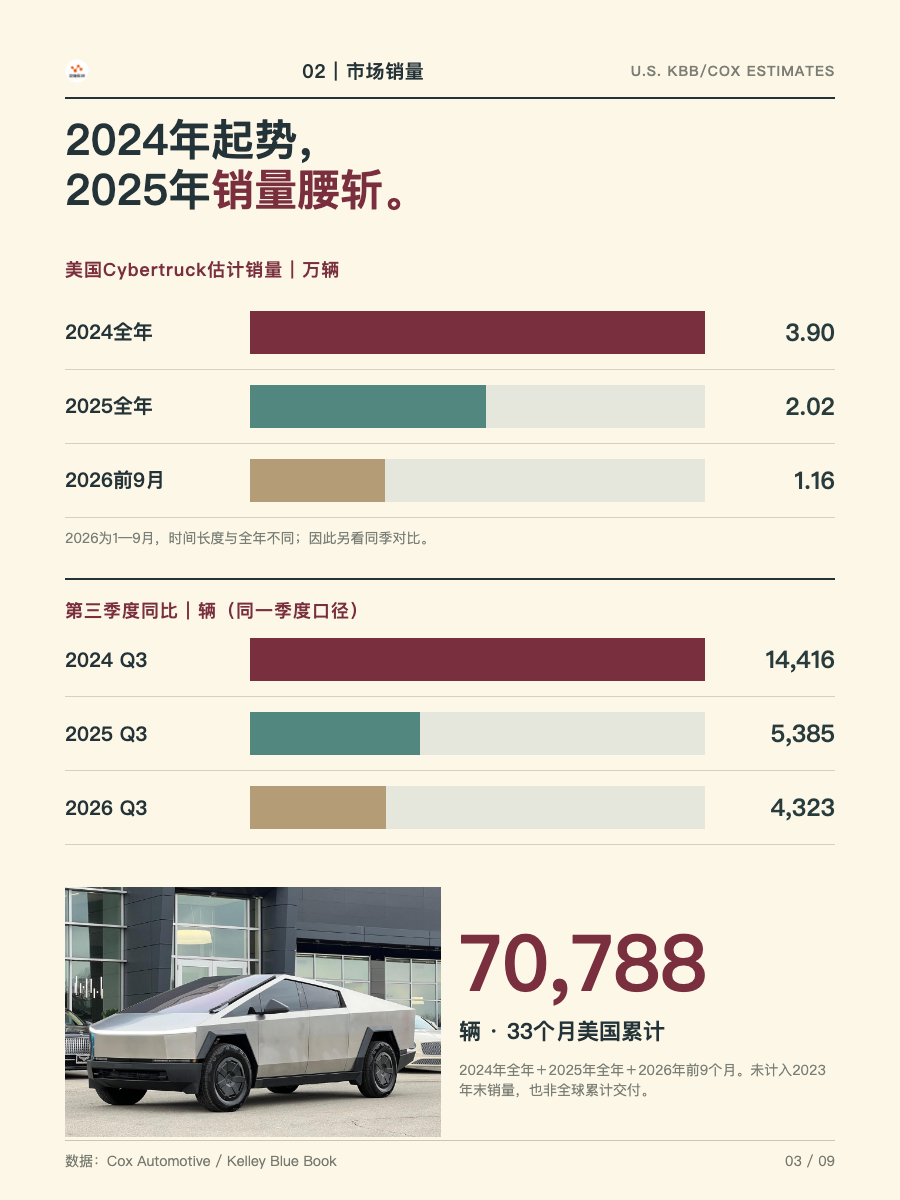
According to U.S. sales estimates from Cox Automotive and Kelley Blue Book, 38,965 units in 2024 marked the full-year peak.
Sales fell to 20,237 units in 2025 and reached 11,586 units in the first nine months of 2026, totaling 70,788 units over 33 months.
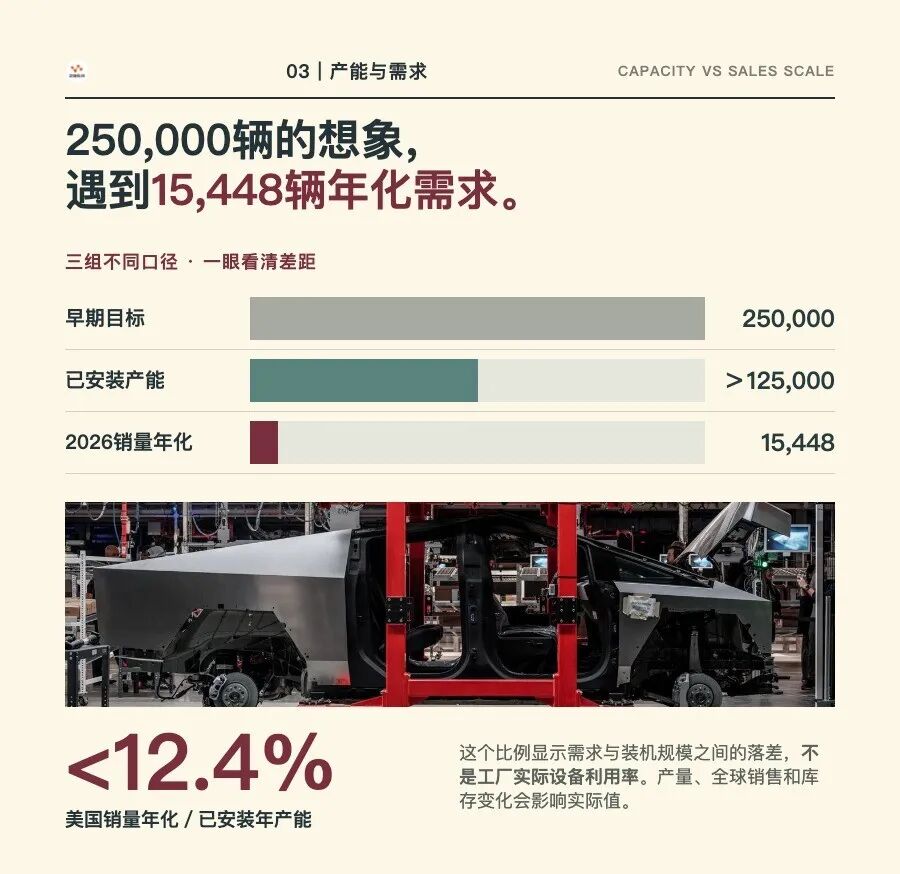
The installed annual Cybertruck capacity disclosed by the Texas factory in the third quarter of 2026 still exceeds 125,000 units. Annualized from the first nine months at 15,448 units, that is only about 12.4% of the lower capacity limit.
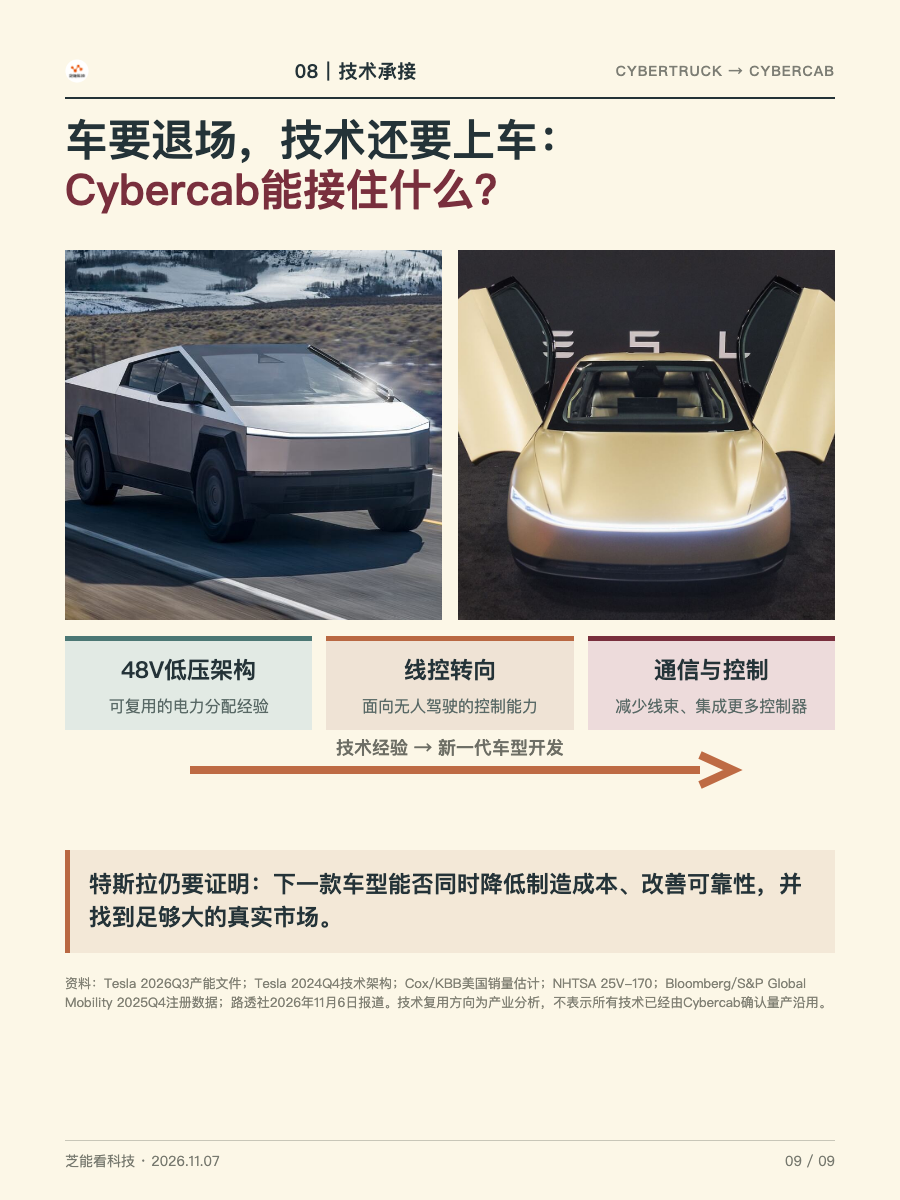
The production line also leaves behind a 48V low-voltage power supply, Etherloop in-vehicle communication, and steer-by-wire. This electrical and electronic architecture will follow the engineering team into Cybercab.
From $39,900 to $92,490: Stainless Steel Was the Biggest Failure

On November 21, 2019, Cybertruck made its debut in Hawthorne, near Los Angeles, with large flat stainless steel panels forming a silhouette almost like a sci-fi prop. During the on-site demonstration of armored glass, two windows were cracked by steel balls.
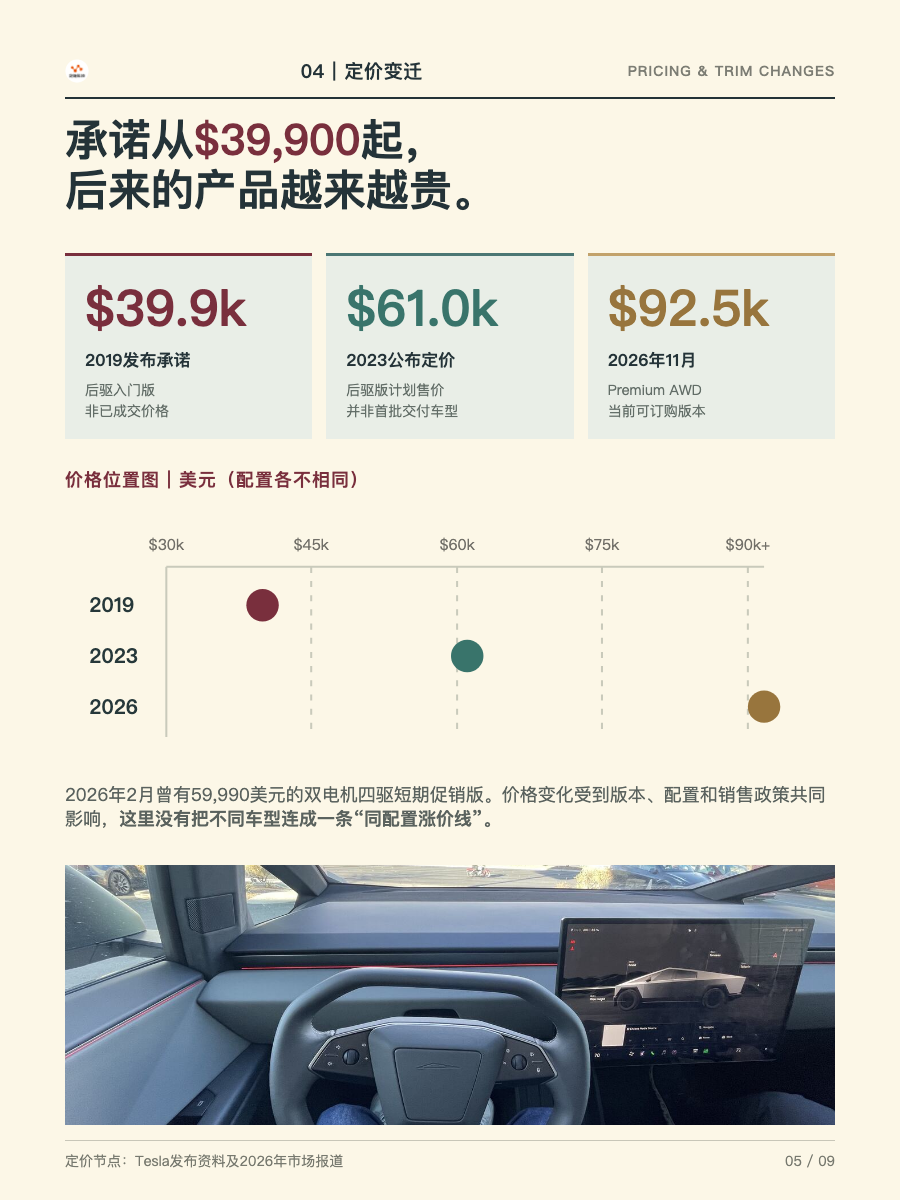
The entry rear-wheel-drive version Tesla quoted at the time was $39,900, the dual-motor version $49,900, and the tri-motor version $69,900. Production was planned for the end of 2021.
For U.S. pickup buyers, this price band, combined with all-electric power and extremely strong recognizability, fell directly into the mainstream high-trim pickup segment.
The delivery event on November 30, 2023 announced another set of numbers. The rear-wheel-drive version was $60,990, the all-wheel-drive version $79,990, and Cyberbeast $99,990.
By February 2026, Tesla briefly launched a $59,990 dual-motor all-wheel-drive version. By November, the Premium AWD available for direct order was already $92,490, and Cyberbeast exceeded $100,000. The price more than doubled.
The stainless steel body is the engineering starting point for the price change.
U.S. full-size pickups have long used mature stamping, welding, painting, and assembly processes, with a large-scale parts supply chain and an existing repair and modification system.
Cybertruck switched to high-strength cold-rolled stainless steel panels, eliminating the painting step and letting the exterior surface directly carry product identity.
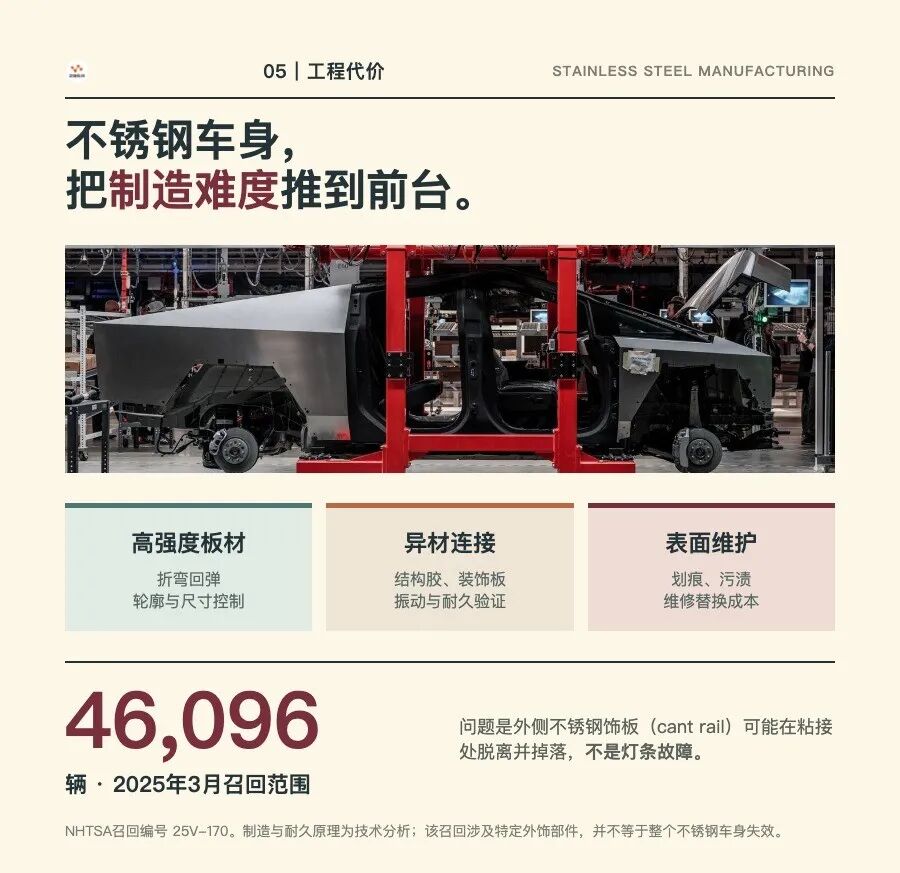
Forming the stainless steel panels first held up the pace of mass production, with the difficulty lying in springback and dimensional consistency.
High-strength materials are difficult to freely stamp into complex curves like common body steel plates, and bending springback and dimensional consistency are harder to manage. Long straight lines and large flat surfaces also expose panel gaps, local waviness, and scratches to view.
The joining process between different materials then became the next bottleneck.
The exterior surface uses stainless steel, while brackets, trim parts, glass, and internal and external structures on the vehicle still need to be connected to it. The thermal expansion, vibration, bonding, and long-term durability of different materials all have to be validated.
In March 2025, Tesla recalled 46,096 Cybertrucks because the stainless steel trim panels on the body-side cant rail had a risk of separating and falling off at the adhesive locations.
Cost pressure ultimately fell on production line scale, as dedicated equipment had no output volume to spread costs over.
Eliminating painting removed one process, but high-strength materials, special processing, surface protection, rework, and assembly consistency added several more. A dedicated production line serving only a relatively small model volume cannot spread the investment in molds, tooling, manufacturing equipment, quality validation, and supply chain management.
70,788 Units in 33 Months, 125,000 Units of Capacity
Full-year 2024 sales of 38,965 units were the first full sales year, and full-year 2025 sales were 20,237 units, down 48.1% year on year.
In the first nine months of 2026, sales were 11,586 units, down 28.0% year on year.
In the third quarter of 2026, sales were 4,323 units, rebounding from the second quarter.
About 14,416 units in the third quarter of 2024 and about 12,991 units in the fourth quarter were the peak left by concentrated deliveries to early reservation holders. By the fourth quarter of 2025, only 4,140 units remained.
Tesla's own quarterly disclosure refers to production capacity. In the third quarter of 2026, Cybertruck's installed annual capacity at the Texas factory was still stated as more than 125,000 units.
Simple annualization of first-nine-month sales gives about 15,448 units, equivalent to 12.4% of this lower capacity limit. Annual output of 250,000 units was once in the original plan. Demand stopped at one tenth.
S&P Global Mobility registration data also breaks out buyers. In the fourth quarter of 2025, 7,071 Cybertrucks were registered in the United States, of which 1,279 went to SpaceX. Another 60 were registered by other companies controlled by Musk, together accounting for about 19%. Individual demand is even thinner.
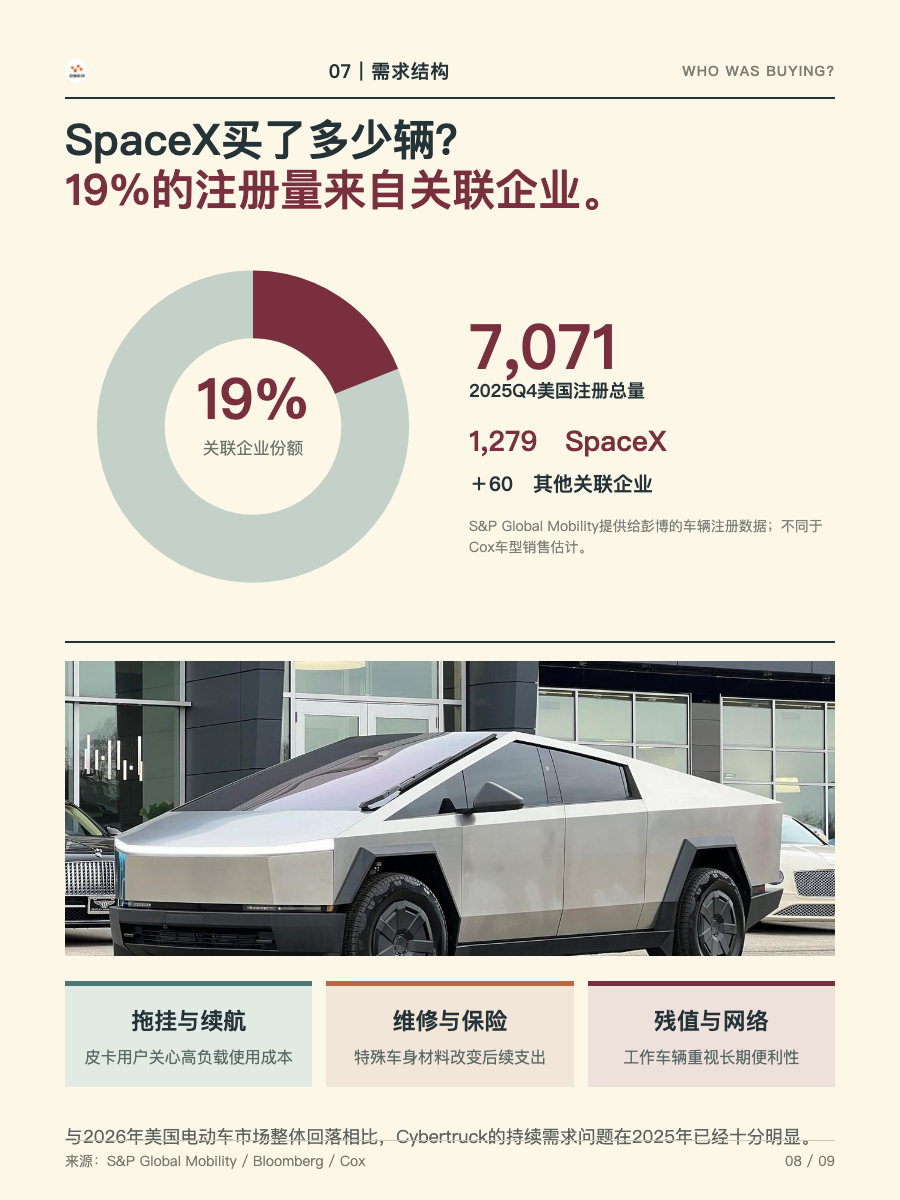
The market environment was also changing during the same period, with U.S. all-electric vehicle demand declining in 2026 due to subsidy changes.
Pickup customers look at 0-100 km/h acceleration, but they also calculate range while towing, bed practicality, repair costs, insurance, residual value, and after-sales convenience. A sharply angular exterior can pull the first batch of users into showrooms, but to sell more broadly going forward, these daily-use costs all have to be addressed.
48V, Etherloop, and Steer-by-Wire Await Cybercab to Carry Them Forward
The 48V low-voltage electrical system replaced the 12V system that had been used for years.
At the same power, Cybertruck reduces theoretical current to about one quarter of 12V, with wiring and thermal management optimized accordingly. As more actuators are used, the value of this low-voltage architecture will be amplified along with the vehicle's electronic load.
Etherloop in-vehicle communication connects controllers to a high-bandwidth backbone, reducing cross-vehicle wiring harnesses by about 70%.
More controllers operate collaboratively around backbone communication, and harness length and assembly steps decrease accordingly.
Steer-by-wire removes the mechanical connection between the steering wheel and the wheels.
Input sensors, controllers, and actuators work through electronic signals, and the steering ratio can be adjusted according to vehicle speed. Rear-wheel steering works together to reduce the turning space of a large pickup. The difficulty lies after a failure. Power supply, communication, sensors, and actuators all require fault detection and redundancy design.
The high-voltage architecture also supports high-power charging and Powershare external power supply.
Putting external power supply on a vehicle like a pickup that serves both as a work tool and for family mobility is very suitable. Cybertruck chief engineer Wes Morrill has stated that the experience of this vehicle as a technology development platform will continue into Cybercab.
The goals of the two vehicles are far apart. Cybertruck emphasizes extreme styling and high-load performance, while Cybercab focuses on autonomous driving, cost, utilization rate, and scalable manufacturing.
Conclusion
Cybertruck can be considered a failed product, with U.S. sales over 33 months stopping at 70,788 units. The 48V system, Ethernet backbone, and steer-by-wire have run a round on production vehicles. Let's see how Cybercab performs; all-electric pickups cannot sell in the United States.
-
![]()
Thailand Begins to Settle Old Scores with Chinese Automakers
-
![]()
Why Did It Take smart Seven Years to Perfect a Small Car Priced at 99,900 Yuan?
-
![]()
Tesla's All-Electric Pickup Cybertruck Is About to Be Discontinued: 70,800 Units Sold in 33 Months, Production Line to Be Freed Up for Cybercab in Mid-2027
-
![]()
OpenAI Account Bans Are Just the Tip of the Iceberg: The "Reckoning" of AI Compute Is Unfolding Simultaneously in Washington and Wall Street
-
![]()
Multiphoton Microscopy Imaging Technology No. 55: Self-localized Ultrafast Pencil Beams for Volumetric Multiphoton Imaging
-
![]()
China and the US have already settled their AI competition—and it's not even close: Multiple US states move to halt data center construction
-
![]()
Huguang Shares: Revenue Down 8.05%, Profit Plummets 80.25% Amid Wave of New Designations, Gross Margin Falls 3.74 Points
-
![]()
BYD Executive Responds to Maserati Acquisition Rumors: BYD's Cars Are the Fastest in the World