October New Energy Sales Review: Exports Nearly 1.5 Times Higher in a Single Month, But Plug-in Hybrids Are Losing Steam
 11/10 2026
 439
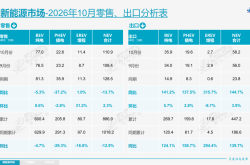
On November 9, the China Passenger Car Association (CPCA) released October new energy data. The most striking contrast in this report card: exports of new energy passenger vehicles reached 582,000 units, up 144.7% year-on-year; domestic retail sales were 1.109 million units, down 13.7% year-on-year. Overseas markets posted a single-month increase of nearly 1.5 times, while the domestic market remains in a downward channel. China's new energy vehicle market has already taken shape as an operating pattern of "two sets of rhythms and two sets of logic" running in parallel.
Under Two Sets of Logic, Overseas Markets Become a Second Home Market
Economical Small Cars Lead Exports
In October, exports by new energy passenger vehicle manufacturers reached 582,000 units, up another 3.9% month-on-month. From January to October, cumulative exports reached 4.472 million units, up 139.7% year-on-year. New energy vehicles already account for 62.8% of total passenger vehicle exports, 20 percentage points higher than the same period last year. The structure of China's automotive exports has completely shifted from "fuel vehicles as the foundation" to "new energy dominating."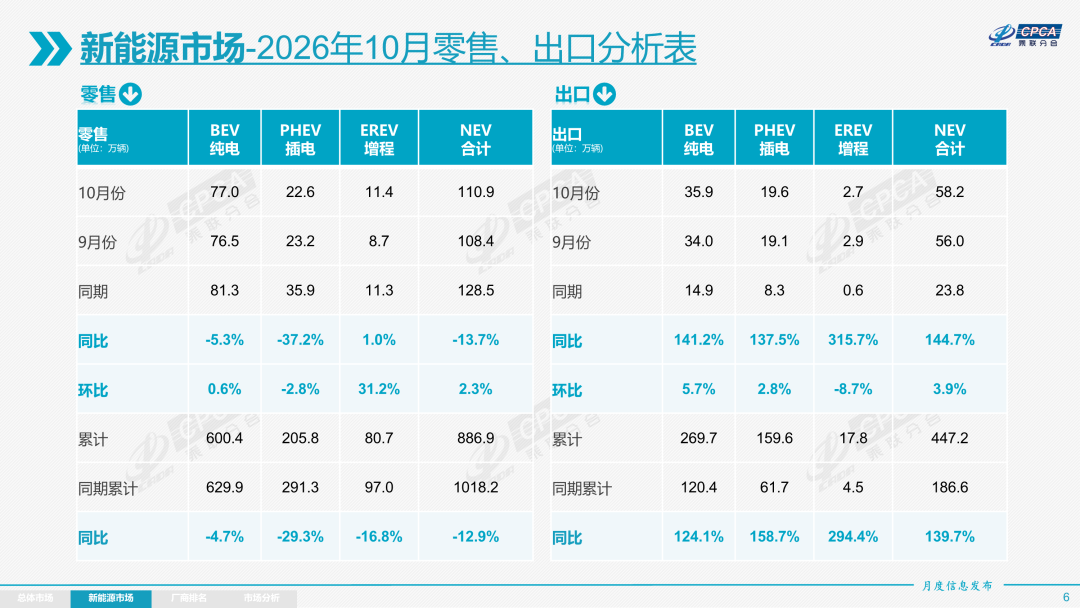
The product mix of exports is also changing. Pure electric vehicles account for 61.7% of new energy exports, among which A00 and A0 economical small cars account for 56.4% of pure electric exports, compared with only 42.1% a year ago. In other words, overseas markets are repeating the domestic popularization path of previous years, with affordable and practical small electric vehicles driving volume growth. Plug-in hybrids account for 33.7% of exports, and extended-range vehicles account for 4.6%, the latter significantly higher than 2.7% in the same period last year. Although trade policies in some overseas countries remain uncertain, shipments of independent plug-in hybrids in developing countries are still expanding rapidly.
At the company level, BYD ranked first with monthly exports of 165,194 units, followed by Chery with 83,843 units, Geely with 80,119 units, and Tesla China with 59,012 units. In terms of localization, the share of CKD kit assembly exports of SAIC-GM-Wuling has reached 41.9%, Great Wall Motor 31.1%, and SAIC Passenger Vehicle 27.6%. The shift from complete vehicle exports to overseas assembly production is becoming a common move among leading enterprises.
Domestic Retail Rose for Two Consecutive Months Month-on-Month, Fuel Vehicle Contraction Is Accelerating
On the domestic side, October new energy retail sales were 1.109 million units, down 13.7% year-on-year, but up 2.3% month-on-month, rising month-on-month for the second consecutive month; from January to October, cumulative retail sales were 8.869 million units, down 12.9% year-on-year. Retail penetration rose to 67.5%, up 10.5 percentage points year-on-year, setting another historical high.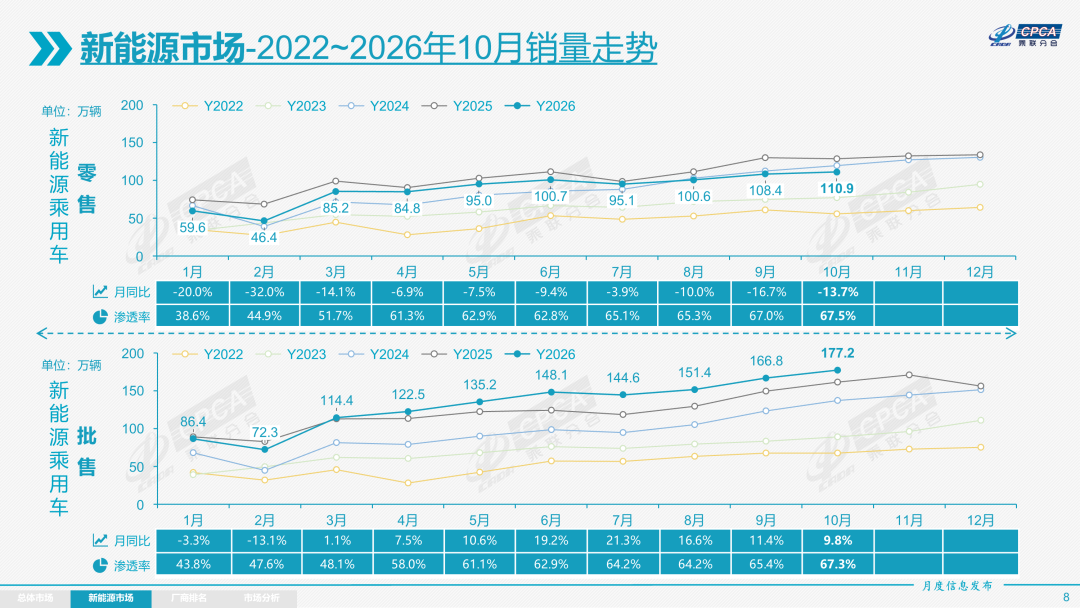
Looking at the other half of the pie: retail sales of conventional fuel passenger vehicles were 530,000 units, down 45% year-on-year, with the annual decline continuing to expand. The only segment still growing is ordinary hybrid vehicles, with October ordinary hybrid retail sales up 28% year-on-year. Fuel vehicles are exiting faster than new energy vehicles are filling the gap, which is the direct reason for the overall contraction of the domestic market.
In terms of brand camps, the new energy retail penetration rate of independent brands was 84.8%; mainstream joint venture brands rose to 19.7%, and their share of new energy retail also increased by 2.6 percentage points year-on-year to 5.9%. Although joint venture transformation is slow, it has begun to contribute incremental volume. The retail share of new forces was 23.9%, and the share of second-generation brands (Zeekr, Aion, Arcfox, Voyah, etc.) was 15.3%.
Extended-Range Turns Positive, Plug-in Hybrids Lose Speed, the Ranking of Technology Routes Is Changing
The most informative change in October data occurred at the technology route level. Extended-range wholesale volume was 152,000 units, up 19.9% year-on-year and up 31.3% month-on-month, with its share rising to 8.6%. This is a rare year-on-year positive growth for the extended-range category recently, and new product cycles from brands such as AITO and Li Auto are heating up this sub-market again.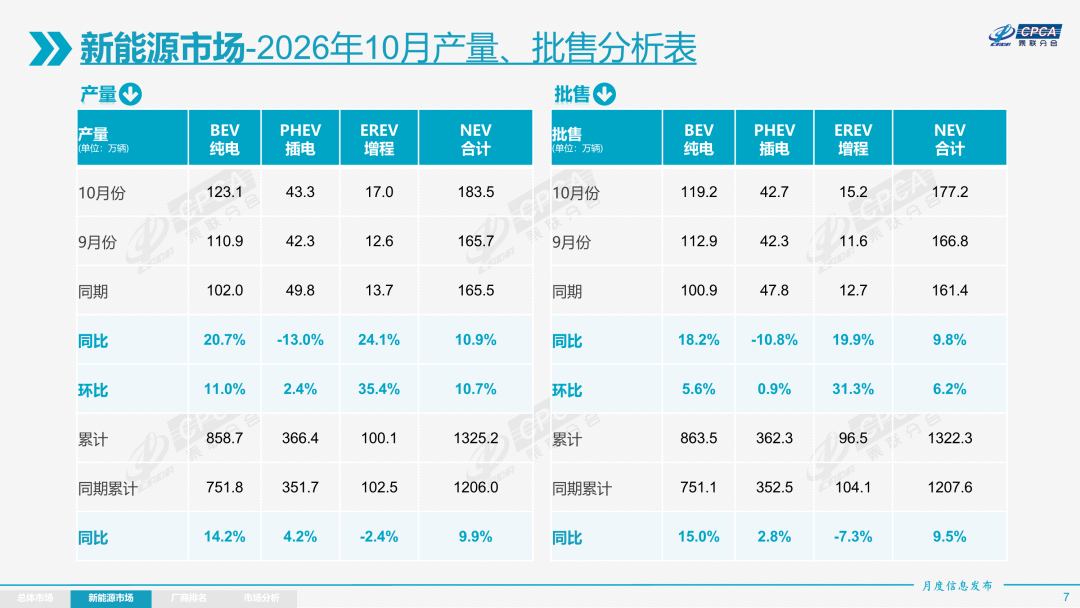
In contrast, narrow-sense plug-in hybrid wholesale volume was 427,000 units, down 10.8% year-on-year, with its share falling to 24.1%. Plug-in hybrids had previously been the most stable foundation of the new energy market. This double-digit year-on-year decline suggests that domestic plug-in hybrid demand may be being diverted by extended-range and pure electric vehicles at both ends. Whether this turning point is a trend or a single-month fluctuation needs to be confirmed by November and December data.
Pure electric continued to strengthen, with wholesale volume of 1.192 million units, up 18.2% year-on-year, accounting for 67.3% of total new energy wholesale, up 4.8 percentage points year-on-year. Taken together, pure electric further widened its lead, extended-range rose rapidly, plug-in hybrids fell behind, and the growth logic of the three major routes showed clear divergence.
Models and Automakers: Small Cars Cold at Home, Popular Overseas
An intriguing scissors gap is A00-class electric vehicles: domestic wholesale volume was 101,000 units, down 41% year-on-year, accounting for only 8% of pure electric share, shrinking by 8.6 percentage points from the same period last year. After the halving of purchase tax and the phase-out of subsidies, the entry-level market has become the segment under the greatest pressure; the same batch of models is highly popular overseas, supporting half of pure electric exports. A0-class domestic wholesale volume was 456,000 units, up 13.6% year-on-year, accounting for 38% of pure electric, becoming the domestic pure electric foundation. B-class wholesale volume was 307,000 units, down 7% month-on-month, and competition in the mid-end market is beginning to intensify.
On the automaker wholesale ranking, BYD ranked first with 482,610 units, followed by Geely with 211,240 units, Chery with 133,890 units, Leapmotor with 103,025 units, Changan with 99,494 units, and SAIC-GM-Wuling with 97,241 units forming the second tier. Tesla China with 67,829 units, XPeng with 50,237 units, and Xiaomi with 50,168 units followed closely. Twenty-three manufacturers exceeded 10,000 units in wholesale, together accounting for 95.5% of total new energy volume, with concentration continuing to rise from last month. The number of brands with retail sales exceeding 20,000 units reached 17, with BYD at 250,301 units, Geely at 131,708 units, and Leapmotor at 83,573 units leading. In terms of hit models, the number of models with wholesale volume exceeding 20,000 units increased to 25. BYD Song topped the list with 74,365 units, while Geely Xingyuan, BYD Yuan UP, Dolphin, and Model Y ranked among the top.
Under Two Sets of Logic, the Yardstick for Judging the Industry Must Change
October data suggests that continuing to judge the new energy industry solely by "domestic retail" is no longer sufficient. The domestic market is in an adjustment period after policy phase-out, with retail sales still declining year-on-year but continuously recovering month-on-month. The fourth-quarter peak season combined with new product launches is expected to bring further improvement; the overseas market, with a year-on-year growth rate of nearly 1.5 times, has taken over as the growth engine, and the main growth force has shifted from high-end models to economical small cars. In terms of technology routes, the growth gap among pure electric, extended-range, and plug-in hybrid has widened, and product planning and capacity allocation need to be recalibrated according to the new landscape. For automakers, domestically they compete for existing share at a high penetration rate of 67.5%, while overseas they compete on localized capacity and channels. The two battles are already completely different in approach.
-
![]()
October New Energy Sales Review: Exports Nearly 1.5 Times Higher in a Single Month, But Plug-in Hybrids Are Losing Steam
-
![]()
China Auto Q3 Export Tracker: Exports Up 72%, Racing Ahead of Tax Rebate Cuts and Hybrid Quotas
-
![]()
Porsche in China: An Outsider in a Marginal Market?
-
![]()
The Four Major EV-Exclusive "Black Technologies" That Gas Cars Can Only Dream Of
-
![]()
Why Can't Autonomous Driving Get Around Traditional Automakers? Insights from the Waymo-Toyota Collaboration
-
![]()
BMW's Profits Are Heading Toward Zero in Fiscal Year 2026
-
![]()
SAIC Invests RMB 300 Million in New Intelligent Driving Joint Venture as Core Executive Yang Xiaodong Announces Resignation, Drawing Market Attention
-
![]()
Xeon Fusion's 8 Billion Yuan IPO Bid Set for This Week's Regulatory Review in ChiNext Sprint