Why Can Nissan, Shrinking in Scale, Grow Again? | Cover Story: Japanese Automakers at the Crossroads of Transformation (IV)
 11/11 2026
 459
The competitive landscape of the automotive industry is being reshaped, and the window for transformation is closing fast. Electrification and intelligence have become the core engines of upgrading, while globalization has become the proving ground for their success. As electrification and intelligent technologies shift from quantitative to qualitative change, and as Chinese automakers rapidly expand globally, Japanese automakers find themselves at the crossroads of transformation. At this historic juncture, if they want to laugh last, they urgently need to rebuild their existing advantages and create new latecomer advantages.
Focusing on the transformation of Japanese automakers, Auto Review has produced this special cover story report. The report consists of six articles; today we publish the fourth. Stay tuned.
After Espinosa took office, Nissan launched a large-scale contraction—closing plants, cutting jobs, reducing models, and reallocating global resources. Financial indicators have already begun to improve, but for Nissan, "successful cost stabilization" and "successful recovery" are two different things.
The Sunderland plant in the UK is Nissan's only remaining plant in Europe and also the largest automotive plant in the UK. On September 16, Nissan announced a 170 million pound investment there for production of the Kicks e-POWER. Three months earlier, the plant had drawn attention for insufficient capacity utilization and Nissan's consideration of leasing one production line to Chinese automaker Chery.
According to the memorandum of understanding at the time, the vacated production line will produce Chery models from fiscal year 2027. The plant remains wholly owned by Nissan, and employees are hired by Nissan, with Chery only paying manufacturing costs. Nissan's own Qashqai and Leaf were consolidated onto another production line, switching to three-shift production. Handing plants to external automakers is not a first for Nissan: Chery previously took over Nissan's old Barcelona plant in Spain and acquired Nissan's Rosslyn production base in South Africa.
This Japanese automaker once won against competitors with "global platforms, global capacity," but now it is compressing its global manufacturing network, planning to reduce vehicle plants from 17 to 10 while redirecting new products to key plants. New CEO Ivan Espinosa launched the "Re:Nissan" restructuring plan more than a month after taking office, and the Sunderland adjustment is one step in it.
The Sunderland adjustment shows that Nissan must first bring costs down; but contraction is not the end, and the remaining business still needs to grow again. What is harder is this: after the scale becomes smaller, what will drive renewed growth?
Why Nissan Must "Become Smaller"
When discussing Nissan's many current problems, one cannot avoid former CEO and "fugitive" Carlos Ghosn. After 1999, through measures such as the "Nissan Revival Plan," he quickly cut costs, integrated the supplier system, and improved capacity utilization, significantly improving operational efficiency. The subsequent Power 88 plan set global market share and operating profit margin as explicit goals. This model was built on a very clear logic: first restore scale, then dilute fixed costs through scale, thereby creating profitability. This was effective at the time, but it does not mean it can be copied unchanged and extended to today.
The competitive variables in the automotive industry have shifted. In the past, platforms, engines, and manufacturing systems could continue to play a role over a longer cycle, and cost control and scale expansion were important sources of competitiveness; entering the stage of new energy and intelligence, product development cycles, software iteration, electronic and electrical architectures, battery costs, and supply chain response speeds increasingly and directly determine the competitiveness of a product. Scale is still important, but scale alone can no longer explain profitability.
Therefore, the operating model formed in the Ghosn era is a key to understanding Nissan's current predicament, but not the whole answer. Nissan was once good at making a massive organization operate efficiently, but now it must answer: can a leaner organization bring competitive products to market faster?
After Ghosn's escape, although Nissan did not immediately fall into financial crisis, the switch in operating capability was never completed. Executive turnover, governance disputes, performance decline, and strategic adjustments occurred one after another. The 2019 "Nissan NEXT" attempted to restore profitability, with the core still being cost reduction and efficiency improvement. After the market entered the new energy era, the first-mover advantages of models such as the Leaf were gradually depleted, and Nissan's product renewal speed in hybrids, pure electric vehicles, and intelligence failed to form a continuous product cycle supporting global growth. This is also why Nissan's problems today cannot simply be attributed to a single operational mistake, but are more like the company failing to complete the switch from "scale management" to "product and technological capability management" over a long period. Ultimately, declining sales began to amplify the problems of the original cost structure in turn.
In fiscal year 2025, Nissan's global retail sales were 3.151 million units, down 5.8% year on year; net loss was 533.1 billion yen. The automotive business operating loss was 239.9 billion yen, and free cash flow was negative 480.8 billion yen. During the same period, Nissan's automotive business net cash was still 1.17 trillion yen. Therefore, Nissan is not facing an immediate survival crisis with cash flow running out, but rather an imbalance in the relationship among revenue, sales, and fixed costs. Having cash reserves does not equal safety; once plants, R&D, procurement systems, and organizational scale become too large, they will still continuously consume profits and cash. Nissan used to have many vehicle plants, and when global sales decline and model updates slow, a large amount of fixed costs becomes difficult to dilute through scale.
As a result, after Espinosa took over, the first thing he did was not immediately look for a new blockbuster product, but first re-examine the cost structure. The Re:Nissan strategy emerged from this.
How Espinosa Will Remake Nissan
How does Espinosa plan to change things? From the currently announced plan, it can be roughly summarized as "four cuts."
The first cut: manufacturing and organization. The first layer of logic in Re:Nissan is very direct: bring fixed costs down. Nissan plans to compress global vehicle plants from 17 to 10, improve plant utilization by integrating production, powertrain, and development resources, and cut about 20,000 positions. The company's proposed cost-saving target of 500 billion yen is not achieved only by layoffs, but covers multiple links including manufacturing, engineering, procurement, and supply chain. In the latest recovery plan, Nissan lists manufacturing network integration and cost structure optimization as paths to improve business resilience. In other words, Nissan is accepting a reality: future sales scale may be lower than in the past, but the company still must preserve profitability.
Sunderland is an example: adjustment does not mean simply withdrawing from overseas manufacturing. While considering using partners to improve idle capacity utilization, Nissan is also reinvesting the Kicks e-POWER locally. The new investment announced on September 16 shows that after the manufacturing network contracts, the real question for Nissan is not "do we still want plants," but "which plants are worth keeping, and what should the remaining plants produce?"
The second cut: compress products and development cycles. More important than plant contraction is the change in the development system. Nissan will reduce the number of global models from 56 to 45 and concentrate R&D resources on three major product families, covering more than 80% of sales. At the same time, each vehicle is given a clearer role, divided into four categories: heartbeat models, core models, growth models, and cooperation synergy models, to avoid resources being spread across product lines. Behind this is a shift in business logic: in the past, the goal was to cover different markets and segmented needs as much as possible; now, with limited resources, the need is to make fewer vehicles faster and more efficiently. Nissan's latest strategy emphasizes shortening the development cycle by about 40% and reducing the time from development to market launch through architecture-based development, shared platforms, powertrains, and software platforms. This may be closer to the capability Nissan truly needs to build than layoffs. If the development cycle cannot be reduced, then even if the company becomes "lighter," the remaining organization will merely be a smaller company that still responds slowly.
The third cut: rehandle supply chain relationships. In the past, Nissan long emphasized cost pressure and procurement efficiency with suppliers. Re:Nissan puts total delivered cost first, that is, managing the comprehensive costs of parts, manufacturing, logistics, and other links together. Supply chain optimization is no longer just about pressing prices, but about calculating procurement, engineering, and manufacturing costs on one table. For an automaker whose global sales have clearly declined, this is actually switching to a different algorithm: with less procurement scale, Nissan can only recover cost efficiency through fewer platforms, higher parts commonality, and more stable procurement volumes.
The fourth cut: redefine the tasks of different markets. This is clearly different from the past business logic of "all markets must grow." Nissan's latest market strategy defines Japan, the United States, and China as three core markets and assigns different responsibilities: the United States undertakes scale and profit growth, Japan maintains the domestic base as well as the technological and brand foundation, and China is repositioned as a center for global innovation and export capabilities. At the same time, Mexico serves as a regional export hub, and Europe continues to be an important platform for electrification and e-POWER.
With market tasks changed, Nissan no longer applies the same product and resource allocation logic globally. For example, the United States is the focus for Nissan to restore sales and profitability, with a target of 1 million units in fiscal year 2030; Japan's target is 550,000 units, bearing more of the domestic market and technological foundation. China sales are still declining, but Nissan is using local R&D, manufacturing, and supply chain capabilities to export products outward. Europe continues to be laid out around electrified products and the Renault alliance, while Mexico and Latin America undertake regional market and export functions.
From this perspective, Espinosa's remaking of Nissan is not just about cutting global scale smaller, but about redeciding where the remaining resources should be invested. This may be the biggest difference between Re:Nissan and the past: no longer rolling out globally according to a unified template, but redistributing roles according to the strategic value of each market. For an automaker that has been contracting for years, this step may be more critical than having fewer plants and fewer models.
Nissan Has Stopped the Bleeding, But Has Not Yet Recovered
The current change is that Nissan's financial condition is beginning to repair before sales do.
In the first quarter of fiscal year 2026, Nissan's operating revenue was 2.9642 trillion yen, up 9.5% year on year; operating profit was 77.9 billion yen, compared with a loss of 79.1 billion yen in the same period last year; net profit was 3.8 billion yen, compared with a loss of 115.8 billion yen in the same period last year. During the same period, global retail sales were 701,000 units, down 0.9% year on year. The group's operating profit turning positive again looks like a clear improvement.
But the automotive business has still not returned to profitability. In the same period, the automotive business operating loss was 8.3 billion yen, and free cash flow was negative 323.9 billion yen. Nissan also pointed out that revenue growth was affected by factors such as exchange rates, prices, and product mix, and cost reductions also contributed to the improvement.
In other words, what is happening now is more operational cost stabilization than business reversal. Nissan has begun to push losses down, but has not yet proved that a new product and market mix can pull sales back up.
This difference is more obvious in regional market performance. The United States is currently the market where improvement appears earliest. In the first quarter of fiscal year 2026, Nissan's U.S. sales were about 243,000 units, up 9.6% year on year; July sales were 75,926 units, up 2.3% year on year. Core products such as the Rogue provided support, and localized production also helped reduce the impact of tariffs and supply chain fluctuations. Nissan has already set a U.S. sales target of 1 million units for fiscal year 2030.
But from one quarter and one month of data, it is still difficult to define this improvement as the restart of a growth cycle. Whether subsequent product launches can sustain sales growth, whether market share can stabilize, and whether sales improvement can ultimately be transmitted to profit still need time to verify.
Japan's change is closer to stopping the decline. In July, Nissan's sales in Japan were 35,872 units, up 3.6% year on year, with new products such as the Kicks and Elgrand providing some support. But looking back at full-year data, Nissan's fiscal year 2025 sales in Japan were only 399,000 units, down 13.5% year on year, and market share fell to 8.8%. Therefore, the current rebound is more like a phased improvement under a low base, and what the Japanese market first needs to restore is still the base.
China tells another story: sales are still shrinking fast, but the role of the China business is changing. In fiscal 2025, Nissan's China sales came to 653,000 units, down 6.3% year on year, and its market share slipped to 2.4%. Pressure mounted further once fiscal 2026 began. In July, Nissan sold 23,677 vehicles in China, down 58.7% year on year; cumulative sales from April to July reached 131,100 units, down 39.2% year on year. Yet even as sales volume contracts, Dongfeng Nissan is speeding up its product mix adjustment. In the first half of 2026, cumulative wholesale volume of its N-series new energy vehicles topped 100,000 units, new energy sales jumped 192% year on year, and by June new energy models accounted for 30% of sales. The N7, N6, and NX8 have rolled into the market one after another, emerging as important attempts by Dongfeng Nissan to rebuild its product lineup.
At the same time, Dongfeng Nissan has begun to take on more of Nissan's globalization functions. Nissan plans to bring China-developed or China-built models such as the N7, Frontier Pro, and NX8 to Latin America, Southeast Asia, and the Middle East, and to keep expanding exports from its Chinese plants. In other words, Nissan's China business used to be judged mainly by sales and market share; now the question is also whether the R&D, manufacturing, and supply chain capabilities built in China can be turned into products and revenue in other markets.
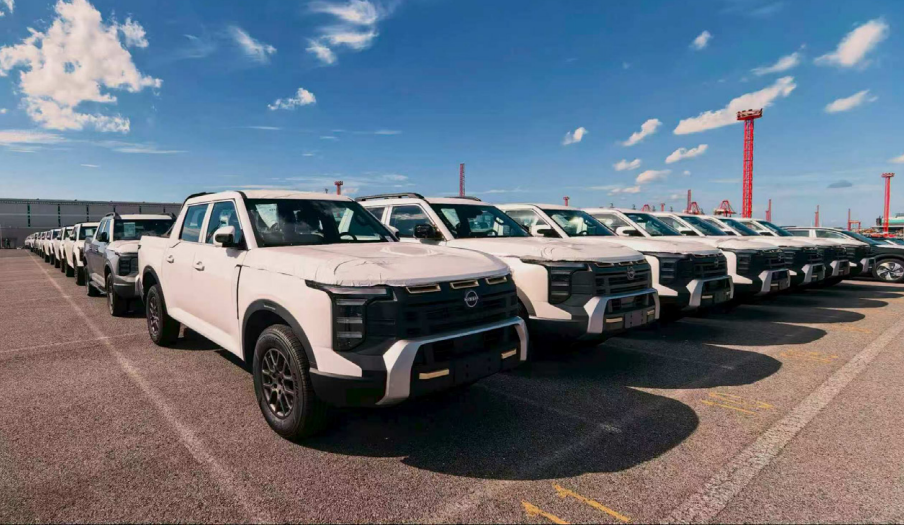
This path is beginning to take shape, but exports are still in the expansion stage, and whether a sufficient scale can ultimately be reached depends on product competitiveness, overseas sales, and profitability.
Europe remains in an adjustment period. In fiscal 2025, Nissan's European sales were 317,000 units, down 9.7% year on year; from April to July of fiscal 2026, sales were 85,200 units, down 12.6% year on year. Capacity utilization at Sunderland is still under pressure, but the September 16 announcement of an additional 170 million pounds of investment to build the Kicks e-POWER locally shows that Nissan has not simply given up on UK manufacturing; instead, it is rearranging products and capacity after shrinking its network. Latin America, meanwhile, carries more of the burden of product renewal and scale maintenance. Nissan plans to launch 6 new models and 3 electrification technologies in the region over the next 12 months, continuing to rely on Mexico's production and export system to sustain the regional business.
Taken together, these changes do not yet amount to a full reversal for Nissan: the United States has begun to improve, Japan has stopped declining, China's sales are under pressure but its global role has grown, Europe is still restructuring, and Latin America is shouldering scale repair. Re:Nissan has produced some partial changes, but their effects have not yet converged into a new growth curve.
Perhaps it is fair to say that what Nissan is grappling with is how to run a smaller company with fewer resources. What remains to be verified is whether this company can rebuild sales and profits.
From "surviving" to "growing again"
To this day, the governance problems left over from the Ghosn era are also gradually fading from the main line of Nissan's management.
After 2023, Renault and Nissan readjusted their shareholding and voting rights relationship, and the special control arrangements of the past changed. At this year's shareholders meeting in June, Nissan shareholders also rejected the appointment of outside director Motoo Nagai. According to a Reuters report at the time, major international proxy voting advisory firms all raised doubts about his independence, and Renault abstained in the relevant vote.
Today's Nissan no longer needs to repeatedly answer "who controls whom." The question at the governance level has become whether the board can effectively supervise business strategy, and whether management can keep delivering results on that strategy. And this is precisely where the real difficulty of the next stage of the Re:Nissan strategy lies. Over the past year or more, Nissan has completed a great deal of subtraction: fewer factories, compressed staffing, a shrunken model lineup, reordered development resources, and reallocated market resources. Nissan already has increasingly clear answers about what can be cut.
What must be answered next, however, are all addition questions. What products will the remaining factories rely on to improve utilization? Can the streamlined 45 models support new sales? Can models developed in China truly form a global business? Can improvements in the U.S. market be retained as profit? Can the European manufacturing system regain efficiency? Together they point to one question: after Nissan has shrunk, can the remaining system actually create higher unit value than before?
This is also where "healthier as it shrinks, yet smaller and smaller" truly deserves vigilance. Cost reductions show up on the income statement relatively quickly, while the recovery of product competitiveness needs to go through R&D, launch, sales, and market validation. If in the coming years Nissan still relies mainly on closing factories, cutting staff, reducing models, and procurement optimization to improve profit, financial indicators may of course continue to recover, but the shrinking scale itself will also gradually create new pressure.
So next we cannot look only at how much cost has been saved, nor only at whether quarterly operating profit has turned positive. What is more worth watching is whether Nissan's global sales can move from halting the decline to growth, whether new products can keep entering core markets with shorter development cycles, and whether the source of profit growth can gradually shift from cost cutting to products, sales, market structure, and technological capability.
At this stage, the success criteria for Re:Nissan have also changed. In the previous stage, Nissan needed to prove that it could survive; in the next stage, it needs to prove that it has the ability to grow again.
Related reports:
Cover story (1): Defense and offense in the transformation of Japanese automakers
Cover story (2): Under the advance of independent brands, Toyota's defense of its throne and rebirth
Cover story (3): The end of Honda's technological myth and its breakthrough and rebirth

Image: from the internet
Article: Auto Review
Layout: Auto Review
-
![]()
I Just Wanted to Turn Off My Brain and Binge Some Short Dramas—Never Expected to Be Ambushed by Historical Knowledge
-
![]()
After a Decade-Long March Toward Premiumization, Has BYD Lost Interest in Maserati?
-
![]()
AI Short Dramas Go Global: Traffic Is Proven, but Monetization Remains the Real Test
-
![]()
In Depth | The German Big Three's "China Cash Machine" Has Completely Stalled
-
![]()
Who Benefits from the Partnership Between Zunjie, Which Seeks Scale, and Maserati, Which Seeks Prestige?
-
![]()
Changan Personnel Adjustment: Wu Xuxi Promoted to Vice President of Kaicheng, Liu Bin to Head Changan Mazda Marketing
-
![]()
Why Can Nissan, Shrinking in Scale, Grow Again? | Cover Story: Japanese Automakers at the Crossroads of Transformation (IV)
-
Has the U.S. Stock Market AI Bubble Burst?