In Depth | The German Big Three's "China Cash Machine" Has Completely Stalled
 11/11 2026
 342
Today, let's talk about the German Big Three.
Recently, Volkswagen, Mercedes-Benz, and BMW have released their Q3 2026 financial reports one after another.
Honestly, after reading these three report cards, even the most die-hard German car fans would struggle to offer comforting words like "a starved camel is still bigger than a horse."
Without further ado, let's get straight to the point.
01 A "Brutal" Q3 Report
Let's start with BMW.
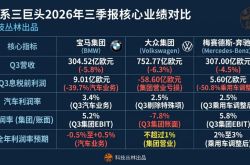
On November 4, BMW Group officially released its Q3 2026 financial report: Q3 group revenue fell 5.8% year-on-year to €30.452 billion.
Within that, core automotive business EBIT plunged 39.7% year-on-year to just €901 million, with the quarterly automotive EBIT margin dropping from 5.2% in the same period last year to 3.4%.
Even more painful is that BMW explicitly lowered its full-year 2026 automotive EBIT margin forecast in the Q3 report from the previously projected 1% to 3% down to -0.5% to +0.5%, which includes approximately 2.5 percentage points of portfolio and structural adjustment measures; even excluding that impact, the full-year automotive EBIT margin would only remain above 2%.
What does that mean? In 2009, the year Lehman Brothers collapsed during the global financial crisis, BMW's automotive business margin was -0.6%; even during the worst of the pandemic in 2020, it was 2.7%.
You should know that BMW's full-year automotive margin target set at the beginning of the year was still 4% to 6%.
Now, looking at the end of 2026, factoring in model and architecture restructuring costs, BMW's full-year automotive margin is directly approaching "zero," returning overnight to financial crisis levels from 17 years ago—and it might even end up losing money:)
Even Rolls-Royce, BMW's ultra-luxury brand that has always been an easy money-maker, saw Q3 global deliveries fall 18% to just 1,069 units.
And that's not all.
If BMW is "working a whole year for nothing," then Volkswagen and Mercedes-Benz, which reported a few days earlier, also have unimpressive numbers.
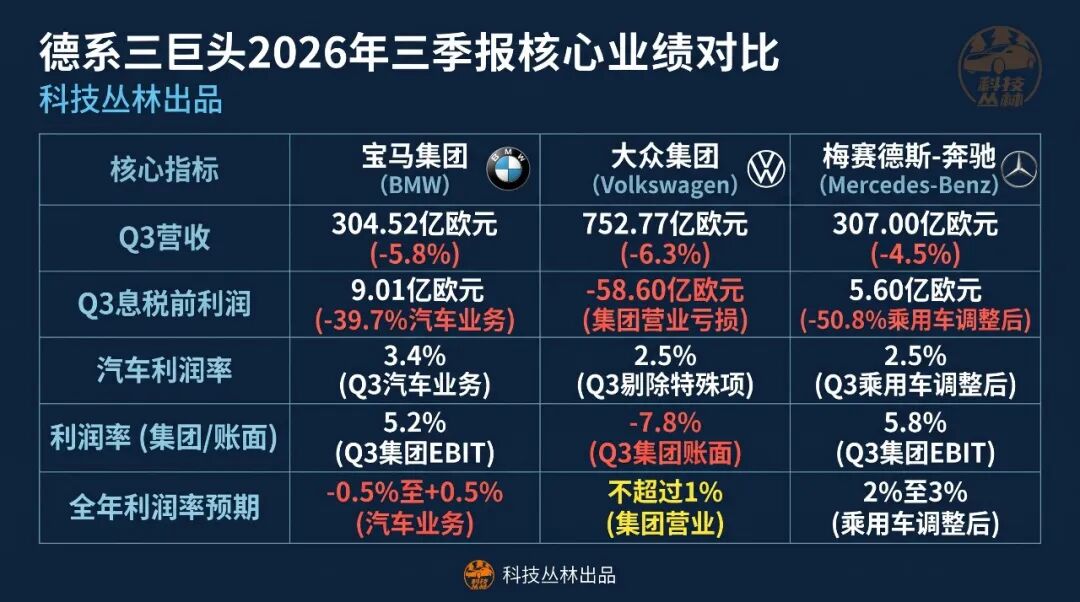
According to Volkswagen Group's Q3 report disclosed on October 29, VW Group's Q3 revenue fell 6.3% year-on-year to €75.277 billion, with a quarterly operating loss of €5.86 billion (even excluding €7.76 billion in special items, the Q3 adjusted group operating margin was only about 2.5%), and the group's after-tax net loss reached €5.822 billion (net loss attributable to shareholders was €4.648 billion).
This is also Volkswagen's worst quarterly loss in the entire 11 years since the 2015 "Dieselgate" crisis.
For the first three quarters combined, hit by approximately €8.7 billion in special items including a €6.4 billion non-cash goodwill impairment for Porsche, Volkswagen Group's reported operating profit plunged 98.7% from €5.408 billion in the same period last year to just €71 million (operating margin fell to 0.0%), and the full-year group operating margin forecast has been firmly capped at "no more than 1%"; even excluding the €8.7 billion in special items, VW's adjusted operating profit for the first three quarters was only about €8.8 billion, with an operating margin of just 3.8%.
Now let's look at Mercedes-Benz.
According to Mercedes-Benz's Q3 report released on October 28, Q3 group revenue fell 4.5% year-on-year to €30.7 billion; although the low base from large layoff and restructuring charges in the same period last year meant Q3 passenger car reported EBIT was €455 million (+5.8% year-on-year) and group reported EBIT was €1.773 billion (+136.4% year-on-year).
But the passenger car "adjusted" EBIT that truly reflects core business profitability was only €560 million, plunging 50.8% year-on-year (group adjusted EBIT was €1.78 billion, down 15% year-on-year), and the passenger car adjusted return on sales was halved from 4.8% in the same period last year to 2.5% (the full-year passenger car adjusted return on sales forecast is also only 2% to 3%).
Maybach, once the "cash cow" that earned Mercedes-Benz its highest premiums, saw Q3 global sales plunge 46% year-on-year to just 2,590 units in the quarter.
One posted a quarterly after-tax loss of €5.822 billion, one saw its core adjusted margin halved to 2.5%, and one saw its full-year automotive margin approach zero.
The German Big Three hit the iceberg at the same time.
02 Europe and the US Are Still Growing, So Why Can't That Save Them?
Reading this, many people might ask: Is the global economy just bad, and are European and American consumers also not buying BBA and Volkswagen?
That's a good question.
If you look at the official delivery breakdowns of the three automakers, you'll find that the Big Three are clearly still growing in their European and American home markets—the real collapse is only in the China market.
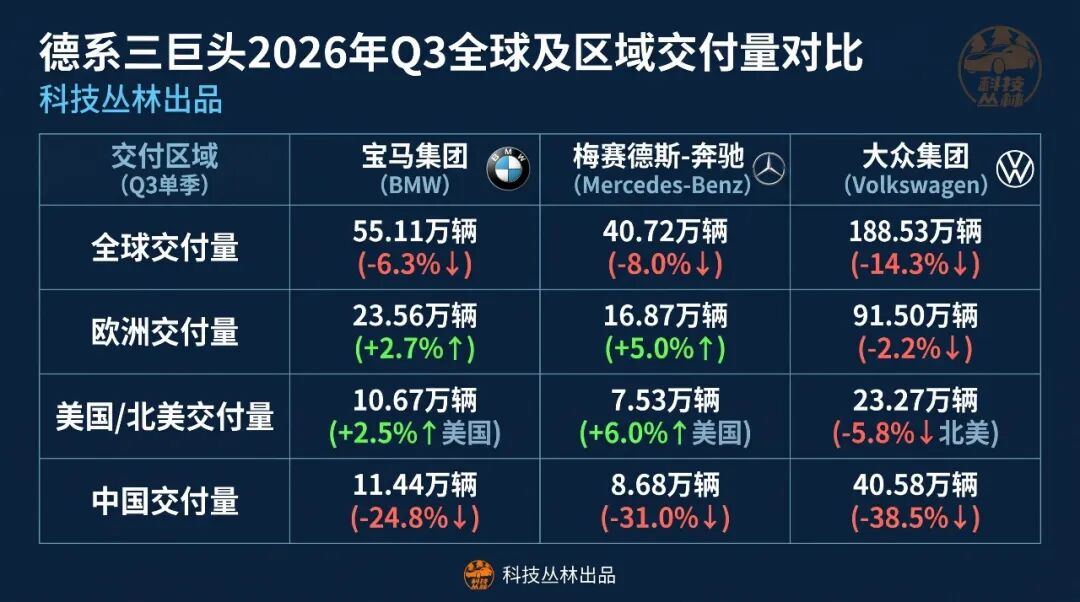
Take BMW's Q3 delivery data officially disclosed on October 13: BMW delivered 551,100 vehicles globally in Q3 (down 6.3% year-on-year), of which 235,600 were sold in Europe, up 2.7% year-on-year (235,800 and +2.6% under the financial reporting basis including Rolls-Royce); in the US market it sold 106,700 vehicles, up 2.5% year-on-year.
Only in the China market did BMW deliver just 114,400 vehicles in Q3, plunging 24.8% year-on-year; cumulative deliveries in China for the first three quarters were 376,100 vehicles, down 21.8% year-on-year, with domestic mainstay BMW Brilliance's January-September sales shrinking to 316,900 vehicles.
Mercedes-Benz's script is exactly the same.
Mercedes-Benz's Q3 sales data officially released on October 8 shows that Mercedes-Benz delivered 407,200 vehicles globally in Q3 (down 8% year-on-year); excluding the China market, overseas overall actually grew slightly by 1%. Among that, the European market grew 5% (168,700 vehicles), and the US market grew 6% (75,300 vehicles under the group's global announcement basis, 76,200 vehicles and +4% under the US retail basis).
Only in the China market did Q3 sales plunge 31%, from 125,100 vehicles in the same period last year to 86,800 vehicles (cumulative China sales for the first three quarters fell 29% to 297,000 vehicles).
Volkswagen was not spared either. Volkswagen's official financial report dated October 29 shows that global customer deliveries in the first three quarters of this year were 6.011 million vehicles (down 9.0% year-on-year), and group wholesale sales were 5.880 million vehicles (down 10.6% year-on-year). Excluding Chinese joint ventures, Volkswagen's sales in other markets in the first three quarters actually only dipped 1%, and new car orders in its European home market actually grew 4% against the trend in the first three quarters (pure electric orders surged 39%).
Only the China market became the biggest bleeding point: Volkswagen's total deliveries in China in the first three quarters fell 30.2% to 1,378,800 vehicles (of which Chinese joint venture sales plunged 35% to 1,224,000 vehicles), and looking at Q3 alone, Volkswagen's deliveries in China were only 405,800 vehicles, plunging 38.5% year-on-year!
So here's the question: Why can't stable-to-growing European and American markets fill the hole left by the collapse in China?
Because what Europe and the US earn is essentially "hard-earned money," while China has been the German Big Three's real "windfall cash machine" for the past decade or more.
We can directly break down the regional margins and profit structures in the three companies' financial reports.
In Germany and Europe, constrained by strict union protections, high energy and labor costs, plus additional US import tariffs (US tariffs alone directly shaved 1.25 percentage points off BMW's automotive business margin in Q3), the Big Three's operating margins on mainstream volume models in Europe and the US are generally only around 3% to 5%.
The most intuitive evidence is Volkswagen: in the first three quarters of this year, the Volkswagen Core brand group, which mainly sells volume models in Europe, sold 3.753 million vehicles with revenue as high as €106.4 billion, but its operating margin was a pitiful 4.1% (only 4.4% in the same period last year); the Progressive brand group, which includes Audi, saw its operating margin fall to 2.7% in the first three quarters.
Put simply, selling a Golf in Europe, or an entry-level A-Class or 1 Series, after deducting high rigid local costs, barely earns a few pennies.
What truly propped up the Big Three's tens of billions of euros in profit and 8% to 14% high margins in the past was the China market!
During the golden era, Beijing Benz alone had a gross margin consistently above 20% and a net margin steadily above 12% to 15%; Chinese consumers spending lavishly on high-spec 5 Series, E-Class, S-Class, Maybach, Cayenne, and Panamera contributed the world's fattest per-vehicle windfall profits.
But now, the profit pool in China has completely bottomed out.
First, Mercedes-Benz. The result of fighting Chinese automakers in close combat in the 200,000 to 400,000 yuan volume segment is that the joint venture went directly from a money printer to a bleeding point. Its equity investment income from Beijing Benz and other China operations plunged from +€427 million in the first half of 2025 to -€445 million in the first half of 2026; during the same period, Mercedes-Benz also recorded a €704 million asset impairment on its equity in Chinese joint ventures, mainly Beijing Benz.
BAIC Motor's Q3 report further confirms this: dragged down by Beijing Benz's performance, BAIC Motor's gross margin plunged 5.3 percentage points to 12.44% in the first three quarters, gross profit was halved (-50.69%), and net profit attributable to shareholders swung directly from profit to loss, with a massive loss of 3.09 billion yuan.
Coupled with the Q3 global sales of high-margin flagship premium models plunging 21% and Maybach plunging 46% in the quarter, Mercedes-Benz's global passenger car adjusted return on sales was directly dragged from a peak of over 12% down to 2.5% in Q3.
Now BMW. BMW Brilliance's domestic annual sales fell from a peak of over 650,000 vehicles in 2021 (673,600 including exports) all the way to an estimated only around 400,000 vehicles this year, with the sharpest decline precisely in BMW's most profitable 300,000 to 600,000 yuan price band.
To defend market share, BMW had to heavily subsidize dealers, and combined with the asset depreciation and amortization from consolidating BMW Brilliance (directly dragging down BMW's automotive business margin by 1.2 percentage points), it single-handedly pulled BMW's automotive margin from 8.6% in 2022 to the brink of zero today.
Volkswagen and Porsche are even worse off. At their peak (2019 to 2021), Volkswagen's Chinese joint ventures once contributed €3 billion to €4.5 billion in proportional operating profit annually; by 2025 that had fallen to €958 million, and in the first half of 2026 this profit plunged more than 60% year-on-year to €184 million, with the full year expected to leave only €200 million to €600 million (of which Audi China's first-half profit contribution plunged 74% to €73 million).
And in the ultra-luxury market above 500,000 to over 2 million yuan, amid the encirclement by Chinese high-end new energy vehicles such as AITO M9, Maextro S800, Li Auto, NIO, and Yangwang, Porsche—once enjoying a return on sales above 14%—saw its China sales plunge more than 30%, with its return on sales diving to 1.1% in 2025 (and only 6.7% for the automotive business in the first three quarters of this year).
This directly forced Volkswagen to record a goodwill impairment of up to €6.4 billion on Porsche in Q3, plus approximately €1 billion in asset impairments on consolidated Chinese subsidiaries, single-handedly detonating a €5.86 billion quarterly operating loss.
So once China, the "super cash machine," stalled, the German Big Three's fig leaf in global financial reports naturally could no longer be maintained.
03 Amputating Layoffs and "Self-Disabling"
Tech Jungle has always emphasized one point: the auto industry is a long-cycle industry with inertia, so you can't just sing praises because current performance looks good, because good has inertia and bad has inertia too—it takes time to show.
The German Big Three's financial bleeding today is essentially paying the bill for their hesitation, wavering, and arrogance over the past five years in electrification and intelligentization.
The most typical examples are the "BMW cutting old models" and "Mercedes-Benz abandoning L3" that just happened in recent days.
Why did BMW cut its full-year automotive margin forecast to zero in its November 4 Q3 report?
BMW clearly explained in its financial report: before restructuring measures, the full-year automotive business operating margin could originally have remained above 2%; the reason it fell to -0.5% to +0.5% is that a large structural adjustment charge will be concentrated in Q4 to phase out some models based on fifth-generation (Gen5) battery and electric drive technology ahead of schedule, making room for the Neue Klasse lineup.
However convenient it was back then to build transitional "shared ICE/EV" platform models, it is equally painful today to phase out old-technology models early and record impairments.
Now look at Mercedes-Benz, which staged a whole drama of personally "sentencing L3 to death."
On November 7, Mercedes-Benz Chief Technology Officer (CTO) Jörg Burzer publicly admitted at a media roundtable that as the world's first automaker to obtain legal road certification for L3, Mercedes-Benz's early L3 autonomous driving system (Drive Pilot, US version limited to 64 km/h, German version raised to 95 km/h but still limited to specific highways and requiring a lead vehicle, with an annual US subscription fee as high as $2,500) "was pushed too far ahead, has very limited practicality for everyday drivers, and has high hardware costs such as lidar."
Burzer confirmed that Mercedes-Benz has suspended the installation of this L3 system on its latest models, including the 2026 facelifted S-Class, and is now pivoting to refine a higher-level L2++ system that offers broader applicability without the need for expensive lidar. The company plans to skip L3 altogether and bet directly on L4 autonomous driving after 2030.
Consider this: while Chinese automakers are using end-to-end large models to bring city NOA that "works nationwide" into 150,000-yuan and even 100,000-yuan family cars, the traditional giants have not only failed to hold the L3 high ground but have had to sheath their own swords and go back to making up lessons on higher-level L2.
And the chill from automakers has been transmitted unreservedly to the entire German auto industry.
On November 3, German parts giant Schaeffler, which supplies Volkswagen and BMW, announced it would cut 3,460 net jobs in Europe (including 2,660 in Germany) and directly close five European plants (four in Germany) by 2028.
On November 5, supplier giant Bosch announced that, hit by competition from Chinese automakers and the low gross margins of electrification, it plans to cut another 750 positions at its R&D center in Abstatt, Germany. Counting the previously announced plan to cut 13,000 jobs by 2030, the cumulative planned job cuts across Bosch's core automotive and intelligent transportation business have exceeded 23,000.

Looking at the Big Three themselves, from the perspective of their global headquarters, an unprecedented elimination round is already in full swing: Volkswagen Group is pushing a cost-cutting plan of about 31 billion euros (involving the reduction of roughly 100,000 positions over a long horizon through 2030; the outside world had previously even discussed an upper limit of as many as 120,000 positions; Porsche also plans to cut a cumulative total of about 8,900 positions in Germany by 2035); BMW has launched a restructuring plan to cut 8,000 jobs globally; Mercedes-Benz's previous voluntary departure program has already seen about 5,500 German employees leave (in the first half of this year alone it spent about 1.1 billion euros on severance), and it will restart a new round of voluntary departure programs in December.
And when this chill is broken down to the domestic market, the knife cuts ever deeper, each stroke drawing blood.
FAW-Volkswagen orally communicated internally last week (reported on November 9) the cancellation of the BD bonus (commonly known as the year-end bonus) for both 2025 and 2026, directly shrinking the annual income of a large number of employees by more than 40%; BMW Brilliance, starting November 2 (reported on November 3), launched layoffs covering frontline production positions at its three major Shenyang plants, streamlining about 1,800 people with N+5 compensation (about 10% of the total workforce); Mercedes-Benz in China has likewise launched deep adjustments including downsizing its sales company, cutting R&D staff, and optimizing manufacturing.
04 Written at the end
So, are the German Big Three about to fall behind? The answer is, for the time being, not yet.
Whether Volkswagen, BMW, or Mercedes-Benz, they still hold deep chassis-tuning expertise, globalized manufacturing systems, and still-substantial cash flow and financial reserves.
And frankly speaking, after two years of being battered by the Chinese market, the Big Three's self-rescue actions are now much more clear-headed and pragmatic than two years ago; they no longer expect to handle Chinese consumers by building cars behind closed doors at German headquarters.
First, Volkswagen, the most thorough in delegating power among the three.
Volkswagen has not only built its largest R&D center outside its Wolfsburg headquarters in Hefei, Anhui (VCTC), gathering more than 3,000 local engineers and giving the local team direct decision-making authority, forcibly shortening the new-car development cycle by 30%; it has also thoroughly set aside the airs of a century-old giant: on one hand, it has put real money into Xpeng, directly installing the CEA electrical and electronic architecture jointly developed by both sides into new Volkswagen-brand cars to be produced in Hefei in 2026; on the other hand, it has formed a joint venture with Horizon Robotics, "CARIZON," to relentlessly work on local intelligent-driving algorithms and chips, preparing to intensively launch more than 20 new energy vehicle models from 2026 to 2027.
On Mercedes-Benz's side, it has also begun a comprehensive overhaul of its architecture and intelligent features.
The pure electric long-wheelbase CLA built on the all-new MMA platform not only finally fills in the 800V high-voltage architecture and an electric two-speed transmission rarely seen in its class (pulling CLTC range to more than 850 kilometers), but also for the first time installs the self-developed all-new MB.OS architecture; as for its shortcomings in intelligence, Mercedes-Benz has completely handed leadership to its China R&D team, deeply binding with Momenta on the intelligent-driving side to implement "mapless" end-to-end urban and highway navigation, while on the cockpit side it directly connects to ByteDance's "Doubao" generative AI large model and AISpeech voice interaction technology, comprehensively aligning itself with China's local new forces.
As for BMW, it is also holding back for a "decisive" all-out technology offensive.
Many people think BMW has only one new-generation iX3 in hand, but in fact, BMW would rather sacrifice this year's full-year profit margin to phase out some fifth-generation technology models ahead of schedule, in order to fully switch to the 800V high-voltage platform, sixth-generation large cylindrical batteries, and an all-new electrical and electronic architecture composed of four super brains (including the "Heart of Joy" driving-control brain); according to the plan, by the end of 2027 BMW will launch about 40 new cars or facelifted models equipped with new-generation technology worldwide, nearly 20 of them in the Chinese market (even the four-motor pure electric M3 has been confirmed for mass production in 2027).
More importantly, in terms of localization in China, BMW has this year thoroughly assembled a "full Chinese tech suite." On the intelligent-driving side, it officially announced a partnership with Momenta to co-create, based on the flywheel large model, a China-exclusive full-scenario point-to-point navigation assist (first equipped on the domestically produced new-generation iX3 to roll off the line in Shenyang this year, then rolled out to multiple models); on the cockpit and ecosystem side, it has for the first time simultaneously joined hands with Huawei, Alibaba, and DeepSeek, not only deeply integrating with Huawei's HarmonyOS ecosystem to develop native applications based on HarmonyOS NEXT, but also stuffing Alibaba's Tongyi and DeepSeek large models into BMW's smart cockpit.
However, the cruelest thing about the Chinese auto market is that it never gives slow starters a buffer period.
The time window left for the German Big Three to turn around in this dead-end alley is at most the last product cycle, through 2027.
As for whether these three century-old elephants can run through the new game before the bleeding stops?
Let's let the bullets fly a little longer.
The end.
-
![]()
I Just Wanted to Turn Off My Brain and Binge Some Short Dramas—Never Expected to Be Ambushed by Historical Knowledge
-
![]()
After a Decade-Long March Toward Premiumization, Has BYD Lost Interest in Maserati?
-
![]()
AI Short Dramas Go Global: Traffic Is Proven, but Monetization Remains the Real Test
-
![]()
In Depth | The German Big Three's "China Cash Machine" Has Completely Stalled
-
![]()
Who Benefits from the Partnership Between Zunjie, Which Seeks Scale, and Maserati, Which Seeks Prestige?
-
![]()
Changan Personnel Adjustment: Wu Xuxi Promoted to Vice President of Kaicheng, Liu Bin to Head Changan Mazda Marketing
-
![]()
Why Can Nissan, Shrinking in Scale, Grow Again? | Cover Story: Japanese Automakers at the Crossroads of Transformation (IV)
-
Has the U.S. Stock Market AI Bubble Burst?