Q3 Net Profit Excluding Non-recurring Gains and Losses Plummets by 42.8%! Yutong Optics' Profitability Quality Alarm Sounds
 10/29 2026
 545
Recently, Yutong Optics disclosed its third-quarter report for 2026. In the first three quarters, the company's revenue reached RMB 2.738 billion, up 15.90% year-on-year, and net profit attributable to the parent company reached RMB 197 million, up 5.00% year-on-year. The fundamental strength of being the global leader in security lens shipments for eleven consecutive years remains intact.
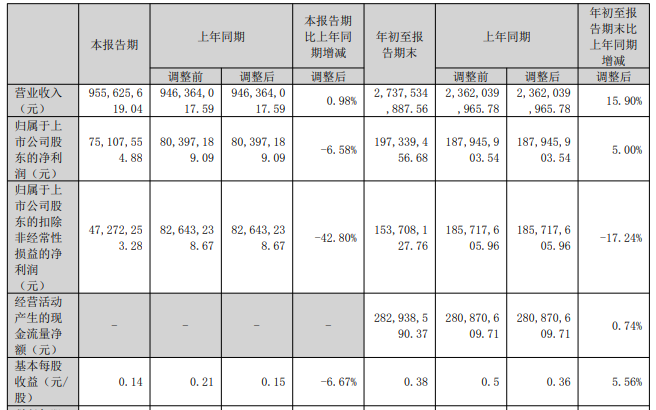
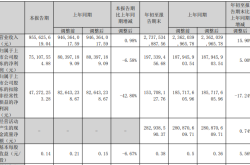
In Q3 2026, the company's revenue was RMB 956 million, up only 0.98% year-on-year; net profit attributable to the parent company was RMB 75.1076 million, down 6.58% year-on-year; and net profit excluding non-recurring gains and losses was RMB 47.2723 million, down sharply by 42.80% year-on-year. The simultaneous occurrence of zero revenue growth and a near-halving of net profit excluding non-recurring gains and losses indicates that the profit structure is under substantial pressure.
The Q3 income statement needs to be dissected. The difference of approximately RMB 27.84 million between net profit attributable to the parent company and net profit excluding non-recurring gains and losses mainly comes from the "change in fair value of other non-current financial assets" of RMB 30.34 million. In the context of Q3 alone, the "respectability" of the book net profit is largely supported by non-operating gains and losses, and the true profitability level of the main business is weaker than what the net profit attributable to the parent company suggests.
Analyzing by business segment, the profitability quality of the three lines shows different forms of pressure. The security segment is the foundation of Yutong. In the first half of 2026, its revenue was RMB 901 million, up 15.25% year-on-year, but the gross profit margin declined by 2.56 percentage points year-on-year to 21.63%. The security sector has entered maturity, and the market share of the leader means limited room for further price increases, making it difficult to fully pass on rising raw material costs downstream.
Automotive optics is the fastest-growing segment but also requires a dialectical view. In the first half of the year, automotive revenue was RMB 257 million, up 57.26% year-on-year, but the gross profit margin declined by 9.31 percentage points year-on-year to 15.08%. The coexistence of high growth and low margins reflects the competitive reality of the automotive lens sector, where "volume for price" is the norm.
The intense price competition due to deep integration with automakers makes it difficult for scale expansion to translate into profit growth in the short term. Yutong's 8M high-end ADAS lenses have completed Momenta's whitelist certification and been designated for Great Wall Motors, with other customers expected to be designated for mass production from the second half of 2026 to 2027. Upgrading the product structure takes time, and margin recovery also requires economies of scale to amortize the initial investments.
The high growth of the new consumer business has encountered disruptions from external variables. In the first half of the year, revenue from this segment was RMB 192 million, up 132.17% year-on-year, with rapid adoption of glass aspherical lenses in sports cameras, drones, AI glasses, and other applications. However, the company explicitly stated at the September earnings briefing that the continuous rise in storage chip prices has led to lower-than-expected growth in demand for the new consumer market, putting pressure on margins.
Yutong's current situation reflects the common "timing mismatch" faced by optical manufacturing companies transitioning from a single security leader to a multi-sector platform: capital expenditures and R&D investments for new businesses come first, followed by capacity ramp-up and yield optimization, with profit realization coming last. Meanwhile, the gross profit margin of existing businesses is slowly declining under the dual pressures of competition and rising raw material costs.
The Q3 net profit excluding non-recurring gains and losses data serves as a valuable reminder: beyond the narrative of scale, the pace of profitability quality recovery is the ultimate basis for valuation anchoring.
-
![]()
Blogger Exposes iPhone Air 2 Specifications: Equipped with 2nm A20 Chip, Adds Ultra-Wide Lens
-
Insta360's Q3 Report: Expansion Continues Amid Dual Pressures on Cash Flow and Financing
-
![]()
Ofilm's Patent for Eight-Lens Variable Aperture Granted!
-
![]()
Q3 Net Profit Excluding Non-recurring Gains and Losses Plummets by 42.8%! Yutong Optics' Profitability Quality Alarm Sounds
-
![]()
Google Cloud Revenue Doubles, Why Did the Stock Price Still Drop?
-
Will the New Li Auto i6 Sustain the Triumph of Its Predecessor?
-
![]()
Fuyao Glass Reports 14.97% Drop in Net Profit to 6.006 Billion Yuan for First Three Quarters, While Dimming Glass Yield Soars from 10% to 90%
-
![]()
GPS is Vulnerable to Interference, This Startup Aims to Provide a Centimeter-Level Alternative with 258 Satellites