Fujian Forecam Optics Posts 84.13 Million Yuan Loss in First Three Quarters as Transformation Stalls in the "Transitional Gap"
 11/05 2026
 484
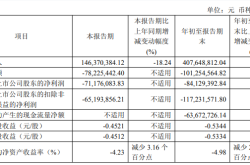
Fujian Forecam Optics recently released its third-quarter report for 2026. In the first three quarters, the company recorded total operating revenue of 408 million yuan, down 14.67% year on year. Net loss attributable to shareholders reached 84.1294 million yuan, while net loss after deducting non-recurring gains and losses stood at 117 million yuan.
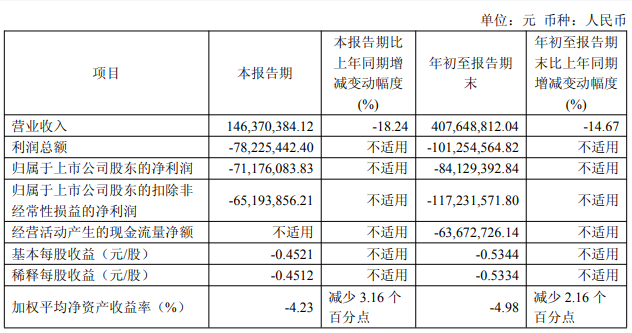
The single-quarter figures paint an even starker picture of the downward trajectory: third-quarter revenue came in at 146 million yuan, down 18.24% year on year, with the decline widening further from the first half.
In addition, alongside the release of its third-quarter report, the company announced the accrual of asset impairment provisions, which reduced total profit for the first three quarters by 41.6052 million yuan, placing further pressure on an already fragile income statement.
The direct driver of the loss is no mystery. Fujian Forecam Optics made this clear in its 2026 semi-annual report: the year-on-year decline in overseas sales revenue from security products within its non-customized optical lens segment was the primary source of the revenue drop.
At the same time, the company has in recent years added a relatively large amount of fixed assets to support long-term capacity reserves, keeping depreciation charges elevated and creating significant negative operating leverage as revenue contracts. This combination of declining revenue and rigid depreciation costs is the key to understanding Fujian Forecam Optics' current financial picture.
That said, from a business perspective, the company's transformation has not been without progress. The problem is that the profit contribution from new businesses has yet to reach the threshold needed to cover fixed costs. In the first half of 2026, revenue from customized products rose 22.11% year on year, and revenue from optical components increased 13.96%. The automotive business successfully brought in leading core customers, added 23 designated projects, and saw multiple automotive LiDAR lenses pass verification by leading mainstream customers and enter mass production. However, these remain in the early ramp-up stage, with limited incremental contribution to revenue during the reporting period.
The direction of these developments is clear: migrating from the crowded overseas security market toward high-barrier, high-stickiness scenarios such as automotive, aerospace, and high-end equipment. Yet there is a time lag measured in years between automotive designations moving from "introduction" to "scaled revenue," while depreciation and R&D expenses are incurred in the current period. R&D expenses in the first three quarters totaled 54.85 million yuan, rising to 13.46% of revenue—passively increasing during a period of declining revenue.
Another variable worth noting is Fujian Forecam Optics' trade-offs in strategic resource allocation. In September 2026, the company deliberated and approved the investment of approximately 110 million yuan in remaining raised funds into a multi-field precision optical component industrialization project and an aerospace high-performance optical lens R&D project, while terminating the original "Full-Spectrum Precision Lens Intelligent Manufacturing Base Project (Phase I)."
The signal significance of this adjustment outweighs the amount itself: the company is shifting capital expenditure away from scale expansion in general security toward precision optical components and aerospace/low-altitude economy optical systems. The controlling shareholder, Zhongrong Investment, completed its shareholding increase plan in the first half of 2026, raising its stake to 29.60%, while state-owned shareholders continued to reduce holdings due to their own funding needs. This divergence at the capital level itself reflects differing market judgments on the pace of transformation.
Fujian Forecam Optics' third-quarter report presents an interim statement of "the old engine losing speed while the new engine has yet to reach full thrust." The contraction in overseas security and rigid depreciation together created the depth of the current period's loss, while the designated project reserves in automotive and customized businesses lend credibility to the direction—but the financial gap between the two cannot be bridged by narrative alone.
The core indicator to watch going forward is whether gross margin can stabilize and rebound after the revenue share of automotive and high-end customized products rises. That would be the signal that new businesses have truly begun to cover fixed costs. Until then, this established optical manufacturer will continue to face stress tests in the "time lag" of its strategic transition.
-
Can AI Save Television? Only If Manufacturers Dare to Abandon Path Dependence
-
![]()
Works Even Without Power! Musk's New Starlink Product, Battery from China
-
![]()
Yipu Optoelectronics and Neusoft Japan Sign MoU to Jointly Advance Pre-Integrated Vehicle HUD Solutions
-
![]()
Fujian Forecam Optics Posts 84.13 Million Yuan Loss in First Three Quarters as Transformation Stalls in the "Transitional Gap"
-
![]()
Are AI Imaging Features About to Become Paid? Rising Cloud Token Costs for Phone Makers Make On-Device Computing Power the Right Path
-
![]()
Why Is MONA Accelerating Its Split from XPeng—Planning Dedicated Stores for 2027 and Leaving the Door Open to Independence
-
![]()
Apple Is Also Starting to "Save Tokens": The AI Money-Burning Frenzy Has Reached Its Reckoning
-
Behind Musk's Election Campaign Defeat: Who Pays the Bill for AI Expansion?