25km/h, RMB3 million liability insurance, one vehicle one code: What are the 'selling points' of Yinchuan's new regulations for functional unmanned vehicles?
 10/14 2026
 402
402
Introduction
On September 24, 2026, five departments including the Yinchuan Data Bureau jointly issued the 'Implementation Rules for the Road Testing and Demonstration Application Management of Functional Unmanned Vehicles in Yinchuan City (Trial),' which will come into effect on October 12.
This is not merely a document for 'issuing licenses,' but rather an institutional experiment:
Defining unmanned vehicles as 'wheeled mobile equipment,' referring to test vehicles as 'equipment,' allowing 14-cubic-meter high-capacity models on the road, but requiring black boxes, safety officer contact numbers, and passing the 'traffic police manual command recognition' test.
With a 25km/h speed limit, RMB3 million liability insurance, and one vehicle one code, Yinchuan has written a 'manual' for functional unmanned vehicles.
Unmanned Vehicles Are Coming (WeChat Official Account: Unmanned Vehicles Are Coming) discusses this matter with everyone.
(For reference, please click: 'Yinchuan City's 'Implementation Rules for the Road Testing and Demonstration Application Management of Unmanned Driving Equipment' Seeks Public Opinion: RMB5 million Insurance, 45km/h Speed Limit, Three Violations and You're Out! Are the 'Rules of the Game' for Unmanned Driving Being Rewritten?')
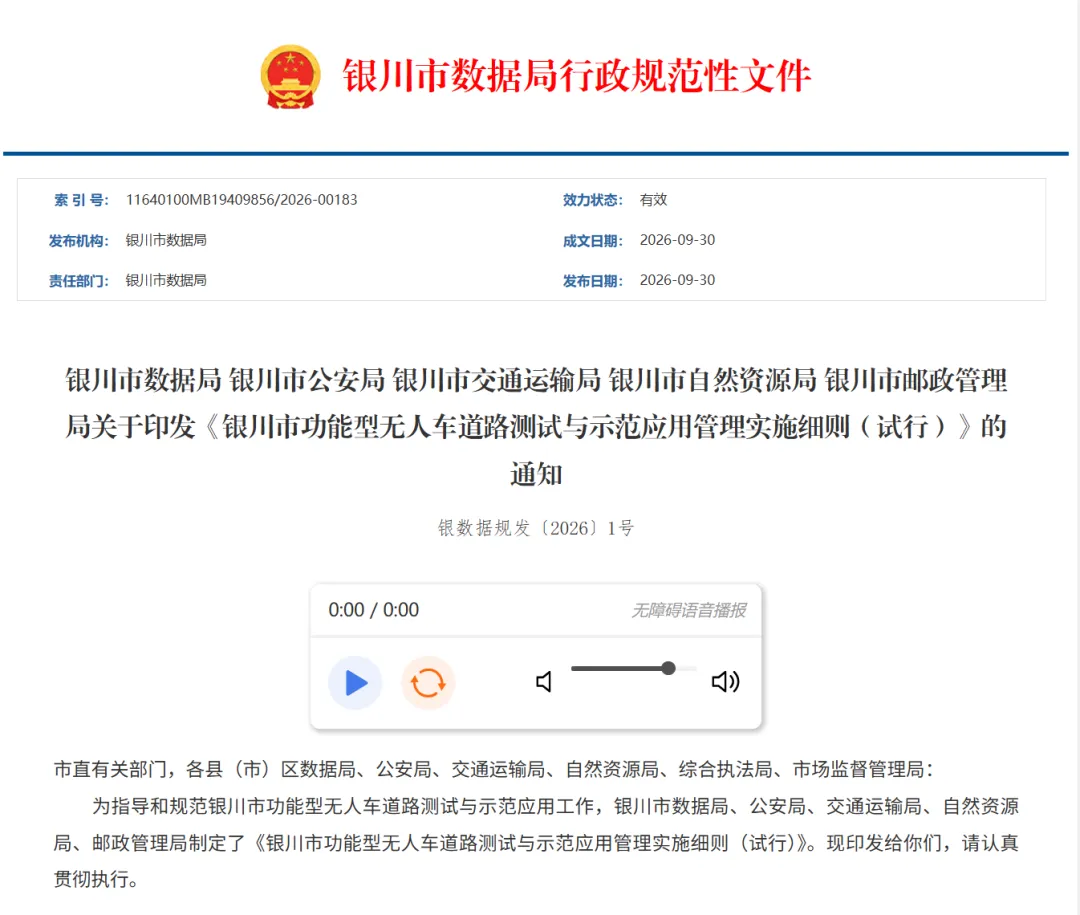 Image source: Official website of the Yinchuan Data Bureau
I. Legal Identity 'Dimensionality Reduction': Not a 'Vehicle,' but 'Equipment'
The most intriguing design in Yinchuan's new regulations is its legal classification of functional unmanned vehicles.
The rules clearly state: Functional unmanned vehicles are 'wheeled mobile equipment equipped with sensors, controllers, actuators, and other devices, capable of environmental perception, intelligent decision-making, automatic control, and driving functions, used for specific purposes such as logistics delivery, inspection, and sanitation, and not included in the motor vehicle product catalog management.'
Test vehicles are identified as 'functional unmanned vehicle road test equipment,' and demonstration vehicles are identified as 'functional unmanned vehicle demonstration application equipment.'
This is not just wordplay.
Functional unmanned vehicles are not included in the motor vehicle product catalog, and if they were referred to as 'motor vehicles,' they would face legal challenges in going on the road;
Referring to them as 'equipment' allows for pilot testing under the framework of non-motor vehicle management.
The reduction in legal identity brings about an upgrade in supervision: Each vehicle has a unique code, which is bound to the applicant, test/demonstration qualifications, insurance, and data access.
II. Allowing 14-Cubic-Meter Models on the Road, but with a 25km/h Speed Limit
Yinchuan has provided ample space in terms of vehicle size this time.
The rules stipulate that for goods delivery unmanned vehicles, the maximum loaded mass shall not exceed 2800kg, with a length of 2000-4000mm, width of 900-1600mm, and height of 1500-2200mm.
Based on these dimensions, the maximum volume can reach 14 cubic meters, meaning Yinchuan allows 14-cubic-meter unmanned logistics vehicles on the road.
This volume range is considered 'high-capacity' in the current market.
Most cities' policies require volumes between 5-8 cubic meters.
However, the speed limit is capped at 25km/h, which is the maximum design speed for the new national standard for electric bicycles and an important dividing line for non-motor vehicle management.
The rules require unmanned vehicles to 'drive on the right side of the non-motor vehicle lane in the forward direction' and 'not drive side by side when there are two or more vehicles.'
Many regions allow unmanned delivery vehicles to run at 40km/h to improve efficiency, but Yinchuan prioritizes safety.
III. Black Box + Safety Officer Contact Number: Accident Liability No Longer Relies on 'Algorithm Explanation'
Yinchuan's new regulations bring the 'algorithm black box' back to the ground of 'corporate responsibility.'
The rules clearly state: After an accident, the safety officer should immediately take over, stop activities, call the police, and protect the scene, and the applicant should report to the industry regulatory authority.
The applicant must not tamper with data and should cooperate in data retrieval, playback, and analysis at any time, with accident data stored for no less than one year.
The rules require unmanned vehicles to have a 'black box' function:
Automatically recording and storing data for at least 90 seconds before and 30 seconds after an accident or failure, including code, control mode, position, speed, remote control instructions, light and horn status, 360-degree video, environmental perception status, fault information, etc., with data stored for no less than one year and connected to the regulatory platform.
More down-to-earth is the attachment requirement: The identifier (which means 'identification' or 'label') must include the emergency contact number of the safety officer, the name of the applicant, and the contact number.
This effectively transforms unmanned vehicles from 'no one to find' to 'someone to contact, and a subject (which means 'entity' or 'subject') to pursue.'
IV. RMB3 Million Liability Insurance + Joint and Several Liability for Consortia: Preventing 'Patchwork Companies' from Shirking Responsibility
The rules require each unmanned vehicle to be insured with liability coverage of no less than RMB3 million.
Beijing, Shenzhen, and other places often require RMB5 million or even higher, but Yinchuan, as a western city, sets the threshold at RMB3 million, balancing industrial attraction and risk pricing.
The rules impose strict constraints on consortia:
For those composed of multiple units, at least one unit must have operational capabilities, and all units should sign an agreement on operational services and the division of tort liability, with all parties in the consortium bearing joint and several liability to third parties.
This effectively keeps 'internal disputes' out of the public eye: The technology provider says the operator didn't take over, the operator says the technology provider didn't recognize, but the victim doesn't need to worry about these; they can hold anyone accountable.
V. 'Traffic Police Manual Command Recognition': The Most Eye-Catching and Also the Most Chinese
The attachment to the rules, 'Functional Unmanned Vehicle Test Items,' lists 15 tests, including traffic signs and markings, signal lights, obstacles, pedestrians and non-motor vehicles, intersection turns and U-turns, lane changes, emergency conditions, remote control, and recognition of driving conditions in rain, snow, etc.
The most eye-catching is the last item: 'Recognition and response to traffic police manual commands.'
The complexity of Chinese roads lies not only in markings and signal lights but also in traffic police gestures, temporary controls, and construction guidance.
Many autonomous driving systems can recognize traffic lights but cannot interpret a traffic police officer's wave.
Yinchuan's inclusion of this item in the test shows that regulation is not about copying foreign standards from an office but about facing local real traffic scenarios.
VI. 240 Hours/1000 Kilometers: The 'Ladder' from Testing to Demonstration
The rules stipulate that unmanned vehicles applying for demonstration applications should have accumulated no less than 240 hours or 1000 kilometers of road testing in autonomous driving mode on the proposed demonstration road section , with no traffic violations or liability accidents during this period.
For those already approved for demonstration in other provinces and municipalities, a verification test of no less than 120 hours or 500 kilometers in this city is sufficient.
This is a typical 'testing-demonstration' ladder.
240 hours or 1000 kilometers is not particularly high, but it requires companies not only to pass tests in closed venues but also to accumulate sufficient mileage on real roads, without traffic violations or liability accidents.
The rules also require that activities should 'not be conducted in principle during extreme weather conditions such as heavy fog, rainstorms, or snow and ice' and that 'daily operating hours should, in principle, be off-peak hours.'
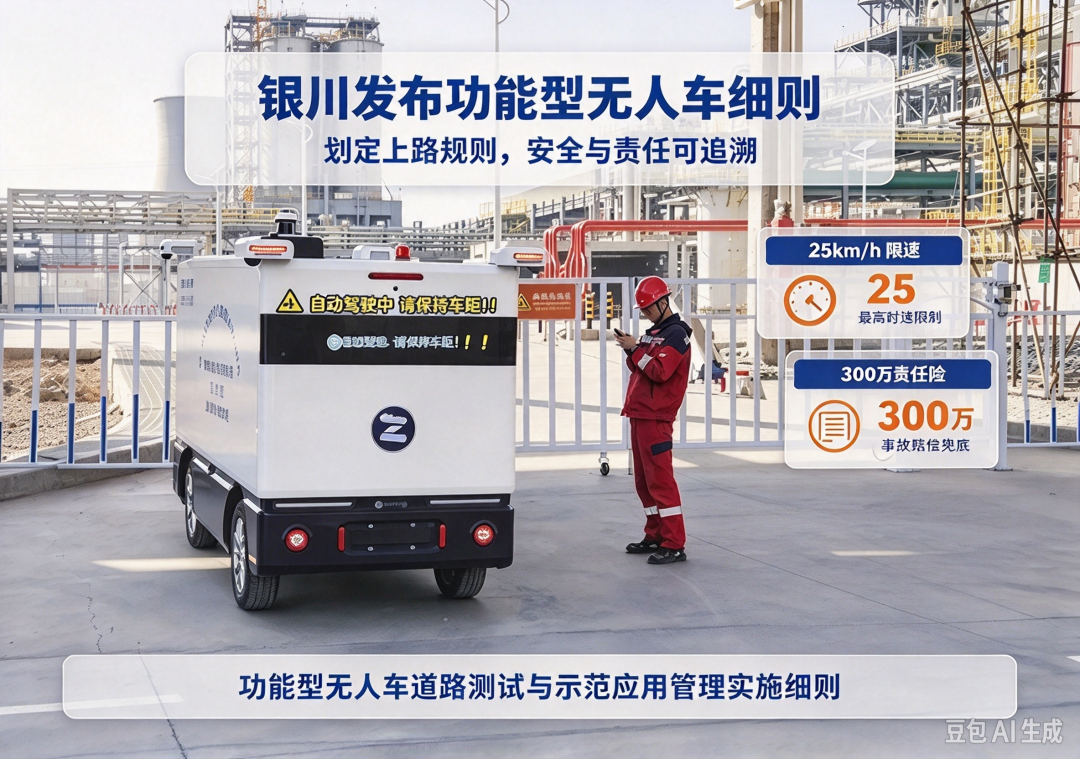
Yinchuan's detailed rules are essentially an institutional experiment to 'put reins on innovation.'
The entire system is interlocking, with both prudent inclusiveness and hard constraints.
For the industry, the signal is clear: Unmanned vehicles can be tested on the road and can be used for demonstration applications, provided that their identity is identifiable, data is retrievable, responsibility is traceable, risks are manageable, and the public can be contacted.
In conclusion, Unmanned Vehicles Are Coming (WeChat Official Account: Unmanned Vehicles Are Coming) believes:
As a western city, Yinchuan has chosen 'safety first, small steps, fast pace.'
This approach may sacrifice some efficiency and raise compliance costs, but it provides a replicable institutional template for other cities across the country.
Hey! What do you think?
References: Reports from the official website of the Yinchuan Data Bureau, Electric Vehicle Resources, Ningxia Traffic Broadcasting, Jintai Information, Ping An Yinchuan V, etc.
#UnmannedVehiclesAreComing #UnmannedDriving #AutonomousDriving #UnmannedVehicles
-
![]()
September Sales Analysis: Top Five Independent Chinese Automakers Excel, with BYD Leading and All Expanding Overseas
-
AI with a Defined Trajectory is Energizing the Entire Industry Ecosystem
-
【Daily Science and Technology Innovation】ArcSoft: Why is Half of Its Revenue Invested in R&D? What is the Invisible Champion of Mobile Algorithm Betting On?
-
![]()
The Paris Motor Show is Set to Disrupt the European Luxury Car Market Again
-
![]()
When Plug-in Hybrid and Extended-Range Vehicles Flood the Fully Electric Era: Are You Prepared to Be the "Cannon Fodder"?
-
![]()
Unitree Admits Mistake, DeepSeek Steps In
-
![]()
ByteDance, The Super APP Factory
-
![]()
“The three-way cooperation among FAW, Toyota, and GAC was nearly called off!”