In the AI era, openGauss is reshaping the value of databases
 12/30 2025
 620
620
Article by | Intelligent Relativity
In the AI era, as the supply capacity of computing power gradually increases and becomes more diverse in form and source, the industry's focus has shifted more towards data. The phrase 'AI capabilities are determined by data' has gained even greater significance. High-quality data and powerful data processing capabilities have become essential for innovation in AI large models.
At this point, the importance of storage infrastructure hardware and database foundational software, which are directly related to 'data,' is self-evident.
However, riding on the wave of AI, these technologies must also evolve new paradigms that adapt to AI demands in order to both 'live up to the expectations of the era' and gain their own competitive market advantages.
On December 26th, the openGauss Summit 2025 was held in Beijing. As the annual flagship event of the open-source database openGauss community, the summit comprehensively showcased the community's latest achievements over the past period, highlighted the interpretation of the openGauss 7.0.0 innovation edition, and announced the official opening of the code repository for oGRAC, the industry's first open-source multi-write database released this year.
Positioned as China's leading database root technology community, openGauss has always focused on core and foundational innovations in database technology. Reviewing its past evolutions, it has precisely responded to the practical needs of industrial development. Behind this summit, openGauss once again provided industry insights on how databases can adapt to the AI era and create new paradigms.
From record-keeping systems to intelligent data engines, AI imposes stricter demands on databases
Unlike the past when AI merely served as an auxiliary application, with the gradual strengthening of large model capabilities, AI applications are now increasingly visible in core production systems. If the database foundation could 'make do' in the past, then with AI deeply embedded in the core systems of industrial production, a transformation of the foundation is now imperative.
For AI, what it requires is no longer a passive, precisely recording 'notebook'-style database that serves human decision-making, but rather an intelligent data engine capable of comprehensively supporting the various needs of AI applications. This engine must meet technical requirements such as multi-modal and multi-state support, computing power fusion, and resource pooling, especially deeply adapting to emerging computing power forms like super nodes.
In layman's terms, databases in the AI era must possess several core capabilities:
They must 'understand content' and have native capabilities to handle multi-modal and vector data, rather than just recording it;
They must 'respond quickly,' especially meeting the demands for real-time data processing with low latency, rather than being sluggish as in the past;
They must 'withstand pressure' and be capable of handling ultra-high throughput and elastic scaling business pressures, allowing enterprises to confidently and effortlessly advance large model projects;
They must 'be capable of getting the job done' and achieve deep integration and collaboration with AI workflows, rather than passively waiting for 'tasks.'
To establish a firm footing in the AI era, databases must undergo a transformation from single-function tools to integrated capability platforms, ushering in a new paradigm.
And this is precisely what openGauss is attempting to do.
Deep collaboration with super nodes: openGauss pioneers a new database paradigm for the AI era
At the conference, openGauss systematically introduced multiple technological advancements. Shifting the perspective to the demands of AI large model development on databases, a new paradigm for AI-era databases that incorporates collaboration and support for emerging computing power models like super nodes has emerged.
2025 marks the 'year of accelerated penetration' for the super node industry. Following the debut of Huawei's Ascend Atlas 900 A3 super node at the 2025 World Artificial Intelligence Conference, a global super node craze has ensued. Leading companies like Huawei have released their own super node products, and this cohort continues to expand.
However, super nodes cannot consist solely of 'cabinets' with multi-card fusion; Improve the industrial ecosystem (Improving the industrial ecosystem) is equally important. In terms of operating systems, the open-source Euler community has released the world's first operating system version tailored for super nodes. Regarding technical standards, Huawei has opened the Lingqu Interconnection Protocol 2.0, all contributing to the standardization of the super node ecosystem.
In the realm of databases, openGauss has aligned with the development trend of super nodes.
This alignment is particularly evident in oGRAC.
In recent years, the trend towards multi-write databases has become clear. They bid farewell to the traditional master-slave architecture model (where the sole master node is both a performance bottleneck and a single point of failure) and have achieved a 'democratic' cluster design. This design grants each node equal read and write capabilities, realizing true decentralization and thereby ensuring the system's ultimate resilience and high reliability.
At the summit, openGauss officially opened the code repository for oGRAC, the industry's first open-source multi-write database released this year. oGRAC is a high-performance database cluster solution that is open-source, free for enterprise core systems, capable of withstanding sudden high pressures, and extremely stable and reliable.

According to official information, oGRAC boasts features such as automatic node failure migration (seamless business switching within seconds when any node goes down, ensuring business continuity), significantly enhanced read and write throughput, a higher expansion ratio (expansion ratio > 0.82, smoothly handling business pressures), stronger performance (5% ahead of industry benchmark products), and higher resource utilization (100% active computing nodes).
More importantly, the multi-read, multi-write architecture of oGRAC inherently requires shared capabilities at the hardware level. Super nodes achieve comprehensive pooling and sharing of computing, memory, networking, and storage, with a design philosophy that highly aligns with oGRAC. This alignment enables oGRAC to better collaborate with super nodes and generate superior efficiency. For example, oGRAC has already achieved a performance of 340tpmC in a general server environment (Kunpeng + openEuler2.03). When simply ported to Huawei's TaiShan 950 SuperPoD general-purpose computing super node released in September, without in-depth development, its performance reached an astonishing 5.4 million tpmC.
Currently, the openGauss community has commenced complete native development for super nodes (rather than simply porting existing architectures), fully leveraging the hardware advantages of super nodes. In the future, it is conceivable that the deep integration of new interfaces, libraries, and acceleration capabilities of super nodes with oGRAC will inevitably lead to the emergence of a 'super node native database (super node DB),' implying even greater performance improvements and innovation space.
Of course, the fact that oGRAC is provided in an open-source format means that any enterprise can freely use, modify, and deploy this cluster technology capable of supporting high-concurrency writes. This breaks the previous situation where such high-performance technologies might only exist in commercial paid products, representing a special form of 'inclusive' database capability to some extent.
It can be said that, based on its revolutionary multi-write architecture, oGRAC is enabling enterprises to build financial-grade highly available and elastic data services.
Looking further, the deep collaboration between openGauss and super nodes addresses computing power bottleneck issues, but as carriers of data, this may not be sufficient. To truly substantiate the phrase 'AI capabilities are determined by data,' openGauss is also synchronously enhancing its effective support for RAG and aiding in the advancement of AI capabilities themselves.
Enterprise RAG can effectively compensate for the shortcomings of large models in terms of knowledge timeliness, professionalism (professionalism), factual accuracy, and data security. Especially when AI applications penetrate core production systems and the demand shifts from simple chat conversations to serious business scenarios like customer support, compliance consulting, employee training, and intelligent bidding, RAG can meet the high requirements for reliability, precision, and security in enterprise applications, thus becoming a must-have for industry clients.
The Kunpeng RAG AI solution introduced by the openGauss community features high performance, Unify the Four Treasures (unified four databases: relational/full-text search/knowledge graph/vector search, simplifying development/operation/maintenance/deployment), and high security. It can support data scales up to 10TB, with vector search performance 30% ahead of competitors, and supports integration with k8s and ray management components, effectively meeting the requirements for elastic resource scheduling and high-concurrency processing of massive data.

Only by providing robust RAG support in tandem with collaborating with super nodes can the true value of databases in this era be more prominently demonstrated.
Of course, behind this lies openGauss's innovation in deeply integrating 'vectorization' capabilities into the database kernel. Its continuously evolving DataVec vector engine is thoroughly transforming retrieval modes, enabling the database to truly become the 'intelligent memory hub' for enterprises.
In the next five years, openGauss aims to lead the technological trend
At the conference, the more efficient, secure, and reliable openGauss 7.0.0 RC3 version was showcased, indicating to the industry that the openGauss community is operating effectively, with continuous iteration and evolution of database technologies and versions. This instills greater confidence in customers, developers, and partners alike.
According to Frost & Sullivan data, in 2024, 28.5% of companies in China chose to develop their products based on the openGauss technology route, surpassing MySQL and PostgreSQL to become one of the most mainstream open-source technology routes. At the summit, Frost & Sullivan released the latest data, showing that in 2025, openGauss-based relational databases accounted for 29.4% of the market, surpassing other open-source database versions and retaining the top position.
Currently, 15 ecosystem partners have developed commercial database distributions based on openGauss, 20 enterprises have built in-house database versions based on openGauss, and an additional 9 openGauss service partners provide professional support services. The diversity of business models enables openGauss to meet the demands of different types of enterprises.
Overall, over the past five years, openGauss has successfully achieved a virtuous cycle of effective community operation, rapid technological evolution, and steady commercial realization, forging its own path.
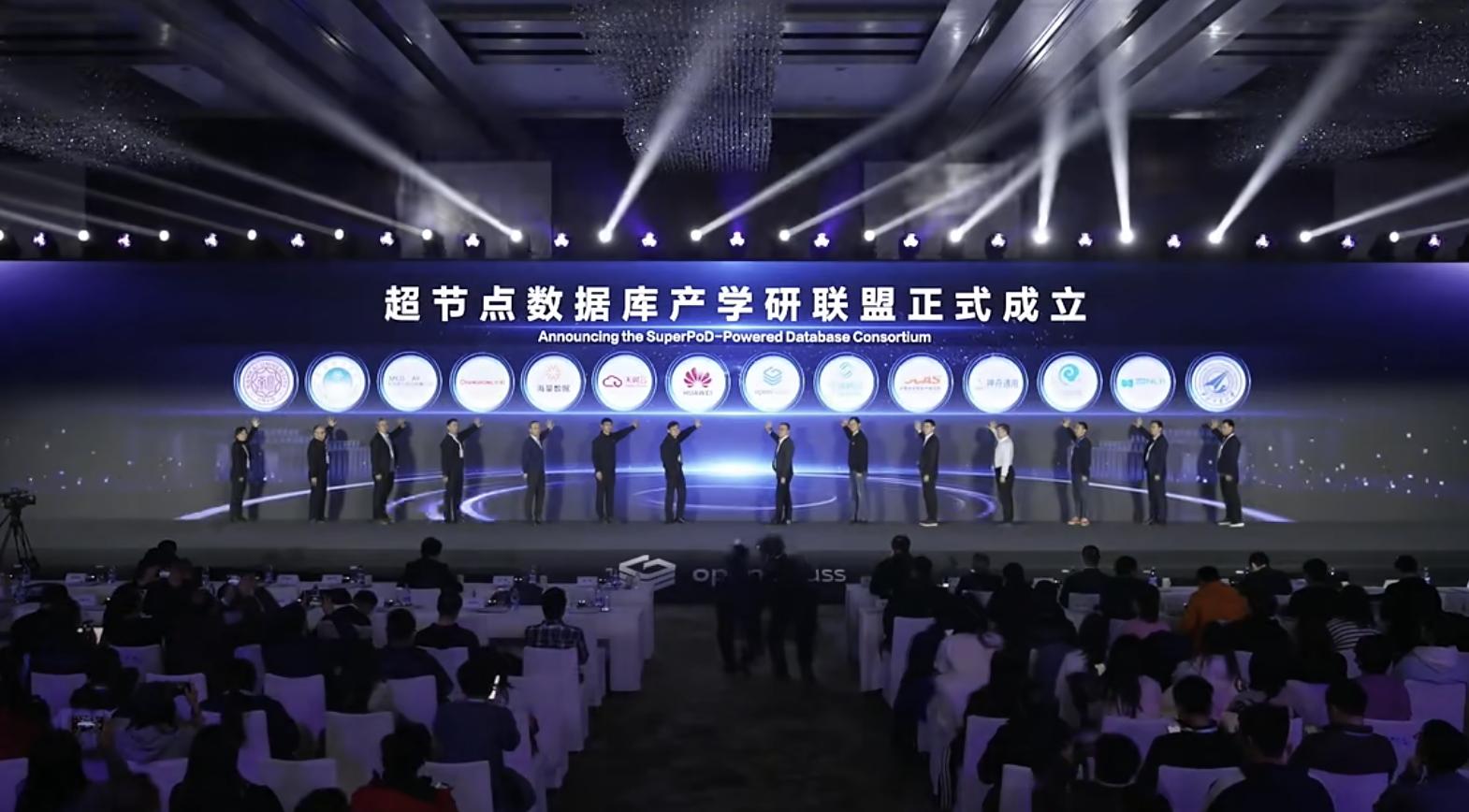
Notably, to explore the potential of combining super nodes with openGauss, the 'Super Node Database Industry-University-Research Alliance' was jointly established at the conference by multiple enterprises and partners from industry, academia, research, and application. Its goal is to cultivate world-leading competitiveness in super node databases and drive the first wave of transformations in super nodes within the general computing domain (especially databases). Hardware vendors, database developers, industry users, and other ecosystem partners have already begun taking action, collectively exploring the application of super node DBs in various industry scenarios through openGauss.
It can be argued that with market share reaching new heights and the establishment and refinement of database paradigms for the AI era, openGauss in the next five years will clearly not be content with merely 'following its own path.' Instead, it aims to lead database technological trends by seizing the pulse of the era, such as super nodes, and aligning with partner and industry demands.
*All images in this article are sourced from the internet
-
![]()
Registered Capital Slashed to 372 Million Yuan! Yutong Optical Finalizes Industrial and Commercial Change Registration
-
![]()
Zhuque-3 Successfully Lands, and 'Time Traveler' Secures Another ¥100 Million in Funding: China's Commercial Space Industry Experiences a 'Dynamic August'
-
![]()
Autohome Faces a Shrinking Window of Opportunity
-
![]()
Even a Titan Like Musk Has Faced Setbacks in Fulfilling Promises
-
![]()
AI Office: The End of the Racing Era, Context Becomes the Key to Success
-
![]()
Domestic Vehicle Chassis Revolution ②: The Steering Wheel Remains, But Mechanical Connections in the Steering System Are Decreasing
-
![]()
Exploring MiniMax Design: Can Video Editing Be as Simple as Speaking?
-
![]()
Why Can SenseTime Achieve Profitability While CloudWalk Still Faces Challenges, Despite Both Adopting Large Models?