2026 CES Observation | The Collective March of China's 'Silicon-Based Army'
 01/12 2026
 760
760
By | Intelligent Relativity
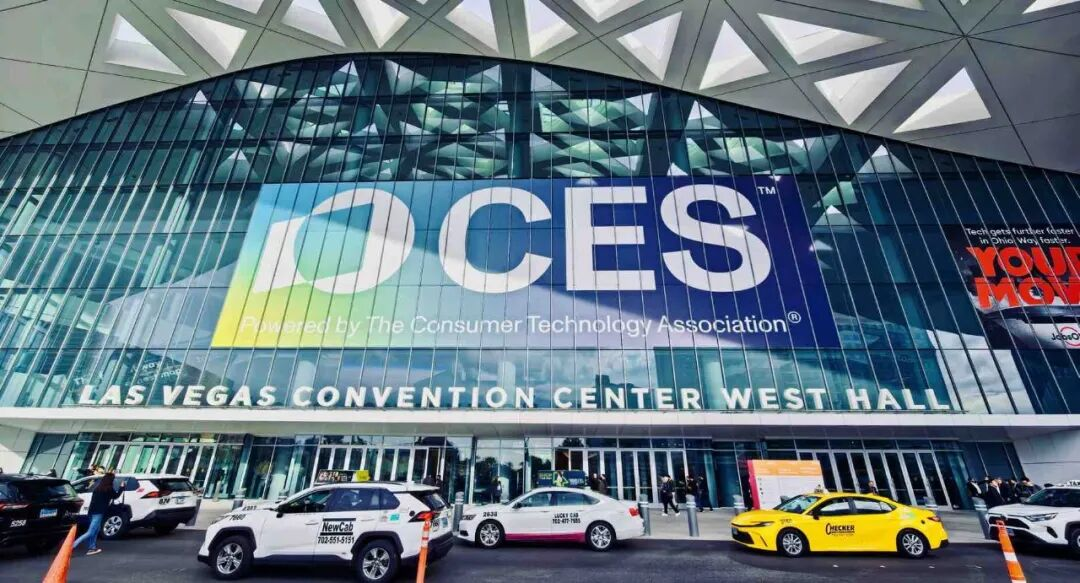
These past few days, Las Vegas has once again been enveloped in the global tech spotlight. The annual International Consumer Electronics Show (CES) is not just a celebration of consumer technology; it has become a core window into the future of productivity.
But if there's a protagonist at this year's event, it's undoubtedly robots. From robotic wrestling and dancing to calisthenics, business card distribution, and even lion dancing, these scenes are further subvert (translated as ' subvert ' to 'subverting') public perceptions of robots. Simultaneously, these scenarios outline a clear and resolute industry trend: the deep integration of artificial intelligence 'brains' with sophisticated mechanical 'bodies.' Robot technology has surpassed the singularity's ridge, accelerating toward a vast plain of scalability and practicality.
Within this grand tapestry painted by global enterprises, a systematic and matrixed Chinese force stands out remarkably. No longer scattered embellishments, they declare the arrival of a new era with a complete industrial lineup, showcasing a fresh posture of systematization, scalability, and ecological integration.
From 'Solo Ventures' to 'Collective Expeditions': CES Witnesses the Rise of China's Robot Army
If CES 2025 was a dazzling solo venture by China's robot industry, then the 2026 event is undoubtedly a meticulously planned collective expedition.
Official data shows 598 robotics-related exhibitors at this CES, with 149 from China—nearly a quarter, forming a substantial sector. More astonishingly, in the humanoid robot sector, the most future-oriented and technically demanding: of the 38 exhibitors, 21 are Chinese, exceeding 55% and truly dominating 'half the kingdom.'
Behind these figures lies the immense energy and unwavering confidence accumulated by China's robot industry over the years. As early as 2017, domestic robots like Leju Robotics debuted at CES. Years later, Leju has evolved from an early explorer to a leader in domestic humanoid robot commercialization, securing nearly 1.5 billion yuan in Pre-IPO funding and achieving substantive breakthroughs in commercial deployment. Its full-size humanoid robot delivery volume ranks among the top domestically, winning a bid for the first publicly tendered humanoid robot project in China's automotive industry initiated by FAW Hongqi, enabling multi-robot collaborative and stable operations in automotive factories.
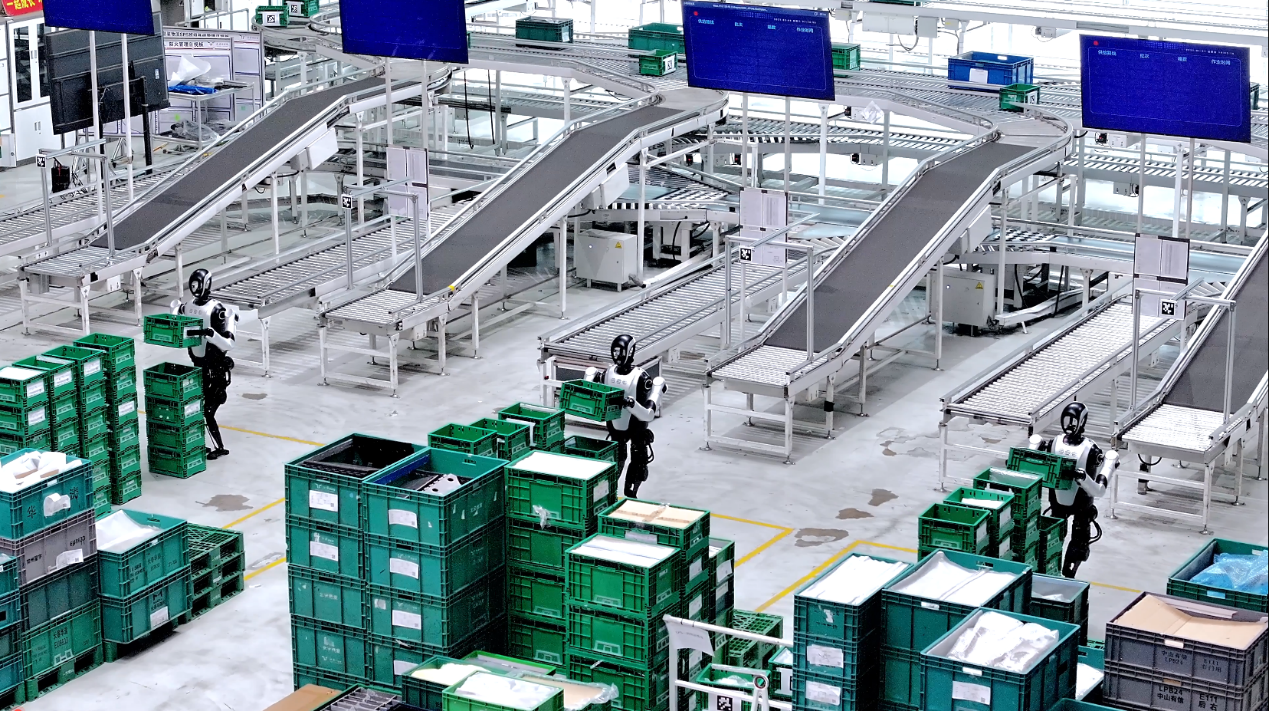
▲ Multiple Leju 'Kuafu' robots achieve long-duration, stable operations at FAW Hongqi factory
Thus, CES witnessing the rise of China's robot army is no exaggeration. Especially this year, within thousands of square meters of Chinese exhibition space, a complete 'robot army' spanning core components, whole-machine design, scenario applications, and brand ecosystems is quietly taking shape.
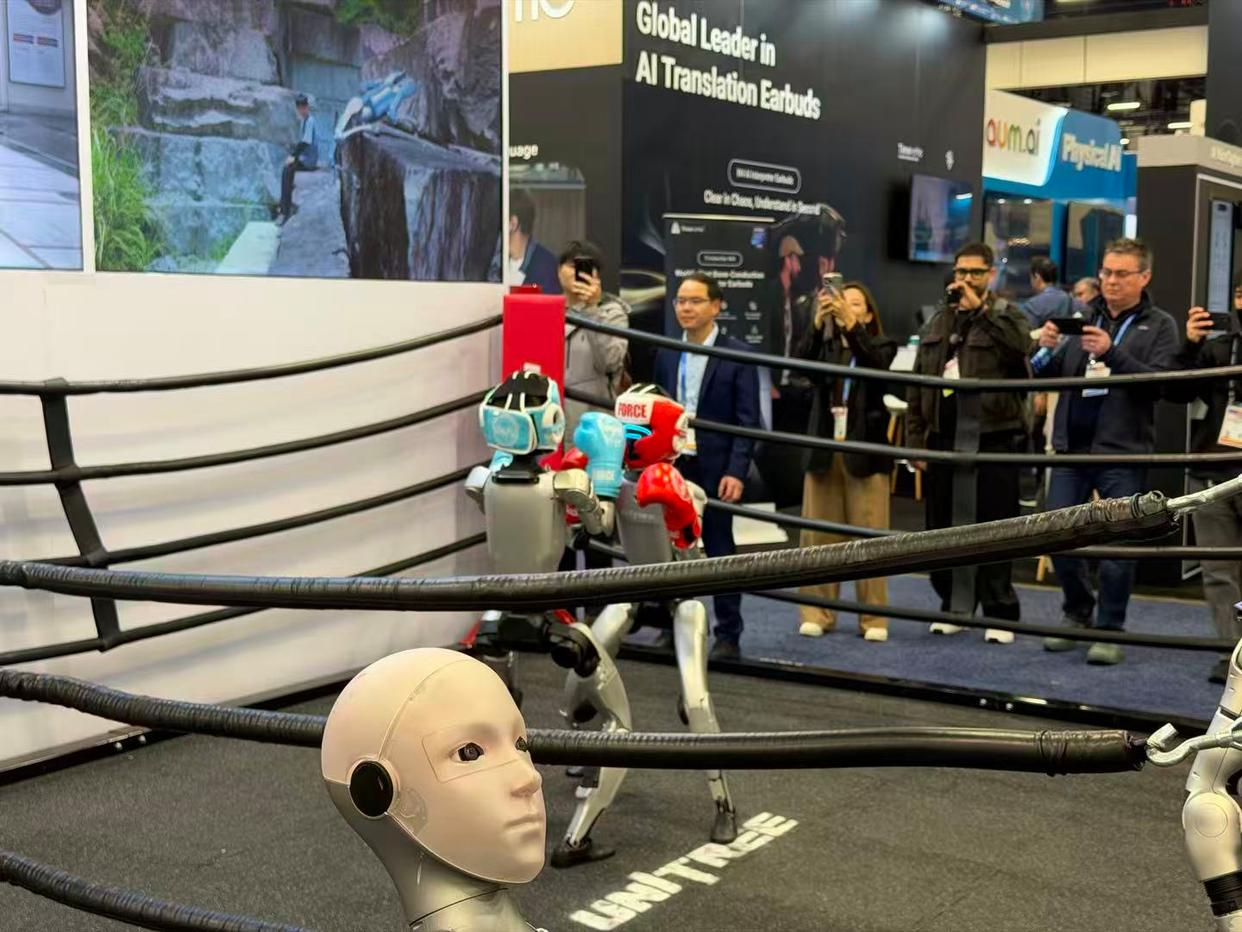
▲ Unitree Robotics showcases wrestling at CES
Take Unitree Technology, for instance. Early in 2025, Unitree robots could only perform Yangge (translated as 'Yangko dance') on the Spring Festival Gala; by year-end, they were performing 'Webster' tricks at concerts. At CES, Unitree enabled robotic wrestling, with the compact G1 robot showcasing astonishing high-dynamic motion capabilities. ZhiYuan Robotics, making its overseas debut, began various role-playing: Far conscript A2 could communicate in multiple languages, perform cowboy dances, ZhiYuan LingXi X2 showcased Tai Chi, and ZhiYuan Spirit G2 transformed into a hotel attendant.
More delightfully, beyond hardware, ZhiYuan unveiled Genie Sim 3.0, the first large language model-driven open-source simulation platform, comprehensively demonstrating its integrated capabilities in embodied intelligence from R&D, mass production to ecosystem construction.
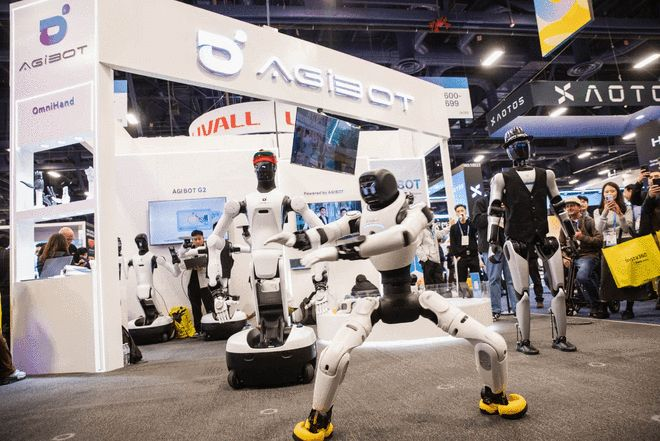
▲ ZhiYuan LingXi X2 performing Tai Chi
Upstream supply chain players like Daimeng unveiled the world's first force/tactile feedback teleoperation data acquisition system DM-EXton2 at CES, enabling 'tactile' teleoperation for robots to address the scarcity of real physical interaction data in training. Orbbec released multiple 3D camera products for humanoid robots and outdoor autonomous mobile robots, providing stable visual solutions for fine operation perception, compatible with NVIDIA Jetson Thor platforms.
These collective displays highlight not just breakthroughs in motion control, environmental perception, or interaction logic but also the systemic maturity of China's capabilities in humanoid robot engineering and productization.
More importantly, behind this 'collective expedition' lies a solid industrial foundation and clear strategic transformation. Customs data shows a 54.9% growth in China's industrial robot exports in the first three quarters of 2025. Chinese enterprises' core competitiveness in going global is upgrading from past 'cost-effectiveness' advantages to a composite edge based on core technologies, deep scenario understanding, and distinct brand philosophies.
CES has become a core hub for Chinese robot brands to undergo global market scrutiny and further formulate globalization strategies. Simultaneously, this CES, China's robot army conveys two crucial messages: 'mass production' and 'scenario-based deployment.'
CES Signals Two Major Trends: Robots Accelerate Deployment in 2026
In previous years, the robot industry was seen as a 'muscle show' or 'concept show,' primarily due to significant shortcomings in mass production and scenario deployment.
'Mass production' is undoubtedly the first keyword for the robot industry in 2026, and CES reveals this issue is being progressively resolved. The dazzling Unitree G1 is a mass-produced model; ZhiYuan Robotics claims over 5,100 units shipped in 2025, with 2026 projections reaching 'tens of thousands'; Leju Robotics also plans a 10,000-unit annual production line in 2026.
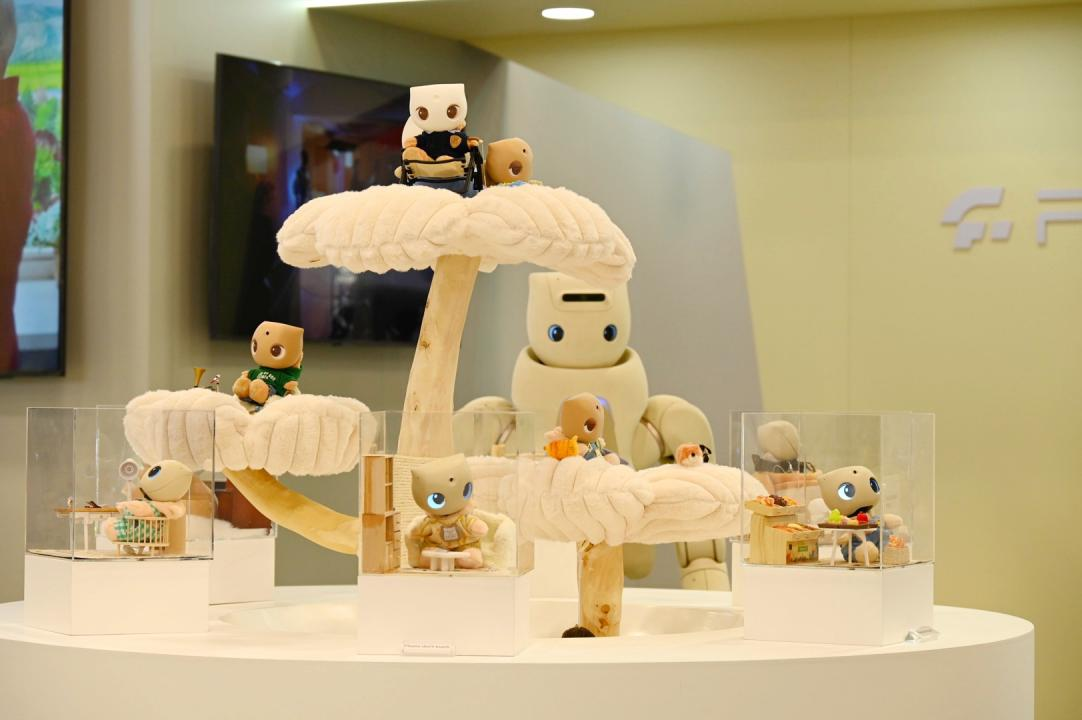
▲ Fourier 'Care-bot' robot concept prototype
These figures are not empty rhetoric but are backed by strong supply chain support and rapidly declining cost curves. On one hand, core component costs are continuously dropping. On the other, product diversification, particularly miniaturization and lightweight trends, is becoming a catalyst for accelerated commercial penetration.
Whether it's the Unitree R1 priced at just 29,900 yuan or Songyan Dynamics' Bumi, a small-sized robot pre-sold for under 10,000 yuan, affordability means humanoid robots are transitioning from expensive lab equipment or industrial assets into broader commercial and even consumer markets. Industry experts predict China's overall humanoid robot production volume could reach 100,000 to 200,000 units in 2026, marking a true 'year of mass production' and 'year of delivery.'
Another distinct trend at this CES is that Chinese robot companies are no longer merely pursuing flashy movements but anchoring their technological prowess in specific, commercializable scenario demands. This is evident from on-site displays: past robot exhibitions often featured physical movements like walking and dancing. This year, robots have taken on more specific 'professions.'

▲ TCL AiMe Companion Robot
TCL showcased the TCL AiMe Companion Robot, focusing on perception, interaction, and companionship experiences, emphasizing continuous presence in daily life. Fourier Intelligence's 'Care-bot' GR-3 engages in anthropomorphic 'tic-tac-toe' games with audiences, enhancing emotional attributes. Vitar Dynamics' consumer-end quadruped robot dog, Bobo, enables auto-following at speeds up to 13.3 km/h and a maximum load of 12 kg, offering a 'cyber dog-walking' experience.
Beyond consumer markets, deep B2B market penetration is evident. For instance, Fourier focuses on healthcare, serving over 2,000 medical institutions and clients in more than 40 countries and regions globally. Keenon Robotics' cleaning robots, with 'three-roller' integration technology and intelligent obstacle avoidance systems, have proven efficient and coherent operational value in malls, hotels, and other scenarios.
Robot applications in B2B markets extend far beyond what CES showcases. For example, Leju not only secured an offer from FAW in China but also serves as a guide at Honor Alpha's global flagship stores and a sales assistant at Lotus Car 4S dealerships.
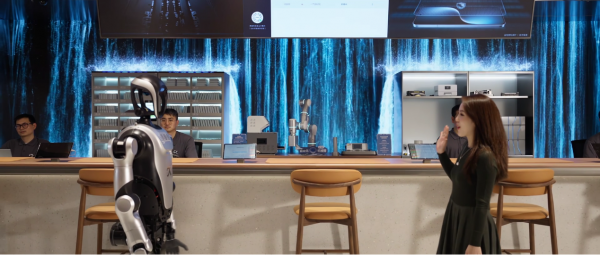
▲ Leju Robots debut at Honor Alpha's global flagship store
It's foreseeable that as technology iterates and scenarios expand, robot deployments in diverse commercial environments will become increasingly normalized.
Indeed, Leju Robotics' perseverance and success epitomize China's robot industry's accumulation and breakthrough. Today, the Chinese force on the CES stage is no longer a solitary star. Beyond long-termists like Leju emerging from labs, the industry includes high-dynamic performers like Unitree Technology and ZhiYuan Robotics, vertical experts like UBTECH and Fourier Intelligence deep cultivation (translated as ' deep cultivation ' to 'deeply cultivating') industrial and rehabilitation scenarios with commercial deliveries, and a host of emerging forces like Beijing Humanoid Robot Innovation Center, ZhiXi Dynamics, and Vitar Dynamics making their overseas debut at CES.
This year's CES reveals a crucial transformation in China's domestic robot industry: shifting from technological display to practical tools, from concept chasing to addressing real needs. Creating tangible value is the new benchmark set by China's players for the global robot industry.
Conclusion
From 'lone wolves' to 'collective might,' this change reflects not just a quantitative and scalable shift for Chinese enterprises on the global stage but a profound leap in their development logic and industrial phase. It signifies China's robot industry has transitioned from early technological following and single-point breakthroughs to a 'systemic innovation' era characterized by full-stack self-research, ecological aggregation, and commercial closure.
What the global market witnesses is no longer just novel products but a complete capability system spanning underlying hardware, core algorithms, scenario definitions, and ecological standards. This stems from a chemical reaction catalyzed by China's unique manufacturing foundation, vibrant application markets, and resolute technological innovation (translated as ' technological innovation ' to 'technological innovation') policies.
*All images in this article are sourced from the internet
-
![]()
Registered Capital Slashed to 372 Million Yuan! Yutong Optical Finalizes Industrial and Commercial Change Registration
-
![]()
Zhuque-3 Successfully Lands, and 'Time Traveler' Secures Another ¥100 Million in Funding: China's Commercial Space Industry Experiences a 'Dynamic August'
-
![]()
Autohome Faces a Shrinking Window of Opportunity
-
![]()
Even a Titan Like Musk Has Faced Setbacks in Fulfilling Promises
-
![]()
AI Office: The End of the Racing Era, Context Becomes the Key to Success
-
![]()
Domestic Vehicle Chassis Revolution ②: The Steering Wheel Remains, But Mechanical Connections in the Steering System Are Decreasing
-
![]()
Exploring MiniMax Design: Can Video Editing Be as Simple as Speaking?
-
![]()
Why Can SenseTime Achieve Profitability While CloudWalk Still Faces Challenges, Despite Both Adopting Large Models?