AI-Powered Browsers Are Taking the World by Storm! Where Do Entrepreneurs Fit In?
 01/16 2026
 458
458
Who would have thought that the browser industry, deemed obsolete for over a decade, would experience a resurgence driven by AI?
For more than ten years, the browser market, dominated by Microsoft's Internet Explorer (IE) and Google's Chrome, has remained stagnant. The industry has largely focused on superficial changes, such as altering user interfaces and adding plugins, while adhering to the traditional model of 'tabs + search bar.' The underlying logic of generating revenue through advertising has stayed the same.
The prevailing sentiment in the industry is that this sector no longer presents viable entrepreneurial opportunities.

However, the advent of generative AI has shaken up this stagnant industry.
Silicon Valley's rising star, The Browser Company, made a bold move by abandoning its popular Arc browser to fully focus on the new AI browser, Dia. Meanwhile, in China, Kuake took it a step further by integrating the Qianwen large language model, transforming into an 'AI Productivity Center,' and experiencing a surge in user numbers despite market trends.
Is this wave of enthusiasm for AI browsers merely a bubble fueled by capital, or does it represent the next era's gateway to online traffic? Do entrepreneurs still have a chance to carve out a niche?
Today, let's explore the underlying dynamics of this industry with Zhang Dongwei.
I. Core Transformation: From 'Web Page Viewing' to 'Task Execution'—Browsers Evolve into Smart Assistants
Traditional browsers essentially serve as 'information windows,' requiring users to search, locate, and filter information on their own. For complex tasks, users often open multiple tabs and switch back and forth, leading to exhaustion. Even with the most refined page interactions, these browsers are essentially just 're-skinned versions of IE or Chrome,' failing to break free from the original framework.
The core ambition of AI browsers is to transform this 'window' into an 'execution agent (Agent).' In simpler terms, they aim to shift from 'helping you find answers' to 'directly getting things done for you.'
In the United States, Dia, now fully available, eliminates the need for manual product comparison. By entering a query like 'Select the most cost-effective entry-level laptop,' it automatically crawls multiple review sites and e-commerce platforms, extracts key parameters for comparison, and directly provides conclusions along with source links for verification.
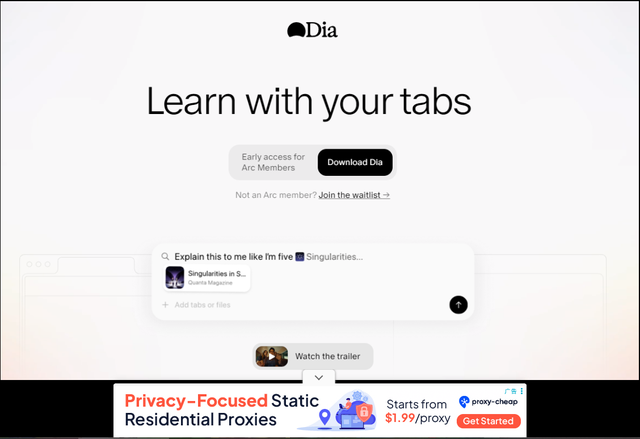
Even more impressively, Dia can directly treat multiple web pages and local files as conversational context. Users can highlight text to trigger AI interpretation and even summarize key points from online videos, all within a single interface without the need for constant switching.
Notably, Dia's ambitions extend far beyond this. It aims to become the 'operating system of the Web era.' Whereas users once downloaded various apps, now, through AI browsers, web pages serve as plugins. Dia is already experimenting with directly scheduling emails, calendars, and Notion tasks within the browser. This 'cross-web automated collaboration' represents its most formidable competitive advantage.
This shift from 'Search' to 'Answer' is not a minor adjustment but a complete reconstruction of the interaction logic between humans and web information. Browsers are no longer just tools; they are intelligent assistants ready to serve at your command.
II. China vs. West: Silicon Valley's 'Reinvention' vs. China's 'Scene Cultivation'—Which Path Is More Viable?
Faced with the opportunities presented by AI browsers, China and the West have taken two distinct paths.
According to Zhang Dongwei, neither approach is inherently superior; rather, they represent rational choices made under different market environments.
A. Silicon Valley's Approach: Disruptive Revolution, Betting on the Future
Players like Dia in Silicon Valley are taking the 'reinvention' route. They are directly eliminating traditional tabs, featuring a single search bar interface, and deeply integrating AI into the browser's core, attempting to completely overturn the existing operational logic.
Their goal is not to create a 'better Chrome' but to invent the 'light bulb' rather than a 'brighter candle.'

This approach has an extremely high ceiling. If successful, it could define the next generation of human-computer interaction interfaces. However, the risks are immense, akin to blazing a trail in uncharted territory, with challenges in technological maturity and user habit cultivation.
Currently, although Dia is fully downloadable and offers a $20/month Pro subscription, its core features remain focused on information summarization and simple interactions, still far from a true 'execution agent.'
B. China's Strategy: Tool-Based Improvements, Earning Now
Domestic players like Kuake and 360 AI Browser are taking the 'scene cultivation + tool-based' route. They are not overturning the existing browser architecture but embedding high-frequency AI tools within it to precisely solve specific user pain points.
This approach may seem 'less disruptive,' but its commercialization path is shorter, and user acceptance is higher.

For example, Kuake, after deeply integrating the Qianwen large language model, has transformed into a 'mobile intelligent laboratory.' Students use it to erase test questions and generate ID photos; professionals use it for word highlighting and translation, summarizing long documents; and even without opening the browser, a desktop floating ball can instantly invoke AI to handle file format conversions.
More critically, Kuake's success is also due to its 'cloud-integrated' ecosystem advantage. Backed by its cloud storage and Kuake Scanner, the AI browser serves not just as an entry point but also as a data storage device. Scanned PDFs and summarized documents are directly stored in the cloud, forming a closed loop of 'processing + storage.' This ecosystem advantage is highly coveted by pure tool-based startups.

360 AI Browser specializes in long-text processing, generating summaries of scientific research papers in seconds.
Mita AI focuses on professional fields, emphasizing the rigor of search sources to alleviate information anxiety for researchers and professionals.
In essence, China's approach is 'solve specific user problems first, then gradually cultivate habits,' while Silicon Valley's is 'define the future form first, then let users adapt.'
III. Entrepreneurs Beware! These Three Pitfalls Are Fatal
Although AI browsers seem promising, entrepreneurship in this field is far from smooth sailing. These three core challenges are almost life-and-death for all startups:
1. The Siege of Tech Giants Is Already Upon Us
Google has already integrated Gemini into Chrome, allowing developers to right-click and summon AI to check CSS bugs, analyze performance issues, directly locate erroneous code, and provide optimization solutions. Apple is also incorporating Apple Intelligence into Safari, leveraging its ecosystem advantage to capture users.
Startups must find highly differentiated entry points to break through the 'family bucket' (all-in-one suite) shadow of tech giants. For example, they could specialize in source verification for the scientific research field or focus on exam preparation scenarios for students. A broad, all-encompassing approach is a sure path to failure.
2. The Computational Cost Arms Race Is Not for Everyone
Traditional browsers could generate revenue passively through advertising, but every answer and summary from an AI browser consumes computational power, incurring high costs.
Consider this: The marginal cost of traditional search is nearly zero, but each interaction cost of AI search (RAG architecture) can be dozens of times higher.
Currently, Dia's Pro subscription and some of Kuake's advanced features are charging, all exploring new business models.
For startups, if they cannot implement a subscription model within six months or, like 360, offset costs through enterprise security services, they may die from uncontrollable computational costs due to 'overly active users.'
Without a higher-dimensional monetization method than advertising—such as industry-specific API revenue sharing or vertical scenario subscriptions—relying solely on burning cash will not sustain them until profitability.

3. The 'Predatory' Conflict Over Content Ecosystems
This is the most easily overlooked but most fatal issue: AI browsers directly scrape web content to generate summaries, effectively intercepting traffic that would have originally gone to the original websites.
This 'predatory' information acquisition is likely to trigger copyright disputes and ethical controversies, even potentially disrupting the entire web ecosystem.
Some content platforms have already started restricting AI scraping, and this conflict will only intensify in the future.
Epilogue: Not 'Better Chrome,' but 'New Species'
Zhang Dongwei believes that AI browsers are undoubtedly an opportunity worth pursuing, but they are more of a 'ticket' to future human-computer interaction rather than a simple 'browser upgrade.'
For entrepreneurs, the era of succeeding by simply 'adding an AI dialog box to Chrome' is over.
The real opportunity lies in breaking the boundaries between 'web pages' and 'applications.' This can be achieved by digging deep into vertical scenarios like Kuake to solve specific user pain points and by possessing the execution capabilities of an Agent like Dia to proactively complete complex tasks for users.
The history of the internet is always cyclical.
Thirty years ago, Netscape opened the door to the information age with browsers; fifteen years ago, Chrome ended the portal era with simplicity and speed.
Today, AI browsers are attempting to send the term 'browser' to the history museum, replacing it with an 'omniscient personal agent.'
For entrepreneurs, do not try to replicate Chrome; instead, seek out the 'ruins' forgotten by traditional browsers. Whether it's a specialized academic brain for research or a grounded life assistant, these hold the tickets to the next era.
Final Interactive Question:
If browsers could handle everything for you in the future, what's the one task you'd most like them to automatically complete? Is it 'automatically comparing prices and placing orders' or 'automatically filtering out all spam marketing messages?'
Welcome to leave your brainstorming ideas in the comments section. Thank you.
-
![]()
Registered Capital Slashed to 372 Million Yuan! Yutong Optical Finalizes Industrial and Commercial Change Registration
-
![]()
Zhuque-3 Successfully Lands, and 'Time Traveler' Secures Another ¥100 Million in Funding: China's Commercial Space Industry Experiences a 'Dynamic August'
-
![]()
Autohome Faces a Shrinking Window of Opportunity
-
![]()
Even a Titan Like Musk Has Faced Setbacks in Fulfilling Promises
-
![]()
AI Office: The End of the Racing Era, Context Becomes the Key to Success
-
![]()
Domestic Vehicle Chassis Revolution ②: The Steering Wheel Remains, But Mechanical Connections in the Steering System Are Decreasing
-
![]()
Exploring MiniMax Design: Can Video Editing Be as Simple as Speaking?
-
![]()
Why Can SenseTime Achieve Profitability While CloudWalk Still Faces Challenges, Despite Both Adopting Large Models?