[Industry In-Depth Research] Why is the AI Access Race So Pivotal, as Jack Ma and Other Internet Pioneers Step into the Spotlight?
 02/11 2026
 542
542

Author | Meng Xiao
Explore More Financial Insights | BT Financial Data Pass
The main text spans 3,880 characters and is estimated to take 9 minutes to read.
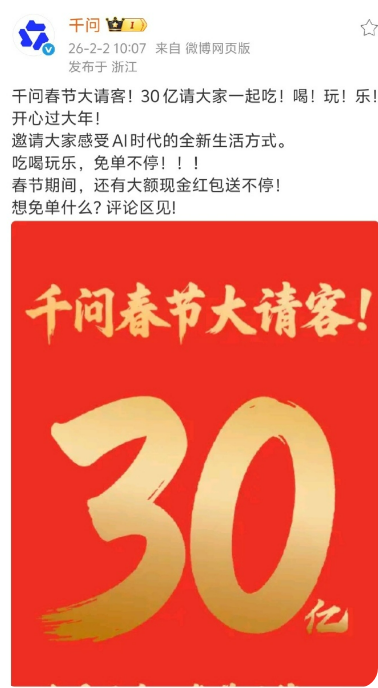
Recently, internet pioneers like Jack Ma and Pony Ma have made public appearances to champion their large-scale AI models, drawing significant attention. As the Spring Festival nears, the AI race intensifies. Tencent, Baidu, ByteDance, and others have launched Spring Festival red packet campaigns, with Alibaba QianWen joining the fray by announcing a RMB 3 billion 'Spring Festival Hospitality Plan.' Subsequently, the typically low-profile Jack Ma made a high-profile appearance at the Alibaba QianWen office building, announcing that Alibaba's ecosystem businesses, including Taobao Deals, Fliggy, Damai, Hema, Tmall Supermarket, and Alipay, will participate in the QianWen hospitality plan.
According to QianWen App's official Weibo account, the 'QianWen Spring Festival Hospitality Plan' will officially commence on February 6, emphasizing 'Free Eats, Drinks, and Entertainment Non-Stop,' along with substantial cash red packets.
Pony Ma made a rare appearance at Tencent's annual gala, where he shared his insights on the current AI landscape. His stance consistently revolves around 'prioritizing user value,' maintaining both a底线 (principle) and rationality. This approach may seem deliberate and slow, but it is actually a strategic move—waiting for the market to stabilize and become rational. For Tencent, the goal is to explore how new technologies can best integrate with its products rather than following trends blindly.
For a while, first-generation internet entrepreneurs like Jack Ma and Pony Ma have made appearances to support their AI products, reminiscent of the 'Hundred-Group Battle' in the early days of the internet. No one wants to miss the AI opportunity and is giving their all. Some media outlets believe that the high-profile endorsements by tycoons like Jack Ma are aimed at securing a strategic position, resource allocation, ecosystem synergy, and building confidence during the critical phase of AI access competition. Essentially, they are betting on AI to reshape user access and the final competition in the business ecosystem.
This logic aligns with how WeChat red packets once overtook Alipay and established the e-commerce landscape. It represents an inevitable path for tech giants to shift from traffic competition to 'ecosystem competition.'
1
Jack Ma Appears at QianWen Office Building

In recent years, Jack Ma has made few public appearances. BT Finance has found that since May 2024, Jack Ma has only made eight public appearances, three of which were related to AI large-scale models.
In May 2024, Jack Ma appeared in Hangzhou, visiting the Tongyi Laboratory and engaging with Alibaba's AI team. This was a significant appearance after he had been relatively absent from the public eye since 2023. Although no major press conference or public speech was held during this visit, it was confirmed through internal announcements from the Alibaba Group and some media reports. During the visit, he expressed strong interest in the development of AI large-scale models and encouraged the team to persist in technological innovation.
In April 2025, Jack Ma appeared at Alibaba's new fiscal year kickoff event and delivered a speech, emphasizing that AI should serve humanity rather than replace it. He mentioned AI chip autonomy for the first time, stressing the importance of not relying on others for critical technologies.
On February 4, 2026, Jack Ma visited Alibaba's headquarters in Hangzhou for the QianWen Spring Festival project team. Accompanied by Alibaba partner Shao Xiaofeng, he toured the QianWen office area, which was already adorned with New Year decorations featuring horse motifs, labeled 'QianWen Consumer Business Group.' After announcing the RMB 3 billion hospitality plan on February 2, QianWen announced on February 3 that it would exclusively sponsor the Spring Festival galas of four TV stations. As QianWen actively competes for consumer-end access, Jack Ma's visit holds significant implications.
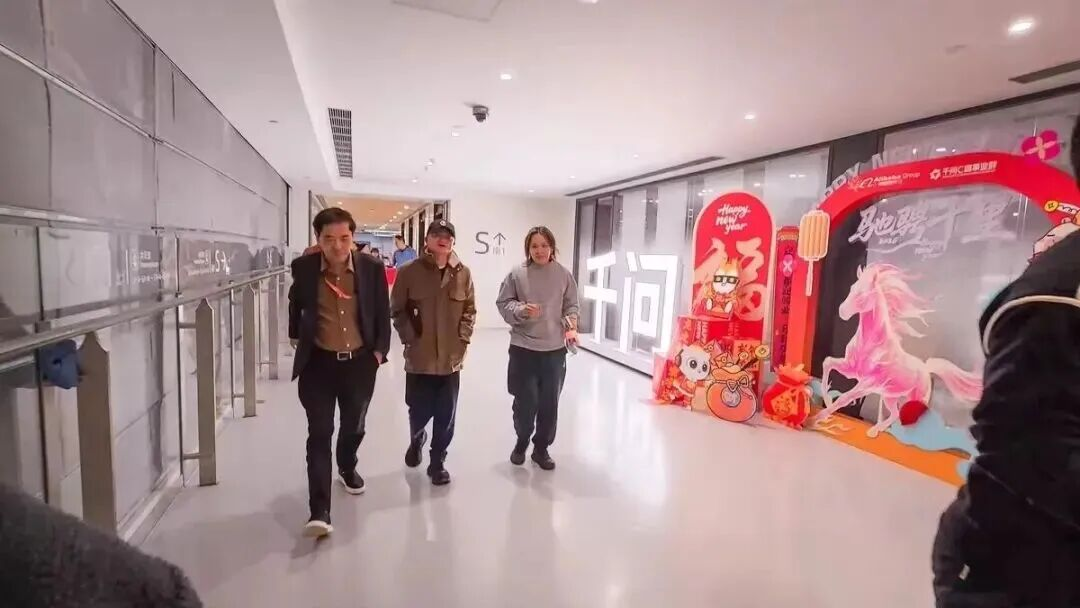
Jack Ma wields significant influence in the business world, and his presence has boosted the morale of the QianWen team. AI research and development involve long cycles and high uncertainty. As the founder of Alibaba, Jack Ma's visit can inspire the team, convey a determination to 'go all-in on AI,' and stabilize morale. His appearance indicates that the AI project has received group-level resources from Alibaba, including funding, computing power, and traffic. Alibaba has integrated core products such as Kuake and UC to accelerate product iteration and market promotion for QianWen. At the same time, Jack Ma's endorsement can enhance the company's attractiveness in the fiercely competitive AI talent market, helping to attract top AI talent and retain core team members with above-industry salaries and strategic visions. This represents an invisible asset in the AI field, where aggressive recruitment is underway.
Jack Ma's 'inspection' of QianWen reflects Alibaba's high level of importance in this battle. Alibaba has integrated its former Smart Information and Smart Connectivity business units, encompassing core product matrices such as the QianWen App, Kuake, AI hardware, UC, and Shuqi, to establish the QianWen Consumer Business Group. Despite its recent establishment, the group has already fully integrated with ecosystem businesses like Taobao, Alipay, Taobao Deals, Fliggy, and Gaode, representing nearly the full resources of Alibaba Group. This demonstrates Alibaba's commitment to competing for 'AI access.' Wu Jia, the head of the business group, stated in a media interview that Alibaba aims to bring many new lifestyle services through AI, not just maintaining existing ones.
2
A Record-Breaking RMB 760 Billion
At Alibaba Cloud's new fiscal year kickoff event in April 2025, Jack Ma stated that 'AI should serve humanity rather than replace it,' positioning large-scale models as Alibaba's core strategy for the next decade and driving Alibaba's transition from 'e-commerce-led' to AI-driven.
Public data shows that from 2016 to 2025, Alibaba has invested approximately RMB 380 billion in the AI field, covering cloud and AI infrastructure. This investment has followed a three-stage progression: 'early-stage diversified exploration—mid-stage focused infrastructure building—late-stage full-stack sprint.' From 2016 to 2018, investments were primarily at the RMB 100 million level, focusing on R&D. From 2019 to 2022, investments reached the RMB 10 billion level, centering on the Academy of Discovery and T-Head Semiconductor. After 2023, investments entered a high-intensity phase exceeding RMB 100 billion, focusing on computing clusters, large-scale models, and chip self-research. In 2025 alone, AI-related capital expenditures exceeded RMB 100 billion. Over four quarters from 2024 to 2025, cumulative capital expenditures for AI + cloud infrastructure reached RMB 120 billion, with Q1 2025 capital expenditures reaching RMB 38.6 billion, a 220% year-over-year increase, setting a new historical high.
Alibaba recently announced that it will continue to invest RMB 380 billion in AI infrastructure over the next three years, surpassing the total investment of the past decade. This covers computing power, chips, and model research. Thus, Alibaba's total investment in AI over the past decade and the next three years will exceed RMB 760 billion, averaging RMB 58.5 billion annually. Excluding the RMB 100 million and RMB 10 billion investments before 2022, the average annual investment in AI after 2023 exceeds RMB 120 billion. Clearly, AI is a costly endeavor, and only financially robust companies can afford to play. Currently, influential and market-leading products like ByteDance's Doubao, Baidu's Wenxin, and Tencent's Yuanbao all come from financially strong companies. However, even among these competitors, Alibaba's AI investment has set industry records and renewed the highest record for AI investment by a Chinese private enterprise.
Massive R&D investments have gradually formed QianWen's competitive moat. With an open-source core strategy, QianWen's mathematical and programming capabilities rival GPT-4, with over 90,000 global open-source derivative models, surpassing Llama as the largest open-source model family, with downloads exceeding 1 billion.
Self-developed chips form its foundation. T-Head Semiconductor launched the 'Zhenwu 810E' PPU, with performance comparable to NVIDIA's H20, already deployed in clusters of over 10,000 cards on Alibaba Cloud, serving over 400 clients and addressing large-scale model memory and communication bottlenecks. In January 2026, a trillion-parameter QianWen inference model was released, with 36T Tokens of pre-training data, matching the performance of top models like GPT-5.2, supporting multimodal understanding, logical reasoning, and autonomous decision-making.
Alibaba's massive AI investment stems from its emphasis on AI infrastructure. To date, it has added eight AI data centers globally, increasing available zones to 95 across 30 regions, supporting large-scale model training and inference.
3
Unprecedented 'AI Red Packet Battle'
During the 2026 Spring Festival, an unprecedented 'AI Red Packet Battle' unfolded across China's internet landscape.
Alibaba QianWen launched a RMB 3 billion 'Spring Festival Hospitality Plan,' Tencent Yuanbao distributed RMB 1 billion in cash to replicate the success of WeChat red packets, Baidu Wenxin offered RMB 500 million in red packets tied to AI interactive gameplay, and ByteDance achieved national exposure through an exclusive AI cloud partnership with the Spring Festival Gala. With a total investment exceeding RMB 4.5 billion in cash, what appears to be a festive marketing frenzy is, in reality, a strategic battle for dominance in the AI ecosystem over the next decade.
This battle transcends traditional traffic competition, shifting from 'who gives away more money' to 'who captures user mindshare first.' If the 2014 WeChat red packet battle was about securing payment access, the 2026 AI red packet battle is about securing the 'primary access' for human-computer interaction—the AI assistant users turn to first when seeking services.
In recent years, traditional red packet games like 'collecting five blessings' and 'grabbing passwords' have grown stale, with declining user interest in pure cash incentives. This year, major companies have significantly upgraded their strategies: red packets are no longer the endpoint but an 'entry ticket' guiding users to engage with large-scale model functions.
Alibaba QianWen allows users to trigger free order cards by chatting with the command 'help me order a bubble tea'; Baidu Wenxin requires users to unlock red packets by guessing 'horse-themed passwords' through AI; Tencent Yuanbao combines social sharing with AI dialogue, encouraging users to generate blessings for lucky draws. Behind these designs lies meticulously planned 'behavioral implantation,' allowing users to naturally experience AI capabilities like writing Spring Festival couplets, creating emojis, summarizing group chats, and planning itineraries through lighthearted interactions.
This 'subtle education' approach is key to breaking the stereotype that 'AI is far from daily life.' When users first use AI to grab red packets, second to write blessings, and third to book flights, search for information, or compare prices, the Spring Festival's universal coverage provides the best testing ground for cultivating AI usage habits.
Despite shared goals, each company's approach reflects distinct corporate DNA and strategic priorities. Tencent continues its 'relationship chain-centric' logic, attempting to embed Yuanbao into the WeChat ecosystem for effective dissemination through social sharing.
ByteDance leverages its exclusive AI partnership with the Spring Festival Gala for 'seamless exposure.' Doubao does not emphasize transactions or social interaction but integrates AI deeply into content consumption flows through Douyin's algorithmic advantages. Its goal is not to make users 'download a new app' but to 'ask a question while scrolling videos,' thereby occupying mindshare at the attention level.
Alibaba's strategy is the most aggressive, directly using RMB 3 billion in subsidies to connect commercial loops like Taobao Deals, Hema, and Fliggy. QianWen is not just a chatbot but an integrated 'AI shopping guide + payment + fulfillment' access point. Alibaba's ambition is clear: in the future, users will not open Taobao to search for products but simply tell QianWen, 'help me buy a bubble tea,' with AI handling product selection, ordering, and payment automatically.
Baidu takes a differentiated route, not promoting a standalone app but embedding Wenxin Assistant within Mobile Baidu. Leveraging its 700 million monthly active users' search habits, users receive AI-generated answers instantly upon entering questions and can directly access services like maps, hotels, and encyclopedias. This 'download-free, search-and-use' model significantly lowers usage barriers, aligning with the idea that 'AI should be as invisible as utilities.'
The excitement will eventually fade, and the real competition will begin after the festival. Historical data shows that subsidy-acquired users typically have a retention rate of less than 20% after 30 days. This means that 90% of 'opportunity seekers' will uninstall apps after cashing out. Major companies are well aware that cash incentives can only drive short-term traffic; only product strength can win long-term trust.
In essence, the Spring Festival red packet competition functions as a large-scale stress test. The 2026 AI red packet competition, although it may appear to be a mere marketing campaign at first glance, is actually an ecosystem-wide contest. It signifies the shift in large-scale model competition from merely comparing individual technical parameters to engaging in comprehensive “model + scenario + ecosystem” contests. The ultimate victor in the future may not be the most intelligent model per se, but rather the one that can integrate AI most seamlessly into users' daily lives, work routines, and consumption patterns.
Once the Spring Festival festivities conclude and the red packet “rain” ceases, what users will find lingering on their phones will be more than just a handful of app icons. These icons could potentially serve as the gateway to a future digital lifestyle. This nationwide AI preview could very well herald China's genuine entry into the “intelligent agent era.”
This article is an original work by BT Finance. Any unauthorized use, reproduction, dissemination, or adaptation of this content is strictly prohibited. Legal action will be taken against any infringement.

-
![]()
Silicon-Based OLED Pioneer Unveils Financial Results: H1 Shipments Outpace Entire 2025 Volume
-
![]()
AI's First "Lost Summer"
-
![]()
Zeiss Makes Another €2.2 Million Bet: Will Eye Tracking Be the Next Big Thing in the Smart Glasses Industry?
-
![]()
RUNTO Ranking | Global Top TV ODM Factories' Shipment Figures for July 2026
-
![]()
Dealer Service Operational Prowess | How After-Sales Managers Can Harness Efficiency and Expertise to Secure Trust in the New Energy Era
-
![]()
Xiaohongshu: Navigating Through the AI Anxiety Storm
-
The Foundation of AI is Being Built
-
![]()
Huawei and Apple Embrace Change, Samsung Steps Back: Is Variable Aperture Technology a Game-Changer?