Waymo Secures $16 Billion in Record-Breaking Funding: Time to Reassess China's L4 Autonomous Driving Firms?
 02/13 2026
 627
627

Source: Zhiche Technology
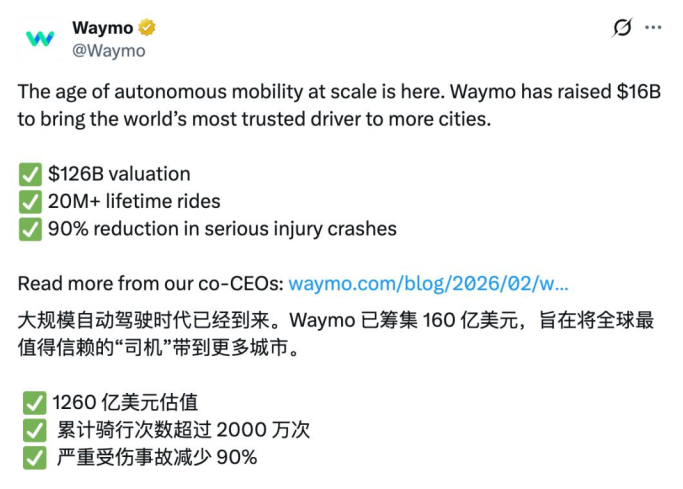
On February 2 (local time), Waymo, the autonomous driving arm of Google's parent company Alphabet, announced the successful closure of a new funding round totaling $16 billion. This marks the largest single financing event in the global autonomous driving sector to date.
With this latest infusion of capital, Waymo's post-money valuation has skyrocketed to $126 billion, cementing its status as the industry's most valuable unicorn. This milestone signals that the global L4 autonomous driving sector has officially entered a new era of large-scale commercialization.

Billion-Dollar Funding Propels Industry Momentum
The funding round attracted a stellar lineup of investors, co-led by Dragoneer Investment Group, DST Global, and Sequoia Capital. Global institutions such as Andreessen Horowitz, Mubadala Capital, Bessemer Venture Partners, Silver Lake, and Tiger Global Management also participated. Alphabet, Waymo's controlling shareholder, not only joined this round but also maintained its majority stake, providing stable strategic support for technological innovation and business expansion. This move underscores Alphabet's long-term confidence in the autonomous driving sector.
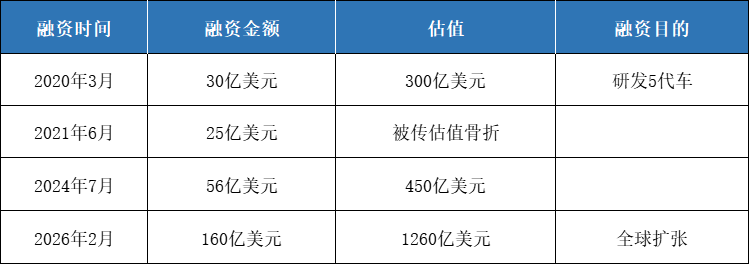
Since its first public financing in 2020, Waymo has completed four funding rounds, raising a total of $27.1 billion. Its previous funding round in October 2024 secured $5.6 billion at a valuation of approximately $45 billion. Over just 16 months, Waymo's valuation surged by 180%, reflecting strong capital market recognition of its technological maturity and commercial potential.
As a global pioneer in autonomous driving, Waymo originated from Google's autonomous vehicle project in 2009 and became an independent Alphabet subsidiary in 2016. To date, it has accumulated over 125 million miles of fully autonomous driving experience. Its Waymo Driver system demonstrates industry-leading safety, with a 90% lower rate of serious injury incidents compared to human-driven vehicles.
Beyond its core Robotaxi business, Waymo is actively diversifying its portfolio. According to The Information, the company plans three new initiatives: (1) food delivery services using Robotaxi trunks for customer pickups, (2) relaunching its Robotruck business for long-haul freight transport, and (3) licensing autonomous technology to automakers, though this segment remains in early development. These diversified efforts aim to expand revenue streams and reduce reliance on any single business line.
Waymo's co-CEOs Tekedra Mawakana and Dmitri Dolgov stated in an official announcement that the new funds will focus on three priorities: (1) expanding the Robotaxi fleet while optimizing vehicle hardware costs and operational efficiency, (2) accelerating global expansion with services planned in over 20 international cities including London and Tokyo (with London targeting fully autonomous taxi services by Q4 2026 as its European debut), and (3) advancing autonomous technology through enhanced complex road condition adaptation and dynamic target recognition capabilities while refining end-to-end operational systems.
Driving this valuation surge are Waymo's improving commercial operations. The company now operates stably across six major U.S. metro areas: Phoenix, San Francisco, Los Angeles, Austin, Atlanta, and Miami. In January, it received approval to launch autonomous services to and from San Francisco International Airport. Additionally, its partnership with Uber has expanded service accessibility, marking its transition from concept validation to large-scale commercialization.
Waymo's billion-dollar funding not only fuels its own growth but also reshapes the global autonomous driving landscape. After a period of capital market cooldown, this record financing reignites sector enthusiasm, reflecting renewed investor confidence in autonomous driving commercialization. It will also accelerate resource consolidation toward industry leaders, compelling smaller players to pursue niche differentiation.

Revaluation Moment for Chinese Players
The autonomous driving industry now features two distinct competitive camps: U.S. technological depth versus Chinese implementation efficiency. Waymo leads the L4 sector through technological prowess and capital strength, while Chinese frontrunners like Baidu's Apollo Go, Pony.ai, and WeRide leverage policy support and scenario advantages to excel in commercialization speed and cost control, creating a clear differentiation strategy. With Waymo's valuation doubling, reevaluating Chinese L4 players has become an industry focal point.
Baidu's Apollo Go focuses on the core Robotaxi market, operating in 22 global cities including Beijing, Shanghai, Shenzhen, Wuhan, Hong Kong, Dubai, and Abu Dhabi, with over 240 million cumulative autonomous miles driven. As of November 2025, it handles over 250,000 weekly orders—all fully driverless—surpassing 17 million total orders. These metrics rank it among global leaders and position it as China's Robotaxi enterprise closest to Waymo's commercialization level, with its value proposition rising alongside industry development.
WeRide distinguishes itself as the "first dual-listed company" in the sector—being both the "world's first listed Robotaxi company" and the "first listed general-purpose autonomous driving company." Unlike single-sector competitors, WeRide's AI driving technology covers all scenarios, deployed across Robotaxi, Robobus, autonomous delivery vehicles, and road-sweeping machines. In 2025, it began mass-producing L2-level ADAS solutions, becoming China's most diversified autonomous driving technology provider. As of October 31, 2025, its fleet exceeded 1,600 vehicles, including nearly 750 dedicated Robotaxi units. By mid-January 2026, its global Robotaxi fleet surpassed 1,000 vehicles, enhancing its large-scale operational capabilities.
Pony.ai, which returned to Hong Kong for listing alongside WeRide, has established three business pillars: Robotaxi, Robotruck, and technology licensing. By late January 2026, its Robotaxi fleet exceeded 1,159 vehicles and was projected to surpass 3,000 units in 2026. Public data shows its next-generation Robotaxi achieved bicycle profitability (per-vehicle profitability) in Guangzhou, marking a critical commercialization milestone and demonstrating strong growth resilience.
With Waymo's valuation tripling during global industry restructuring, the time has come to reevaluate Chinese L4 autonomous driving players.

Accelerating Global Competition
2026 marks a pivotal year for large-scale L4 autonomous driving breakthroughs, with sector competition reaching fever pitch.
Expanding application scenarios drive industry growth. From Robotaxi to freight transport, autonomous logistics vehicles, shuttles, and mining equipment, L4 use cases are becoming clearly defined with increasingly concrete commercialization paths.
Capital activity remains robust. Public data shows L4 autonomous driving financing surpassed 30 billion yuan ($4.2 billion) in 2025. The player ecosystem continues expanding, with companies like Hello Inc., Neolix, and Idriverplus accelerating deployments, Pony.ai's successful Hong Kong listing, and continued investments from Didi, Stena Driving, and Carl Force. Meituan also restructured its autonomous vehicle leadership in January 2026 to secure competitive advantages.
Technological innovation enters a new phase. Waymo's disclosed technical roadmap shows core technologies like dual-system architectures, end-to-end algorithms, large model integration, and full-stack data loops have been validated and deployed, setting important benchmarks for industry upgrades.
However, Waymo's rapid expansion faces challenges. The company increasingly confronts safety concerns following recent incidents, including traffic violations near schools and a minor collision involving a child. These events have sparked public debate over autonomous driving safety, prompting joint investigations by the U.S. National Highway Traffic Safety Administration (NHTSA) and National Transportation Safety Board (NTSB), while increasing regulatory pressures.
Despite significant cost reductions, Waymo's per-vehicle cost remains around $150,000—too high for emerging markets. Additionally, limited U.S. travel demand growth and regulatory compliance costs across different regions pose challenges for its global expansion.
Moreover, despite strong operational data, Waymo's fleet size remains constrained at approximately 2,500 Robotaxi vehicles, limiting its large-scale commercialization potential.
Waymo emphasized in its official statement: "We're no longer validating autonomous driving concepts—we're scaling commercial realities." This billion-dollar funding represents a critical transition from technological R&D to large-scale profitability in the autonomous driving industry. With capital deployment and technological optimization, Waymo aims to solidify its global leadership and expand services to more cities. Global competition will shift from technological benchmarking to comprehensive evaluations of "technological maturity + commercialization efficiency + regulatory compliance."
For the industry, Waymo's trajectory provides a blueprint for leading companies' scale-up while driving collaborative upgrades across the supply chain, accelerating autonomous driving's integration into daily life.
For Chinese players, Waymo's valuation surge and scale-up efforts present both opportunities and challenges. While validating L4 commercialization prospects, they compel Chinese firms to accelerate technological iteration and cost optimization while developing differentiated advantages in niche scenarios.
Global autonomous driving players are simultaneously undergoing Waymo-triggered revaluations, initiating a comprehensive competition encompassing technology, capital, and commercialization.
- End -
Disclaimer:
Works marked "Source: XXX (non-Zhiche Technology)" in this publication are reproduced from other media for information-sharing purposes only and do not represent this platform's views or endorse their authenticity. Copyright belongs to the original authors. For infringement issues, please contact us for removal.
-
![]()
Who’s Sounding the Alarm on ‘Rushed Vehicles’?
-
![]()
Over 5.3 Billion Yuan in Losses Over Three and a Half Years! Can Yonyou Reverse Its Fortunes Through Streamlining and AI Transformation?
-
![]()
Baidu AI Adopts Free Model: A Strategic Maneuver in Traffic and Monetization
-
![]()
Silicon-Based OLED Pioneer Unveils Financial Results: H1 Shipments Outpace Entire 2025 Volume
-
![]()
AI's First "Lost Summer"
-
![]()
Zeiss Makes Another €2.2 Million Bet: Will Eye Tracking Be the Next Big Thing in the Smart Glasses Industry?
-
![]()
RUNTO Ranking | Global Top TV ODM Factories' Shipment Figures for July 2026
-
![]()
Dealer Service Operational Prowess | How After-Sales Managers Can Harness Efficiency and Expertise to Secure Trust in the New Energy Era