A 'Lobster' Sparks the 'Ancient AI Battlefield' and May Usher in a New Era of Employment Opportunities
 03/11 2026
 599
599
Baker Street Detective
As Agents Begin to Perform Tasks for Humans, Token Consumption Enters an Exponential Era
In early 2026, a 'red lobster' suddenly went viral in the global tech community and on Chinese social media platforms. It was not a new type of pet, nor was it an internet meme, but rather the newly prominent 'AI agent tool' known as OpenClaw. Because its icon is a red lobster, Chinese netizens quickly dubbed the process of deploying and using it 'raising lobsters.'
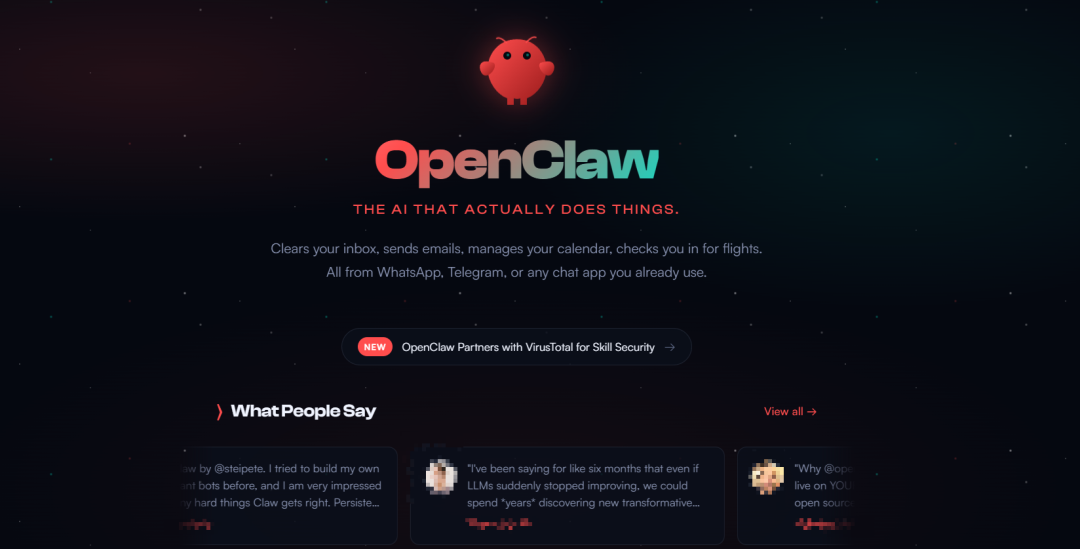
This technical project, originally confined to programmer communities, rapidly spread from the GitHub tech sphere to government affairs, corporate offices, and even everyday discussions among ordinary internet users in just a few months, becoming one of the most talked-about AI phenomena of 2026.
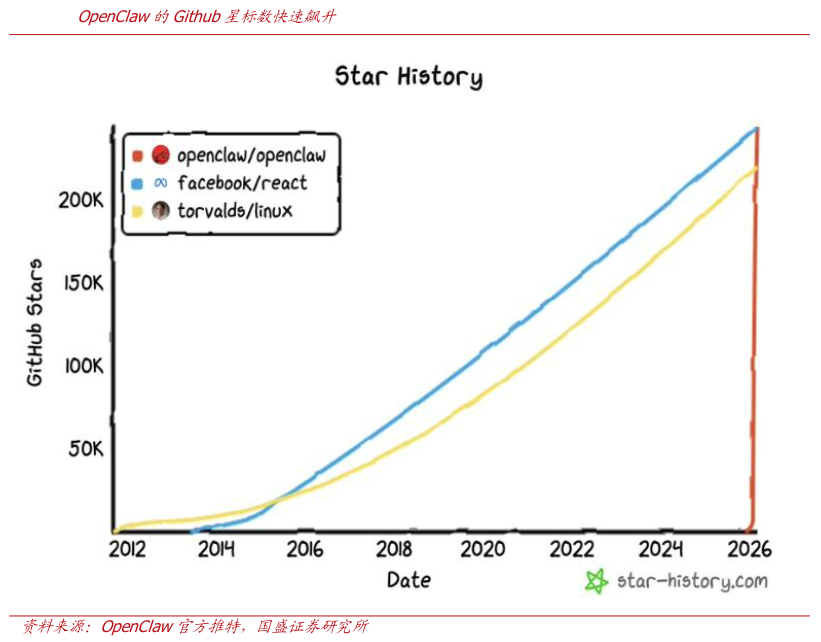
Upon its release, OpenClaw's GitHub star count surged in a nearly straight line within an extremely short period. By March 8, it had reached 260,000 stars and nearly 48,000 forks on GitHub, surpassing React and Linux in star count, with its popularity continuing to climb.
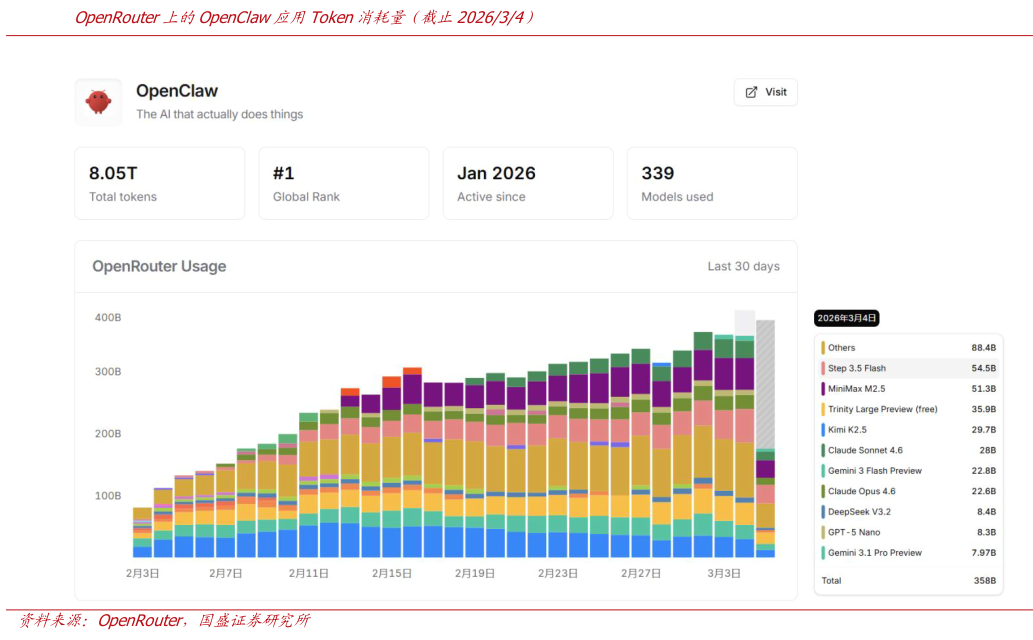
Its viral nature was also reflected in data from third-party model API routing platforms. Between February 5, 2026, and March 5, 2026, OpenClaw was the application with the highest token consumption on the OpenRouter platform, reaching a staggering 7.63 terabytes—far exceeding the second-ranked application.
In addition to OpenClaw, major model manufacturers have also ramped up their Agent layout (Agent deployment), with AI Agents entering the practical implementation stage. For example, Minimax Agent can not only process files like PPT, Excel, Word, and PDF but also offers a desktop version and expert Agents. The desktop version allows the Agent to enter the user's work environment to directly organize files and sort information; expert Agents, after being injected with specific knowledge and behavioral templates and learning specific SOPs, can perform certain tasks more effectively.
The viral success of OpenClaw is just the tip of the iceberg in the agent industry's rise. Behind it lies an industry transformation and explosive growth in supporting infrastructure.
01 A 'Lobster' Drawing Widespread Attention
OpenClaw's core capability is transforming AI from a mere chat tool into an intelligent agent that can truly 'perform tasks for humans.'
The rapid rise of OpenClaw is closely tied to its open-source nature. Developed by Austrian software engineer Peter Steinberg, the project began as Clawdbot and Moltbot before evolving into OpenClaw.
If traditional AI is merely a 'talking brain,' OpenClaw resembles a 'thinking digital assistant capable of taking action.' Users need only set a goal, such as 'organize customer complaints this week and generate an analysis report,' and the system can automatically open spreadsheets, organize data, invoke models for analysis, and generate documents, achieving cross-software automation.
After local deployment and integration with large language models, OpenClaw can take over mouse and keyboard operations on a user's computer, overcoming barriers between various software and platforms to execute tasks such as automatically organizing documents, batch-processing data, replying to emails, generating reports, and even completing complex workflows across multiple applications.
Thanks to this capability, OpenClaw quickly found practical applications across multiple industries. For example, in government affairs, some civil servants in Shenzhen have begun using a version dubbed the 'government lobster' to handle public complaints and administrative licensing guidance, improving efficiency by automatically organizing citizen complaints, categorizing issues, and generating handling suggestions. In corporate office settings, many teams use it for report organization, customer service responses, and operational data analysis, significantly reducing repetitive work.

Following Shenzhen's Longgang District and Wuxi's High-Tech Zone, Changshu City in Suzhou has also established a 'lobster pool,' inviting people to 'raise lobsters' locally. According to a March 9 evening post by the municipal government news office's official WeChat account 'iChangshu,' the city has released 'Several Measures (Draft for Comments)' to accelerate the development of open-source communities like OpenClaw and promote high-quality industrial development, introducing 13 initiatives to support OPCs (one-person companies) in using OpenClaw for production and operations. OPC projects selected for talent plans at various levels will receive up to 6 million yuan in comprehensive support.
At a recent national conference, multiple delegates and committee members also mentioned this phenomenon. Zhou Hongyi, founder of 360 Group, stated that agents like OpenClaw are transforming 'cloud-based software capabilities into personalized assistants for everyone'; even Ma Huateng was surprised by the rapid adoption of this technology.
In March 2026, Tencent offered free OpenClaw installation and experience services at its Shenzhen headquarters, sparking queues of over a thousand people. During the same period, Shenzhen's Longgang District released special policies to support the OpenClaw ecosystem, offering rewards of up to 1 million yuan for related innovative application projects, attempting to convert this open-source project into new industrial opportunities. A new technological ecosystem centered around OpenClaw is taking shape, involving governments, enterprises, and individual developers.
On the flip side of the technological boom, a gray market for 'lobster-raising' services has quickly emerged. Since OpenClaw requires local deployment environments, model configurations, and permission settings—a high threshold for ordinary users—many technicians have begun offering installation services.
On domestic social media platforms, advertisements for 'on-site lobster raising' and 'remote lobster raising' soon appeared, with prices ranging from tens to thousands of yuan: remote installation services typically cost 50 to 100 yuan, while on-site deployment and debugging range from 300 to 1,000 yuan. Some practitioners even claimed to have earned 260,000 yuan in just a few days by helping others install OpenClaw.
However, for individual users, the installation fee is just the beginning. Subsequent server rental costs start at 50 yuan per month, with 200 yuan renting a relatively smooth configuration. Assembling a 'lobster cage' oneself costs at least 4,000 yuan for decent usability. Moreover, hardware alone won't keep the 'lobster' ready at all times; users must continuously provide tokens to sustain its operation. Starting at 30 yuan, costs are unlimited—the smarter the model used, the higher the expense. Having your lobster complete basic tasks could easily cost tens of thousands of yuan per month, leading some netizens to remark: 'As long as your trap is novel enough, there will always be fresh garlic chives (a term for easily exploited consumers).' Others commented that it is entirely useless for ordinary people.

Image Source: Silicon-Based Agent WeChat Channel
Beyond high costs, 'raising lobsters' poses significant security risks for individual users.
02 Security Concerns of 'Raising Lobsters'
OpenClaw has the ability to operate continuously, make autonomous decisions, and invoke system resources. If misconfigured, its risks far exceed those of ordinary software.
The Ministry of Industry and Information Technology's Cybersecurity Threat and Vulnerability Information Sharing Platform recently monitored that some OpenClaw instances pose high security risks under default or improper configurations. During deployment, trust boundaries are blurred, and the system often operates with high privileges. Once induced by malicious instructions or taken over by attackers, it may perform unauthorized operations, leading to sensitive information leaks, remote system control, or even becoming nodes for cyberattacks.
First is the risk of privilege abuse, where AI might access corporate core data or delete critical files under instruction. Second is the risk of information leakage, as the open-source version lacks robust data encryption and access auditing mechanisms. Third is the risk of malicious takeover, where some instances exposed to the public internet may be exploited by hackers as entry points to attack corporate systems. Fourth is the risk of unpredictable behavior, such as accidental data deletion, unauthorized automatic operations, or even being used for spam dissemination and online fraud by criminals.
Therefore, experts recommend using isolated environments or cloud sandboxes when deploying OpenClaw, disabling unnecessary public internet access, and establishing identity authentication, permission management, data encryption, and security auditing mechanisms to mitigate potential cybersecurity risks.
From these security concerns, it is clear that the greatest difference between AI agents and traditional software lies in their ability not only to 'be used' but also to possess a degree of 'autonomous action.' Without robust permission controls, identity authentication, logging audits, and data encryption mechanisms, the consequences of such systems being exploited could be far more severe than ordinary software vulnerabilities.
For this reason, officials recommend that relevant organizations and individual users disable unnecessary public internet access interfaces when deploying OpenClaw, strictly set up identity authentication and access control mechanisms, encrypt data, establish security auditing systems, and continuously monitor official security announcements and reinforcement recommendations to reduce potential cybersecurity risks.
From an industry perspective, however, every technological innovation is a double-edged sword, carrying risks alongside advantages. The 'lobster-raising' phenomenon reflects a transformation in AI application forms: AI is evolving from a 'conversational tool' into an 'action agent.' In the past, people used AI primarily to ask questions and obtain answers; now, AI is beginning to directly participate in workflows and execute specific tasks.
As intelligent agents capable of understanding goals, planning steps, and automatically operating software emerge, the relationship between individuals and computers is also changing. Perhaps, as many industry insiders suggest, OpenClaw's viral success is not merely the triumph of an open-source project but may also herald a prelude to a revolution in work styles in the AI era.
If the keyword of the internet era was 'connection' and that of the mobile internet era was 'platform,' then in the AI agent era, a new keyword is emerging: 'agency.' As more tasks are completed by intelligent agents, the collaboration between humans and technology will be redefined.
And that unexpectedly viral 'red lobster' may well signal the dawn of this new AI Agent era. The tokens that ordinary people find unaffordable are precisely the future growth drivers for AI companies.
03 Industry Transformation Driven by 'Lobster Raising'
As agents become widespread in office, development, and operational scenarios, a vast number of tasks will be completed through AI automatically invoking models, tools, and data interfaces, implying sustained growth in computing power and token consumption.
According to IDC forecasts, the number of active intelligent agents in China will surpass 350 million by 2031, with a compound annual growth rate (CAGR) exceeding 135%—the highest globally. As task density and complexity increase, agent token consumption will experience exponential growth, surging over 30-fold annually.
Currently, enterprise token consumption in China's market is still dominated by conversational and generative AI. However, as agent operation scales and task complexity rise simultaneously, token consumption among active agents is entering a period of rapid growth. According to First Voice Think Tank, enterprise agents can be categorized into five tiers based on token consumption, scenario coverage, and impact on core businesses. China is currently transitioning from widespread adoption to integration, with annual token usage still having 10-100x growth potential. China's agent market is on the brink of explosive growth with ample room for expansion.
From personal assistants to corporate 'digital employees,' every task execution, data analysis, and process collaboration by AI Agents requires model capabilities as support. As the number and frequency of agent usage increase, token consumption is likely to experience exponential growth, driving the formation of a new AI application ecosystem.
As a leading Chinese large model manufacturer, ByteDance delivered a striking performance in the AI field by year-end. By December 2025, its Doubao large model's daily token usage exceeded 50 trillion, a more than tenfold increase year-on-year. Over 100 enterprise clients have each consumed more than one trillion tokens to date.
According to research by EqualOcean Intelligence, AI Agent penetration among KA and SMB enterprises in China will rise from 3%/0.5% in 2023 to 25%/10% by 2028. The Chinese AI Agent market will also expand rapidly at a CAGR of 125%, soaring from 57.4 billion yuan in 2023 to 3.3009 trillion yuan by 2028.
According to a speech by Yang Chaobin, CEO of Huawei's ICT BG, global daily token consumption has grown nearly 300-fold over the past two years. According to the Science and Technology Innovation Board Daily, China's overall daily token consumption was 100 billion in early 2024, surpassed 30 trillion by mid-2025, and reached 180 trillion for mainstream large models by February 2026.
Focusing back on OpenClaw, token consumption data released on the Open Router platform indicates over a fourfold increase in a month. Notably, OpenClaw has been available for less than two months since its official release on January 29, 2026.
According to user data from the Open Router platform, OpenClaw's token consumption surged from 80.6 billion on February 3, 2026, to 358 billion by March 4, 2026—a roughly 4.4-fold increase in a month, underscoring the massive token consumption driven by AI Agents.
Due to the inherent characteristics of AI Agents, which involve multi-tool invocation, long-context processing, and multi-process workflows, their token consumption grows at an extremely rapid rate. According to estimates by Wujin Research, using a simple chatbot as a baseline, the computational demands for image generation, reasoning, video generation, and in-depth research are 10x/100x/3000x/1000000x, respectively. As task complexity increases, computational requirements explode, driving a quantum leap in token consumption.
AI Agents operate by invoking different tools, and during this process, they typically break down a single instruction into various processes and execute them in stages, naturally involving long contexts. This paradigm leads to an extremely rapid increase in token consumption for AI Agents.
Conclusion
The core costs of intelligent agents are concentrated in the reasoning phase. As Agent adoption increases, the focus of computational demand shifts from training to reasoning. Reasoning computational power is primarily responsible for the inference tasks of AI models, mainly used for processing and executing already trained models in practical applications, with a focus on low latency and low power consumption.
As AI transitions from a training-centric approach to a reasoning-centric one, the demand for private and edge deployments is surging. According to IDC data, as AI shifts towards reasoning, the demand for reasoning scenarios is increasing daily, with the proportion of reasoning workloads expected to rise from 65% in 2024 to 73% in 2028.
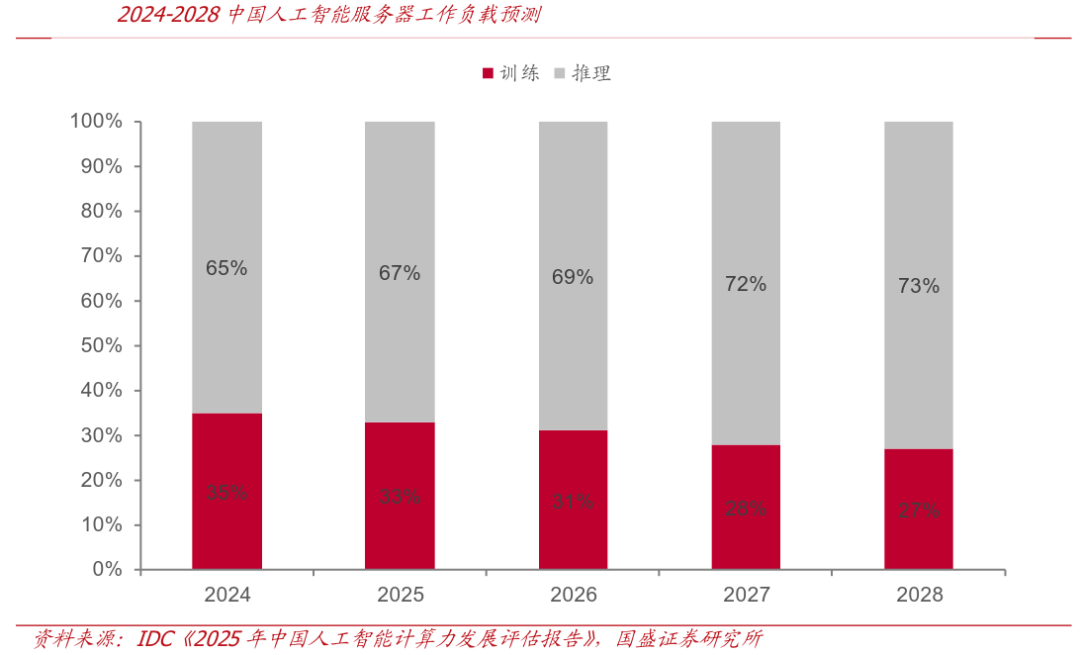
The expansion of AI reasoning demand is set to drive the Chinese reasoning market to an estimated 293.12 billion yuan by 2028. As AI applications shift from a lack of model training to a lack of reasoning services, reasoning computational power, as the core infrastructure for AI commercialization, will directly benefit from long-term trends such as the industrialization of intelligent agents and the implementation of industry-specific large models.
According to Frost & Sullivan and Headspring Research Institute, the Chinese reasoning market was valued at 17.52 billion yuan in 2024 and is expected to grow to 293.12 billion yuan by 2028, with a compound annual growth rate (CAGR) of approximately 102% from 2024 to 2028.
Against this backdrop, both power and computational demands are poised for explosive growth, warranting sustained market attention.
© THE END
All materials are sourced from official public information.
This article does not constitute any investment advice.
This article is originally created by Baker Street Detective and may not be reproduced without permission.
Images are sourced from public information. If there is any infringement, please contact us for removal.
-
![]()
Doubao Work Unveiled! Domestic AI Leaders Fully Commit to the 'Work' Sector
-
![]()
Who’s Sounding the Alarm on ‘Rushed Vehicles’?
-
![]()
Over 5.3 Billion Yuan in Losses Over Three and a Half Years! Can Yonyou Reverse Its Fortunes Through Streamlining and AI Transformation?
-
![]()
Baidu AI Adopts Free Model: A Strategic Maneuver in Traffic and Monetization
-
![]()
Silicon-Based OLED Pioneer Unveils Financial Results: H1 Shipments Outpace Entire 2025 Volume
-
![]()
AI's First "Lost Summer"
-
![]()
Zeiss Makes Another €2.2 Million Bet: Will Eye Tracking Be the Next Big Thing in the Smart Glasses Industry?
-
![]()
RUNTO Ranking | Global Top TV ODM Factories' Shipment Figures for July 2026